
9 Best Sales Enablement Tools (Ranked After Live Deals) in 2026

Co-founder at Peony — I built the data room platform, with a background in document security, file systems, and AI.
Connect with me on LinkedIn! I want to help you :)9 Best Sales Enablement Tools in 2026 (I Tested Them on Real Deals)
Last updated: March 2026
I run Peony, a data room platform, and I work with sales teams who need to share proposals, track engagement, and close deals faster. Over the past two years I have signed up for every major sales enablement tool, uploaded real proposal decks, and tested each one on actual B2B deals — not demo environments.
This guide is written from that vantage point. Not as a neutral reviewer — I obviously believe in what we built — but as someone who has sent hundreds of proposals through these platforms and knows exactly where each one helps or falls short when a deal is on the line.
TL;DR: Most sales enablement tools are either proposal builders that lack analytics, or enterprise content platforms that cost $500+/month. Peony (free, $0) bridges the gap: page-level analytics show which proposal pages each prospect reads, built-in e-signatures close the deal in the same workflow, custom branding makes every touchpoint look institutional, and secure deal rooms organize multi-document deals. Business plan: $40/month total. For enterprise enablement at scale, Highspot and Seismic are the proven choices. For interactive web proposals, Showpad and Qwilr are strong alternatives.
By the Numbers
- $3.2 billion — global sales enablement market size in 2025, projected to reach $11.1 billion by 2032 (Grand View Research)
- 68% of data breaches involve a human element — social engineering, errors, or misuse (Verizon 2024 DBIR)
- 76% of B2B buyers expect personalized engagement from sales reps (Salesforce State of Sales)
- Under 5 minutes — setup time on modern platforms like Peony vs. weeks for enterprise rollouts on Seismic or Highspot
- $4.88 million — average cost of a data breach in 2024, making proposal security a business-critical concern (IBM Cost of a Data Breach Report)
What Is Sales Enablement Software?
Sales enablement software is any platform that helps sales teams create, share, track, and manage the content they use to move deals forward — proposals, pitch decks, contracts, case studies, pricing sheets, and NDAs. The best platforms combine four capabilities:
Content sharing and tracking. Send proposals via secure links instead of email attachments. See exactly who opened your proposal, which pages they read, how long they spent on each section, and when they came back. Platforms like Peony provide page-level engagement data that turns passive document delivery into active deal intelligence. For a deeper dive into how deal rooms work in practice, see our digital sales room guide.
E-signatures and closing. Eliminate the friction of printing, signing, scanning, and emailing contracts. Built-in e-signatures let prospects sign directly within the proposal experience — no switching to a separate tool.
Branding and presentation. Custom domains, logos, colors, and branded viewing experiences make every proposal look like it came from an institutional sales operation, not a startup using free tools. Peony's branding features create that impression from day one.
Security and control. Dynamic watermarks, screenshot protection, link expiration, download controls, and access revocation protect sensitive pricing, terms, and competitive information from being forwarded or leaked.
For B2B sales teams, the right enablement platform is the difference between knowing a prospect "opened your email" and knowing they spent 12 minutes on your pricing page and reopened the case study three times before the decision meeting.
Scored Comparison: 9 Best Sales Enablement Platforms (2026)
| Rank | Platform | Starting Price | Proposal Analytics (/5) | Security (/5) | Ease of Use (/5) | Value for Money (/5) | Best For |
|---|---|---|---|---|---|---|---|
| 1 | Peony | Free ($0) | 4.9 | 4.8 | 4.7 | 4.9 | Secure deal rooms, proposal tracking, e-signing |
| 2 | Highspot | Custom pricing | 3.8 | 3.5 | 3.8 | 2.5 | Enterprise content governance and coaching |
| 3 | Seismic | Custom pricing | 3.6 | 3.5 | 3.5 | 2.3 | Large sales org enablement at scale |
| 4 | Showpad | Custom pricing | 3.5 | 3.2 | 4.0 | 2.8 | Content management with seller training |
| 5 | GetAccept | Custom pricing | 3.8 | 3.0 | 3.5 | 3.0 | Digital sales rooms with video messaging |
| 6 | PandaDoc | $19/user/mo | 3.2 | 2.5 | 4.0 | 2.8 | Document automation and e-signatures |
| 7 | Proposify | $29/user/mo | 3.0 | 2.2 | 4.2 | 3.0 | Visual proposal design for agencies |
| 8 | Qwilr | $35/user/mo | 2.8 | 2.0 | 4.4 | 3.0 | Web-based interactive proposals |
| 9 | HubSpot Sales Hub | Free (limited) | 2.0 | 2.5 | 4.0 | 3.5 | CRM-native sales tools for HubSpot users |
Methodology: Platforms ranked across four criteria, each scored independently out of 5.0 based on publicly available features and hands-on testing as of March 2026. Proposal Analytics evaluates engagement tracking depth — from page-level heatmaps and time-per-section metrics to AI-powered follow-up insights. Security assesses watermarking, screenshot protection, access controls, link management, and encryption. Ease of Use reflects setup time, UI quality, mobile experience, and learning curve for sales reps. Value for Money compares feature breadth against total cost including per-user pricing at a 5-person team.
1. Peony — Best for Secure Deal Rooms and Proposal Tracking
Most sales enablement tools make you choose: good analytics or good security. Proposal builders or deal rooms. Free tier or useful features. Peony does not force that trade-off.
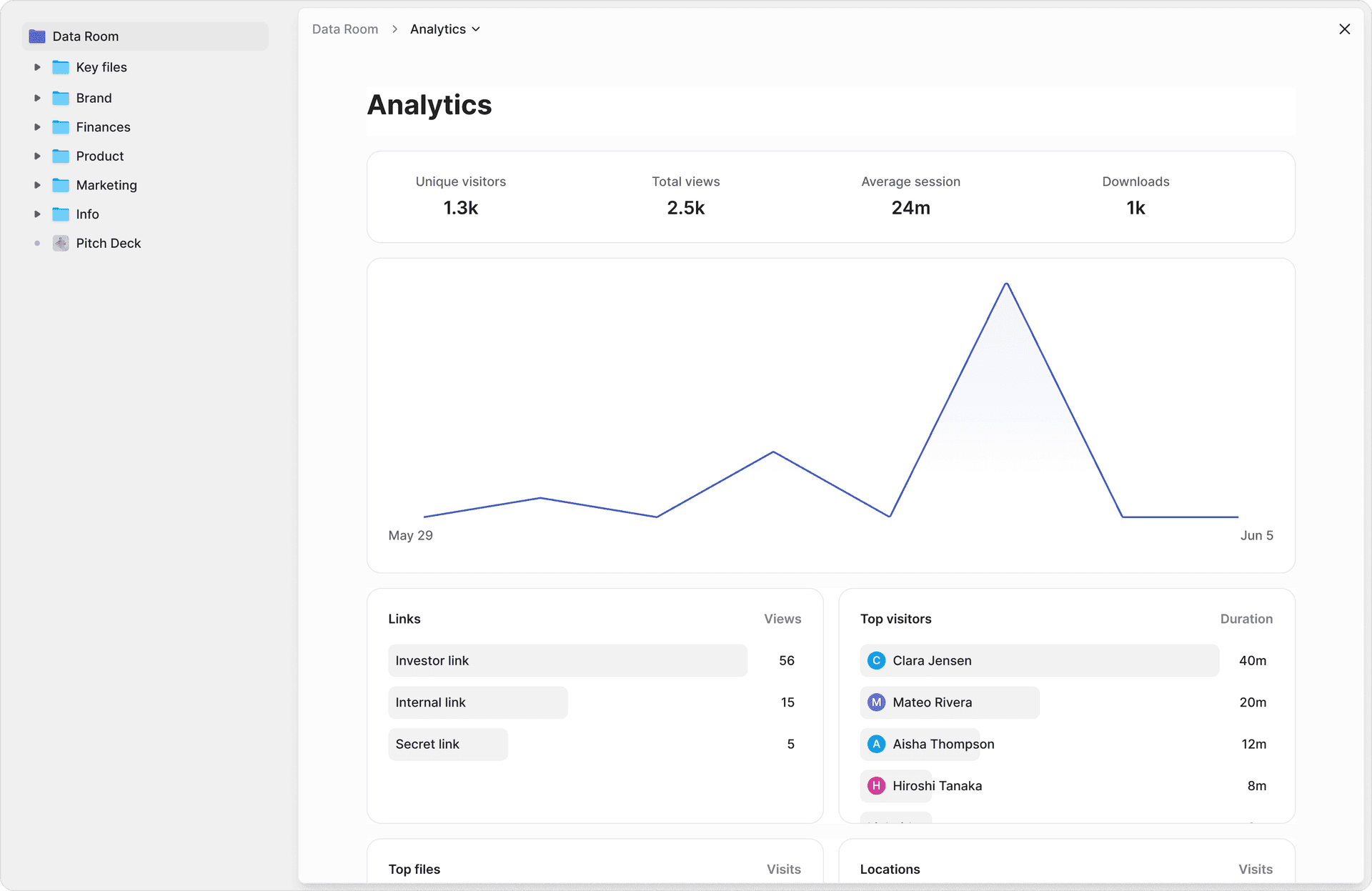
When I tested proposal workflows across all nine platforms, Peony was the only one where I could upload a proposal PDF, share it via a branded link, see exactly which pages the prospect read (down to time per section), get notified the instant they opened it, and close with a built-in e-signature — all without leaving the platform. On most competitors, I needed two or three separate tools to replicate that workflow.
The page-level analytics are where Peony pulls ahead of every other platform on this list. When I shared a 12-page SaaS proposal through Peony, the dashboard showed me that the prospect spent 6 minutes on the pricing section (pages 8-9), re-opened the case study (page 4) twice, and never scrolled past the implementation timeline (page 11). That is not "User A opened your link at 2:14 PM" — that is actionable intelligence for the follow-up call.
The security layer matters more than most sales teams realize. I once had a prospect screenshot a pricing page and forward it to a competitor for a counter-bid. On Peony, screenshot protection blocks that behavior and alerts you with the viewer's email and timestamp. Dynamic watermarks embed the viewer's identity on every page, so even if someone photographs their screen, the source is traceable. For deals involving sensitive terms, NDAs, or competitive pricing, this is not a nice-to-have — it is deal protection.
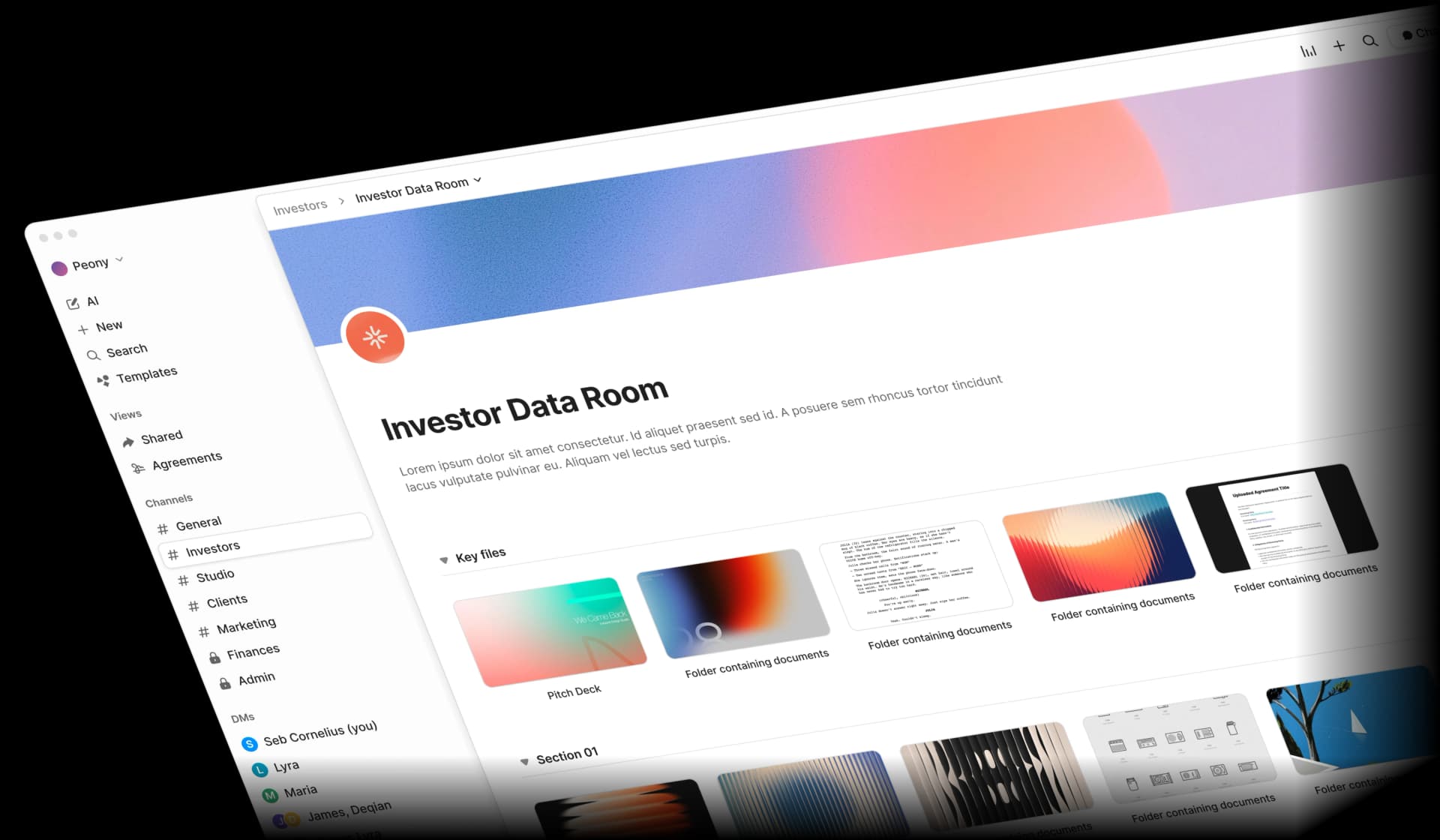
The data rooms transform how multi-document deals work. Instead of sending five separate email attachments (proposal, NDA, case study, pricing, contract), I create one branded deal room and drop everything in. The prospect gets a single link to a professional, organized space — and I get per-document, per-page analytics across the entire deal package. For technology sales teams running complex enterprise deals, this is a fundamentally better workflow than scattered emails.
Custom branding makes every Peony link look institutional. Custom domain (yourcompany.peony.ink), your logo, your colors — prospects see your brand, not a third-party tool. First impressions matter in B2B sales, and a branded deal room signals that you take the relationship seriously.
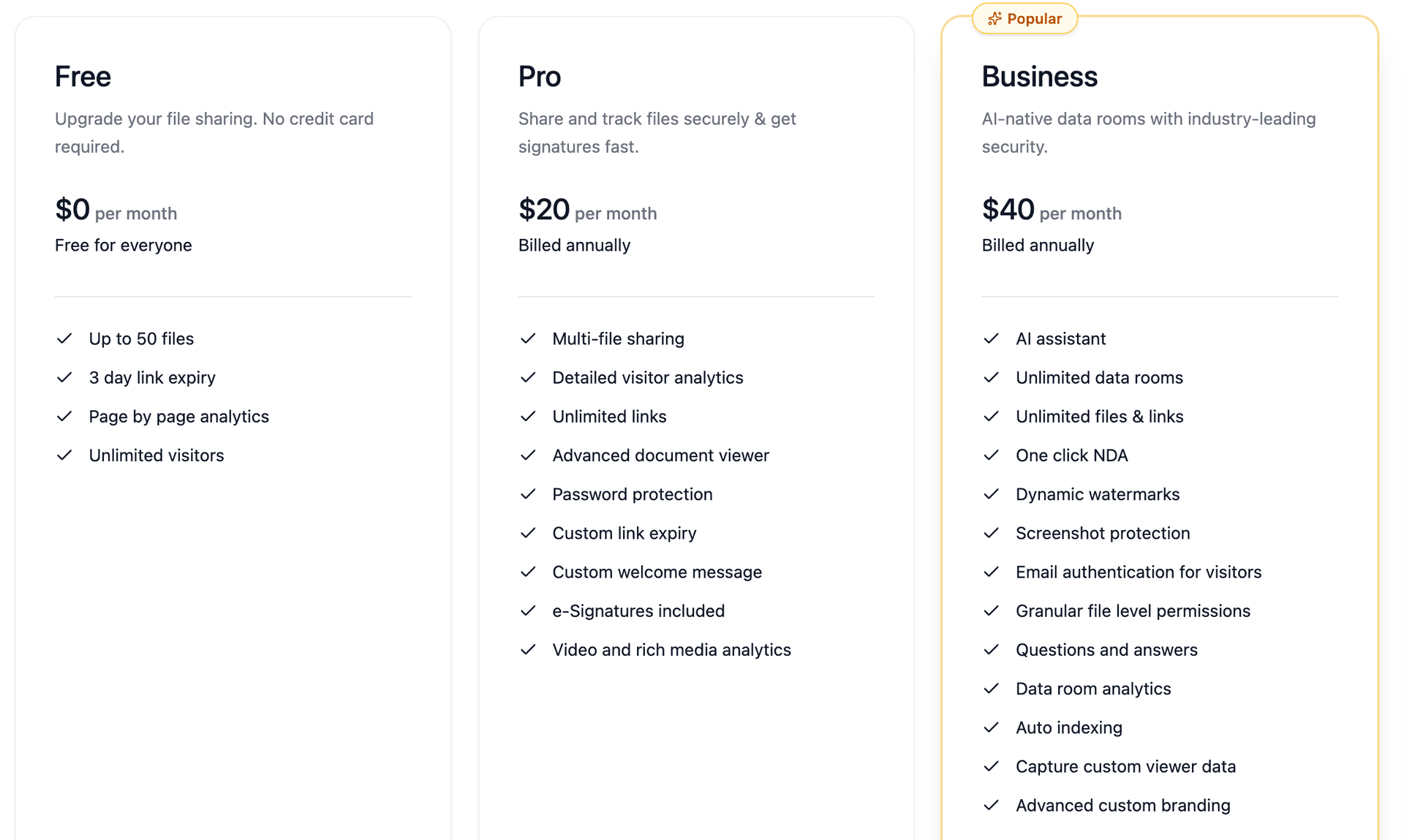
Pricing: Free tier with document sharing, page-level analytics, and viewer identification. Pro: $20/admin/month. Business: $40/admin/month with unlimited data rooms, e-signatures, custom branding, and advanced security. Enterprise: custom. No per-user pricing — viewers are always free.
Best for: B2B sales teams that need proposal tracking, deal rooms, e-signatures, and security in one platform — without paying per user.
2. Highspot — Best for Enterprise Content Governance
Highspot is built for large sales organizations that need content governance, coaching, and analytics across hundreds of reps. It is not a proposal tool — it is an enablement operating system.
When I tested Highspot, the strength was content intelligence. The platform surfaces the right content for each deal stage, tracks which assets reps actually use (and which they ignore), and provides coaching modules tied to deal outcomes. For a VP of Sales managing 200+ reps, that visibility is invaluable. The guided selling playbooks connect deal stages to recommended content, so a new rep on their first enterprise deal gets the same pitch materials as a 10-year veteran.
The trade-off is accessibility. Highspot requires a meaningful implementation — typically weeks, not hours. The pricing is quote-based and typically packaged for organizations with 50+ reps. For a 5-person sales team, Highspot is overkill. For a 500-person sales org standardizing execution, it is a strong choice. But if your primary need is tracking who reads your proposals page by page, Peony's analytics are more granular at a fraction of the cost.
Pricing: Custom quotes only. Typically suited for enterprise budgets.
Best for: Large enterprise sales organizations standardizing content, coaching, and execution across a big team.
3. Seismic — Best for Large Sales Org Enablement
Seismic competes directly with Highspot in the enterprise enablement space. Its content management platform includes personalization workflows, content recommendations, training layers, and analytics around content usage and team adoption.
I tested Seismic's content recommendation engine, and the personalization is strong — it dynamically suggests content based on deal stage, industry, and buyer persona. For a rep preparing for a meeting with a healthcare CFO, Seismic surfaces the healthcare-specific case studies, ROI calculators, and compliance documentation automatically. That saves the 30 minutes a rep would spend digging through a shared drive.
The limitation is the same as Highspot: this is an enterprise platform priced for enterprise budgets, with an implementation cycle measured in weeks. The analytics are content-usage focused (which assets get shared, which get ignored) rather than page-level engagement (which pages of a specific proposal does this specific prospect read). For granular proposal tracking with security, Peony's page-level analytics and deal rooms are a more targeted solution at a fraction of the investment.
Pricing: Custom quotes only. Enterprise implementation required.
Best for: Enterprise organizations with 100+ reps that need content governance, AI-powered personalization, and training at scale.
4. Showpad — Best for Content Management with Seller Training
Showpad sits between the enterprise heavyweights (Highspot, Seismic) and the lightweight proposal tools. It combines content management with seller training and coaching in a package that mid-market teams can actually implement.
During testing, Showpad's content management stood out. The platform organizes sales collateral into searchable libraries with usage analytics — you can see which pitch decks close deals and which ones get sent and ignored. The training modules let managers create guided learning paths for new reps, which is useful for onboarding but requires consistent content investment.
The buyer engagement features include shared spaces where reps and prospects can collaborate on deal materials. These are lighter than Peony's data rooms — no dynamic watermarks, no screenshot protection, no granular per-page tracking — but they provide a branded destination for multi-stakeholder deals. If your priority is internal content governance with some external sharing, Showpad works. If your priority is knowing which proposal pages a prospect reads and protecting your pricing from screenshots, Peony is purpose-built for that.
Pricing: Custom quotes. More accessible than Highspot or Seismic for mid-market teams.
Best for: Mid-market sales teams that need content management, seller training, and buyer engagement in one platform.
5. GetAccept — Best for Digital Sales Rooms with Video
GetAccept combines digital sales rooms with proposals, e-signatures, and video messaging. The video component is what differentiates it — reps can record personalized video messages attached to proposals, which adds a human touch to digital selling.
I tested GetAccept's digital sales room by sending a proposal with an embedded video walkthrough. The prospect experience was polished: they see the video, scroll through the proposal, and can sign directly in the room. The engagement tracking showed when the prospect watched the video, how far they got, and which proposal sections they viewed afterward. That video-to-proposal engagement chain is something no other platform on this list offers natively.
The limitation is analytics depth. GetAccept tracks engagement at the document level (opened, viewed, time spent), but the page-level granularity is lighter than Peony's — I could not see exactly which pages of a 15-page proposal got the most attention. The security features are basic compared to Peony's dynamic watermarks and screenshot protection. For teams where personalized video outreach matters more than page-level tracking, GetAccept is a strong choice. For deal rooms with deep analytics and security, Peony covers more ground.
Pricing: Custom quotes. Packages vary by team size and features.
Best for: B2B sales teams that use personalized video in their outreach and want proposals, e-signatures, and video in one platform.
6. PandaDoc — Best for Document Automation and E-Signatures
PandaDoc is primarily a document automation tool with strong e-signature capabilities. If your sales team creates high volumes of proposals from templates with variable fields, pricing tables, and approval workflows, PandaDoc's template engine is one of the most mature on the market.
I tested PandaDoc's proposal builder extensively. The drag-and-drop editor works well for structured proposals — select a template, customize the variables, add pricing, and send for signature. The CRM integrations (Salesforce, HubSpot, Pipedrive) pull deal data directly into proposals, which saves reps from copying client information manually. The template library is extensive, covering proposals, quotes, contracts, and invoices.
The trade-offs became clear during testing. PandaDoc charges per user — the Starter plan at $19/user/month and Business at $49/user/month means a 5-person team pays $95-$245/month. The analytics show when documents are opened and viewed, but there is no page-level engagement tracking comparable to Peony's per-page analytics. There is no screenshot protection, no dynamic watermarking, and the "Rooms" feature (added for deal rooms) is limited to 3 rooms on the Business plan with minimal security. For teams that need deep engagement intelligence and document security, PandaDoc's proposal-first architecture has gaps that Peony fills.
Pricing: Free eSign (limited). Starter: $19/user/month. Business: $49/user/month. Enterprise: custom.
Best for: Teams creating high volumes of templated proposals with built-in e-signatures and CRM integration.
7. Proposify — Best for Visual Proposal Design
Proposify is purpose-built for creating visually impressive, interactive proposals. If your sales process depends on beautiful, branded documents that stand out from the competition, Proposify's design tools are among the best.
Testing Proposify, the template editor is genuinely good. Interactive pricing tables let prospects select options and see totals update in real time. The content library keeps approved sections (about us, case studies, terms) organized for drag-and-drop reuse. The proposal analytics dashboard shows pipeline-level metrics — which proposals are pending, which are viewed, which are won or lost.
Where Proposify falls short for modern B2B sales is analytics depth and security. The engagement tracking shows document opens and time spent, but not per-page engagement. There is no screenshot protection, no dynamic watermarks, and no deal room capability for multi-document deals. At $29-$59/user/month, a 5-person team pays $145-$295/month for a tool that tracks fewer signals than Peony's free tier. If proposal design is your top priority and your deals involve a single beautiful document, Proposify delivers. If you need page-level analytics, security, and multi-document deal rooms, Peony's data rooms and analytics are a better fit.
Pricing: Team: $29/user/month. Business: $59/user/month. Enterprise: custom.
Best for: Marketing agencies, consultancies, and design-forward B2B teams creating visually polished proposals.
8. Qwilr — Best for Web-Based Interactive Proposals
Qwilr takes a different approach to proposals: instead of PDFs, you create web-page-style proposals that look like modern landing pages. Interactive pricing, embedded videos, dynamic content blocks — the proposals are responsive, mobile-friendly, and visually striking.
I tested Qwilr by creating a SaaS proposal with interactive pricing tiers. The buyer experience was impressive — the prospect could toggle between pricing options, watch an embedded demo video, and accept the proposal with an e-signature, all on a single responsive web page. For creative agencies and SaaS companies where the proposal itself is a brand statement, Qwilr delivers a polished experience.
The limitations for B2B sales teams are real. Because Qwilr proposals are web pages rather than document viewers, the analytics track page visits and engagement but not the per-page, per-section depth that PDF-based platforms like Peony provide. You cannot see "the prospect spent 4 minutes on page 7 of 12." There are no dynamic watermarks, no screenshot protection, and no deal room functionality. At $35-$75/user/month, the cost adds up quickly for a tool that prioritizes visual design over deal intelligence. Peony's branding features can make standard documents look polished without sacrificing analytics depth.
Pricing: Business: $35/user/month. Enterprise: $75/user/month.
Best for: Creative agencies and SaaS companies wanting web-native, interactive proposal experiences.
9. HubSpot Sales Hub — Best CRM-Native Sales Tools
HubSpot Sales Hub is not a standalone sales enablement tool — it is the sales layer of HubSpot's CRM platform. If your team already lives inside HubSpot for pipeline management, contact records, and marketing, Sales Hub adds sequence automation, meeting scheduling, quote tools, and basic document tracking without leaving the CRM.
I tested HubSpot Sales Hub's document tracking by uploading a proposal and sharing it through the CRM. The integration is seamless — you share a document from a deal record, and the engagement data flows back into the CRM timeline. The tracking shows when the document was opened and how long the recipient spent viewing it.
The trade-off is depth. HubSpot's document tracking is a CRM add-on, not a purpose-built analytics platform. There is no page-level engagement tracking, no screenshot protection, no dynamic watermarks, and no deal room functionality. The value proposition is consolidation: one fewer tool in your stack. But for teams that take proposal analytics seriously, pairing HubSpot CRM with Peony's page-level analytics and deal rooms gives you the best of both — CRM pipeline management plus deep engagement intelligence.
Pricing: Free tools available. Starter: $15/month. Professional: $90/month. Enterprise: $150/month. Pricing per seat varies by tier.
Best for: Teams committed to the HubSpot ecosystem that want fewer tools rather than best-of-breed enablement.
Pricing Comparison
| Platform | Free Tier | Starting Paid Plan | 5-Person Team Cost (Monthly) | Per-User Pricing | E-Signatures Included |
|---|---|---|---|---|---|
| Peony | Yes (generous) | $20/admin/mo | $40/mo (Business) | No | Yes |
| Highspot | No | Custom quote | Custom quote | Yes | No |
| Seismic | No | Custom quote | Custom quote | Yes | No |
| Showpad | No | Custom quote | Custom quote | Yes | Partial |
| GetAccept | No | Custom quote | Custom quote | Yes | Yes |
| PandaDoc | eSign only | $19/user/mo | $95-$245/mo | Yes | Yes |
| Proposify | No | $29/user/mo | $145-$295/mo | Yes | Yes |
| Qwilr | No | $35/user/mo | $175-$375/mo | Yes | Yes |
| HubSpot Sales | Yes (limited) | $15/mo | $15-$150/mo + per seat | Varies | Partial |
The pricing gap is striking. A 5-person sales team on PandaDoc Business pays $245/month for per-user proposal tools. The same team on Peony Business pays $40/month total — with deeper analytics, stronger security, deal rooms, and e-signatures included. Enterprise platforms like Highspot and Seismic are priced for organizations with 50+ reps and budgets to match.
Use Case Guide: Which Platform Fits Your Team?
By Team Size
Solo reps and 2-3 person teams: Start with Peony Free. You get page-level analytics, viewer identification, and branded sharing at no cost. Upgrade to Pro ($20/month) or Business ($40/month) when you need e-signatures, deal rooms, and advanced security. Qwilr is worth considering if visual web proposals are central to your pitch.
5-15 person sales teams: Peony Business ($40/month total) covers proposal tracking, deal rooms, e-signatures, and branding without per-user math. PandaDoc is the alternative if you need a template-heavy proposal builder with CRM integration — but budget for $49/user/month on Business. GetAccept is strong if personalized video is part of your outreach.
50+ person sales organizations: Evaluate Highspot or Seismic for content governance, coaching, and enterprise analytics. Use Peony alongside your enablement platform for the deal room and proposal tracking layer — Highspot and Seismic excel at content management but do not provide Peony-level page-level engagement tracking or document security.
By Industry and Use Case
SaaS and technology sales: Peony — multi-document deal rooms, page-level analytics on technical proposals, screenshot protection for competitive pricing, e-signatures for contracts. The technology sales solution is built for this workflow.
Professional services and consulting: Proposify or Qwilr for visually polished proposals. Peony for the deal room that houses the proposal, SOW, NDA, and contract in one branded space with per-document analytics.
Enterprise and complex sales: Highspot or Seismic for content governance across a large team, plus Peony for the external-facing deal room where prospects access and sign materials. The combination gives you internal enablement and external deal intelligence.
Startups and early-stage teams: Peony Free — no reason to pay per user when you are closing your first 50 deals. Upgrade to Business when you need deal rooms and e-signatures. HubSpot Sales Hub Free is a solid companion CRM. If your team is also fundraising, our seed funding guide covers how to use the same platform for investor outreach.
Financial services and M&A: Peony's data rooms are purpose-built for this — NDA gates, dynamic watermarks, screenshot protection, and audit logs. The same platform that handles M&A due diligence handles sales proposals.
How to Evaluate Sales Enablement Software
Before committing to a platform, run this 30-minute test:
Step 1: Upload a real proposal. Not a demo PDF — your actual current proposal. See how the platform handles it. Does the viewer load fast? Does it look professional?
Step 2: Share it with a colleague. Send the link and ask them to read specific sections. Check the analytics: can you see which pages they read, how long they spent, and where they dropped off? If the analytics only show "opened at 2:14 PM," that is not sales enablement — that is email tracking.
Step 3: Test the security. Try to screenshot the proposal. Try to download it. Try to forward the link. Can you control each of these behaviors? If not, your pricing is one screenshot away from being forwarded to a competitor.
Step 4: Check the branding. Does the sharing experience look like your brand or the tool's brand? Prospects notice.
Step 5: Calculate the real cost. Multiply per-user pricing by your team size. Include viewers if they are charged. Compare to Peony's pricing — no per-user math, viewers always free.
Common Mistakes When Choosing Sales Enablement Software
Mistake 1: Confusing CRM features with enablement. Your CRM tracks deals. Your enablement platform tracks how prospects engage with deal content. These are different capabilities. HubSpot Sales Hub is a great CRM — but pairing it with Peony's analytics gives you the engagement intelligence that CRM-native tools miss.
Mistake 2: Ignoring per-user pricing math. A tool at $35/user/month sounds reasonable until your team grows. Five users: $175/month. Ten users: $350/month. Twenty users: $700/month. Peony's Business plan is $40/month total — the cost stays flat as your team grows.
Mistake 3: Sending proposals as email attachments. You lose all visibility the moment you hit send. No analytics, no security, no branding, no control. Even a free plan on Peony gives you page-level tracking and viewer identification.
Mistake 4: Skipping security for convenience. Proposals contain competitive pricing, deal terms, and customer information. Without watermarks and screenshot protection, a single forwarded screenshot can undermine your deal. Peony's security features protect your content without adding friction for the prospect.
Mistake 5: Buying enterprise enablement for a startup team. Highspot and Seismic are powerful platforms for 100+ person sales orgs. For a 5-person team, the implementation cost and complexity are not justified. Start with Peony, scale to enterprise enablement when your team size demands it.
Frequently Asked Questions
What is the best sales enablement software for B2B teams in 2026?
Based on hands-on testing across live deals, Peony is the best sales enablement platform for B2B teams that need secure proposal sharing with page-level analytics, built-in e-signatures, and custom branding. It starts free and the Business plan is $40/month total — not per user. For enterprise content governance at scale, Highspot and Seismic are strong choices. For interactive web-based proposals, Showpad and Qwilr offer polished design tools.
How does sales enablement software help close deals faster?
Sales enablement software accelerates deals by showing exactly which proposal pages a prospect reads, how long they spend on pricing versus case studies, and when they re-open the document before a decision call. Peony's page-level analytics provide this signal in real time — I have seen reps cut their average follow-up time by days because they knew exactly which sections to address. Platforms without page-level tracking leave reps guessing.
What is the difference between sales enablement and CRM software?
CRM software like HubSpot Sales Hub tracks pipeline stages, contact records, and deal values. Sales enablement software like Peony focuses on the content layer — how proposals are created, shared, tracked, and signed. The best stack uses both: a CRM for pipeline management and a sales enablement tool like Peony for document analytics, e-signatures, and secure deal rooms. Most CRMs have basic document features, but they lack page-level engagement tracking, dynamic watermarks, and screenshot protection.
How much does sales enablement software cost?
Sales enablement software ranges from $0 (Peony Free) to $500+/month for enterprise platforms like Seismic and Highspot that require custom quotes. Mid-range tools like Showpad, GetAccept, and Proposify typically charge $25-$50/user/month. Peony's Business plan at $40/month total includes unlimited data rooms, page-level analytics, e-signatures, screenshot protection, and custom branding — features that per-user platforms charge $200-$500/month for at a 5-person team.
Can I track which pages of my sales proposal a prospect reads?
Yes, but only if your platform offers page-level analytics. Most sales enablement tools only show that a link was opened. Peony shows exactly which pages each prospect read, how long they spent on each section, and where they dropped off. For example, if a prospect spends 8 minutes on your pricing page but skips your case studies, you know exactly what to address in the follow-up call. This level of engagement intelligence is what separates deal rooms from basic file sharing.
What security features should sales enablement software have?
Essential security features include dynamic watermarking (viewer name and email embedded on every page), screenshot protection, email verification, link expiration, download controls, and access revocation. Peony includes all of these on the Business plan at $40/month. Many proposal tools have no watermarking or screenshot protection at any price — meaning a prospect can screenshot your pricing and forward it to a competitor. For sensitive deal terms, NDAs, and pricing documents, security is non-negotiable.
Is Peony good for sales teams that are not doing M&A or fundraising?
Absolutely. While Peony is well known for M&A data rooms and fundraising, sales teams are the fastest-growing segment. B2B sales reps use Peony to share proposals with page-level analytics, get e-signatures on contracts, brand their deal rooms with company logos and colors, and track prospect engagement in real time. The sales solutions page is built specifically for sales workflows — from initial proposal to signed contract.
How do I choose between a proposal tool and a deal room for sales?
If your sales cycle involves a single document (one proposal, one contract), a lightweight proposal tool like Proposify or Qwilr works. If your deals involve multiple documents — proposals, NDAs, pricing sheets, case studies, contracts — you need a deal room. Peony's data rooms let you organize all deal materials in one branded space with granular permissions, page-level analytics per document, and built-in e-signatures. Most B2B deals with deal sizes above $10,000 benefit from a deal room approach.
What is the best free sales enablement tool?
Peony offers the most capable free tier among sales enablement platforms. The free plan includes document sharing with page-level analytics, viewer identification, real-time notifications, and basic branding — features that most competitors charge $25-$65/user/month for. HubSpot Sales Hub has a free CRM tier, but its document tracking and proposal features are limited compared to a dedicated platform. For teams getting started with sales enablement, Peony Free is the best entry point.
Can Peony replace PandaDoc or Proposify for sales proposals?
Yes, for most B2B sales workflows. Peony handles proposal sharing with page-level analytics, built-in e-signatures, custom branding, and secure deal rooms — covering the core use cases that PandaDoc and Proposify address. Where Peony goes further is security (screenshot protection, dynamic watermarks, NDA gates) and analytics depth (per-page engagement, not just open rates). Where PandaDoc and Proposify may still win is in drag-and-drop template building for highly designed proposals. If your proposals are primarily PDFs, slide decks, or documents, Peony is a direct and more secure replacement.
Bottom Line
The sales enablement market in 2026 splits into three tiers:
Enterprise enablement platforms (Highspot, Seismic, Showpad) — built for 50+ person sales organizations that need content governance, coaching, and analytics at scale. Budget: custom quotes, typically $500+/month.
Proposal and document tools (PandaDoc, Proposify, Qwilr, GetAccept) — built for creating and sending individual proposals with e-signatures. Strong design tools, but limited analytics and security. Budget: $25-$65/user/month.
Secure deal rooms with analytics (Peony) — built for B2B sales teams that need page-level engagement tracking, document security, e-signatures, and branded deal rooms in one platform. Budget: Free to $40/month total.
If your team sends proposals and cares about knowing what prospects actually read, start with Peony. The free tier gives you more analytics than most paid plans, and the Business plan at $40/month replaces tools that cost $200-$500/month on per-user pricing.
Related Resources
- Sales Solutions for B2B Teams
- Technology Sales Deal Rooms
- Page-Level Analytics for Proposals
- Built-in E-Signatures
- Custom Branding for Deal Rooms
- How to Create a Sales Pitch Deck
- Sales Proposal Tracking Software Comparison
- Document Analytics Complete Guide
- Digital Sales Room Guide
- How to Send a Pitch Deck to Investors
- How to Track Pitch Deck Engagement
- PandaDoc Alternatives
- How to Send a Sales Proposal Email
- Best Data Rooms for Startups
- Seed Funding Guide
- How to Protect Your Pitch Deck
- Secure File Sharing Guide
- Peony Pricing
You might also like
Mar 21, 2026
Digital Sales Rooms (What Buyers Actually Want to See) in 2026
Apr 28, 2026
DocSend vs Paperflite vs Tilkee vs Peony (2026 Head-to-Head)
Apr 1, 2026
OneDrive Analytics (What You Can and Cannot Track) in 2026