
Know who read what — and how they read it
Last updated May 2026
Page-level analytics track time spent on every page of every document you share. Peony shows you which slides get attention, where viewers drop off, and who's actually reading — not just clicking.
TLDR · Updated May 2026
- • Per-page time tracking on every plan, including Free
- • Viewer identity, device, location, NDA + Q&A + AI chat logs
- • Engagement scoring vs Datasite/Firmex/DocSend access-log-only analytics
What does Peony track per viewer?
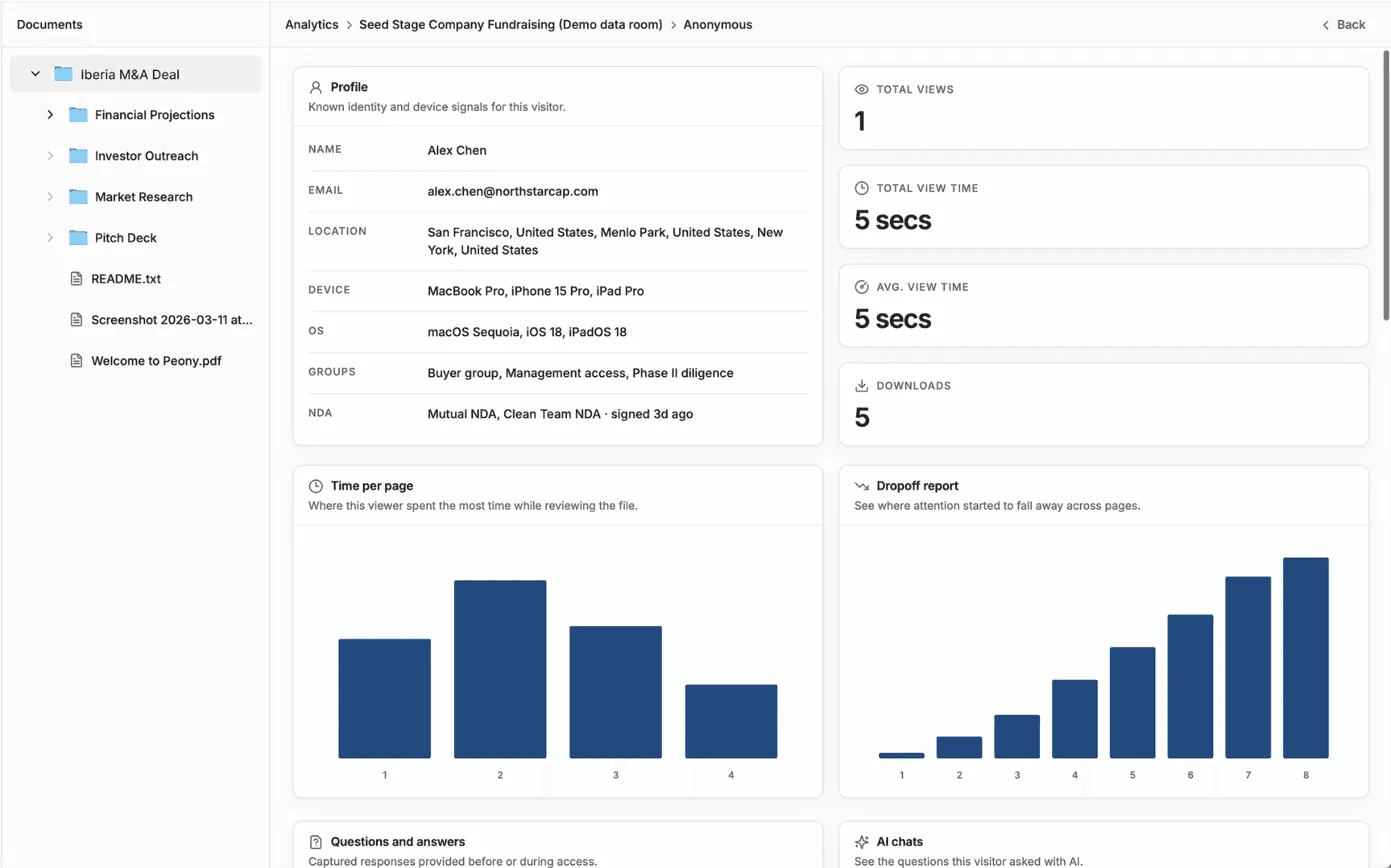
Peony captures each viewer's identity, device, location, NDA status, per-page dwell time, Q&A history, and AI chat logs in a single dashboard
Why use page-by-page analytics instead of access logs?
Access logs only tell you a file was opened. Page-by-page analytics show which sections viewers actually studied, where they dropped off, and how engaged each party really is — so your team can prioritize follow-ups based on demonstrated intent, not clicks.
Full viewer profiles
See every viewer's name, email, location (city and country), device type, and operating system. Know exactly who is reading your documents and from where — no anonymous clicks.
Per-page time tracking
See how many seconds each viewer spends on each page. Know whether they skimmed the financials or studied them for ten minutes.
Drop-off reports
Identify the exact page where viewers lose interest. Fix weak sections in your deck before the next share.
Engagement scoring
Peony assigns each viewer an engagement score based on time spent, pages viewed, and return visits. Prioritize follow-ups with the most engaged prospects.
NDA tracking per viewer
See which NDAs each viewer has signed and when. Peony logs Mutual NDAs, Clean Team NDAs, and custom agreements — so you always know who has agreed to your terms before accessing sensitive materials.
Q&A history per viewer
Every question a viewer submits and every answer you provide is captured in their analytics profile. Review the full conversation history to understand what due diligence topics matter most to each party.
AI chat logs per viewer
See exactly what questions each viewer asked Peony's AI assistant about your documents. Understand which sections prompted questions and what information viewers were looking for — without them telling you directly.
"Peony is by far the simplest and most intuitive way to populate and share data rooms with investors and partners. All the key analytics and features integrated into a sleek interface!"
Mark Petrov
Head of Financials, Loop
Page analytics by VDR
| Capability | Peony | Datasite | Firmex | DocSend |
|---|---|---|---|---|
| Per-page dwell time | Yes — every plan, including Free | No — open/download access logs only | No page-level analytics | Deck-only; not full data rooms |
| Viewer identity | Name, email, location, device | Basic access logs | Basic access logs | Link-level only |
| NDA gating | Yes — Business ($30/admin/mo) | Enterprise add-on | Limited | Not for full data rooms |
| Engagement score | Yes — all plans | No — manual access-log tally | No | No |
| Pricing | Free; Business $30/admin/mo | $60,000+/yr | Custom enterprise | $45–$300/user/mo |
Frequently asked questions
My team tracks engagement from 12+ bidders on a $120M sell-side mandate — how do I see which ones actually studied the CIM?
Peony gives your deal team page-by-page time tracking on every document in your data room, available on all plans including Free. You can see that Bidder A spent 47 minutes across your CIM's revenue-bridge pages while Bidder B skimmed the executive summary for 90 seconds and left. That level of granularity does not exist in Datasite, which only logs basic open-and-download events, or Firmex, which has no page-level analytics at all. On Business ($30/admin/month), you also get NDA gating so your team can require each bidder to sign before accessing Phase II materials, and screenshot protection to prevent bidders from capturing sensitive financials. For a competitive sell-side process this size, Data Room ($52/admin/month) adds unlimited data rooms, dynamic watermarks stamped with each viewer's email on every page, Advanced NDA with a signed PDF and audit trail per bidder, and granular permissions. Engagement scores rank your bidders by demonstrated intent — time spent, pages viewed, return visits — so you can prioritize management presentations for the parties most likely to submit a competitive offer on your $120M process.
We're running a $75M recapitalization and need to know which PE sponsors are seriously reviewing our model — can Peony show that?
Yes. Every time a sponsor opens your financial model in Peony, you see their name, email, location, device, and exactly how long they spent on each page. If a sponsor logged 22 minutes on the debt schedule but skipped the management bios, your team knows where their diligence focus sits before you ever get on a call. Peony's analytics are included on every plan, so you can track all of this from day one at no cost. DocSend limits its analytics to deck-style documents and charges $300 per user per month for advanced features — and it still cannot track activity across a full data room with hundreds of documents. On Business ($30/admin/month), you can add NDA gating to require executed confidentiality agreements before sponsors access your $75M recap materials, plus AI document Q&A logs that show you every question each sponsor asked about your documents.
I just sent my pitch deck to 30 VCs for a $45M Series B raise — how do I know which partners actually opened it?
Peony sends your team a real-time email notification the moment any VC opens your deck link, and your dashboard shows each viewer's name, firm, location, and device. You can see that a partner at Fund X spent 11 minutes on your traction slide but bounced at the competitive landscape, while an associate at Fund Y viewed every slide twice in two days. This is available on Peony's Free plan with no per-viewer or per-link limits. Firmex does not offer pitch-deck analytics at all, and DocSend caps link tracking unless you pay for its enterprise tier. If you want to protect your $45M raise materials further, Business ($30/admin/month) adds screenshot protection so partners cannot capture your cap table, and a custom logo so your deck opens with your company's branding, and Data Room ($52/admin/month) adds dynamic watermarks with each viewer's email burned into every slide.
Our fund is raising a $200M continuation vehicle and I need to track which LPs are engaging with the disclosure materials — does Peony handle that?
Peony is built for exactly that scenario. Your team uploads the GP disclosure package, ILPA-compliant election notices, and valuation materials into a single data room, then shares personalized links with each LP. Peony's per-page analytics — available on all plans — show you which LPs studied the valuation methodology for 30 minutes versus which ones have not opened the link at all, so your IR team can follow up with the right LPs before the 30-day election window closes. Datasite charges $60,000 or more per year for a comparable setup and still gives you only basic access logs without page-level dwell time. On Business ($30/admin/month), your team gets NDA gating to enforce LP confidentiality before they access your $200M CV materials. For a CV of this scale, Data Room ($52/admin/month) adds unlimited data rooms, dynamic watermarks on every page so any leaked document traces back to the specific LP who received it, Advanced NDA with a signed PDF and audit trail per LP, and granular permissions.
We manage a $90M sell-side process with 8 bidders in Phase II — how do engagement scores help us decide who gets management meetings?
Peony assigns each bidder an engagement score based on total time in your data room, number of pages viewed across your CIM and financial models, and return visits. On your $90M process, a bidder who logged 14 hours across five sessions and submitted detailed questions through Smart Q&A scores far higher than one who opened the teaser once and never came back. Your team can sort bidders by score in seconds and allocate limited management meeting slots to the three or four parties showing the strongest demonstrated intent. This scoring is included on all plans. Datasite does not offer engagement scoring — your bankers would need to manually tally access logs across spreadsheets. On Business ($30/admin/month), you can pair engagement scores with NDA gating so your team can require each Phase II bidder to sign before accessing materials. On the Data Room plan ($52/admin/month), dynamic watermarks stamp every page your Phase II bidders view with their identity.
I'm a startup founder sharing a $30M Series A deck — do I need to pay anything to see who viewed it and for how long?
No. Peony's page-by-page analytics are included on the Free plan at $0 with no limits on viewers, pages tracked, or links shared. You can see each investor's name, email, location, device, time spent per slide, and drop-off point without paying a cent. If a VC spent eight minutes on your unit economics slide but bounced at the competitive landscape, you know exactly what to sharpen before your partner meeting. DocSend charges $45 per user per month just to get started and reserves advanced analytics for its $300-per-user enterprise tier — a steep price for a founder managing a $30M raise. If you later want to protect your deck with screenshot protection, dynamic watermarks, a custom logo, or e-signatures for term sheets, those features are all available on Business ($30/admin/month).
We used Datasite on our last $150M deal and the analytics were basically just access logs — how is Peony different?
Datasite logs who opened a folder and whether they downloaded a file, but it does not track time spent per page, scroll depth, drop-off points, or return-visit patterns — the signals that actually tell your team whether a bidder is serious about your $150M process. Peony records all of that on every plan, including Free. Your bankers see exactly which pages of the CIM each bidder studied, how long they spent on the working-capital adjustment schedule versus the customer list, and whether they came back to re-read the earn-out section a second time. Firmex similarly lacks page-level dwell time, and DocSend only works for single-document sharing — not a full data room with hundreds of files. On Business ($30/admin/month), your team also gets NDA gating, screenshot protection, and AI chat logs showing every question bidders asked about your documents. The Data Room plan ($52/admin/month) adds dynamic watermarks with each viewer's email on every page.
Which VDRs offer page-level analytics and engagement tracking in 2026?
Peony ships page-level analytics on every plan including Free: page-by-page time tracking, scroll depth, drop-off points, return visits, and engagement scores that rank viewers by demonstrated intent. Among other platforms, DealRoom offers page-level analytics as part of its M&A workflow, and DocSend tracks page time well but only for deck-style documents — its advanced tier runs $300 per user per month and cannot track a full data room with hundreds of files. The legacy VDRs stop earlier: Datasite logs opens and downloads but not per-page dwell time, Firmex has no page-level analytics, and Ansarada's AI Predict scores bidder engagement at the room level rather than page by page. If the goal is knowing which bidder studied the working-capital schedule versus who skimmed the executive summary, per-page dwell data is the feature to verify before signing.
Related features
Manage Links
View, edit, and control all your shared links from a single dashboard.
Personalised Links
Create unique share links for each recipient to track engagement and personalize the experience.
Watermarks
Add dynamic watermarks with viewer details to every page, deterring unauthorized redistribution.