
The room is your control surface at the moment of least leverage
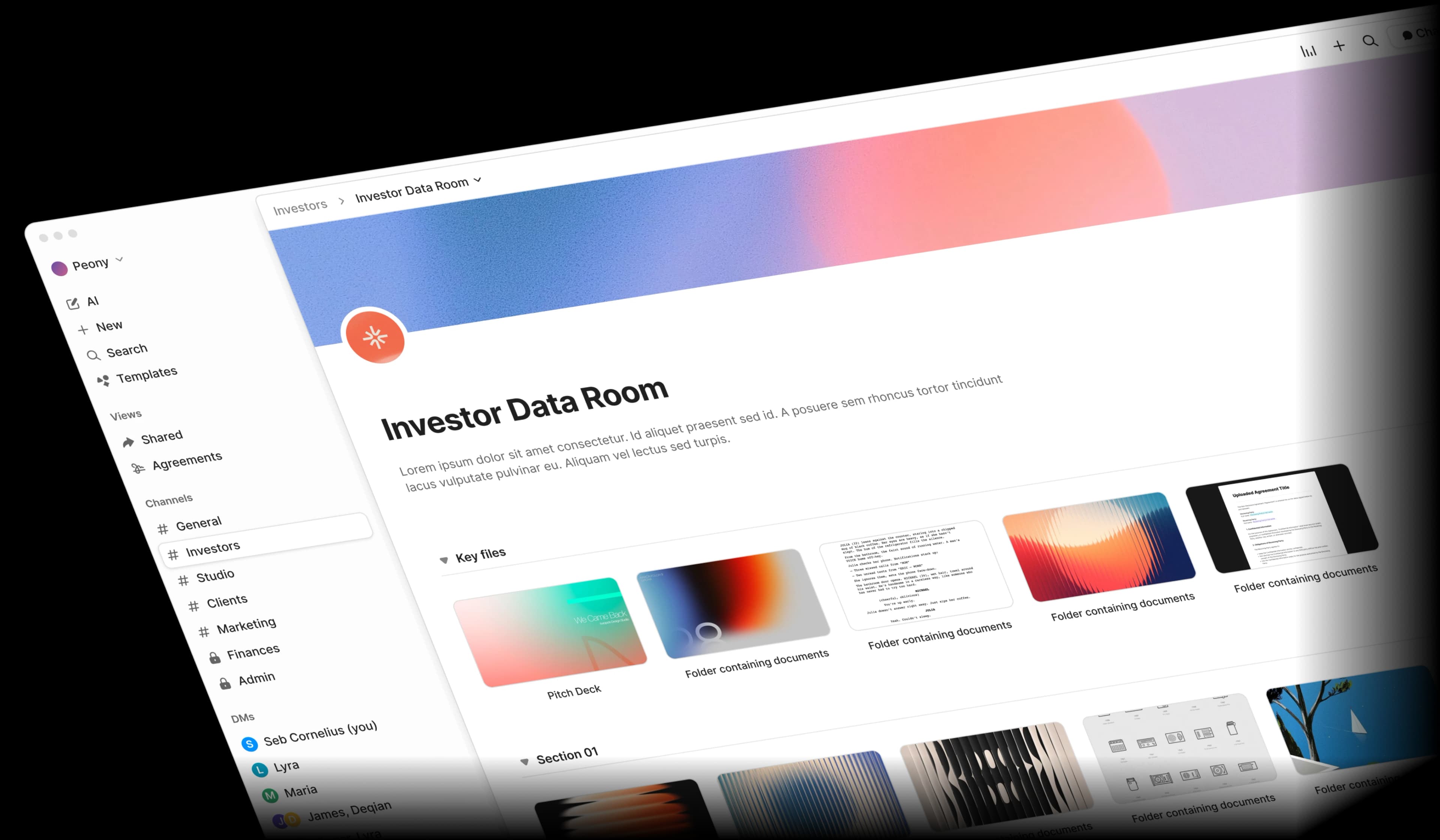
A restructuring forces you to disclose a great deal, to people you may not fully trust, with less leverage than usual. The data room is the one part of that you can control — what goes in, who sees it, when, and whether they can take it with them. Peony tiers your IP disclosure, walls buyers, lenders, and creditors into one room, and keeps a defensible audit trail. More than 6,800 customers run sensitive processes this way.
Quick answer · Updated June 2026
What is a restructuring data room? It's a permissioned, audit-logged room for sharing sensitive material — financials, contracts, cap table, and IP — with the counterparties involved in reorganizing or selling a business. The first decision is which track you're on: a strategic restructuring (where you control disclosure) or a distressed §363 / Chapter 11 process (where a court or creditor clock controls it). The room's mechanics are the same; the governance differs. Either way, stage disclosure in tiers, wall counterparties into groups, watermark and lock down everything sensitive, and prefer flat-rate pricing. On Peony, per-group isolation starts on the Business plan ($30/admin/month); dynamic watermarking is on the Data Room plan ($52/admin/month), the anchor for a serious process. Peony is SOC 2 Type II-ready.
No credit card required
Restructuring punishes the shortcuts companies reach for under pressure
It's the same room as an M&A or fundraising data room, doing a harder job. Three things change at once: your leverage is low, the cast is bigger (buyers, lenders, creditors, and their advisors), and the process can be challenged after the fact — so "who saw what, and when" becomes a legal record. Emailing documents, a shared drive, or a link-tracking deck tool fails on all three.
You're disclosing because you have to, not because you chose to
This is the Disclosure-Under-Duress problem. In a healthy raise you disclose from strength; in a restructuring a lender wants diligence, a board wants to test the market, a clock is running — and you disclose at the moment of least leverage. The room is the one part of that you can control: what goes in, who sees it, when, and whether they can take it with them.
Wrong track, wrong room
A strategic restructuring (you control disclosure) and a distressed §363 process (a court or creditor clock controls it) need the room governed differently. Most teams skip this decision and find out the hard way. Know which of the two tracks you're on before you grant the first login.
A competitor mines your IP and walks
Any bidder might be a tire-kicker or a competitor on a fishing expedition. Dump source code into a shared folder on day one and you can't watermark it, can't stage it, and can't trace it. The crown jewels need to stay gated until a counterparty is serious — and load view-only and watermarked when they finally do.
A shared drive can't revoke access or prove what was seen
Email and "anyone with the link" tools give you no per-party walls, no real revocation, and no defensible log. In a distressed process the conduct of the sale can be challenged later, so "who saw what, and when" stops being a convenience and becomes a legal record your tooling has to produce.
Disclose what you must, to whom you choose, on terms you control
Peony treats the room as a control surface, not a filing cabinet. Govern disclosure by track, tier your IP exposure to counterparty commitment, wall every party into its own group, and keep a defensible per-group audit trail. For a serious process, lead with the Data Room plan ($52/admin/month); the M&A-focused Deal Team plan ($64/admin/month) adds advanced redaction and an audit-grade Q&A module. Start from the restructuring data room guide.
Which restructuring track are you on — strategic or distressed?
Build the room for a strategic process but in a way that survives a move to a distressed one. The architecture is identical — a clean, tiered, permissioned room is what you want in either case; only the governance changes. So a pivot from "exploring alternatives" to a §363 sale is a change in who you grant access to and how fast, never a frantic rebuild at the worst possible moment.
Strategic track — you control disclosure
Exploring a sale, recapitalization, or new investor as a going concern. You decide who gets in, what they see, and when — and you can walk away. The strategic-alternatives playbook covers the quiet, going-concern build.
Distressed track — the process controls it
A §363 sale, Chapter 11, or lender-driven workout on a court or forbearance clock, with stalking-horse dynamics and creditor information rights. The distressed-asset-sale playbook covers the compressed, defensible build.
Build once, pivot without rebuilding
Pre-build the index from the diligence checklist a buyer or lender will send — before they send it. The same indexed, permissioned room serves a strategic buyer, a new investor, or a senior lender; you just open the right tiers to the right group.
How do I disclose IP and source code at the moment of least leverage?
Tier your disclosure to commitment — never expose the crown jewels to a party that hasn't earned access. Three tiers, each unlocked by a higher level of counterparty commitment, so a competitor running a fishing expedition stalls before it ever reaches the engineering folder, and everything it does see is view-only, watermarked, and traceable.
Stage disclosure in three tiers
Tier 1 (NDA accepted): teaser, summary financials, structure. Tier 2 (indication of interest): detailed financials, contracts, draft purchase agreement. Tier 3 (signed LOI / clean team): source code, engineering specs, trade secrets — view-only with downloads off.
Per-viewer dynamic watermarks
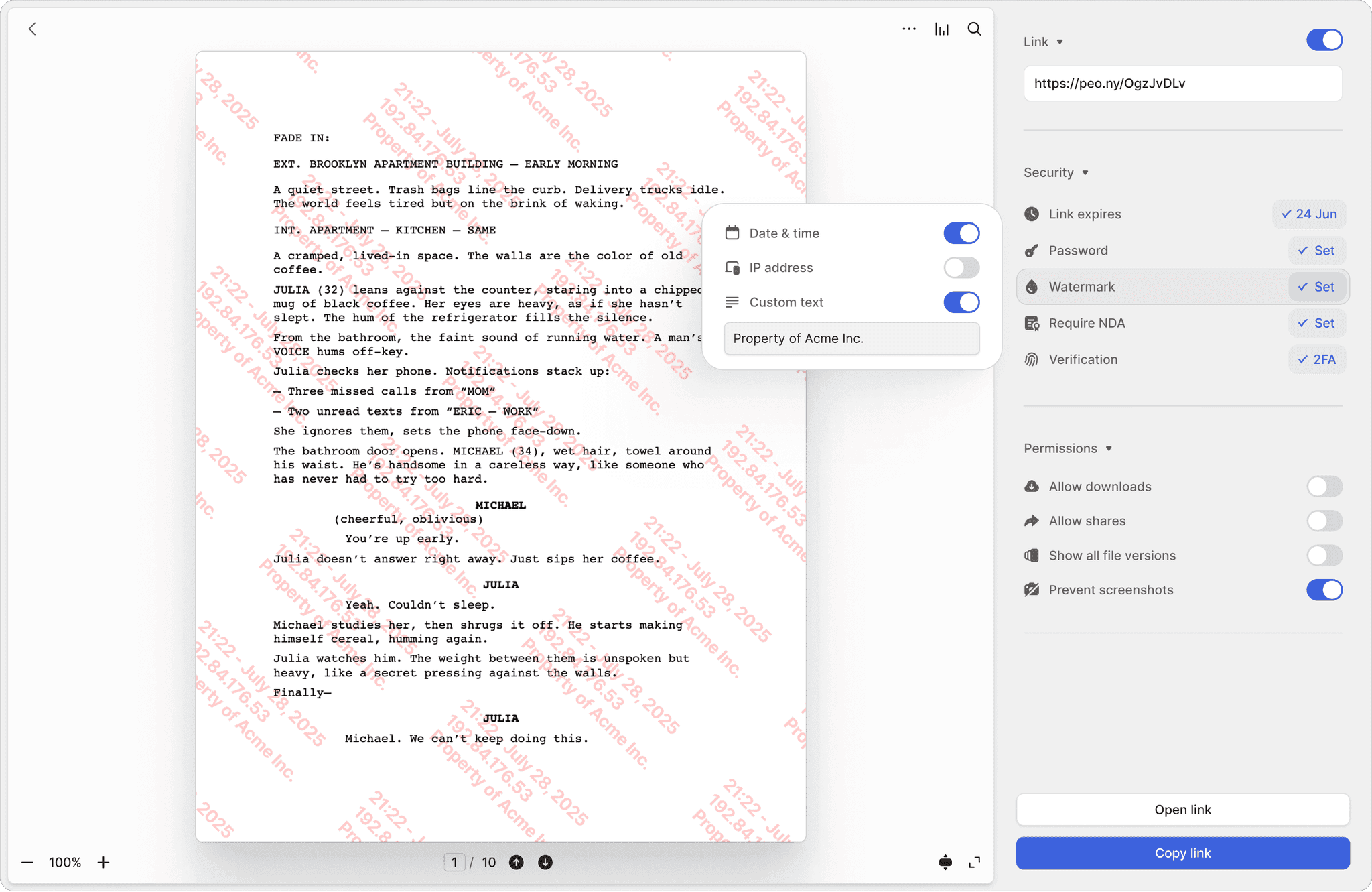
On the Data Room plan ($52/admin/month), every page on Tier 3 is stamped with the viewer's email, IP, and timestamp — so anything photographed or leaked names the party that saw it. No tool stops a phone camera; a watermark turns the leak into a signed confession.
Screenshot protection and Screenshield
Desktop screen-capture blocking and download prevention ship on the Business plan ($30/admin/month); Screenshield adds advanced screen-capture and screen-recording blocking on Data Room — attribution and deterrence applied to the most sensitive material.
How do I wall buyers, lenders, and creditors into one room — and prove what each saw?
Run one room with a walled group per party type, not a pile of separate rooms and not one shared folder. Each group sees only its slice, signs its own NDA, gets its own tracked links, and carries its own audit trail — so you serve buyers, lenders, and a creditors' committee from a single master index while keeping every wall intact and every access logged.
A visitor group per party type
Strategic buyers, financial sponsors, senior lenders, creditors' advisors — each is a named container with its own folder- and file-level permissions and NDA. Lenders see the debt schedule and collateral, not your roadmap; per-group document isolation is a Business-plan capability.
Revoke a whole party in one action
Because access attaches to a group, disabling it cuts off every user from that party at once — no stray live links. When a bidder drops out or a lender stands down, access ends cleanly and the audit trail is retained as proof.
A defensible, per-group audit trail
Every view, download, NDA acceptance, and Q&A exchange is timestamped with user attribution, scoped per group. In a distressed process that record is how the conduct of the sale is defended if a creditor or losing bidder later challenges it. Fully walled per-group Q&A threads are an Enterprise capability.
"Ease of use, drag and drop capabilities, rapid response in support, and great service and value. It was easy to navigate throughout the platform as well as setting up our data room."
Joseph Garcia
Providence Water
Frequently asked questions
We're restructuring but haven't decided between a sale and a Chapter 11 — should I open the data room now or wait?
Open it now, but build it for the track you're most likely on and keep it private until you're ready to grant access. The work of organizing a clean, indexed room — financials, contracts, cap table, IP schedule, org chart — is identical whether you end up in a strategic sale, a recapitalization, or a distressed §363 process, and doing it early is the single biggest lever you have on speed and leverage. What changes by track is who controls disclosure and how fast counterparties arrive: a strategic process runs on your timeline; a distressed process compresses diligence into weeks on a court or lender clock. Build the room, stage the sensitive material behind permissions, and you can pivot from "exploring alternatives" to "running a sale" without rebuilding anything. The full playbook is in our restructuring data room guide.
What's actually different between a strategic-restructuring data room and a distressed (§363) one?
The mechanics of the room are the same; what differs is who controls disclosure, who's in the room, and how fast it moves. In a strategic restructuring — exploring a sale, recapitalization, or new investor as a going concern — you control the process: you decide who gets in, what they see, and when, and you can walk away. In a distressed or §363 process, control shifts to a court-supervised or lender-driven timeline: a stalking-horse bidder may get earlier or deeper access, creditors and their advisors have information rights, diligence compresses into weeks, and every access needs to be logged because the estate's conduct can be challenged. Same room, different governance. We cover each track in depth — the strategic-alternatives playbook and the distressed-asset-sale playbook.
Is it safe to put our source code and engineering secrets in a data room while we're restructuring?
Yes — if the room controls disclosure rather than just storing files, and if you tier what you expose. Peony lets you keep source code, engineering documentation, and trade secrets out of the room entirely until a counterparty is serious, then expose them view-only with per-viewer dynamic watermarks, download prevention, and screen-capture blocking, so anything shown carries the viewer's identity. The mistake is treating restructuring disclosure as all-or-nothing. Stage your crown jewels: keep the most sensitive material gated until a signed LOI or a clean-team arrangement, and disclose the rest in tiers. On Peony, screenshot protection and download prevention are on the Business plan ($30/admin/month); per-viewer dynamic watermarks and Screenshield (advanced screen-capture/recording blocking) are on the Data Room plan ($52/admin/month). No tool stops a phone camera, but a per-viewer watermark turns a leaked page into a signed confession that names the leaker.
Should I run one data room for buyers, lenders, and creditors, or set up separate ones?
Run one room with walled groups, not separate rooms — with one exception. A single room with a visitor group per party type (strategic buyers, financial sponsors, senior lenders, creditors' advisors) lets each group see only what it's entitled to, sign its own NDA, and carry its own audit trail, while you keep one master index and one Q&A queue. Lenders typically need financials, the cap table, and the collateral package but not your product roadmap; buyers need the operating and commercial detail; creditors' advisors need a defined disclosure set. Group-based permissions deliver all of that in one room. On Peony, per-group document and access isolation is a Business-plan capability; the one case for going further is when you need fully walled, independent Q&A threads per group — where one party's questions are invisible to another even inside the room — which is an Enterprise capability.
If a bidder or lender drops out, how do I cut off their access and prove they can't still get in?
Revoke at the group level and keep the log. Because access attaches to a visitor group rather than to scattered individual links, disabling the group cuts off every user from that party in one action — no per-file cleanup, no stray live link. Then retain the group's audit trail after revocation: in a restructuring that may later be scrutinized by creditors, a court, or a disappointed bidder, being able to show exactly what a party accessed and that its access was cleanly terminated is part of running a defensible process. The failure mode to avoid is the consumer-cloud pattern — an "anyone with the link" share you can't truly recall — which is one of the main reasons restructuring teams move off Google Drive, Dropbox, and link-tracking tools onto a permissioned room.
How much does a data room cost for a restructuring, and is flat-rate better than per-page?
For a restructuring, prefer flat-rate — per-page and per-GB pricing punish exactly the shape of a restructuring room. It tends to be large (years of financials, full contract sets, engineering documentation), open for months, and accessed by many counterparties — every variable a metered VDR bills against. Peony's Data Room plan is $52/admin/month billed annually with unlimited storage, unlimited rooms, and no per-page metering; the M&A-focused Deal Team plan is $64/admin/month. Compare that to Datasite or Intralinks in the tens of thousands per process, or Firmex at roughly $5,000–10,000 per deal. The point isn't "cheapest wins" — it's that a cash-sensitive restructuring is the worst possible time to sign a metered contract whose bill grows with every document and every party you add. We break down the mechanics in flat-rate vs per-GB VDR pricing.
Should I control the data room myself or let our banker or restructuring advisor run it?
Own the room; let your advisor operate inside it. Your banker or chief restructuring officer should run the day-to-day — managing the index, fielding Q&A, advancing bidders — but the room should sit on an account the company controls, not be locked inside an advisor's or bank's platform you lose when the engagement ends. Restructurings change advisors and processes restart, and you want your indexed room, audit trail, and document set to be portable assets you keep, not something you rebuild when a mandate turns over. A flat-rate room you own and grant your advisor admin access to gives you professional operation without vendor lock-in or a per-deal bill from the bank's data room. See full pricing.
Run the restructuring. Don't let it run you
Build the index once, tier your disclosure, wall every party into its own group, lock down the crown jewels, and keep one audit trail per party — on flat-rate pricing built for a large, months-long, many-party process. Join the 6,800+ customers who run sensitive processes on Peony. No credit card required.
No credit card required