
Your AI built it in seconds. Now share it with control
Claude and GPT now generate the work product — live HTML models, AI-drafted CIMs and memos, interactive dashboards — in minutes. The hard part is sharing it without losing control. Peony renders the live artifact (JavaScript executing) and wraps every format in per-viewer watermarks, screenshot protection, NDA gating, granular permissions, page analytics, and instant revoke. More than 6,800 customers share confidential work this way.
Quick answer · Updated June 2026
How do I share an AI-generated document or Claude/GPT artifact securely? Share it through Peony, which renders .html/.htm artifacts natively with JavaScript executing — so a live Claude or GPT model, calculator, or dashboard actually runs for your recipient instead of flattening into a dead PDF. Every format then gets the same control layer: per-viewer dynamic watermarks, screenshot protection, NDA gating, granular permissions, page analytics, and one-click revoke. Dynamic watermarks come with the Data Room plan ($52/admin/month); screenshot protection starts on Business ($30/admin/month). Connecting your own ChatGPT, Claude, or Gemini and auditing every document it touched is an Enterprise capability. Peony is SOC 2 Type II-ready and trusted by 6,800+ customers.
No credit card required
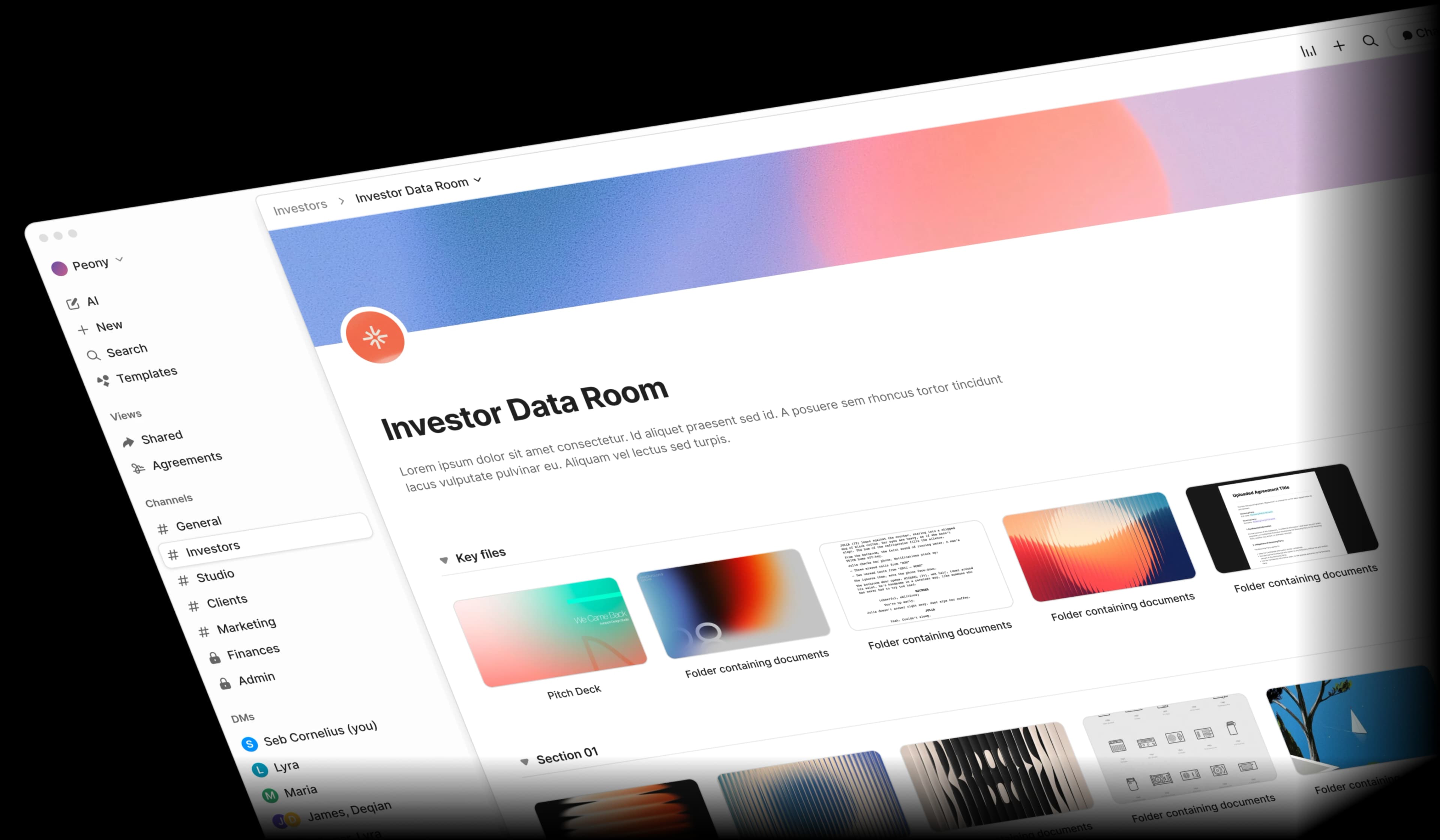
AI made the work easy. Sharing it safely is the new bottleneck
A PE associate builds a valuation model in Claude before lunch. A startup CFO has GPT draft a full financial model by Friday. A consultant ships an interactive dashboard to a client overnight. The work product is suddenly free — but the moment you send it to a counterparty, an investor, or a client, every option betrays you: a raw file is uncontrolled the instant it leaves your outbox, a legacy data room kills the live app, and a second vendor's AI may quietly ingest the file you trusted a first AI to write.
You let a second AI ingest what you trusted the first one to write
This is the Two-AI Trust Gap: you used Claude or GPT to build the work product, and now you're afraid the platform you share it through will feed it to its own model. Peony does not train on your documents; AI Q&A and extraction call a third-party model at query time with no training or retention, and auto-indexing runs in-house. SOC 2 Type II, AES-256, AWS US region.
Letting your own LLM into the room goes dark on the log
Connect ChatGPT or Claude to the diligence room and your access log goes silent on the AI — you can't prove to counsel which documents it actually read. That's the Audit Gap. Peony closes it: connect your own LLM and audit every query it ran and every file it opened, on Enterprise.
Your live artifact dies on arrival
You built a working ROI calculator or valuation model with Claude — buttons recalculate, charts redraw. Drop the .html into a typical data room and it converts to PDF: the calculator stops calculating, the dashboard stops filtering. The recipient never experiences the thing you made. Peony renders it live instead.
A raw file has zero control once sent
Email the AI-drafted CIM or model and the instant it leaves your outbox you can't watermark it, can't see who opened it, and can't pull it back. There's no NDA gate, no per-viewer attribution, no instant revoke — just a file loose in someone's inbox.
Keep the work product live. Wrap it in deal-grade control
Peony is the rare data room built for the work product AI actually produces. It renders the live artifact instead of flattening it, applies per-viewer control to the running app and every AI-drafted document, and — at Enterprise — lets you connect your own LLM with a full audit of what it touched. For deal-grade sharing, lead with the Data Room plan ($52/admin/month). The step-by-step is in our guide to sharing AI artifacts securely.
Does the AI artifact actually run for the recipient?
Peony renders .html and .htm files natively in the viewer with JavaScript executing, so a Claude or GPT artifact — dashboard, calculator, valuation model, mini-app — runs live for the person you share it with. Most data rooms convert HTML to PDF and the app dies; Peony keeps it interactive while applying full security on top.
The artifact actually runs
The recipient clicks, toggles, and recalculates the live app exactly as you built it — no static screenshot, no exported PDF, no dead model. The work product arrives the way you made it.
Native .html/.htm, no conversion
Upload the file Claude or GPT generated straight into a room or a single link. No plugin, no conversion step. See the full list of formats Peony renders in our supported file formats doc.
Every AI format, one control layer
Live HTML, AI-drafted CIMs and memos, models, and reports all get the same protections — so you share interactive and flat work product from one secured room.
Can I watermark and lock down a live artifact the way I would a PDF?
Yes — that's the whole point. The per-viewer control applies to the running app itself, not just to attached files. Dynamic watermarks, screenshot protection, NDA gates, and granular permissions all wrap the live render so every AI artifact carries the identity of whoever is viewing it.
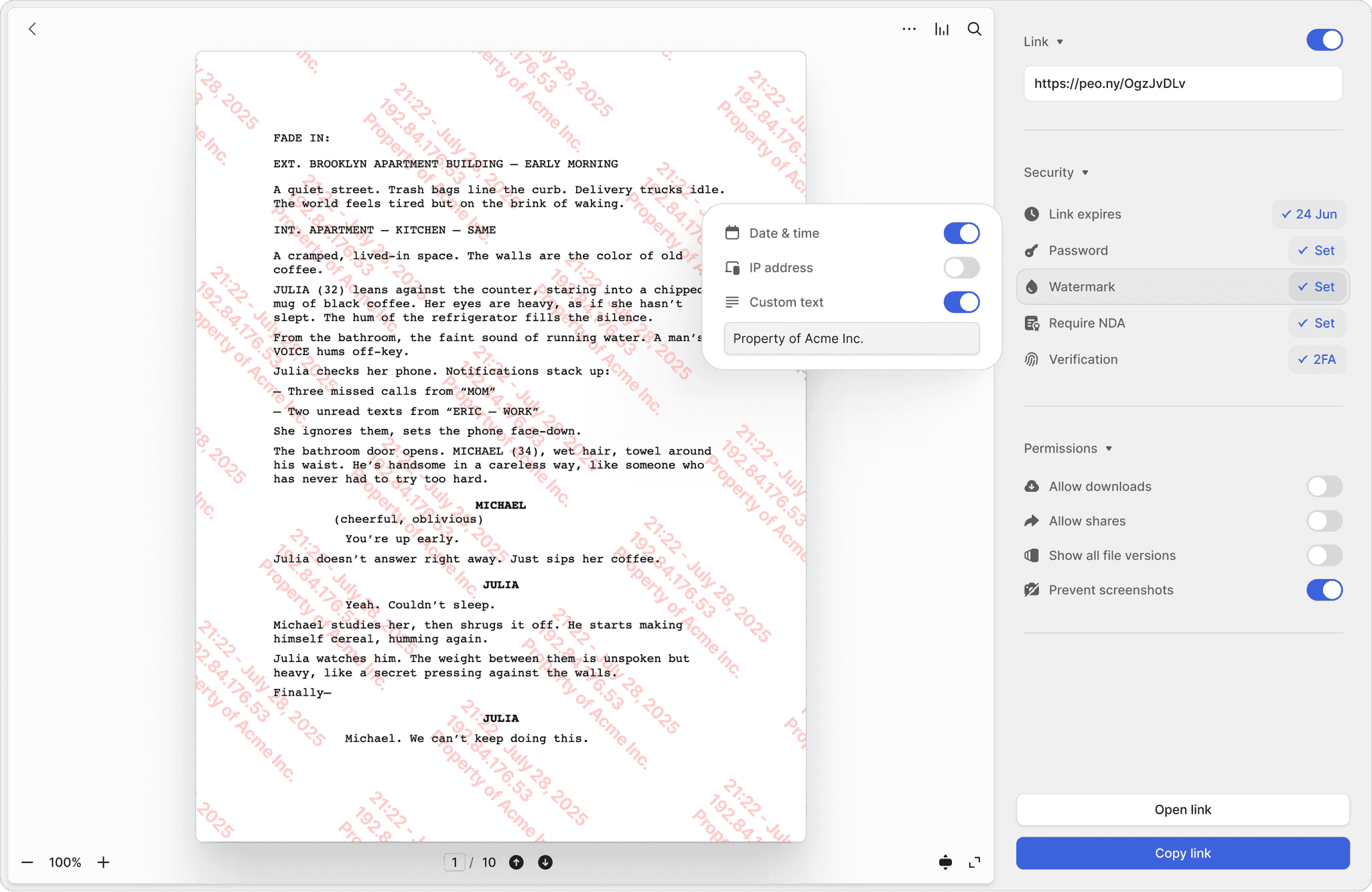
Dynamic per-viewer watermark
On the Data Room plan ($52/admin/month) and above, the live render is stamped with each viewer's name, email, and timestamp — so if your AI-built model leaks, the copy points back to who saw it.
Screenshot protection
Desktop screen-capture blocking ships from the Business plan ($30/admin/month); Screenshield adds mobile screen-capture blocking on Data Room. Attribution and deterrence, applied to the running artifact.
NDA gate before access
Require a counterparty, investor, or client to accept or sign an NDA before the artifact will load. Simple acknowledgment on Business; digitally signed, countersigned PDF on Data Room.
How do I prove who saw the work product — including a connected AI?
Peony gives every viewer a row in the access record, then lets you cut access the moment a process changes. Page-level analytics show who opened your AI-drafted memo and for how long; granular permissions isolate what each party sees; and on Enterprise you can connect your own LLM and audit exactly what it read — so the AI gets a row in the same log as a human.
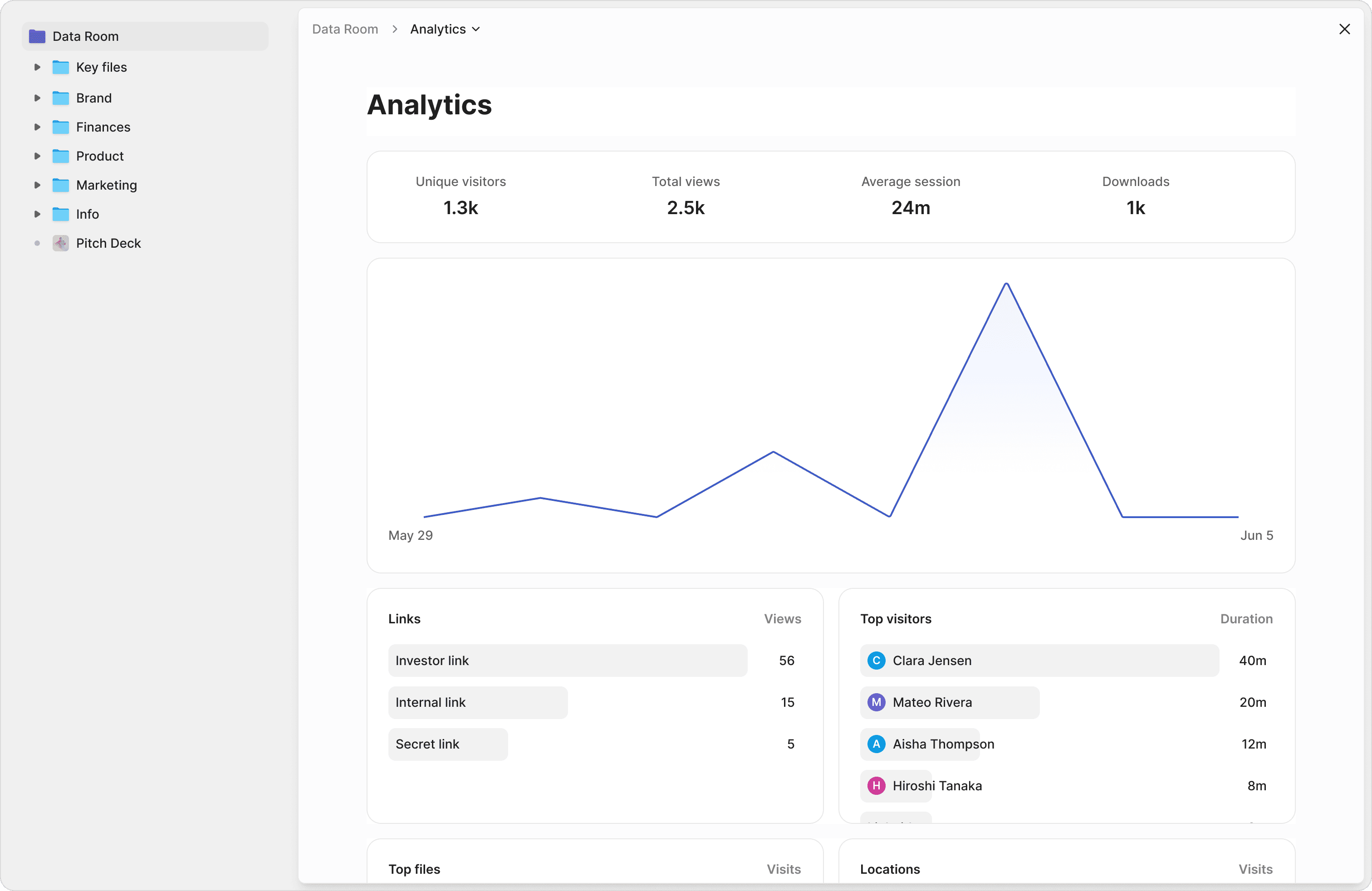
Page-level analytics
See which bidder spent twenty minutes in the valuation model and which never opened the CIM. Engagement signals on the exact AI artifact you shared — so you negotiate from data, not guesses.
Instant revoke
One click cuts off access to any shared artifact or document — a stale model, a dropped bidder, a finished engagement — wherever the link traveled. Full audit trail stays intact.
Connect your LLM and audit it
On Enterprise, connect your own ChatGPT, Claude, or Gemini and audit every query it ran and every document it touched — so a connected AI gets a row in the access record like any other viewer, closing the Audit Gap.
"Peony is a great example of a customer-obsessed company with a fantastic sense of design and UX. We moved on from Docsend in the first week — what we are really excited about is what all Peony does next."
Anish Bharadwaj
Founder & CEO, KiwiQ
Frequently asked questions
I'm a PE associate — how do I send a Claude-built HTML valuation model to a buy-side counterparty without it turning into a dead PDF?
Upload the .html file straight into a Peony room or a single secure link. Peony renders it natively with JavaScript executing, so the counterparty opens your link and the model actually runs — they flex assumptions, recalculate, and explore the live app instead of staring at a flattened screenshot. On the Data Room plan ($52/admin/month) you stamp a per-viewer dynamic watermark (name, email, timestamp) on the running model, gate it behind an NDA, set granular per-file permissions, watch page-level analytics, and revoke access the moment the bidder drops out. Legacy data rooms convert HTML to PDF and the model stops calculating — Peony is the one that keeps it live. More than 6,800 customers share deal material this way. See our private equity and M&A workflows for the full deal-side setup.
I'm a startup CFO sending a GPT-drafted financial model to term-sheet investors — will the platform I share it through train its own AI on my numbers?
No. Peony does not train any model on your documents. AI Q&A and extraction call a third-party LLM at query time with no training and no retention of your files, and auto-indexing runs in-house — so the file you trusted GPT to write isn't quietly fed to a second vendor's model. That's the Two-AI Trust Gap most founders miss. On the security side, Peony is SOC 2 Type II-ready, encrypts with AES-256, and stores data in the AWS US region (EU residency is available on Enterprise). When you share the model, each investor carries a dynamic watermark on the Data Room plan ($52/admin/month), and an NDA gate can block access until terms are accepted. See our fundraising page for the raise-side workflow.
I'm a consultant delivering an AI-generated interactive dashboard to a client — how do I keep it interactive but control every viewer?
Peony renders your dashboard's .html natively so the client gets the running app — filters, drill-downs, live charts — not a static export. Then you wrap it in control: a per-viewer watermark (Data Room, $52/admin/month) ties the render to each named stakeholder, screenshot protection deters capture, granular permissions decide who on the client side sees which views, and page analytics show which executives actually engaged. When the engagement ends, revoke access in one click. It's the cleanest way to hand over interactive AI work product without letting it walk out the door uncontrolled. Read more on sharing Claude artifacts.
How is this page different from your ranked guide to the best data rooms for AI-generated documents?
This page is Peony's product and use-case landing — how to actually share your AI work product with control, step by step. If you want a vendor-by-vendor comparison that ranks eight data rooms on how they handle AI-generated documents, read our separate guide, best data room for AI-generated documents. The short version of the difference: most tools either flatten your live HTML to a PDF, so the app dies, or display it with no per-viewer control. Peony keeps the artifact live and applies deal-grade control — watermark, NDA, permissions, analytics, revoke — to the running app itself. We also cover which data rooms support HTML display and how to password-protect an HTML file.
Which plan do I need to connect my own ChatGPT or Claude — and what AI do I get on the lower plans?
Connecting your own external LLM — ChatGPT, Claude, or Gemini — and auditing every query and document it touched is an Enterprise capability, which also adds SAML SSO and EU data residency. Below that, you get Peony's self-contained native AI: AI document Q&A and extraction from the Business plan ($30/admin/month), plus AI room generation and auto-indexing from the Data Room plan ($52/admin/month) — no external connection required. The reason the Enterprise audit matters is the chain of custody: the moment an AI reaches confidential documents, most access logs go silent on it, and that gap is the compliance liability. Peony gives the connected AI a row in the same audit trail as a human viewer. More on the trade-offs in AI in the data room and data room Q&A.
Is sharing an AI artifact through Peony actually secure enough for a deal or a board?
Yes. Peony is SOC 2 Type II-ready, encrypts with AES-256, and stores data in the AWS US region (EU and custom residency on Enterprise). For most AI work product, lead with the Data Room plan ($52/admin/month): dynamic per-viewer watermarks, Screenshield mobile blocking, advanced signed NDAs, granular per-file permissions, and unlimited rooms. Business ($30/admin/month) covers screenshot protection, simple NDA, and AI document Q&A; Deal Team ($64/admin/month, min 4 admins) adds advanced redaction and an audit-grade Q&A module. Note that watermarks and screenshot protection are attribution and deterrence layers, not a physical barrier — which is exactly how serious diligence teams expect document control to work. See full pricing and security.
Share your AI-built work. Keep control of it
Upload the artifact Claude or GPT generated, share a secure link, and your recipient gets the running app — wrapped in per-viewer watermarks, screenshot protection, NDA gating, analytics, and instant revoke. Join the 6,800+ customers who share confidential work product on Peony. No credit card required.
No credit card required