
The fundraising data room that shows which investors are reading
Send every investor a tracked link to the deck and model, see who read your financials (not just who opened the link) and came back, and open the cap table and diligence files only after an NDA: one secure Peony room per raise, equity or debt.
No credit card · 7-day Data Room trial that never auto-charges · investors and lenders view free, no account · 24/7 support
Live in under 5 minutes: the median time from sign-up to first uploaded document is 4 min 19 s (State of M&A Data Rooms, Q3 2026 edition).
Last updated October 2026
8,000+ customers in 60+ countries · $44.7B in client assets
Peony staff can't open your documents, your documents aren't used to train AI, and Peony has had no data breach since launch.
What is Peony's fundraising data room, and who is it for?
Peony is a virtual data room that founders and CFOs use to raise equity and debt: a tracked link per investor, page-level analytics, and an NDA in front of the cap table and diligence files. Data Room, the most popular plan, is $52 per admin per month billed yearly with unlimited rooms and storage; Business at $30 covers 3 rooms per admin, and investors never pay.
A fundraising data room is the secure online space where a company shares its pitch deck, financial model, cap table and diligence files with angels, VCs, growth investors or lenders during a raise, with access gated, permissions set per investor and every view tracked. What goes in it is covered in our data room for investors guide; founders at pre-seed and seed can start from startup data rooms, and GPs raising a fund from LPs use venture capital data rooms.
- Send the deck to every firm on its own link: each investor opens it in the browser with no account, and you see which pages they read, for how long and when they came back.
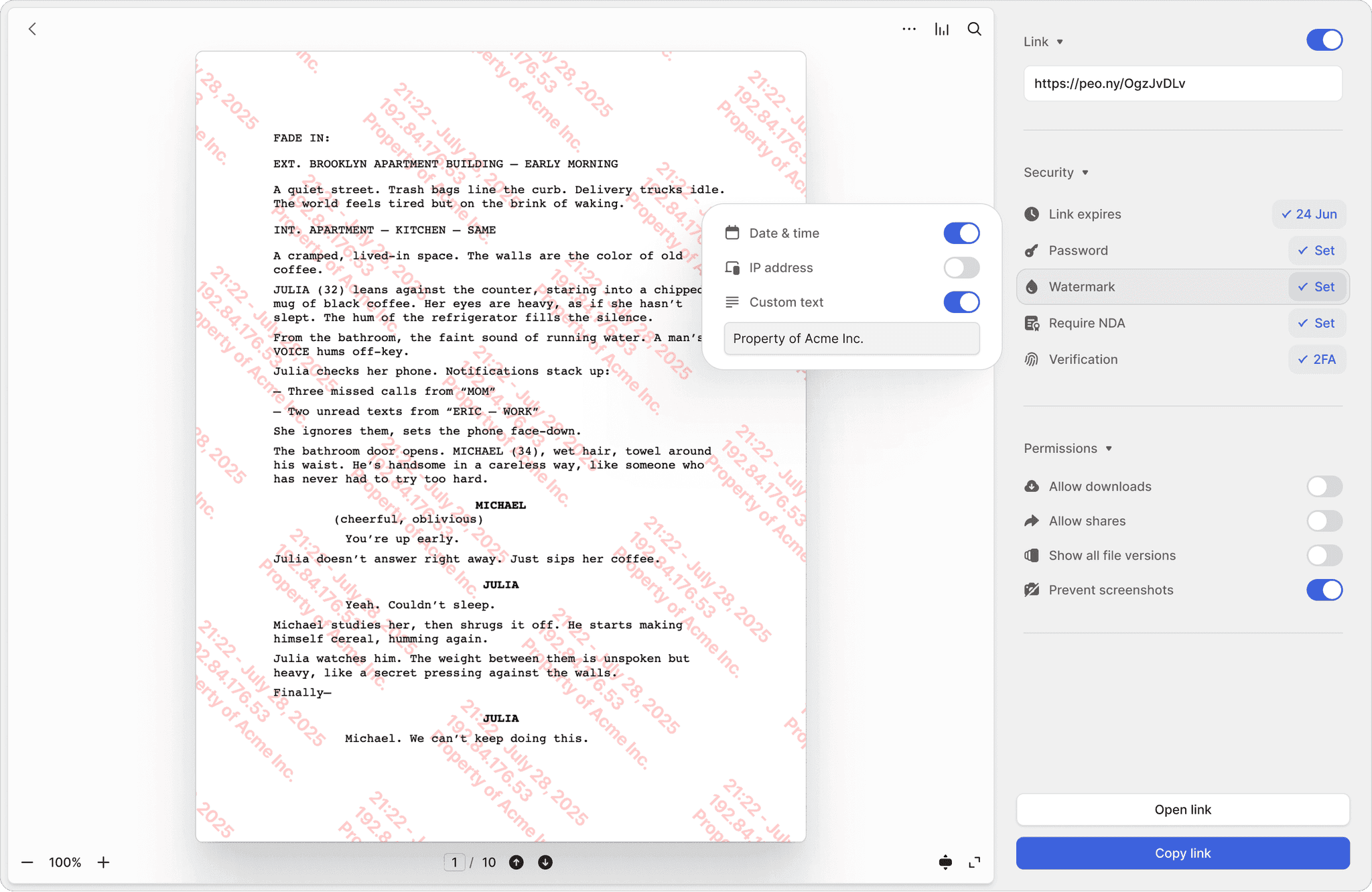
- Stage-gate the cap table and diligence: an NDA in front of the financials, email verification, download and screenshot blocking, and per-investor folder permissions and dynamic watermarks on Data Room.
- Answer diligence in the room, then sign: AI document Q&A with cited page numbers, Visitor Q&A, and built-in e-signatures for the term sheet or SAFE.
Peony at a glance
- Built for
- Pre-seed to growth-stage founders and CFOs raising SAFEs, priced seed and Series A to C rounds, and venture debt or credit facilities, plus the angels, VCs, growth investors and lenders reviewing them.
- Typical plan
- Data Room, $52 per admin per month billed yearly ($75 monthly): unlimited rooms, documents and storage with no per-file size cap, a signed NDA with audit record, dynamic watermarks, folder and file permissions for each investor group, Visitor Q&A, a custom domain, AI room generation and Index documents.
- Pricing
- Business $30, Data Room $52 and Deal Team $64 (minimum 4 admins) per admin per month billed yearly ($44, $75 and $89 monthly); Enterprise is custom. Free ($0) covers 50 documents and 500 MB as tracked single-file links; data rooms start on Business.
- Investors and lenders
- Investors and lenders are unlimited and free on every plan and don't need a Peony account. You pay per admin, not per viewer.
- Rooms and storage
- Unlimited data rooms, documents and storage on Data Room and above, and no per-file size cap on any plan. Business includes 3 data rooms per admin, 1,000 documents per admin and 100 GB of storage, with no per-file size cap.
- Per investor
- One group per investor or firm, each with its own share link, analytics and on/off switch; folder and file permissions per group on Data Room. Switch a group off when the firm passes, or set an expiry.
- Investor analytics
- Page-by-page time, return visits and approximate location for every investor on every plan, Free included; drop-off reports and CSV export from Business; a per-investor audit trail, with the questions they asked the AI, on Data Room. Visitor notifications email you on every view.
- Diligence Q&A
- AI document Q&A answers investors' questions from your files with cited page numbers (Business, switched on per group; 5x usage on Data Room). Visitor Q&A lets investors post questions your team answers in the room (Data Room).
- E-signatures
- Built in, with AI field detection: 3 a month on Free and unlimited from Business, for NDAs, term sheets, SAFEs and side letters. Standard electronic signatures that comply with the US ESIGN Act and EU eIDAS, with signature, timestamp, IP and a verification hash recorded.
- File management
- Upload new version keeps a file's place and link and keeps every earlier version; AI room generation drafts the folder structure, and Index documents numbers every file (Data Room plan).
- Live models
- Peony renders .html files live with JavaScript running, so a Claude or ChatGPT artifact (a model, dashboard or calculator) stays interactive for the viewer, behind your NDA gate, permissions and analytics.
- Versus DocSend
- Data rooms, an NDA gate, viewer email verification and desktop screenshot protection from $30 per admin per month on Business. On DocSend's published pricing (checked October 2026), folder-based data rooms, NDAs, visitor email authentication and folder-level security start on its Advanced tier.
- Security
- AES-256 at rest, TLS 1.2+ in transit. Peony staff can't open your documents, your documents aren't used to train AI, and Peony has had no data breach since launch. Peony's incident-response policy commits to telling affected customers within 72 hours of confirming an incident that affects customer data. SOC 2 Type II-ready and ISO 27001-ready, with both audits underway. Compliance and certifications
- Setup
- Median 4 min 19 s from sign-up to first uploaded document (State of M&A Data Rooms, Q3 2026 edition).
- Trial
- 7-day Data Room trial you start yourself: no credit card, and it never auto-charges. Rooms, files, links, analytics and NDA settings carry over when you upgrade. AI features switch on after you upgrade.
- Support
- 24/7 support, handled directly by the Peony team across Europe, US and Asia hours, with no outsourced tier. Everyone you speak to on Peony support has M&A experience at elite boutiques or bulge-bracket banks, VC experience, or has raised $1M+ themselves.
- Customers
- 8,000+ customers in 60+ countries, with $44.7B in client assets.
Which teams raising capital use a fundraising data room, and for what?
Founders and CFOs use a Peony fundraising data room from the first pitch-deck send through the signed term sheet, and again for debt raises and investor updates between rounds.
Pre-seed and seed founders
Send the deck and a one-page metrics summary on a tracked link per investor, then open the model and cap table to the firms that take a second meeting. The five-file version is our seed round data room template; the early-stage setup lives on startup data rooms.
Series A and B founders
The lead's diligence team works through financials, customer contracts, cohort data and IP in one indexed room, behind a signed NDA, with folder permissions per firm. See the Series A data room guide.
CFOs running growth rounds
Several investor groups, the lead's counsel and the auditors work in one room; Upload new version keeps the model current at the same link, and engagement exports as CSV for the board update.
Venture debt and credit raises
Each lender gets its own group with the runway model, monthly financials, the last round's documents and the lien schedule. See the venture debt data room guide.
Investor updates between rounds
One investor-updates room shows which shareholders open each monthly or quarterly letter, which makes the next raise easier to sequence.
Fund managers raising from LPs
GPs raising a fund share the PPM, DDQ and track record with each LP on its own link; that setup is on venture capital data rooms.
How does Peony help you run your raise like a pipeline?
Peony turns document sharing into fundraising intelligence: it shows which investors read what, protects sensitive materials, and stage-gates your process from first deck to diligence.
Without it, you are raising blind. You sent your materials. You followed up. But you have no idea who is actually moving toward a term sheet. Prioritize engaged investors, protect sensitive materials, and stage-gate your process.
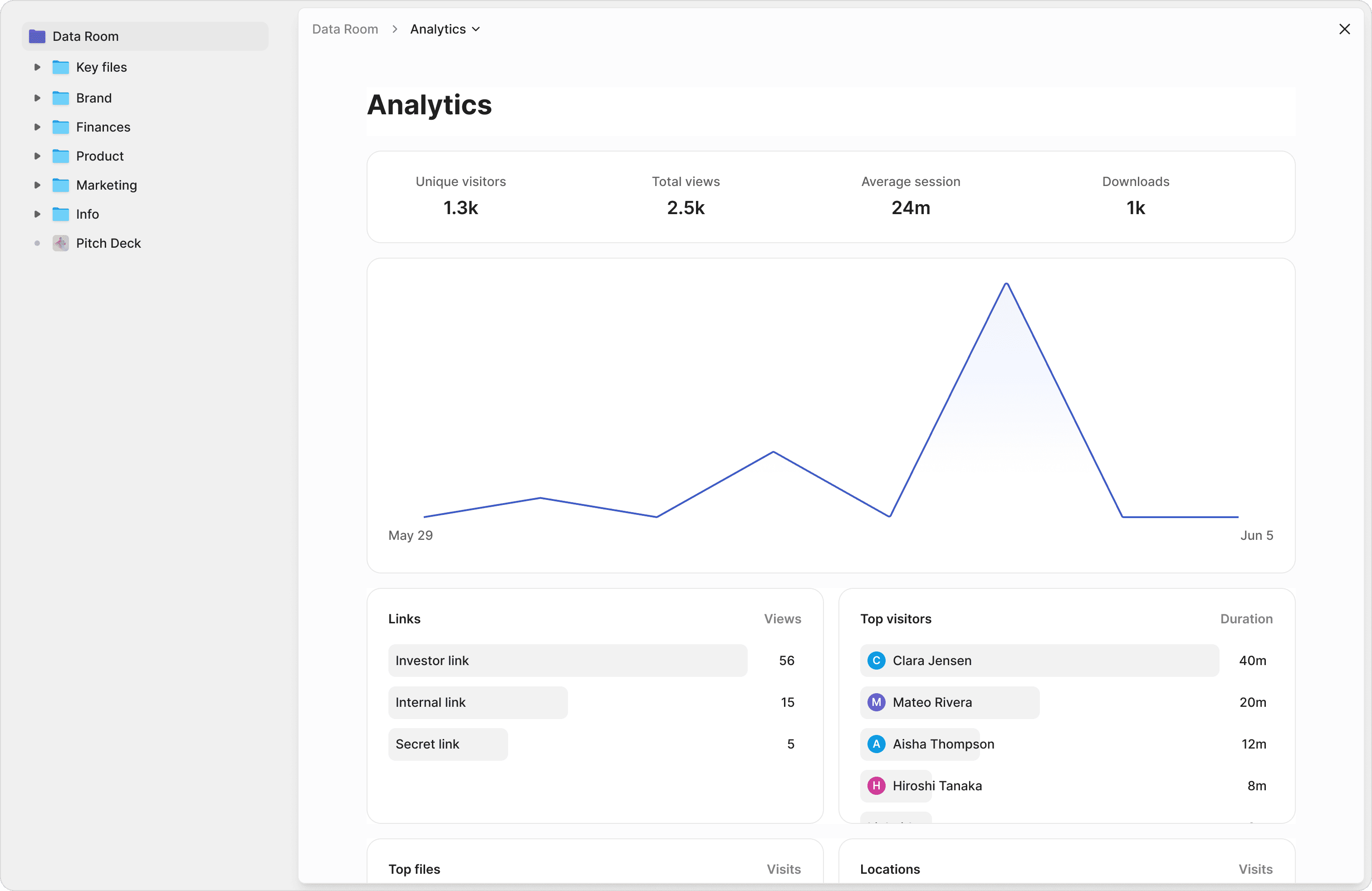
Page-by-page analytics for every investor
Peony shows, page by page, which slides and files each investor read, how long they spent on each one, and how many times they came back.
See which slides each investor spent the most time on, how many times they returned, and which sections they skipped. An investor who spent 12 minutes on your financials slide is signaling something different than one who spent 10 seconds. Give every firm its own link and the follow-up list writes itself.
(Page-level analytics on every plan, Free included; drop-off reports and CSV export from Business ($30/admin/mo billed yearly).)
What it replaces: No signal on who is interested. You emailed 50 VCs. Three replied. But the ones who did not reply might have read every slide twice — you just have no way to know.
NDA gating for sensitive financials
Peony lets you share your pitch deck openly but require a signed NDA before investors can access your cap table, financial projections, or customer contracts.
Progressive document access mirrors how real fundraising works — initial interest first, diligence materials later. With email verification on, a forwarded link shows up as a new viewer under that person's own verified email; downloads and desktop screenshots can be blocked, and on Data Room every page carries the investor's email and IP as a dynamic watermark, so a leaked screenshot traces back to its source.
(Acknowledge-only NDA gate, email verification, download blocking and desktop screenshot protection on Business ($30); the signed NDA with audit record, dynamic watermarks and per-group folder permissions on Data Room ($52/admin/mo billed yearly).)
What it replaces: Financials get forwarded. Your cap table and financial projections end up on desks you never intended. Once a PDF is downloaded, you lose all control.
Let AI answer investor questions 24/7
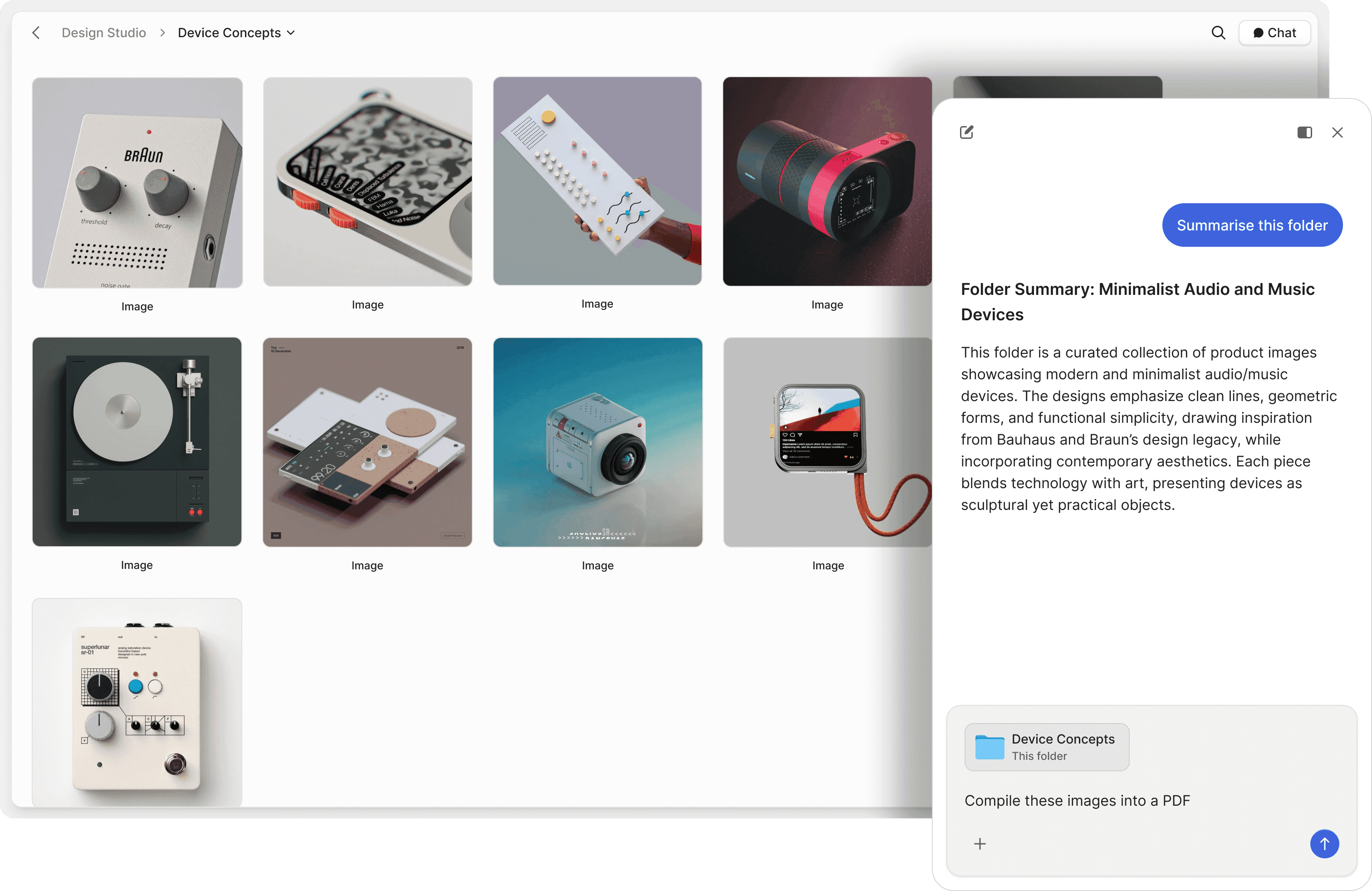
Peony's AI document Q&A lets investors reviewing your data room ask questions and get instant, sourced answers from your documents, with cited page numbers.
You see every question they asked — so you know what concerns to address before your next call. For questions a person should answer, Visitor Q&A lets investors post them inside the room and your team answers once, instead of over email.
(AI document Q&A from Business ($30), switched on per investor group, with 5x usage on Data Room; Visitor Q&A and the per-investor audit trail on Data Room ($52/admin/mo billed yearly).)
Real-time engagement alerts
Get notified the moment an investor opens your data room. See live activity so you can time your follow-up to the minute.
Screenshot protection
Block screen captures of your cap table, financial projections, and customer contracts. Your sensitive numbers stay in the data room. Desktop on Business; iPhone, iPad and Android with Screenshield on Data Room.
Revoke access instantly
Deal fell through? Disable a link in one click. Set expiration dates to automatically cut off access after a diligence window closes.
Built-in eSignatures
Get term sheets and SAFEs signed without switching to DocuSign. AI-powered markup and legally binding signatures included.
How do you use data room activity to decide which investors to call first?
Give every firm its own Peony link, then call first the investors who returned and spent the most time on the model, traction and cap-table pages; Peony records both signals per investor.
Follow-ups are guesswork without engagement data: you follow up with everyone the same way, and warm leads and cold leads get the same email at the same time. Rank them on these five signals instead.
Return visits
A first open is a signal; a second and third visit are much stronger. Peony logs every session per investor, so you see who came back and when.
Time on the pages that price the round
Sort investors by time on the model, traction and cap-table pages. A partner who spent 12 minutes on the financials is in a different place from one who spent 10 seconds.
How far they read
Total session length separates a skim from a read, and the drop-off report shows the page where each investor stopped (Business and above).
What they asked
Questions put to AI document Q&A or posted in Visitor Q&A often say more than which pages an investor opened.
Who else at the firm opened it
With email verification on, a forwarded link shows up as a new viewer under that person's own verified email, so you see when someone new at the firm starts reading.
Visitor notifications email you on every view, with who opened which document, the link they used, the time and a link to the visit's duration and drop-off. Page-level analytics are on every plan, Free included; drop-off reports start on Business ($30 per admin per month billed yearly). The method, slide by slide, is in our guide to tracking pitch deck engagement.
How do you give investors access to the cap table without exposing it to everyone?
Put the cap table in a folder only investors in diligence can open; on Peony's Data Room plan, each investor group gets its own folder permissions, signed NDA and watermark.
Every investor needs different docs: seed investors want your deck and product metrics, Series A investors want audited financials and customer contracts, and managing who sees what by email is a nightmare. In Peony it is one room with a group per investor, laid out like this:
Every investor you pitch
The deck and a one-page metrics summary, with email verification on and downloads off.
Firms that take a second meeting
Add the financial model, product metrics and team, behind an NDA gate.
Firms in diligence
Add the cap table, customer contracts, IP and legal files, behind a signed NDA with audit record and a dynamic watermark on every page.
Your lead investor and its counsel
The full room, downloads where they need PDFs, Visitor Q&A, and the term sheet or SAFE sent for e-signature.
Lenders in a debt raise
Their own group with the runway model, monthly financials, the last round's documents and the lien schedule.
Per-group folder and file permissions, the signed NDA with audit record and dynamic watermarks are on Data Room ($52 per admin per month billed yearly). On Business ($30), run the same ladder as up to 3 rooms per admin: a deck room, then a diligence room behind its own NDA gate. When a firm passes, switch its group off and its link stops opening.
What documents do investors expect in a fundraising data room at each stage?
Seed investors expect the deck, model, cap table and team; Series A adds bank statements or audited financials, customer contracts, cohort retention and IP; Series B+ adds board minutes, option plan and a full audit.
Different rounds require different materials, and a venture lender asks for a different room again. Peony lets you control exactly which documents each investor group can access.
Pre-Seed / Seed
- Pitch deck
- Financial model / projections
- Cap table
- Team bios
- Product demo or screenshots
Series A
- Everything in Seed, plus:
- Audited financials or bank statements
- Key customer contracts
- Cohort retention data
- IP filings or patent portfolio
Series B+
- Everything in Series A, plus:
- Board meeting minutes
- Employee stock option plan
- Legal compliance documents
- Full financial audit report
Venture debt
- Your last round's documents, plus:
- Monthly financials and KPIs (24 to 36 months)
- Runway model with base and downside cases
- AR/AP aging and revenue quality
- Existing debt, leases and lien/UCC schedule
The document-by-document version is our startup data room checklist; the round-specific builds are the seed round data room template, the Series A data room guide and the venture debt data room guide.
How does a raise run in Peony, from first deck to signed term sheet?
A raise in Peony runs in six steps: build the room, give each investor a group, send the deck, rank follow-ups by engagement, open diligence behind the NDA, then sign and close the room down.
Build the room before outreach
Upload the deck, model and cap table; the median time on Peony from sign-up to first uploaded document is 4 min 19 s. On Data Room, AI room generation drafts the folder structure from a one-line description of the round, and Index documents numbers every file.
Create one group per investor or firm
Each group gets its own share link, analytics and on/off switch, so every visit maps to one investor. On Data Room each group also gets its own folder and file permissions.
Send the first-touch deck
Turn email verification on and downloads off. Investors open the deck in any browser, free, with no account.
Rank follow-ups by engagement
Visitor notifications email you on every view; page-level analytics show return visits, time on the model and where each investor stopped reading.
Open diligence behind the NDA
Move interested firms to the diligence group, behind a signed NDA on Data Room. AI document Q&A and Visitor Q&A answer questions in the room, and Upload new version keeps the model current at the same link.
Sign, then close the room down
Send the term sheet or SAFE for e-signature in Peony, switch off the groups that passed, and set an expiry on the rest. Keep the room for investor updates.
Turning an existing deck into this room is a five-step job, covered in how to convert your pitch deck into a data room; the traps to avoid are in 10 fundraising data room mistakes.
“Peony is by far the simplest and most intuitive way to populate and share data rooms with investors and partners. All the key analytics and features integrated into a sleek interface!”
Mark Petrov
Head of Financials at Loop
No credit card · 7-day Data Room trial that never auto-charges · investors and lenders view free, no account
Is Peony or DocSend better for a fundraising data room?
Peony is the better fit when the raise needs a real data room: its Business plan includes folder-based data rooms and an NDA gate, which DocSend starts on its Advanced tier.
DocSend's Standard tier has Spaces, but as flat multi-file links with no folders or per-investor permissions. Peony also adds screenshot protection and AI document Q&A, which DocSend doesn't offer on any tier. Peony is the data room DocSend users graduate to when they need real fundraising intelligence.
| Capability | Peony | DocSend |
|---|---|---|
| Page-by-page analytics per investor | Every plan, Free included | Paid plans (no free plan; 14-day trial) |
| Data rooms | From Business ($30/admin/mo): 3 per admin; unlimited on Data Room ($52) | Folder-based rooms from the Advanced tier; Standard Spaces are flat, with no folders or per-investor permissions |
| NDA before access | Acknowledge-only NDA on Business; signed NDA with audit record on Data Room | From the Advanced tier |
| Viewer email verification | Business and up | From the Advanced tier |
| Folder permissions per investor | Data Room and up | From the Advanced tier |
| Dynamic watermarks | Data Room and up | From the Advanced tier |
| Screenshot protection | Desktop on Business; iPhone, iPad and Android (Screenshield) on Data Room | Not offered on any tier |
| AI answers investor questions from your files | AI document Q&A with cited pages, from Business | No visitor-facing AI document Q&A |
| Q&A module in the room | Visitor Q&A on Data Room; assign-and-approve routing on Deal Team | No Q&A module |
| Pricing basis | Per admin; investors free and unlimited | Per user; Advanced tiers include 3 users |
DocSend tiers from docsend.com/pricing, checked October 2026. The tier-by-tier detail, with prices, is in our DocSend pricing review; the full side-by-side is at Peony vs DocSend.
Robi Lin
Founder & CEO, Sepal AI (YC S24)
Peony is easily the best form factor for sharing client-facing material. At this point, I love hearing, “Does Sepal AI have a sales deck?”
Simple setup, predictable pricing, enterprise-grade security
What does a fundraising data room cost on Peony?
On Peony, fundraising rooms run on Business ($30 per admin per month billed yearly, $44 monthly, 3 rooms per admin) or Data Room, the most popular plan ($52, $75 monthly, unlimited rooms). Investors and lenders never pay.
No per-viewer, per-page, or per-link limits: your costs stay flat whether you share with 10 angels or 50 institutional VCs. Legacy VDRs charge $25K+ per project; Peony delivers the same investor-grade security and analytics at a fraction of the cost.
Business
$30/admin/mo
3 data rooms per admin
A seed raise: a deck room and a diligence room behind an NDA gate, with AI document Q&A
Data Room · Most popular
$52/admin/mo
Unlimited data rooms and storage
Institutional rounds: signed NDA, dynamic watermarks and folder permissions per investor
Try Data Room
7 days free
No credit card, never auto-charges
Put a live room behind an NDA gate, dynamic watermarks and page-level analytics.
Prices per admin per month, billed yearly. Investors and lenders are free and unlimited on every plan. Deal Team ($64, minimum 4 admins) adds advanced redaction and Q&A routing.
Frequently asked questions
What is Peony, and is it a good fit for founders and CFOs running a fundraise?
Yes. Peony is a virtual data room that founders and CFOs raising equity or debt use to share the deck, model and cap table, see which investors read each page and keep diligence behind an NDA. Data Room, the most popular plan, is $52 per admin per month billed yearly ($75 monthly), with unlimited rooms and storage; inviting investors is free and unlimited.
Can I try Peony before I pay?
Yes. Peony's Data Room plan has a 7-day free trial you start yourself, with no credit card, and it never converts to paid on its own. Rooms, files, links, analytics and NDA settings carry over when you upgrade. AI features, such as AI document Q&A and AI room generation, switch on once you're on a paid plan.
What features matter most in a fundraising data room for investor access, tracking and permissions?
Four features matter most: a tracked link per investor, page-level analytics with return visits, an NDA gate with email verification, and per-investor folder permissions; Peony has all four on Data Room. After that, match protection to the stage: download blocking and desktop screenshot protection from Business ($30 per admin per month billed yearly), and dynamic watermarks that stamp each investor's email and IP on every page on Data Room ($52). Two more save the most time in diligence: AI document Q&A, which answers investors' questions from your files with cited page numbers (Business and above), and built-in e-signatures for the NDA, term sheet or SAFE. Investors open everything in the browser, free and with no account, so asking 40 firms to read costs nothing extra. The ranked market view is in our best data rooms for startups and fundraising guide.
How does a data room help startup founders track which VCs are genuinely interested?
A data room with page-level analytics shows which VCs opened your documents, which pages they spent the most time on and how often they came back; Peony records this per investor on every plan. A partner who spent 12 minutes on your financials and came back twice is signaling something different than one who skimmed the first page — Peony surfaces those signals in real time so founders can focus follow-up energy on the VCs most likely to write a term sheet. Visitor notifications email you on every view with who opened what, the link used and the time; the drop-off report (Business and above) shows the page where each investor stopped reading. The method is in our guide to tracking pitch deck engagement.
What documents should a Series A founder include in a fundraising data room?
A Series A data room should include your pitch deck, financial model with 18-month actuals and projections, cap table, cohort retention data, key customer contracts, team bios, and any IP filings. On upload, Peony's AI processes every document, extracting its text so the room is searchable and AI Q&A can cite pages (Business and above); on the Data Room plan, AI room generation drafts the folder structure from a one-line description of the round and Index documents numbers every file (1.1, 1.2...) so a partner can say "open 2.3" on a call. Stage-gate access lets VCs doing initial screening see your deck and metrics, while sensitive materials like your cap table and customer contracts stay locked behind NDA gating until formal diligence begins. The full list is in our startup data room checklist, and the round-specific build in the Series A data room guide.
How do I manage different access levels for different investors?
Create one Peony group per investor or firm, each with its own link, folder and document permissions and analytics; per-group permissions are on the Data Room plan ($52 per admin per month billed yearly). Give seed investors access to your deck and product metrics while restricting Series A materials like audited financials to serious prospects. One room can hold a teaser group, a full-diligence group and a finalist group, so you never duplicate files, and Peony tracks engagement per investor so you always know who is moving toward a term sheet. On Business ($30), which includes 3 data rooms per admin, run the same ladder as separate rooms: a deck room and a diligence room behind its own NDA gate.
How do founders keep cap table and revenue data confidential while sharing with 30+ VCs?
In Peony, give each VC a personalized deck link, require an NDA before anyone opens the cap table, revenue data or customer contracts, and revoke access in one click when a firm passes. Even if you shared with 30 or 50 firms, each link is independently controlled. Peony's Business plan ($30/admin/month billed yearly) adds screenshot protection and Simple NDA gating on top of AES-256 encryption and SOC 2 Type II-ready and ISO 27001-ready infrastructure, with both audits underway. The Data Room plan ($52/admin/month) adds dynamic watermarks and Advanced NDA with signed PDF and audit trail for institutional rounds. Enterprise security with predictable pricing, not per-page charges.
Can VCs ask due diligence questions directly inside a startup's fundraising data room?
Yes. Peony's AI document Q&A (Business and above, from $30 per admin per month billed yearly) lets VCs ask due diligence questions and get instant answers with cited page numbers from your uploaded documents. It answers around the clock — even at midnight before a Monday partner meeting. You switch it on per investor group, and you see every question they asked, giving you insight into their concerns before your next call; each investor's AI questions sit in their audit trail on the Data Room plan ($52). For questions a person should answer, Visitor Q&A (Data Room) lets investors post them inside the room and your team publishes the answer there. This replaces the back-and-forth email chains that slow down traditional fundraising and lets founders focus on building instead of answering repetitive diligence requests.
When should a founder set up a fundraising data room — before or after investor outreach?
Before. Having a polished data room ready when a VC asks for materials signals operational rigor and keeps your fundraise moving instead of stalling while you scramble to organize files. Peony takes under 5 minutes to set up: the median time from sign-up to first uploaded document is 4 min 19 s, per Peony's State of M&A Data Rooms report (Q3 2026 edition). Upload your documents, generate personalized links per investor, and start sharing immediately. Founders who prepare before outreach close rounds faster because there is zero lag between investor interest and document access.
How do you run a data room for a venture debt or debt financing raise?
Give each lender its own Peony group with the runway model, 24 to 36 months of monthly financials, the latest round's documents and your lien schedule, and see which lender reads the downside case. A lender underwrites repayment capacity rather than upside, so the room leads with runway and burn, revenue quality (cohorts, retention, AR/AP aging) and existing debt, leases and UCC filings, alongside the cap table and board approvals. Lenders read everything free in the browser with no account. Per-group folder permissions, the signed NDA and dynamic watermarks are on the Data Room plan ($52 per admin per month billed yearly), and Upload new version keeps the monthly financials current at the same link after the loan closes. The lender-side build is in our venture debt data room guide.
Can one tool track investor interactions, hold the deal documents and run the fundraise in one place?
Yes: Peony runs the document side of a fundraise in one workspace, with a tracked link per investor, page-level reading history, in-room Q&A and e-signatures for the term sheet or SAFE. Visitor notifications email you on every view, and on Data Room ($52) each investor's opens, time per file, return visits and AI questions sit in one audit trail. Keep your fundraising CRM as the pipeline of record: export Peony's analytics as CSV from Business ($30 per admin per month billed yearly), or on Deal Team ($64, minimum 4 admins) use API access, enabled on request, to push room analytics and signed agreements into the CRM.
Is Peony better than DocSend for fundraising?
Yes, when the raise needs a real data room: Peony Business ($30 per admin per month billed yearly) includes data rooms, an NDA gate, viewer email verification and desktop screenshot protection. On DocSend's published pricing (checked October 2026), folder-based data rooms, NDAs, visitor email authentication, folder-level security and dynamic watermarking start on its Advanced tier, and DocSend has no screenshot protection and no visitor-facing AI document Q&A on any tier. Peony shows you exactly which pages each investor read and for how long on every plan, Free included, and its AI document Q&A gives investors cited answers from your files. Peony is the data room DocSend users graduate to when they need real fundraising intelligence. The tier-by-tier detail is in our DocSend pricing review.
How much does a fundraising data room cost for a seed-stage startup?
On Peony, a seed-stage fundraising data room costs $30 per admin per month on Business, billed yearly ($44 monthly), and investors view free; Data Room at $52 ($75 monthly) adds unlimited rooms. Peony's pricing is predictable and scales with your raise. Business includes 3 data rooms per admin, AI document Q&A, screenshot protection, e-signatures, and personalized investor links. Data Room adds dynamic watermarks, unlimited data rooms, unlimited storage, Advanced NDA, and 5x AI Q&A usage for institutional rounds. No per-viewer, per-page, or per-link limits on any plan — your costs stay flat whether you share with 10 angels or 50 institutional VCs. Free ($0) covers 50 documents and 500 MB as tracked single-file links, enough for a first deck send; data rooms start on Business. Legacy VDRs charge $25K+ per project. Peony delivers the same investor-grade security and analytics at a fraction of the cost.
Can Peony staff see the documents in my fundraising data room?
No: Peony staff can't open, move or edit the documents in your room, and your documents aren't used to train AI. Files are encrypted with AES-256 at rest and TLS 1.2 or higher in transit. Peony has had no data breach since launch. Peony's incident-response policy commits to telling affected customers within 72 hours of confirming an incident that affects customer data. Peony is SOC 2 Type II-ready and ISO 27001-ready, with both audits underway. The current status is on Compliance and certifications. Investors read in the browser, so files never leave Peony unless you allow downloads on their link.
Planning the raise? Start with the investor data room guide, the five-file seed round data room template, and the 10 fundraising data room mistakes. Comparing providers? See the best data rooms for startups and fundraising.
Know which investors to call back first
Peony turns document views into fundraising signals. Investor-ready in 5 minutes.
- Investors and lenders never need a seat or an account.
- Unlimited rooms on Data Room: the round, a debt raise and your investor updates cost the same as one room.
- Live in minutes; the 7-day trial never auto-charges.
No credit card · 7-day Data Room trial that never auto-charges · investors and lenders view free, no account · 24/7 support
Live in under 5 minutes
Last updated: October 2026