
The commercial real estatedata room that closes deals
Acquisitions, dispositions, joint ventures, fund raises, and property listings — one secure CRE deal data room for commercial real estate file sharing, with branded portals and page-level analytics.Know exactly which buyers and equity partners are engaged and which sections of your OM they care about most. Trusted by 6,800+ customers, including teams at JLL, Barfoot & Thompson, Aareon, and Van Vlissingen and Co.
24/7 dedicated support for enterprise deals
What is a commercial real estate data room?
A commercial real estate data room — often shortened to a CRE data room or CRE deal room — is a secure online workspace where a broker or deal team shares confidential property documents — the offering memorandum, rent roll, T-12 financials, leases, and diligence reports — with qualified buyers, lenders, and counsel under NDA, with tracked access and per-buyer permissions.
It differs from generic file sharing in three ways: access is gated (a confidentiality agreement and a buyer-qualification form stand between a listing click and your financials), every page is watermarked with the viewer's identity, and engagement is tracked page by page — so you know which buyer studied the T-12 and which one skimmed the cover page. Brokers run one room per listing as a repeatable ladder; sponsors and funds run rooms for acquisitions, dispositions, JVs, and LP reporting on the same flat plan.
What should be included in a commercial real estate data room?
Eight document categories cover nearly every CRE transaction. Load them in this order and buyers stop emailing you for missing files.
Title & ownership
Deed, title policy, ALTA survey, entity documents
Financials
T-12, rent roll, operating statements, budgets, CAM reconciliations
Leases & tenancy
Leases and amendments, abstracts, estoppels, SNDAs
Environmental & engineering
Phase I ESA (ASTM E1527-21), property condition assessment
Zoning & permits
Zoning confirmation, certificates of occupancy, permits
Property condition & capex
Capex history, warranties, service contracts
Insurance
Certificates, loss runs, flood determinations
Deal documents
CA/NDA, LOI, PSA drafts, closing checklist
The full request-list version, organized the way buyer diligence teams actually ask for it, is in our real estate due diligence checklist.
How do you set up a commercial real estate data room?
Pick the pricing model before the platform
Flat per-admin pricing covers unlimited rooms — 25 concurrent listings run about $2,496/year on Peony's Data Room plan — while per-deal VDR quotes bill every room separately. For a brokerage running a listing ladder, the model decides the economics before any feature does.
Clone a folder template per listing
Teaser up front, CA-gated OM and financials behind the gate, and an under-contract diligence file that opens after the PSA. One template, every listing, no rebuilt structure.
Gate the room
A confidentiality agreement as the first screen, plus a buyer-information form — proof-of-funds range, entity type, timeline — so anonymous clicks become a qualified pipeline.
Send per-buyer links with watermarks
Each buyer group gets its own tracked link and its own permissions; every page carries the viewer's identity, so a forwarded rent roll traces back to its source.
Track engagement and revoke on dropout
Page-level analytics rank buyers by demonstrated intent; when a party exits the process, access is revoked in one click and the audit trail keeps the record.
The episodic off-market version of this workflow — the CA gate, the watermarked rent roll, revoke-on-dropout — is in the off-market listing NDA guide.
Who sees what: the CRE permission matrix
One room, four audiences, four different views — enforced by visitor groups and folder-level permissions, not by emailing different attachments.
All approved buyers
Teaser and market overview; the OM opens after the confidentiality agreement is signed.
Qualified institutional buyers
Rent roll, T-12, lease abstracts, and estoppels — after NDA plus your qualification form.
Lender and counsel
The full diligence file with download rights and a complete audit trail for closing.
JV partner
Financial exhibits with tenant names and lease rates redacted until closing (Advanced Redaction, Deal Team plan).
The best data room setup, by CRE deal type
Every property type runs diligence differently. We wrote the deal-type playbooks so you don't have to adapt a generic template.
CRE deals deserve better than email attachments
Every day, deal teams lose time and credibility because of clunky document sharing. Sound familiar?
Scattered deal documents
Rent rolls in email, lease abstracts in Dropbox, Phase I reports in Google Drive. Equity partners waste hours hunting for what they need.
No visibility into interest
You send an offering memorandum and wait. No idea if the buyer even opened it, let alone which sections caught their attention.
Confidential financials at risk
Rent rolls, financial models, and LP agreements forwarded freely. No NDA enforcement, no watermarks, no audit trail.
Unprofessional presentation
Generic file-sharing links undermine your credibility on a nine-figure transaction. Institutional LPs expect more.
Everything you need for commercial real estate deals
Peony gives CRE deal teams a secure, branded space to share offering memoranda, financials, and diligence documents — with the analytics to close faster.
Data rooms that match the deal size
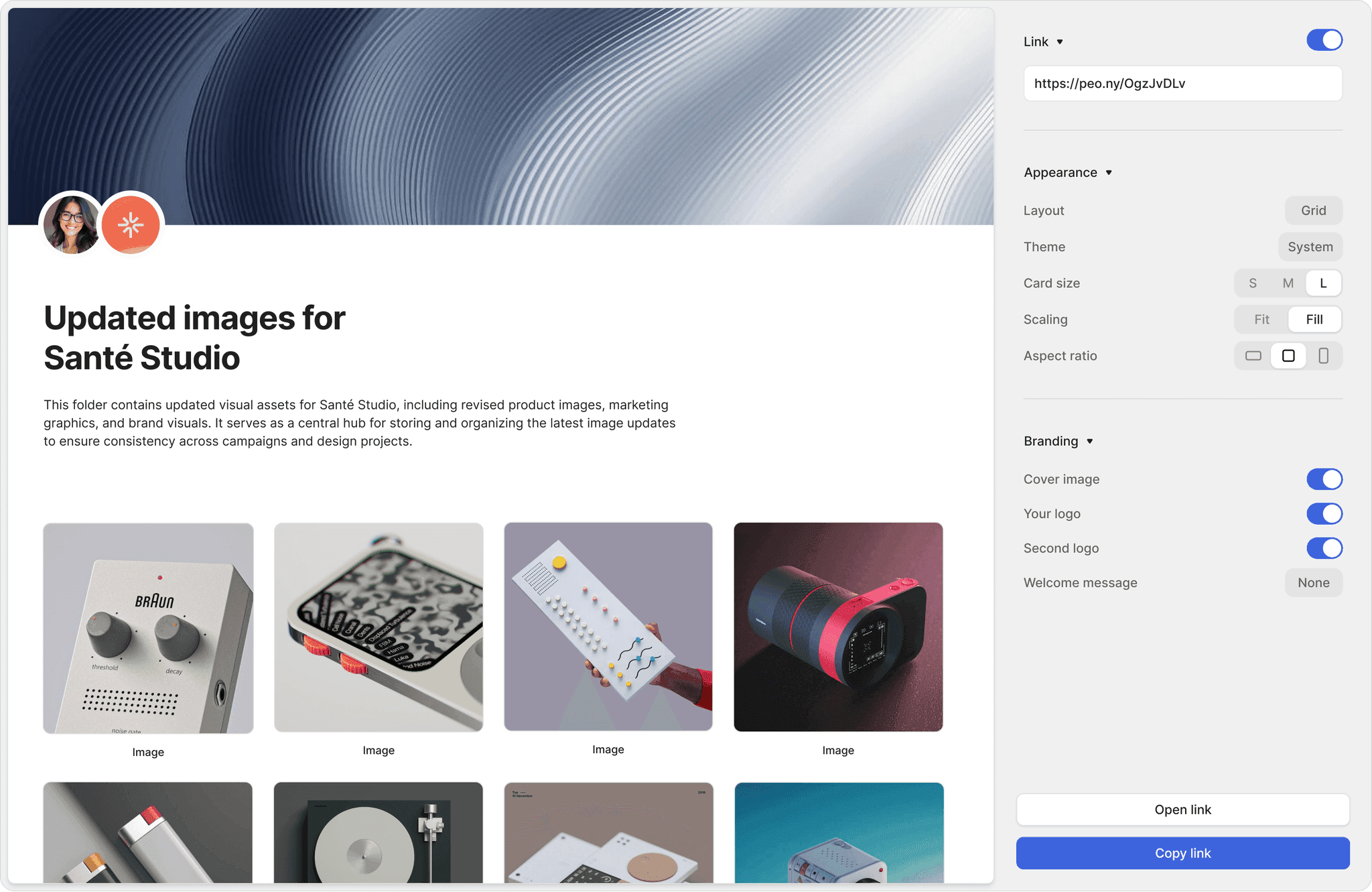
Create branded data rooms with your firm's logo, cover images, and custom colors. Whether you are marketing a single asset or a multi-property portfolio, every document looks polished and institutional-grade.
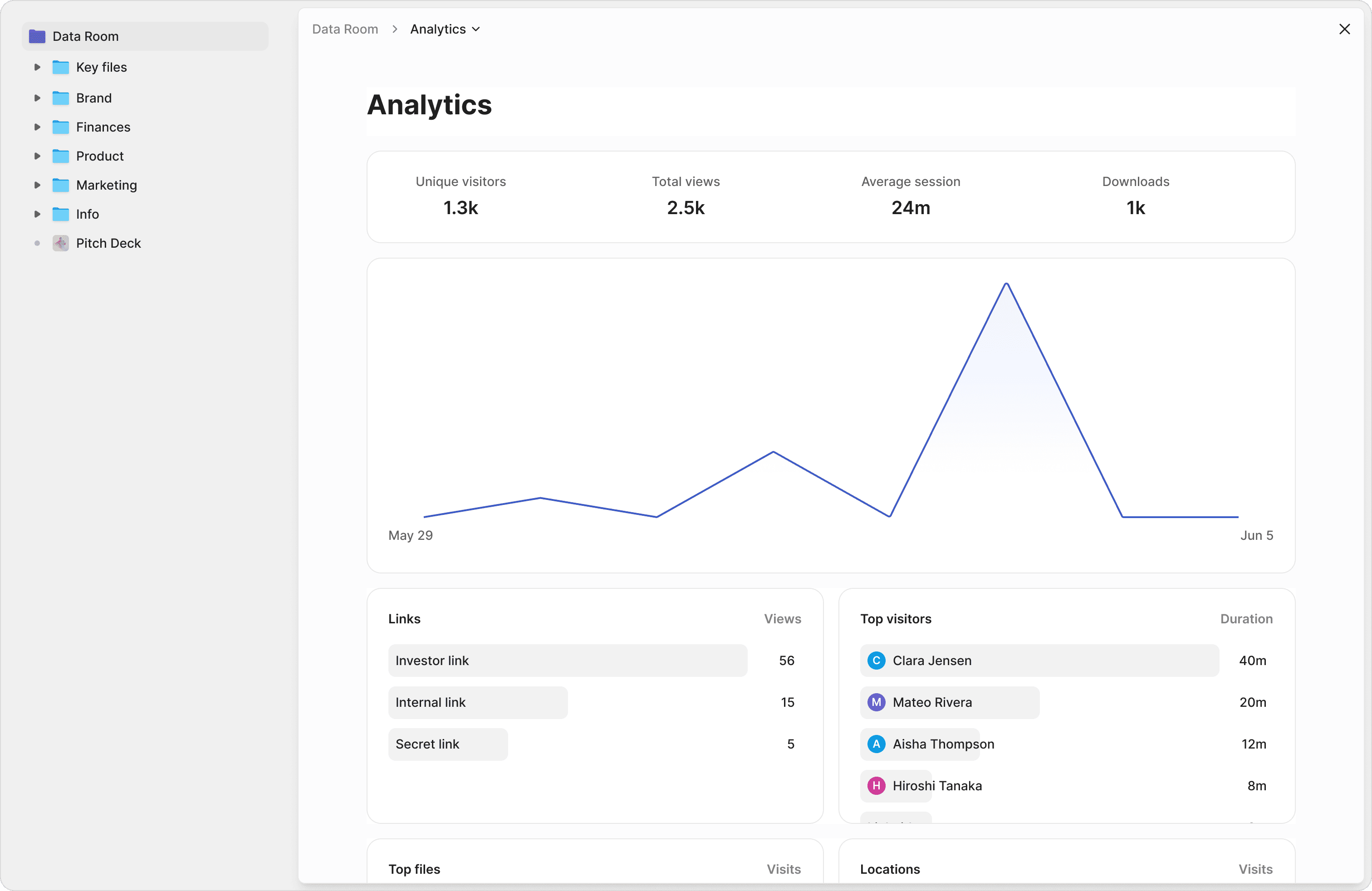
Know which counterparties are serious
See exactly who opened your OM, how long they spent on the financials, and which lease abstracts they revisited. Prioritize follow-ups with the most engaged buyers and equity partners. Brokers link their MLS listings to an NDA-gated data room — turning listing views into qualified leads with contact info, engagement data, and a clear picture of who deserves a call back.
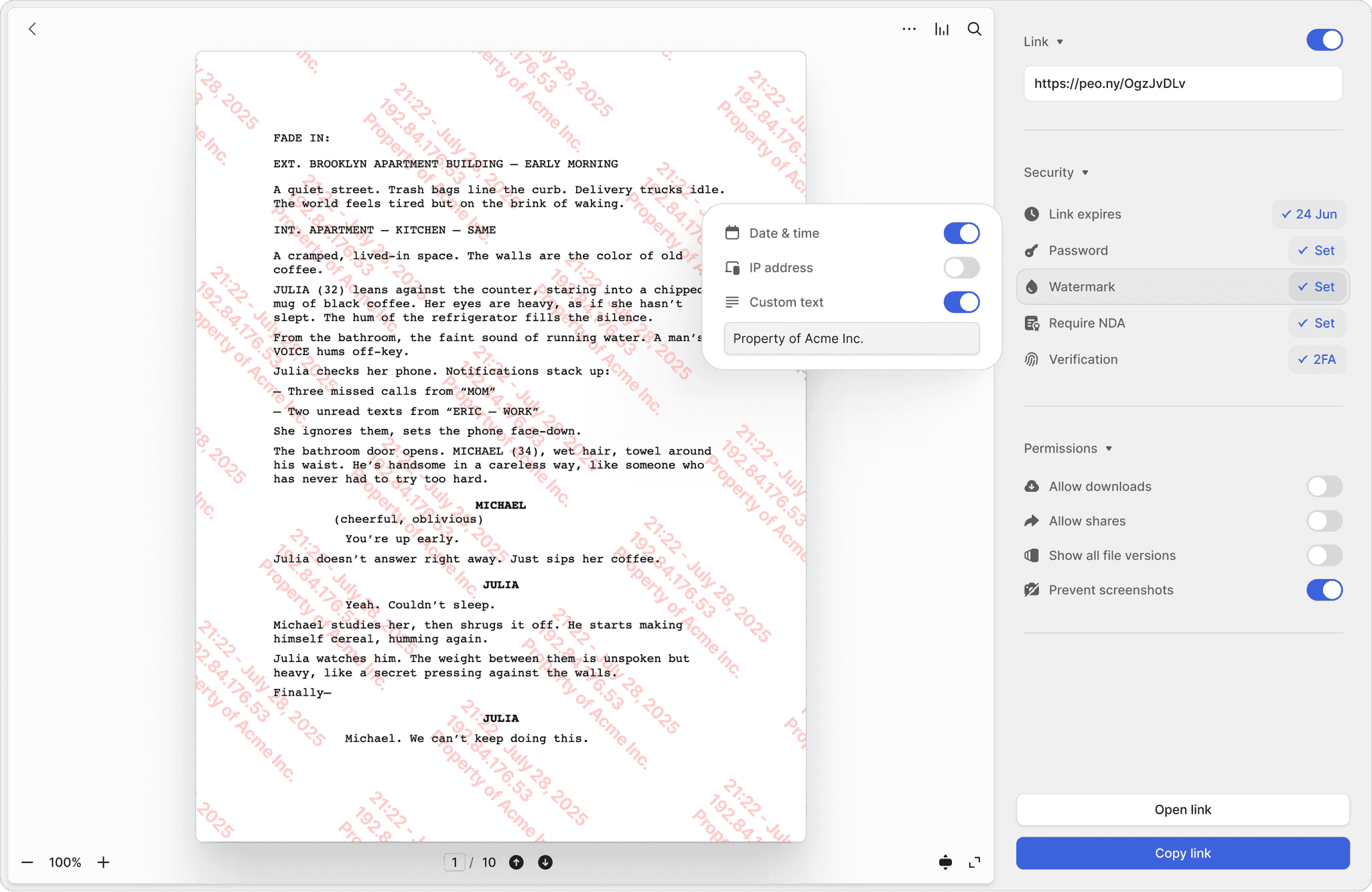
Protect every confidential document
Gate data rooms behind NDAs, add dynamic watermarks to financial models, set link expiration dates, and require 2FA for sensitive records. Full control over who sees what — down to the folder level.
Custom-branded portals
Add your firm's logo, cover images, and brand colors to every data room. Create an institutional-grade experience for equity partners and LPs.
Page-by-page analytics
Track which pages of your OM get the most attention. Understand buyer and LP interest at the section level.
Built-in NDA gating
Require counterparties to sign an NDA before accessing confidential deal documents. Enforce compliance automatically.
Granular access controls
Set passwords, expiration dates, and download permissions per link. Share different folders with different buyer groups or JV partners.
Dynamic watermarks
Protect rent rolls and financial models with viewer-specific watermarks. Deter unauthorized sharing of sensitive deal data.
Unlimited links per document
Create separate tracked links for each buyer group, JV partner, or LP. Manage access individually without creating duplicate rooms.
"We'd been searching for a solution like Peony for ages, and it has completely transformed our workflows. What used to take hours every week is now effortless — Peony saves us so much time that we were finally able to move away from Dropbox Sign. It's been a total game changer!"
Akash Ghavalkar
Co-founder & COO, Third Space
Mark Petrov
Head of Financials, Loop
"Peony is by far the simplest and most intuitive way to populate and share data rooms with investors and partners. All the key analytics and features integrated into a sleek interface!"
Frequently asked questions
I'm a CRE broker marketing a $12M off-market retail property — how do I use a data room to qualify serious buyers before sharing financials?
Create a Peony data room for the property, load your offering memorandum, rent rolls, T-12 financials, lease abstracts, and Phase I report, then gate the entire room behind an NDA and a custom buyer information form. Before any buyer sees a single financial page, they provide their name, company, proof of funds range, and acquisition criteria through Peony's additional-info collection fields — so you know who is a qualified $12M buyer versus a tire-kicker before they ever touch the rent roll. Peony's Data Room plan at $52 per admin per month includes NDA gating, custom access questions for buyer qualification, and page-level analytics that show which buyers actually studied the T-12 versus which ones skimmed the OM cover page. Dropbox and Google Drive have no gating, no buyer information collection, and no page-level visibility — you are sharing financials blind. For the episodic version of this workflow — the CA gate, the watermarked rent roll, revoke-on-dropout, and the pricing math for a shop that takes an off-market deal every other month — see our [off-market listing NDA guide](/blog/off-market-listing-nda-data-room).
I run a 3-person brokerage team marketing 8 listings simultaneously — how do I track which buyers are engaged across all my properties without drowning in spreadsheets?
Create a separate Peony data room for each property and generate unique tracked links for every buyer or buyer group. Peony's page-level analytics show you exactly who opened each property's OM, how long they spent on the rent rolls versus the cap rate summary, whether they came back for a second look, and where they are located — across all 8 listings from one dashboard. For a 3-person team running 8 active listings with 40 or more buyers in the pipeline, this replaces the spreadsheet you are currently maintaining by hand. Peony's Data Room plan at $52 per admin per month gives you unlimited data rooms, unlimited tracked links, and dynamic watermarks with each buyer's identity on every page — so if a confidential OM gets forwarded, you trace it instantly. Firmex charges thousands per room, which makes running 8 simultaneous listings prohibitively expensive for a boutique brokerage.
We're a 20-broker investment sales firm and every agent shares deal documents their own way — one even runs listings through a personal DocSend account. How do we standardize?
Set one firm-level workspace and make the listing ladder the standard: a folder template every new listing clones (teaser, CA-gated OM and financials, then the under-contract diligence file), firm branding on every buyer-facing room, and per-broker permissions so each agent runs their own listings while the firm keeps oversight and the audit trail. Peony's Data Room plan ($52/admin/month) includes unlimited data rooms, so 25 concurrent listings cost no more than one — versus per-deal VDR quotes, or per-seat document tools that fragment into personal accounts the firm cannot see or audit. Brokers keep the workflow they like (send a link), and the firm gets consistent branding, NDA coverage on every offering memorandum, and one view of buyer engagement across every active listing. For a ranked comparison of the platforms a CRE firm would shortlist for this decision, see our [best data rooms for commercial real estate](/blog/best-data-rooms-for-commercial-real-estate) guide.
We're marketing a $35M multifamily portfolio to both institutional buyers and 1031 exchange investors — how do I show different information to different buyer types?
Use Peony's folder-level permissions to create tiered access within one data room. Put the OM, property photos, and market overview in a shared folder visible to all approved buyers. Gate the detailed rent rolls, T-12 financials, and tenant estoppels behind a second permission tier for institutional buyers who have signed the NDA and passed your qualification criteria. For your 1031 exchange investors, create a third tier with tax-advantaged analysis and exchange timeline documentation. Each buyer group gets a separate share link with its own analytics dashboard, so you see which institutional buyers are deep in the financials versus which 1031 investors are still reviewing the overview. Peony's Data Room plan at $52 per admin per month handles all three tiers in one workspace with granular permissions. Google Drive requires separate folders with separate share links and gives you zero consolidated analytics across buyer groups.
Our acquisition team is bidding on a 200-unit apartment complex and needs to share our LOI and proof of funds with the seller's broker — how fast can we get a data room set up?
You can go live in under 5 minutes. Upload your LOI, proof of funds letter, corporate entity documents, and acquisition track record, add your firm's branding, configure NDA-gated access, and share the link with the seller's broker the same afternoon. Peony AI auto-indexing categorizes your uploaded documents into a professional folder structure automatically — no manual sorting. For a competitive bidding situation on a 200-unit complex where multiple buyers are submitting simultaneously, the speed advantage is real: legacy data rooms like Firmex and Ideals take days to provision and require a sales call, which means your competitor's materials arrive before your room is even set up.
I'm a top broker preparing customized packages for 4 different buyer groups on a $20M industrial property — do I need to create 4 separate data rooms?
No. Create one Peony data room with all your documents, then generate 4 separate share links — one per buyer group — each with different permission settings, custom cover pages, and personalized messages. One institutional buyer might see the full financial package including environmental reports. A second buyer group interested in owner-occupancy sees the building specs and zoning but not the detailed tenant financials. Each link has its own analytics so you know which group is most engaged. Peony's Data Room plan at $52 per admin per month includes unlimited links with per-link permissions, dynamic watermarks that print each buyer's name on every page, and Screenshield screenshot protection that blocks and logs capture attempts. With Dropbox or Google Drive, you would need to duplicate files into 4 separate folders and lose all consolidated tracking.
We manage a $150M CRE fund and need to share quarterly reports and capital call notices with 25 LPs — how does Peony handle LP communications?
Create a fund-level data room with folders for quarterly reports, capital call notices, K-1 packages, and investment memos. Generate a unique share link for each LP so you track exactly who opened the quarterly report, how long they spent on the performance tables versus the market commentary, and when they came back for a second review. For a $150M fund with 25 LPs receiving quarterly distributions, this intelligence tells your IR team who to call before the next capital call. Peony's Business plan at $30 per admin per month includes NDA gating and e-signatures for subscription documents and side letters, and the Data Room plan ($52/admin/month) adds dynamic watermarks tied to each LP's identity — all inside the same platform. Running this process on Intralinks or Datasite costs $50,000 or more per year and requires weeks of vendor procurement.
I'm listing a $8M retail strip center and want to collect buyer information before they see the rent roll — what information can I require?
Peony's additional-info collection lets you require any custom fields before a buyer accesses the data room — name, company, email, phone, proof of funds range, entity type, acquisition timeline, geographic focus, intended hold period, or any other qualification criteria your brokerage requires. For an $8M retail strip center with 15 interested parties, this turns anonymous listing clicks into a qualified buyer pipeline ranked by engagement. After buyers submit their information and sign the NDA, Peony page-level analytics show which ones actually studied the rent roll and which ones bounced after the OM cover page. No other file-sharing tool — not Google Drive, not Dropbox, not WeTransfer — combines gated buyer qualification with per-page engagement tracking in a single workflow.
Our JV partner wants to review the property financials but we need to redact tenant names and lease rates from certain exhibits before sharing — can I do that inside the data room?
Yes. Peony's advanced redaction lets you permanently black out tenant PII, specific lease rates, or any commercially sensitive figures directly in the platform before sharing with your JV partner — no need to create redacted copies in Adobe or export to a separate tool. For a joint venture negotiation where your partner needs to review T-12 financials but should not see individual tenant identities until closing, apply redactions to the shared version while keeping the full unredacted original in your admin view. Advanced redaction sits on the Deal Team plan ($64 per admin per month), alongside NDA gating and an audit trail showing exactly who viewed which version — critical when multiple counterparties have different disclosure rights on the same deal.
We're a regional CRE firm running 3 to 5 deals at any time — how much does a data room cost compared to legacy providers like Firmex or Ideals?
For a regional CRE firm running 3 to 5 concurrent deals, Peony's Data Room plan costs $52 per admin per month with unlimited data rooms, unlimited storage, unlimited tracked links, and no per-deal or per-page fees. That is $624 per year for one admin running all your deals simultaneously. Firmex charges $5,000 or more per project, and Ideals charges $25,000 or more per project with per-GB storage fees — meaning 3 to 5 concurrent deals would cost your firm $15,000 to $125,000 per year at legacy providers. Peony includes AI auto-indexing, page-level analytics, NDA gating, dynamic watermarks, Screenshield screenshot protection, built-in e-signatures, and AI document Q&A. The economics are not close.
I need to protect my OMs from getting forwarded around the market — how does Peony prevent unauthorized distribution of deal documents?
Peony applies four layers of protection to prevent your offering memoranda and financials from leaking. First, dynamic watermarks embed each viewer's name, email, and timestamp on every page — so any forwarded screenshot is immediately traceable to the source. Second, screenshot protection blocks and logs any attempt to capture your screen while viewing documents. Third, NDA gating requires every viewer to sign a non-disclosure agreement before seeing a single page. Fourth, link expiry and access revocation let you cut off access instantly when a buyer drops out of the process or a deal closes. For a broker marketing a $20M property to 12 buyer groups, knowing that every leaked page traces back to a specific person changes behavior — buyers stop forwarding your confidential materials because the risk is visible. Google Drive, Dropbox, and email attachments offer none of these protections.
What is a data room in real estate?
A data room in real estate is a secure online workspace where a broker or deal team shares confidential property documents — the offering memorandum, rent roll, T-12 financials, leases, and diligence reports — with qualified buyers, lenders, and counsel under NDA, with tracked access and per-buyer permissions. It replaces email attachments and generic file links at the moment a transaction becomes confidential: access is gated behind a confidentiality agreement, every page carries the viewer's identity as a watermark, and page-level analytics show which buyer actually studied the financials. Brokers typically run one room per listing; sponsors and funds run rooms for acquisitions, dispositions, joint ventures, and LP reporting.
What should be included in a real estate data room?
Eight categories cover nearly every commercial real estate transaction: title and ownership (deed, title policy, ALTA survey, entity documents); financials (T-12, rent roll, operating statements, budgets); leases and tenancy (leases, abstracts, estoppels, SNDAs); environmental and engineering (Phase I ESA under ASTM E1527-21, property condition assessment); zoning and permits (zoning confirmation, certificates of occupancy); property condition and capex (capex history, warranties, service contracts); insurance (certificates, loss runs); and deal documents (CA/NDA, LOI, PSA drafts, closing checklist). Load the teaser first, gate the OM and financials behind the confidentiality agreement, and open the full diligence file once the property goes under contract — see our [real estate due diligence checklist](/blog/real-estate-due-diligence-checklist) for the complete request-list version.
What is a DD room?
A DD room — short for due diligence room — is the data room a buyer's team works through after an offer is accepted: the organized set of title, financial, lease, environmental, and legal documents that lets the buyer, its lender, and counsel verify what they are purchasing before closing. In commercial real estate the DD room is usually the third rung of the listing ladder: the teaser is public, the offering memorandum sits behind a confidentiality agreement, and the full DD file opens to the winning buyer under contract. A well-run DD room tracks every document view, so if a dispute surfaces after closing, the audit trail shows exactly who reviewed which disclosure and when — see our [due diligence data room checklist](/blog/due-diligence-data-room-checklist) for the document-by-document build.
How much does a real estate data room cost?
On flat per-admin pricing, a commercial real estate data room costs $52 per admin per month on Peony's Data Room plan — with unlimited rooms, unlimited storage, and no per-page or per-deal fees, one admin running a 25-listing ladder pays about $624 per year, and a 4-admin brokerage about $2,496. Per-deal VDR pricing works differently: Firmex runs $5,000 or more per project and iDeals quotes per engagement (entry pricing is commonly cited around $500-1,000 per month), so a brokerage with several concurrent listings can face five figures per year for the same workflow. The honest rule: episodic, deal-by-deal sellers should compare per-deal quotes; anyone running listings as a repeatable ladder should price the flat model first — the full math is in our [virtual data room cost guide](/blog/virtual-data-room-cost-guide).
Enterprise security. Startup price
Traditional CRE data rooms from Ideals and Firmex charge thousands per deal. Peony gives you the same security and analytics at a fraction of the cost.
Free
$0
Core analytics
Perfect for solo operators getting started
Business
$30/admin/mo
Up to 3 data rooms
For firms managing a few transactions
Data Room
$52/admin/mo
Unlimited data rooms
Full enterprise security for institutional deals