
The private equity data room for diligence, exits and fund raises
Run buy-side diligence with the target, lenders and QoE team in one room, keep every bidder blind to the others when you exit, and see which LPs actually read the PPM: one secure Peony room per deal, add-on or fund, with unlimited rooms on Data Room.
No credit card · 7-day Data Room trial that never auto-charges · bidders, lenders and LPs view free, no account
24/7 dedicated support for enterprise deals
Last updated October 2026
Trusted by Clayton Dubilier & Rice

8,000+ customers in 60+ countries · $44.7B in client assets
Peony staff can't open your documents, your documents aren't used to train AI, and Peony has had no data breach since launch.
State of M&A Data Rooms (Q3 2026 edition, 733 M&A transactions from $1M to $500M): a sub-$50M room averages 1,206 files and 79 Q&A questions. The same report puts Peony's median time from sign-up to first uploaded document at 4 min 19 s. Read the research
What is Peony's private equity data room, and who is it for?
Peony is a virtual data room that private equity deal teams and independent sponsors use for buy-side diligence, portfolio-company exits, add-ons and LP fundraising, with one permissioned group per counterparty and page-level analytics. Data Room, Peony's most popular plan, is $52 per admin per month billed yearly with unlimited rooms and storage, and bidders, lenders and LPs never pay.
A private equity data room is the permissioned online workspace a fund uses to share confidential deal and fund documents (the CIM, QoE report, model, PPM and DDQ) with targets, lenders, bidders and LPs under NDA. For a ranked comparison of providers, see best data rooms for private equity; for an advisor-run sell-side process, see M&A data rooms.
- Buy-side diligence and add-ons: the target's management uploads into your request folders, and lenders, the QoE provider and counsel each get their own group, NDA and folder permissions.
- Exits: one room per process, a group, link and private question team per bidder, and one switch to cut off a bidder that drops out.
- Fundraising and LPs: a tracked link per LP into the fund room, page-by-page reading of the PPM, track record and DDQ, and signed NDAs and subscription documents in the same workspace.
Peony at a glance
- Built for
- Lower-mid-market and mid-market buyout funds, growth equity firms, independent and fundless sponsors, and their operating partners and IR teams: platform acquisitions, add-ons and roll-ups, portfolio-company exits, continuation vehicles and fund raises.
- Typical plan
- Data Room, $52 per admin per month billed yearly ($75 monthly): unlimited rooms, documents and storage with no per-file size cap, a signed NDA with audit record, dynamic watermarks, a group with its own folder and file permissions per counterparty, Upload-level request folders, Visitor Q&A, access questions, a custom domain and a per-visitor audit trail.
- Pricing
- Business $30, Data Room $52 and Deal Team $64 (minimum 4 admins) per admin per month billed yearly ($44, $75 and $89 monthly); Enterprise is custom. Free ($0) covers 50 documents and 500 MB as tracked single-file links; data rooms start on Business.
- Bidders, lenders and LPs
- Bidders, lenders and LPs are unlimited and free on every plan and don't need a Peony account. You pay per admin, not per viewer.
- Rooms and storage
- Unlimited data rooms, documents and storage on Data Room and above, and no per-file size cap on any plan. Business includes 3 data rooms per admin, 1,000 documents per admin and 100 GB of storage, with no per-file size cap.
- Versus legacy VDRs
- $52/admin/month (Data Room) vs Datasite $25K+/deal — ~99% cost difference. AI Q&A, dynamic watermarks and screenshot blocking are included — not enterprise add-ons.
- Deal management
- Peony runs the document side of PE deal management: one room per deal, add-on or fund, NDA-gated counterparty links, page-level analytics, in-room Q&A and e-signatures. On Deal Team, API access (enabled on request) pushes room analytics and signed agreements into your CRM.
- Fund and team separation
- Put each fund's or strategy's admins in their own team, restricted to that team's rooms in team settings, with partners in every team. Inside a room, groups, permissions and question teams are scoped to that room.
- Large files
- Data Room has unlimited storage and no per-file size cap. PDFs, Word, Excel, PowerPoint, images and video open in the browser with no download, and Excel models show values, not formulas, while viewed.
- File management
- Upload new version keeps a file's place and link and keeps every earlier version; AI room generation drafts the folder structure, and Index documents numbers every file (Data Room plan). Duplicate a data room copies its files and folders into a fresh room; groups, links and analytics start clean.
- Live models
- Peony renders .html files live with JavaScript running, so a Claude or ChatGPT artifact (a model, dashboard or calculator) stays interactive for the viewer, behind your NDA gate, permissions and analytics.
- Enterprise
- Deal Team ($64 per admin per month billed yearly, minimum 4 admins) adds OAuth SSO, API access, room archive download, advanced redaction, Advanced Q&A routing, priority support and a dedicated account manager. Enterprise (custom pricing) adds SAML SSO, BYOK, self-hosted or white-label deployment, and custom data residency including EU-region hosting. Deal Team and Enterprise provide a standard DPA with SCCs on request.
- Security
- AES-256 at rest, TLS 1.2+ in transit. Peony staff can't open your documents, your documents aren't used to train AI, and Peony has had no data breach since launch. Peony's incident-response policy commits to telling affected customers within 72 hours of confirming an incident that affects customer data. SOC 2 Type II-ready and ISO 27001-ready, with both audits underway. Compliance and certifications
- Setup
- Median 4 min 19 s from sign-up to first uploaded document (State of M&A Data Rooms, Q3 2026 edition).
- Trial
- 7-day Data Room trial you start yourself: no credit card, and it never auto-charges. Rooms, files, links, analytics and NDA settings carry over when you upgrade. AI features switch on after you upgrade.
- Support
- 24/7 support, handled directly by the Peony team across Europe, US and Asia hours, with no outsourced tier. Everyone you speak to on Peony support has M&A experience at elite boutiques or bulge-bracket banks, VC experience, or has raised $1M+ themselves.
- Customers
- 8,000+ customers in 60+ countries, with $44.7B in client assets.
Which private equity teams use a data room, and for what?
Private equity teams use a data room wherever a fund shares confidential documents: buy-side diligence, add-ons, exits, LP fundraising, portfolio-company reporting, independent-sponsor raises and continuation vehicles. Seven teams run rooms in Peony, each on the same plan and in the same workspace.
Buy-side deal teams
Platform acquisitions and confirmatory diligence: the request list, the target's uploads, QoE and legal reports, the model and the IC memo. Checklist: private equity due diligence.
Exits and sell-side
Portfolio-company sales, often run with a banker: staged bidder access, in-room Q&A and the closing file. For the advisor's side of the process, see M&A data rooms.
Add-ons and roll-ups
Several add-on diligence rooms open at once on one subscription. See the roll-up data room guide and add-on acquisition strategy.
Investor relations and fundraising
The fund room for the PPM, track record and DDQ, then quarterly reports and capital-call notices. LP reporting portal: investor relations; venture funds: venture capital data rooms.
Operating partners and portfolio companies
A room per portfolio company for board packs, lender reporting and add-on prep, so exit diligence starts from an organized, numbered room.
Independent sponsors
Deal-by-deal capital raising from family offices and co-investors, then target diligence. See best data rooms for independent sponsors and the independent sponsor data room checklist.
GP-leds and continuation vehicles
The LPAC, secondary buyers and every existing LP in one room under separate permissions. See how to structure a continuation vehicle data room.
What do private equity deal teams use Peony for?
Peony gives PE deal teams one room per deal, exit or fund, with a permissioned group for every counterparty. Three jobs come up on almost every fund: buy-side diligence, the exit and the next raise.
Legacy VDRs like Ideals ($2,000+/month) and Datasite ($5,000+/month) were built for large-cap investment banks, not lean PE teams. Peony gives you the same security — watermarks, NDA gating, audit trails — plus AI-powered Q&A, auto-indexing, and page-level analytics at $52/admin/month. Full feature parity, better UX, and AI that actually works.
Run buy-side diligence with the target, lenders and QoE team in one room
Peony gives the target's management Upload access to the request-list folders and puts lenders, the QoE provider and counsel in their own groups, each with its own NDA and folder permissions.
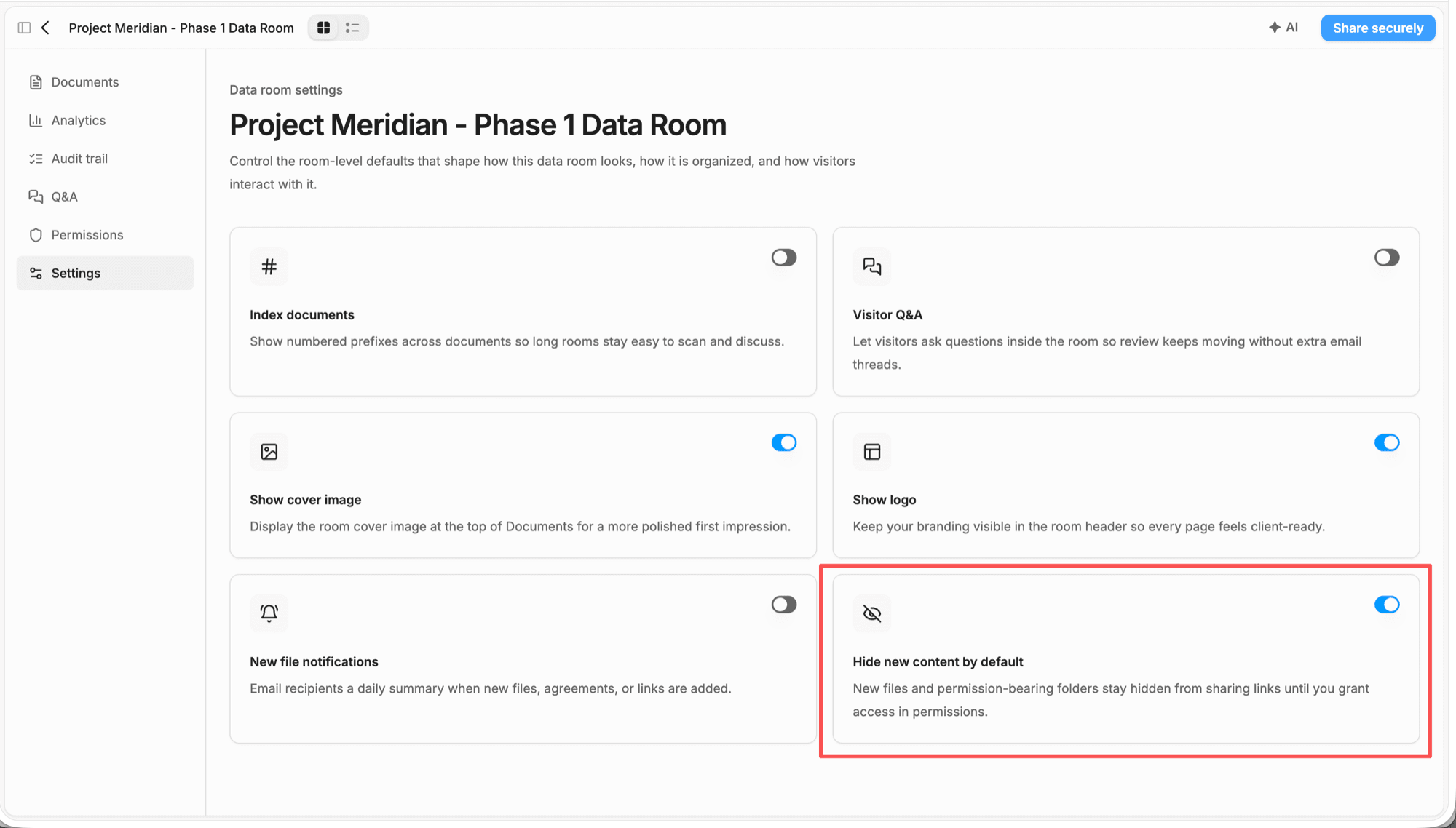
No access removes a folder from a group's view entirely, so a lender never sees the IC memo and file names can't leak. Turn on Hide new content by default and every new upload stays hidden until you grant it, group by group. AI document Q&A answers questions across the CIM, QoE report and contracts with page citations, so an associate can check customer concentration or a change-of-control clause without reading every page. Legacy VDRs like Ideals and Firmex force you to read everything manually; Peony's AI highlights material issues upfront so your team can make a go/no-go decision in days instead of weeks.
(Upload-level request folders and per-group folder and file permissions: Data Room ($52/admin/mo billed yearly). AI document Q&A from Business ($30/admin/mo), once you're on a paid plan.)
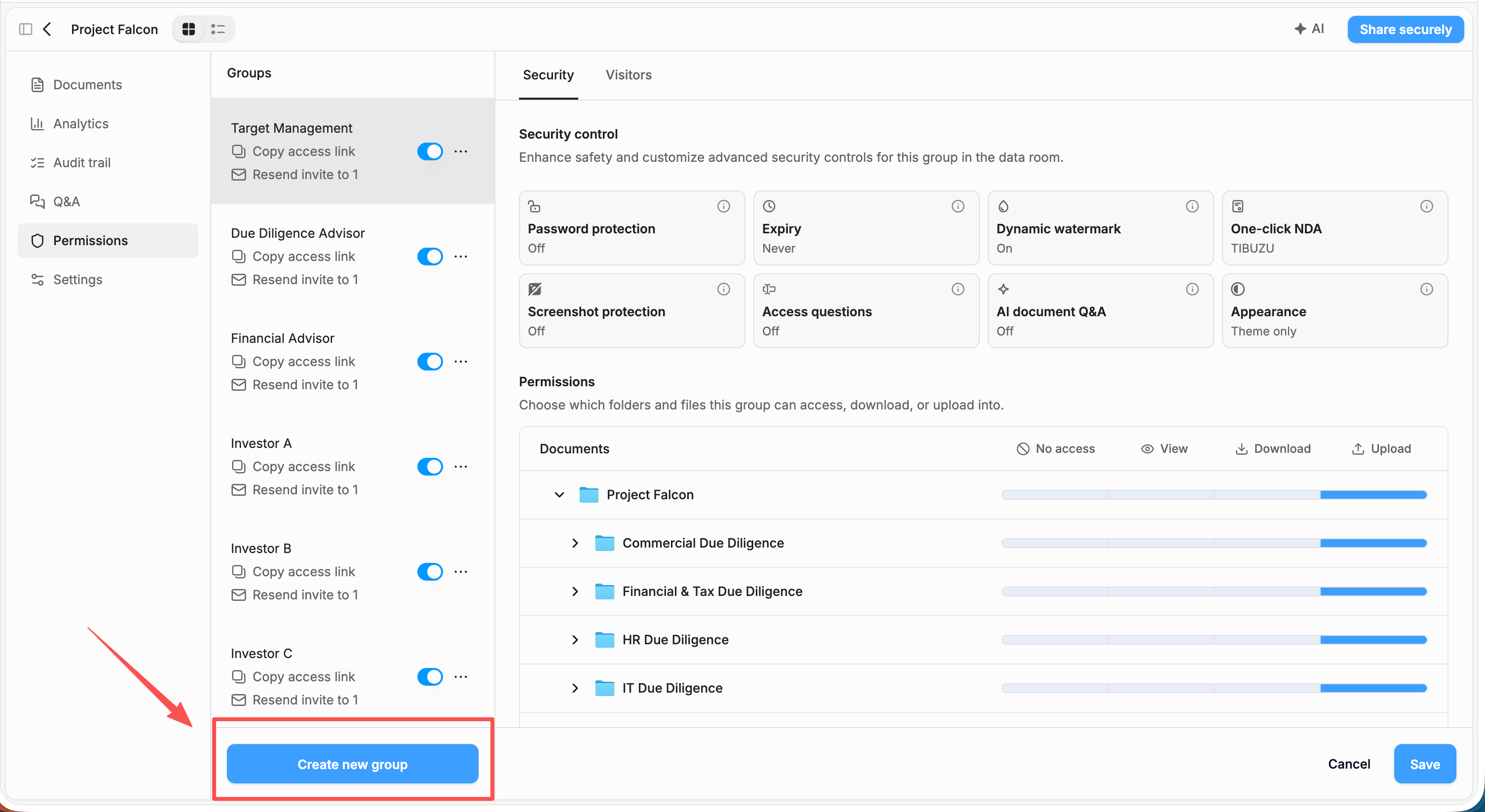
AI document Q&A with page citations
Ask the room a question in plain English and get an answer cited to the source document and page. Switch it on per group so a lender can ask too (Business and above).
Request-list folders
Give the target's team Upload access to one folder per workstream, so its documents land in your room instead of your inbox (Data Room).
Models that keep their logic private
Excel models open in the browser showing values, not formulas, so lenders and co-investors read the numbers while the model's logic stays private; downloads stay off unless you allow them.
Keep every bidder blind to the others when you sell
Peony gives each bidder its own group, link and private question team, so no bidder sees another's folders, questions or activity, and page-level analytics show which bidders are doing real work.
Open deeper folders as bidders advance (teaser and CIM first, the model after IOIs, legal and HR in confirmatory diligence) and switch a group off the moment a bidder drops out: its link stops opening. Answer a process-wide question once and publish it to every bidder without revealing who asked. If a banker is running the sale, the M&A data room page covers the advisor's side.
(Groups, question teams and staged folders: Data Room ($52/admin/mo billed yearly). Advanced Q&A routing with expert and approver sign-off, and advanced redaction: Deal Team ($64/admin/mo, minimum 4 admins).)
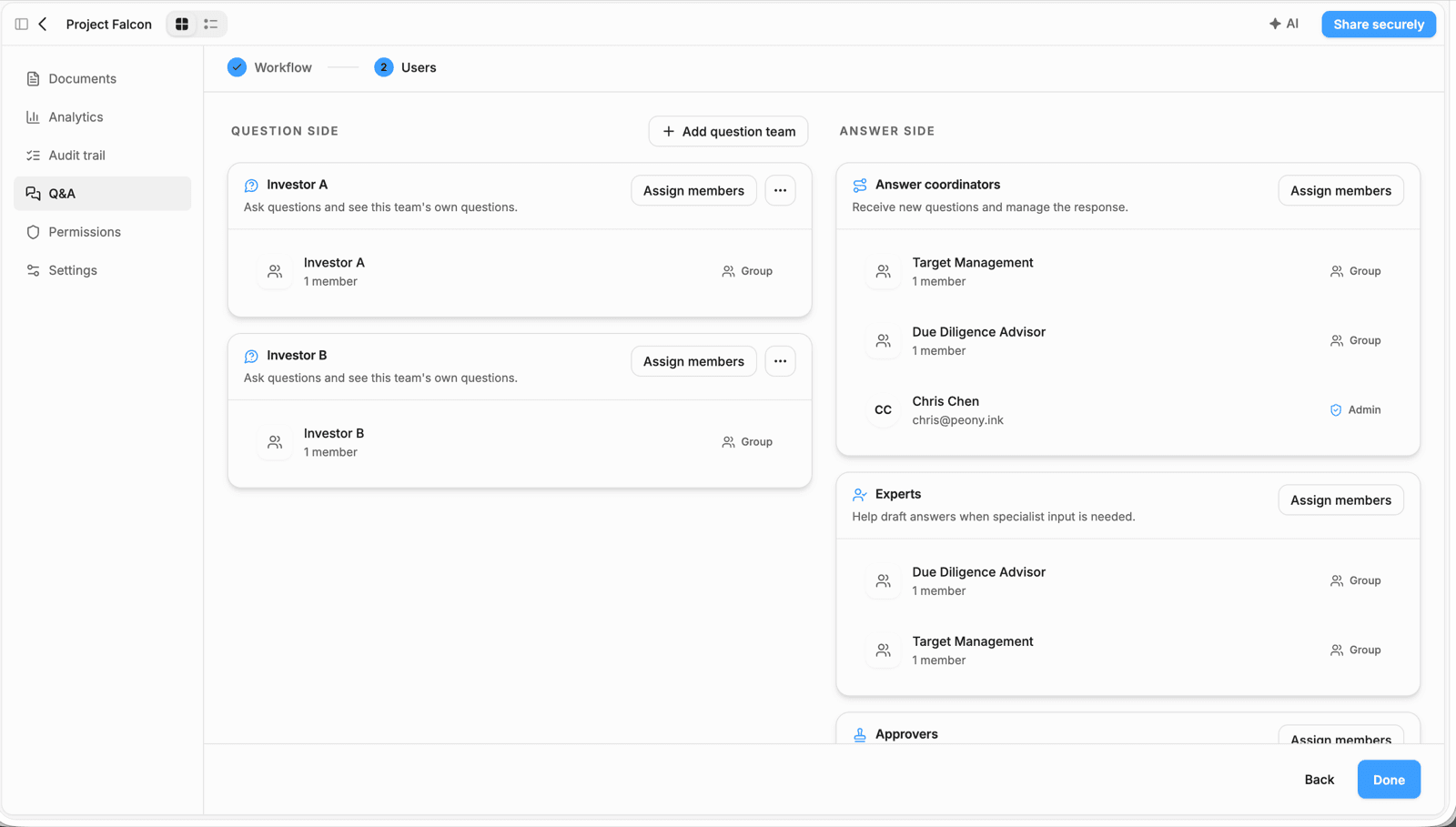
Private question teams
Each bidder asks in its own question team; your side sees every question in one Q&A workspace, filtered by team (Data Room).
A signed NDA before page one
The Advanced NDA is an e-signed agreement with a stored PDF and audit record, set per group, so strategics and sponsors can each sign a different one (Data Room). No separate DocuSign subscription, no back-and-forth PDFs.
Advanced redaction
Take customer names or pricing out of a PDF before a bidder sees it; the redacted copy has the text removed from the file, not covered (Deal Team).
See which LPs actually read the PPM
Peony gives every prospective LP its own tracked link into the fund room and shows, page by page, who read the PPM, track record and DDQ, how long they spent and who came back.
Access questions ask each LP for its type and target commitment before entry, the signed NDA sits in front of the track record, and your logo, cover image and custom domain make a first-time fund look institutional. After the close, the same room carries quarterly reports and capital-call notices, and Upload new version keeps each LP on the latest file at the same link. Datasite charges $60,000+/year for LP reporting infrastructure that Peony delivers for $360/year per admin. For an LP reporting portal, see investor relations.
(Page-level analytics on every plan; NDA gate, logo and unlimited e-signatures from Business ($30/admin/mo); access questions, custom domain and dynamic watermarks on Data Room ($52/admin/mo), billed yearly.)
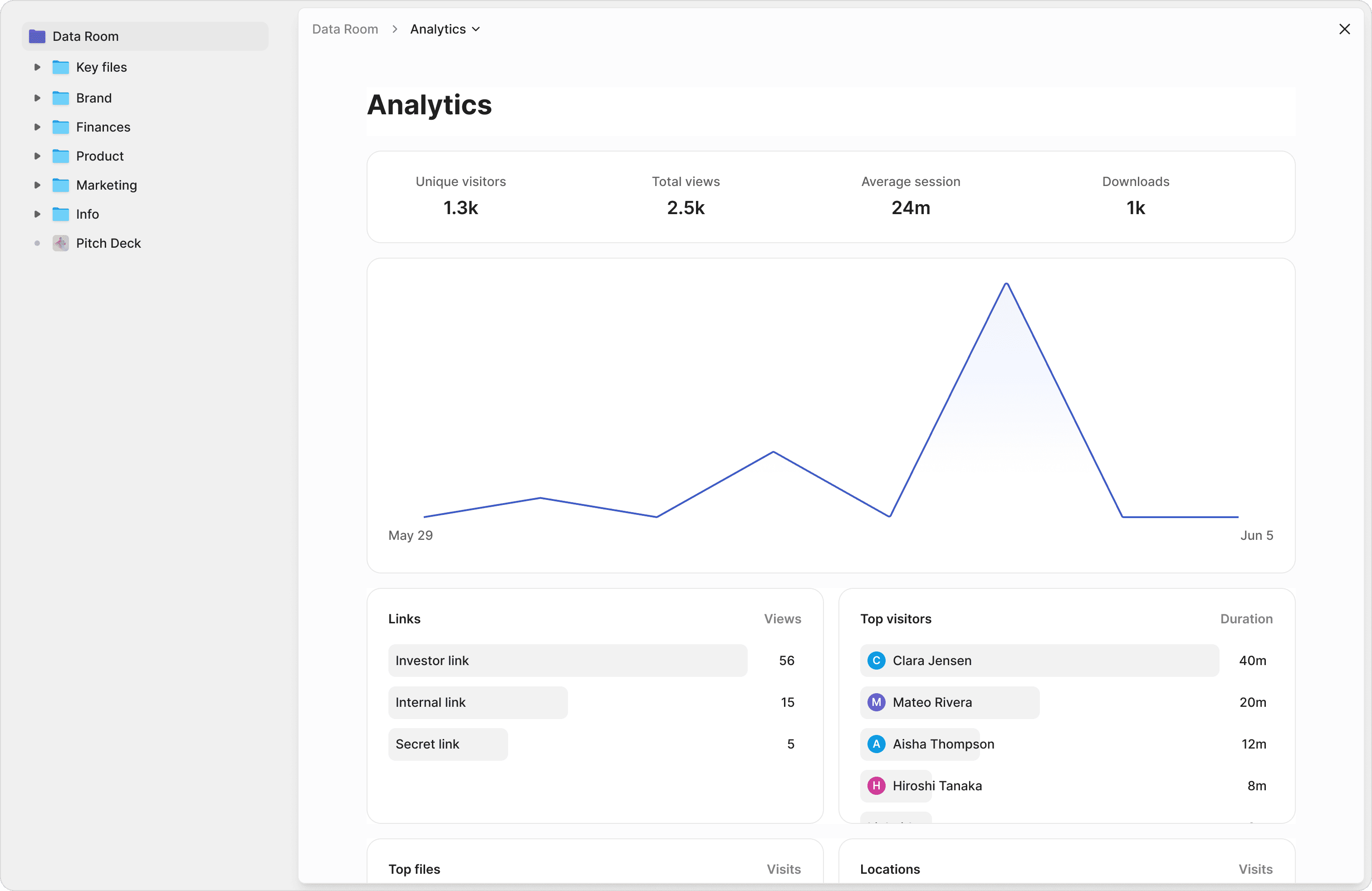
One link per LP
Each LP gets its own group and link, so analytics, NDA records and revocation stay per LP.
Pre-qualify before entry
Ask whether a visitor is a pension, endowment, family office or fund of funds, and its target commitment, before the room opens (Data Room).
Institutional presentation
Logo and cover image from Business; your own domain on Data Room, so LPs see your firm's address rather than Peony's.
How do multi-fund PE firms protect deal data between teams?
Peony keeps each fund's deals in separate rooms, restricts each fund's admin team to its own rooms, and gives every counterparty its own permissioned group, so each fund's deal team sees only its own deals. In practice that is one room per deal, a team per fund or strategy restricted to its own rooms, a group per counterparty with folder-level permissions, and Hide new content by default so a new upload stays hidden until you grant it. Dynamic watermarks and a per-person audit trail cover every room on the Data Room plan ($52 per admin per month billed yearly).
One room per deal
Rooms are unlimited on Data Room, so every platform deal, add-on and fund raise gets its own room, its own NDA and its own audit trail.
A team per fund or strategy
Invite each fund's admins to the workspace, create a team for each fund, and restrict it to that fund's rooms in team settings. Partners and the CFO sit in every team, so they keep access to all of them.
A group per counterparty
Inside a room, each lender, bidder, advisor or LP gets its own group with No access, View, Download or Upload set per folder and per file. No access removes an item from the group's view, file name included, and groups never carry across rooms.
New files stay hidden
Turn on Hide new content by default in the room's settings, and every new upload stays invisible to outside groups until you grant it.
A record of who saw what
Dynamic watermarks put each viewer's email, IP and timestamp on every page, and the audit trail lists every file each person opened and downloaded.
How does a private equity deal run in Peony, from first look to exit?
A PE deal moves from a first-look room to confirmatory diligence, financing, the hold period and the exit; in Peony each stage is a room, group or folder setting on one plan.
- First look. Create a room for the opportunity and let AI room generation draft the folder tree from a one-line description; AI document Q&A answers questions across the CIM with page citations (Data Room; AI features once you're on a paid plan).
- Confirmatory diligence. Give the target's management Upload access to the request-list folders, and put lenders, the QoE provider and counsel in their own groups; Index documents numbers every file so everyone can say "open 4.2" (Data Room).
- Financing and investment committee. Share the model and IC materials with lenders and co-investors, each behind its own NDA, with dynamic watermarks on and downloads off; Upload new version swaps in the revised model at the same link. A returns calculator built as a Claude or ChatGPT HTML artifact runs live in the room, inputs and all, behind the same NDA gate and permissions (Data Room).
- Hold period. Keep a room per portfolio company for board packs, lender reporting and add-on diligence, so the exit starts from an organized, numbered room rather than a shared drive (Data Room: unlimited rooms).
- Exit. Duplicate the portfolio company's room into a sell-side room, give each bidder its own group and question team, open folders by round and switch off drop-outs; Deal Team adds Advanced Q&A routing and advanced redaction.
The workstream-by-workstream request list is in our private equity due diligence guide, and sharing the LBO model is covered in share a financial model.
How private equity teams run their rooms in Peony
Five situations PE teams bring to Peony, each with the setup that handles it and the plan it needs.
Associate: a buy-side room live before the partner's next meeting.
Create the room, describe the deal in one line and AI room generation drafts the folder tree. Upload the CIM and the preliminary request list, give the target's CFO Upload access to the request folders, then copy each group's link. The median Peony customer goes from sign-up to first uploaded document in 4 min 19 s (State of M&A Data Rooms, Q3 2026 edition), with no sales call or onboarding project. Legacy VDRs like Ideals and Firmex require onboarding calls and multi-week implementations.
Data Room plan
Operating partner: three add-ons in one quarter.
Each add-on gets its own room on the same subscription, so three concurrent diligence processes cost the same as one. Duplicate the first room to reuse its folder tree with clean analytics, and AI document Q&A checks each target's contracts for change-of-control terms and customer concentration without reading every page. Datasite would charge $50,000+ per room for 3 concurrent acquisitions — $150,000+ total versus $624/year per admin on Peony.
Data Room plan: unlimited rooms
Investor relations: Fund III with 80 prospective LPs.
Each LP gets its own group and link into the fund room, and page-level analytics rank them by time on the PPM, track record and DDQ, so IR calls first the LPs who came back for a second session. Access questions record each visitor's LP type and target commitment before the room opens.
Data Room plan
Independent sponsor: 19 committed investors and 38 more in the pipeline.
One room, two groups: committed investors see the QoE, customer contracts and model; pipeline investors see the investment memo and summary financials. Move an investor into the full-access group when they get serious. Hide new content by default lets a follow-up file reach only the investor who asked, and adding an investor's firm domain to its group lets colleagues join under their own verified email. Datasite would charge $50,000 or more for this single room.
Data Room plan
Deal partner: two deals under exclusivity with different advisors.
Each deal gets its own room, and outside counsel and accountants are visitors only in the room they work on, so an advisor on one deal never sees that the other room exists. Dynamic watermarks put each viewer's email, IP and timestamp on every page, and the audit trail records what each person opened. Google Drive and Dropbox shared folders have no workspace-level segregation at all — one wrong share permission and your NDA is breached.
Data Room plan
"Peony is a standout for data rooms and gated file sharing — it gave us the control and visibility needed to close the deal with a great viewer experience."
Michael Hui
Managing Director, Piton Partners
Anthony Gale
Founder & CEO, PromoLens
Not often I make recommendations, but I started using Peony to share presentations etc with external people. It works so well & makes us look really organized. We looked at DocSend etc. but the cost & clunkiness just put us off.
No credit card · 7-day Data Room trial that never auto-charges · bidders, lenders and LPs view free, no account
What is the best data room for a continuation vehicle or GP-led secondary?
Peony fits continuation vehicles and GP-led secondaries: rolling LPs, selling LPs, secondary buyers, the LPAC and counsel each get their own permission group in one room, and every LP views free. ILPA guidance recommends that all existing LPs receive data room access with parity of information to new investors and the LPAC, and a minimum 30-day election window. Peony gives the GP the evidence: page-level analytics show which LPs opened the election form, fairness opinion and term sheet and for how long, and the per-visitor audit trail keeps a timestamped record of every file each person viewed or downloaded. No access hides a folder, file names included, from any group that should not see it, so the LPAC's conflict materials never reach secondary buyers. Data Room is $52 per admin per month billed yearly, with unlimited rooms and storage, and LPs, the LPAC, secondary buyers and counsel view free with no Peony account.
Peony runs a continuation vehicle from one room: the LPAC, secondary buyers, rolling and selling LPs and counsel each get their own group, folder permissions and NDA, and every view is logged per person. LP elections, secondary buyer diligence, and ILPA-compliant disclosure run side by side — the operational complexity that legacy VDRs were never designed for. That workload is growing: GP-led secondary volume reached $115 billion in 2025, up 53% year over year, with continuation vehicles making up the majority of GP-led deals, and by 2025 nearly 80% of the top 100 sponsors by AUM had completed a CV (Jefferies, 2025 Global Secondary Market Review, February 10, 2026).
In a GP-led secondary the GP sits on both sides of the transaction, so what each party was shown, and when, matters. ILPA says its continuation-fund guidance (2023, with new draft CV materials whose public comment period closed on August 5, 2026) "addresses the concerns LPs cite most often, from unrealistic decision timelines and incomplete disclosures to the absence of a true status quo option" (ILPA, checked October 2026). Peony keeps the record of what each group received; the folder template and stakeholder access matrix are in how to structure a continuation vehicle data room.
LP election materials
LPs choose to roll, cash out, or elect status quo terms — and ILPA recommends a minimum 30-day election window. Share the election form, fairness opinion and CV term sheet through a link per LP; page-level analytics show which LPs have opened them and who needs a follow-up before the deadline.
ILPA parity of information
ILPA guidance recommends all existing LPs receive data room access with parity of information to new investors and the LPAC. Peony enforces this with permission groups that ensure every LP sees the same disclosure materials — with timestamped audit trails that demonstrate equal access was provided, satisfying the standard ILPA established in its 2023 guidance and 2026 Disclosure Template.
LPAC conflict materials
The LPAC gets its own group for conflict disclosures and the acquisition agreement, with a signed NDA and dynamic watermarks, separate from secondary buyers and LPs.
Multi-tier stakeholder access
Rolling LPs, selling LPs, secondary buyers, the LPAC and counsel each get their own group and folder permissions in one room, and No access hides what a group shouldn't see, file names included. One room, zero information leaks between parties.
Secondary buyer diligence
Open the teaser, then the financials, legal and management materials as secondary buyers advance, and see which sections they spent time on before the next call.
Conflict-of-interest audit trails
In a CV, the GP is on both sides of the transaction — the highest-scrutiny position in PE. Every document view, Q&A exchange, and permission change in Peony is logged in an immutable, exportable audit trail. Prove to your LPAC, board, and regulators that the process was fair.
(Groups, folder permissions, the signed NDA, dynamic watermarks and the audit trail: Data Room, $52/admin/mo billed yearly. Every LP, the LPAC and secondary buyers view free.)
What security does a private equity data room need?
A PE data room needs an NDA before the first page, per-viewer watermarks, screenshot and download blocking, instant revocation and a per-person audit trail; Peony has all five on the Data Room plan.
PE deals involve the most sensitive financial and operational data in the market. Peony protects it at every layer. Peony staff can't open your documents, your documents aren't used to train AI, and Peony has had no data breach since launch. Deal Team and Enterprise provide a standard DPA with SCCs on request; the current audit status is on Compliance and certifications.
Screenshot protection
Block screen captures of CIMs, models and LP materials on desktop from Business; Screenshield extends protection to iPhone, iPad and Android on Data Room.
Dynamic watermarks
Every page carries the viewer's email, IP and timestamp, rendered server-side, so a leaked page traces back to one bidder, lender or LP (Data Room).
NDA-gated access
An acknowledge-only NDA from Business, or a signed e-signature NDA with a stored PDF and audit record on Data Room, set per group.
Instant access revocation
When a bidder drops out or a deal falls through, switch its group off and its link stops opening; every other group is untouched.
Enterprise encryption
AES-256 encryption at rest and TLS 1.3 in transit. SOC 2 Type II-ready and ISO 27001-ready, GDPR, CCPA, and HIPAA compliant infrastructure built for institutional-grade deal security.
Two-factor authentication
Add an extra layer of security for every user accessing your data rooms. Protect against unauthorized logins even if credentials are compromised.
How does Peony's pricing compare with per-deal VDRs for private equity?
Peony charges per admin with unlimited rooms on Data Room, so a fund's tenth deal costs nothing extra, while per-page and per-project VDRs quote every deal separately.
| Question | Peony Data Room | Per-page VDR | Per-project VDR |
|---|---|---|---|
| What you pay for | Admins: $52 per admin per month billed yearly ($75 monthly) | A quote per deal, driven by the pages uploaded | A quote per project or room, for a fixed term |
| What raises the bill | Adding an admin | More pages, and a deal that runs long | More projects, and terms that run past the end date |
| Ten concurrent deals | Same price as one: rooms are unlimited | Ten quotes | Ten quotes |
| Bidders, lenders and LPs | Free and unlimited, no account needed | Set by the quote | Set by the quote |
| Storage and file size | Unlimited, with no per-file size cap | Set by the quote | Set by the quote |
| Getting started | Self-serve sign-up; 7-day Data Room trial with no credit card | Sales quote | Sales quote |
Peony prices from Peony's plans and pricing docs; the pricing models and buyer-reported figures for named providers are in our virtual data room cost guide. Side-by-side pages: Peony vs Datasite, Intralinks, iDeals and Firmex.
How does Peony compare with legacy VDR providers, feature by feature?
PE firms typically pay $25,000–$50,000+ per data room with legacy VDRs. Peony delivers full feature parity plus AI that actually works at $52/admin/month — a 99% cost reduction versus Datasite, with no per-page, per-deal, or storage-based fees.
| Feature | Peony | Datasite | Intralinks | Ideals | Sterling | Firmex | Digify |
|---|---|---|---|---|---|---|---|
| Starting price | $30/admin/mo | $50,000+/deal | $50,000+/deal | $25,000+/project | $10,000+/deal | $5,000+/project | $500/mo |
| Per-page fees | None | Yes | Yes | None | — | None | None |
| Storage-based fees | None | — | Per-MB | Per-GB | — | — | None |
| Setup time | Under 5 minutes | Days | Days | 30+ minutes | Hours | 20+ minutes | 15+ minutes |
| AI document chat | Included (Business) | Add-on | Included | Not included | Not included | Not included | Not included |
| Structured Q&A workflows | Included (Data Room) | Basic | Basic | Not included | Not included | Not included | Not included |
| Unlimited storage | Unlimited | Limited | Per-MB fees | Per-GB fees | Limited | Limited | Limited |
| Unlimited users | Included | Per-user fees | Per-user fees | Add-on | — | Included | Per-user fees |
| Built-in e-signatures | Included | Not included | Not included | Not included | Not included | Not included | Not included |
| Screenshot protection | Included (Screenshield) | Add-on | Not included | Add-on | — | Not included | Included |
| AI file organization | Included | Add-on | Not included | Not included | Not included | Not included | Not included |
| Automatic NDA | Included | Not included | Not included | Add-on | Not included | Not included | Not included |
| Dynamic watermarks | Included | Add-on | Not included | Included | Not included | Included | Included |
| Custom domain & branding | Included | Add-on | Add-on | Add-on | Not included | Add-on | Add-on |
| Ease of use (public rating) | 9.4/10 | 7.5/10 | 7.2/10 | 8.7/10 | 7.4/10 | 8.5/10 | 6.9/10 |
| Average user satisfaction | 9.7/10 | 7.5/10 | 7.2/10 | 8.9/10 | 7.3/10 | 8.8/10 | 7.5/10 |
At $52/admin/month on the Data Room plan, Peony includes unlimited data rooms — so 8-12 concurrent data rooms cost the same as one. A 5-person deal team pays $3,120/year total on Peony. Datasite charges $50,000+ per data room, so 10 deals would run $500,000+/year. Firmex charges $5,000-$20,000 per project with no AI capabilities. Ideals uses enterprise pricing that scales with deal volume. Peony delivers the same security stack — dynamic watermarks, Screenshield screenshot protection, NDA gating, audit trails — plus AI document Q&A and auto-indexing that Firmex and Datasite do not offer. That is a 99% cost reduction versus Datasite with no feature trade-offs.
What does a private equity data room cost on Peony?
On Peony, private equity rooms run on Data Room at $52 per admin per month billed yearly ($75 monthly), with unlimited rooms, documents and storage, and bidders, lenders and LPs view free.
You pay per admin, not per viewer and not per data room: a four-person deal team on Data Room pays $2,496 a year whether it runs one process or ten, versus $60,000+ on Datasite, a 99% cost reduction. Deal Team ($64 per admin per month, minimum 4 admins, $3,072 a year for four) adds advanced redaction, Advanced Q&A routing, OAuth SSO and API access. Deals also run long: blended time-to-close across 733 M&A transactions in State of M&A Data Rooms (Q3 2026 edition) was about 7.9 months, and on flat per-admin pricing a slipped close costs a known number.
Business
100 GB storage, no per-file size limit
$30 /admin/mo billed yearly
$44 billed monthly
3 data rooms per admin, an NDA gate, viewer email verification, download prevention, desktop screenshot protection, drop-off reports and AI document Q&A.
Data Room
Peony's most popular plan
$52 /admin/mo billed yearly
$75 billed monthly
Unlimited rooms, documents and storage, a signed NDA with audit record, dynamic watermarks, granular folder and file permissions, Visitor Q&A, a custom domain, AI room generation and Index documents.
Deal Team
Minimum 4 admins
$64 /admin/mo billed yearly
$89 billed monthly
Everything in Data Room plus advanced redaction, Advanced Q&A routing, custom invite emails, new-file notifications, API access, OAuth SSO, room archive download, a standard DPA and priority support (minimum 4 admins).
Prices are per admin per month billed yearly; monthly billing costs more. Free ($0) covers 50 documents and 500 MB as tracked single-file links; data rooms start on Business. Compare every feature on the pricing page.
Frequently asked questions
What is Peony, and is it a good fit for private equity firms and independent sponsors?
Yes. Peony is a virtual data room that private equity firms and independent sponsors use to run deal and fundraising rooms, give each counterparty its own permissions and see which pages each reads. Data Room, the most popular plan, is $52 per admin per month billed yearly ($75 monthly), with unlimited rooms and storage; inviting counterparties is free and unlimited.
What is a private equity data room?
A private equity data room is the permissioned online workspace a fund uses to share confidential deal and fund documents with targets, lenders, bidders and LPs under NDA, with every view recorded. A fund runs several kinds: a buy-side room for confirmatory diligence, a sell-side room when it exits a portfolio company, a room per add-on, and a fund room for the PPM, track record and DDQ during a raise. On Peony all of them run from one account: the Data Room plan is $52 per admin per month billed yearly, with unlimited rooms, a signed NDA gate, dynamic watermarks and folder-level permissions per group, and bidders, lenders and LPs view free. For a ranked comparison of providers, see best data rooms for private equity.
What data room platforms work for PE portfolio companies?
Peony works for PE portfolio companies: the fund runs one workspace with a room per portfolio company for board packs, lender reporting and add-on diligence, and unlimited rooms on Data Room keep the cost flat. A portfolio company's CFO can be an admin placed in a team restricted to that company's rooms, or can upload into a request folder as a free visitor. Upload new version keeps each monthly pack at the same link, with earlier versions in the version menu, and Index documents numbers every file. When the company is sold, duplicate its room into a sell-side room: files and folders copy over, while groups, links and analytics start clean. Data Room is $52 per admin per month billed yearly; board members, lenders and co-investors view free.
How do PE firms use data rooms to manage deal pipeline transparency?
PE firms run one Peony room per deal, add-on or fund with a link per counterparty, so partners see every live process and which counterparties are reading in one workspace. Page-level analytics show who opened which document, for how long and whether they came back; the audit trail records each person's activity (Data Room plan); and NDA and e-signature records sit in the same workspace. Peony runs the document side of deal management, and on Deal Team ($64 per admin per month billed yearly, minimum 4 admins), API access, enabled on request, pushes room analytics and signed agreements into the CRM your team already uses.
What is the best data room software for independent sponsors and boutique advisors?
For independent sponsors, pick a per-admin data room with unlimited rooms and free viewers; Peony Data Room is $52 per admin per month billed yearly, so a two-person team pays $1,248 a year. A fundless sponsor needs a room for co-investor outreach now and a target diligence room later, often for several deals at once, so per-deal pricing works against the model; boutique advisors running several client mandates face the same math. Datasite charges $50,000 or more per deal, which is economically impossible when you have no management fee income yet. On Peony every room gets its own NDA, groups and audit trail; your logo, cover image and custom domain make a two-person team look institutional to family offices; and page-level analytics show which of 15 capital partners actually read the QoE report. Ranked options are in best data rooms for independent sponsors.
How can a data room support simultaneous multi-fund fundraising?
Run one Peony room per fund or vehicle and give each LP its own link into the rooms it is cleared for, so a Fund III prospect never sees co-invest or Fund II materials. Rooms are unlimited on the Data Room plan ($52 per admin per month billed yearly), and LPs view free with no account. Each room carries its own NDA, access questions (LP type, target commitment) and folder permissions, and page-level analytics show, per LP, who read the PPM, track record and DDQ and who came back. An IR team placed in every fund's workspace team can work all the fund rooms while deal teams stay in their own deal rooms.
What is the best virtual data room for a GP raising a private equity fund?
Peony Data Room fits a GP raising a fund: $52 per admin per month billed yearly, unlimited rooms, a tracked link and signed NDA per LP, and LPs view free with no account. A raise means a few admins and dozens or hundreds of LP readers, so paying per admin ties the cost to your IR team, not your LP list. Datasite charges $60,000+/year for the same workflow. Page-level analytics show which LPs read the PPM, track record and DDQ and who came back; access questions record each LP's type and target commitment before entry; dynamic watermarks and your own custom domain are on the same plan. Deal Team ($64 per admin per month billed yearly, minimum 4 admins) adds custom invite emails, OAuth SSO, API access and Advanced Q&A routing with expert and approver sign-off on LP answers. Everyone you speak to on Peony support has M&A experience at elite boutiques or bulge-bracket banks, VC experience, or has raised $1M+ themselves.
Should a PE sale process use one data room or a separate room per bidder?
Use one Peony room per sale process and one group per bidder: each bidder gets its own link, folder permissions and private question team, so you upload once and nobody sees another bidder. Separate rooms per bidder mean uploading every file several times and reconciling several Q&A logs. Give each portfolio-company exit its own room, though, so its bidders, advisors and audit trail stand alone. Groups, question teams and staged folder access are on the Data Room plan ($52 per admin per month billed yearly), with unlimited rooms, so a fund with three exits in market pays for its admins, not its rooms. Firmex charges $5,000-$20,000 per project with no AI; Peony gives you the full sell-side workflow at a fraction of the cost.
How should a GP budget for a data room in a continuation fund transaction?
On Peony, budget per admin rather than per deal: two admins on Data Room cost $1,248 a year billed yearly, or $150 a month on monthly billing, however many LPs and secondary buyers you invite. Price the stakeholder count, not just the asset: every existing LP, the LPAC, secondary buyers and counsel are free viewers on Peony. Timelines also matter: on flat per-admin pricing a slipped close costs a known number rather than an extension quote, and for comparison, blended time-to-close across 733 M&A transactions in Peony's State of M&A Data Rooms (Q3 2026 edition) was about 7.9 months. The room setup is in how to structure a continuation vehicle data room.
How can GPs share fund documents with LPs securely and keep an audit-ready record?
Give each LP its own Peony link with email verification, an NDA and folder permissions; Peony then records each LP's views, downloads and NDA acceptance with timestamps in a per-person audit trail. Dynamic watermarks put the viewer's email, IP and timestamp on every page, an allow list keeps a forwarded link from opening for anyone you didn't list, and advanced redaction (Deal Team) removes side-letter terms or another LP's details from a PDF before it is shared. Session and analytics logs export as CSV on paid plans; the full audit trail sits on Data Room ($52 per admin per month billed yearly), and a copy is available on request after a close. Peony is the controlled sharing layer for the documents that leave your fund administrator's systems, so your compliance program and records archive stay the record.
How fast can a PE deal team get a buy-side diligence room live?
Usually within minutes: the median Peony customer goes from sign-up to first uploaded document in 4 min 19 s (State of M&A Data Rooms, Q3 2026 edition), with no sales call. Five steps: 1. Create the room and, on the Data Room plan, describe the deal in one line so AI room generation drafts the folder tree. 2. Upload the CIM and the preliminary request list; Index documents numbers every file so everyone can say "open 4.2". 3. Give the target's management Upload access to the request folders. 4. Create a group each for lenders, the QoE provider and counsel, with its own NDA, watermark and folder permissions. 5. Copy each group's link and send it. AI features, such as AI document Q&A and AI room generation, switch on once you're on a paid plan.
Can Peony staff see our deal documents?
No. Peony staff can't open, move or edit the documents in your room. Your documents aren't used to train AI: Peony's LLM providers work under data-handling agreements that prohibit training on customer content. Viewers read documents in the browser; files never leave Peony unless you allow downloads on a link. Peony has had no data breach since launch.
What support does Peony give PE deal teams during a live process?
Peony support runs 24/7 through in-app chat, handled directly by the Peony team across Europe, US and Asia hours, with no outsourced tier. Everyone you speak to on Peony support has M&A experience at elite boutiques or bulge-bracket banks, VC experience, or has raised $1M+ themselves. Email is answered within 24 hours on Data Room and within 12 hours on Deal Team, and an urgent deal blocker, such as a bidder locked out the night before an IOI deadline, is typically answered within a few hours. Deal Team adds priority support and a dedicated account manager.
What does Peony provide for a PE firm's vendor security and IT review?
Peony provides AES-256 encryption at rest and TLS 1.3 in transit, and is SOC 2 Type II-ready and ISO 27001-ready, with both audits underway. Deal Team and Enterprise provide a standard DPA with SCCs on request. Deal Team adds OAuth SSO (Google and Microsoft), API access and room archive download; Enterprise adds SAML SSO, BYOK, self-hosted or white-label deployment and EU-region hosting. Peony's incident-response policy commits to telling affected customers within 72 hours of confirming an incident that affects customer data. Peony has had no data breach since launch. Admins sign in with an emailed one-time code or Google, with no password fallback. The current status is on Compliance and certifications.
Can I try Peony before I pay?
Yes. Peony's Data Room plan has a 7-day free trial you start yourself, with no credit card, and it never converts to paid on its own. Rooms, files, links, analytics and NDA settings carry over when you upgrade. AI features, such as AI document Q&A and AI room generation, switch on once you're on a paid plan.
Related guides for private equity teams
- The diligence request list, workstream by workstream, is in private equity due diligence.
- Ranked providers: best data rooms for private equity and best data rooms for independent sponsors.
- Running a buy-and-build? See the roll-up data room guide.
- GP-led secondary? See how to structure a continuation vehicle data room.
- First-party deal benchmarks from 733 transactions: State of M&A Data Rooms.
- Advisor-run sell-side: M&A data rooms. Venture funds: venture capital data rooms. LP reporting portal: investor relations. Plans and the trial: pricing.
Where do these figures come from?
- ILPA, Continuation Funds guidance page: the 2023 guidance (Continuation Funds: Considerations for Limited Partners and General Partners) and the new draft CV materials, whose public comment period closed on August 5, 2026
- Jefferies Private Capital Advisory, 2025 Global Secondary Market Review: Another Record-Breaking Year (February 10, 2026): GP-led secondary volume of $115 billion in 2025, up 53% year over year and 48% of a $240 billion secondary market; continuation vehicles the majority of GP-led transactions; nearly 80% of the top 100 sponsors by AUM have completed a CV
- Peony, State of M&A Data Rooms (Q3 2026 edition, 733 M&A transactions from $1M to $500M, Q3 2025 to Q3 2026): median 4 min 19 s from sign-up to first uploaded document, blended time-to-close about 7.9 months
- Peony docs, Plans and Pricing
- Peony docs, Compliance and Certifications
Sources checked October 16, 2026.
Run the next deal, exit and raise from one workspace
Join PE firms and independent sponsors already using Peony for buy-side diligence, LP fundraising, continuation vehicles, portfolio monitoring, fundless deal execution, and exit preparation — enterprise-grade security at $52/admin/month.
The median time from sign-up to first uploaded document on Peony is 4 min 19 s (State of M&A Data Rooms, Q3 2026 edition).
- Bidders, lenders and LPs never need a seat or an account.
- Unlimited rooms on Data Room: ten deals cost the same as one.
- Live in minutes; the 7-day trial never auto-charges.
No credit card · 7-day Data Room trial that never auto-charges · bidders, lenders and LPs view free, no account
24/7 dedicated support for enterprise deals
Last updated: October 2026