
The media data room for screeners, catalog sales and content licensing
Stream screeners and pre-release cuts with each buyer's identity watermarked over the picture, give every distributor and licensee its own walled-off set of titles, avails and contracts, and see who actually opened what: one secure room per screening, licensing round or catalog sale, with unlimited storage on Data Room.
No credit card · 7-day Data Room trial that never auto-charges · buyers, distributors and partners view free, no account · 24/7 support
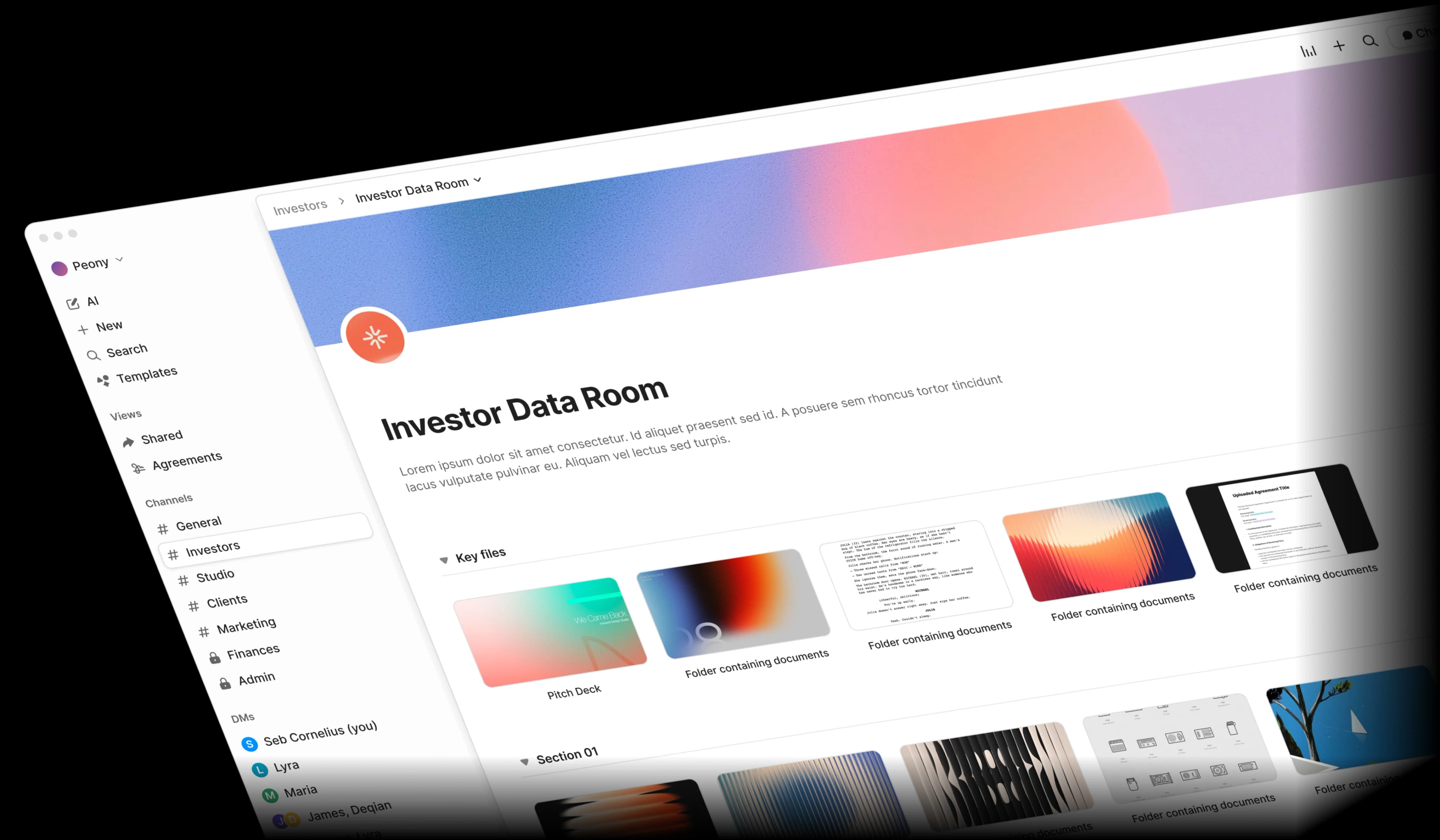
8,000+ customers in 60+ countries · $44.7B in client assets
Peony staff can't open your documents, your documents aren't used to train AI, and Peony has had no data breach since launch.
What is Peony's media data room, and who is it for?
Peony is a virtual data room that studios, distributors, rights holders and media M&A teams use to stream screeners, share catalogs and licensing contracts under NDA, and see which buyers open each title. Rooms start at $30 per admin per month on Business (3 rooms per admin, with video uploads); Data Room, the most popular plan, is $52 with unlimited rooms, storage and file sizes, billed yearly, and buyers, distributors and partners never pay.
A media data room is a permissioned online workspace where a studio, distributor or rights holder shares screeners, rights and licensing files on a title or a catalog with buyers, licensees and their advisers under NDA, with every view tracked. How to structure one for a library sale, title by title, is in our film or TV catalog data room guide; streaming footage to buyers is covered in our secure video data room guide.
- Stream the slate or the catalog: screeners, trailers, rough cuts and audio play in the browser with the player's download control removed, with unlimited storage on Data Room and no per-file size cap on any plan.
- Wall off every buyer and licensee: a signed NDA before the first page, a group per distributor, platform or bidder, and folder access by title, territory or window.
- See who is working which titles: which buyers opened each screener, script and avails sheet, how long they spent, and when they came back.
Peony at a glance
- Built for
- Studios and production companies, distributors and sales agents, film, TV and music catalog owners, talent agencies, and media M&A and fundraising teams on the buy and sell side.
- Typical plan
- Data Room, $52 per admin per month billed yearly ($75 monthly): unlimited rooms, documents and storage with no per-file size cap, video and audio uploads, a signed NDA with audit record, dynamic watermarks over pages and playing video, granular folder and file permissions per buyer group, Screenshield mobile screenshot protection, Visitor Q&A and Index documents.
- Pricing
- Business $30, Data Room $52 and Deal Team $64 (minimum 4 admins) per admin per month billed yearly ($44, $75 and $89 monthly); Enterprise is custom. Free ($0) covers 50 documents and 500 MB as tracked single-file links; data rooms start on Business.
- Buyers, distributors and partners
- Buyers, distributors and partners are unlimited and free on every plan and don't need a Peony account. You pay per admin, not per viewer.
- Rooms and storage
- Unlimited data rooms, documents and storage on Data Room and above, and no per-file size cap on any plan. Business includes 3 data rooms per admin, 1,000 documents per admin and 100 GB of storage, with no per-file size cap.
- Media files
- Video (MP4, MOV, WebM, OGV) and audio (MP3, WAV, FLAC, AIFF and more) upload on Business and above and play in Peony's own player in the browser; scripts and contracts (PDF, Word), avails and revenue workbooks (Excel, CSV), decks (PowerPoint) and key art (JPG, PNG, TIFF, PSD) open with no download. MP4 with H.264 video and AAC audio plays in every modern browser, desktop and mobile.
- Video protection
- The player's own download control and right-click menu are removed, and on Data Room the viewer's dynamic watermark is drawn over the video while it plays. Downloads stay off unless you give a group Download permission.
- File management
- Upload new version keeps a file's place and link and keeps every earlier version; AI room generation drafts the folder structure, and Index documents numbers every file (Data Room plan). Export index downloads the numbered document index, and drag-and-drop folder upload keeps a title-by-title tree's structure.
- Live models
- Peony renders .html files live with JavaScript running, so a Claude or ChatGPT artifact (a model, dashboard or calculator) stays interactive for the viewer, behind your NDA gate, permissions and analytics.
- Enterprise and IT review
- Deal Team (minimum 4 admins) adds OAuth SSO, API access, priority support, a dedicated account manager, security documentation and a standard DPA with SCCs on request. Enterprise (custom) adds SAML SSO, BYOK, self-hosted or white-label deployment and custom data residency, including EU-region hosting. See the security overview.
- Security
- AES-256 at rest, TLS 1.2+ in transit. Peony staff can't open your documents, your documents aren't used to train AI, and Peony has had no data breach since launch. Peony's incident-response policy commits to telling affected customers within 72 hours of confirming an incident that affects customer data. SOC 2 Type II-ready and ISO 27001-ready, with both audits underway. Compliance and certifications
- Setup
- Median 4 min 19 s from sign-up to first uploaded document (State of M&A Data Rooms, Q3 2026 edition).
- Trial
- 7-day Data Room trial you start yourself: no credit card, and it never auto-charges. Rooms, files, links, analytics and NDA settings carry over when you upgrade. AI features switch on after you upgrade.
- Support
- 24/7 support, handled directly by the Peony team across Europe, US and Asia hours, with no outsourced tier. Everyone you speak to on Peony support has M&A experience at elite boutiques or bulge-bracket banks, VC experience, or has raised $1M+ themselves.
- Customers
- 8,000+ customers in 60+ countries, with $44.7B in client assets.
Which media and entertainment teams use a data room, and for which deals?
Peony's media data room serves six kinds of teams: studios and production companies, distributors and sales agents, film and TV catalog owners, music rights holders, talent agencies, and media M&A and fundraising teams.
Peony is the data room purpose-built for studios, production companies, and talent agencies: protect shooting scripts, manage content licensing, and run media M&A with enterprise-grade security, set up in under 5 minutes.
Studios and production companies
Shooting scripts, storyboards, rough cuts, budgets and co-production packages for financiers, co-producers and talent representatives, each partner in its own group under NDA.
Distributors and sales agents
Screeners, trailers, sales sheets, key art and territory avails for each buyer at a market, one tracked link per buyer, with access that expires when the window closes. See the secure video data room guide.
Film and TV catalog owners
Library sales and recapitalizations: title manifest, chain-of-title, encumbrance schedules, residual and participation statements, music clearances and screeners, released title by title. See the film or TV catalog sale guide.
Music publishers and labels
Catalog sales and sync licensing: royalty statements, sync and master-use licenses, splits and audio that plays in the browser (audio uploads on Business and above).
Talent agencies and management
Talent contracts, deal memos and compensation schedules shared only with the parties to that deal, with compensation figures redacted on Deal Team.
Media M&A and fundraising
Sell-side and buy-side deals and raises for media, information and events companies: CIM, audience and subscriber data, advertising contracts and content rights. See media M&A advisors and media investors.
What do media teams use Peony's data room for?
Peony handles the three jobs on almost every media deal: streaming screeners and holding the whole catalog in one room, keeping pre-release content from leaking, and giving every licensing partner its own track.
Media deal-making is leaking from every side. Between unreleased scripts, terabytes of 4K footage and screeners, talent compensation data, and content library valuations, entertainment teams share high-stakes files across insecure channels every day. One leaked master or screener can derail a project or tank a deal.
Stream screeners and keep the whole catalog in one room
Peony streams screeners, trailers and rough cuts in the browser with the player's download control removed, and Data Room's unlimited storage holds the whole catalog with no per-file size cap.
Drag a title-by-title folder tree in and Peony keeps its structure; AI room generation drafts the folders from a one-line description of the deal, and Index documents numbers every title folder (1.1, 1.2…) so a buyer can ask about “4.2” on a call. Upload new version swaps in a recut screener or an amended license at the same link and keeps every earlier version. Peony charges no per-page, per-GB or per-buyer fees.
(Video and audio uploads from Business (100 GB, no per-file size limit); unlimited storage with no file-size cap, AI room generation and Index documents on Data Room ($52/admin/mo billed yearly).)
What it replaces: Content library M&A overload. Valuing a content library for acquisition means organizing thousands of titles with residual schedules, rights windows, and revenue histories — plus streaming 4K masters and screeners to bidders without downloads. Scattered files slow due diligence to a crawl. See our guide to a secure video data room.
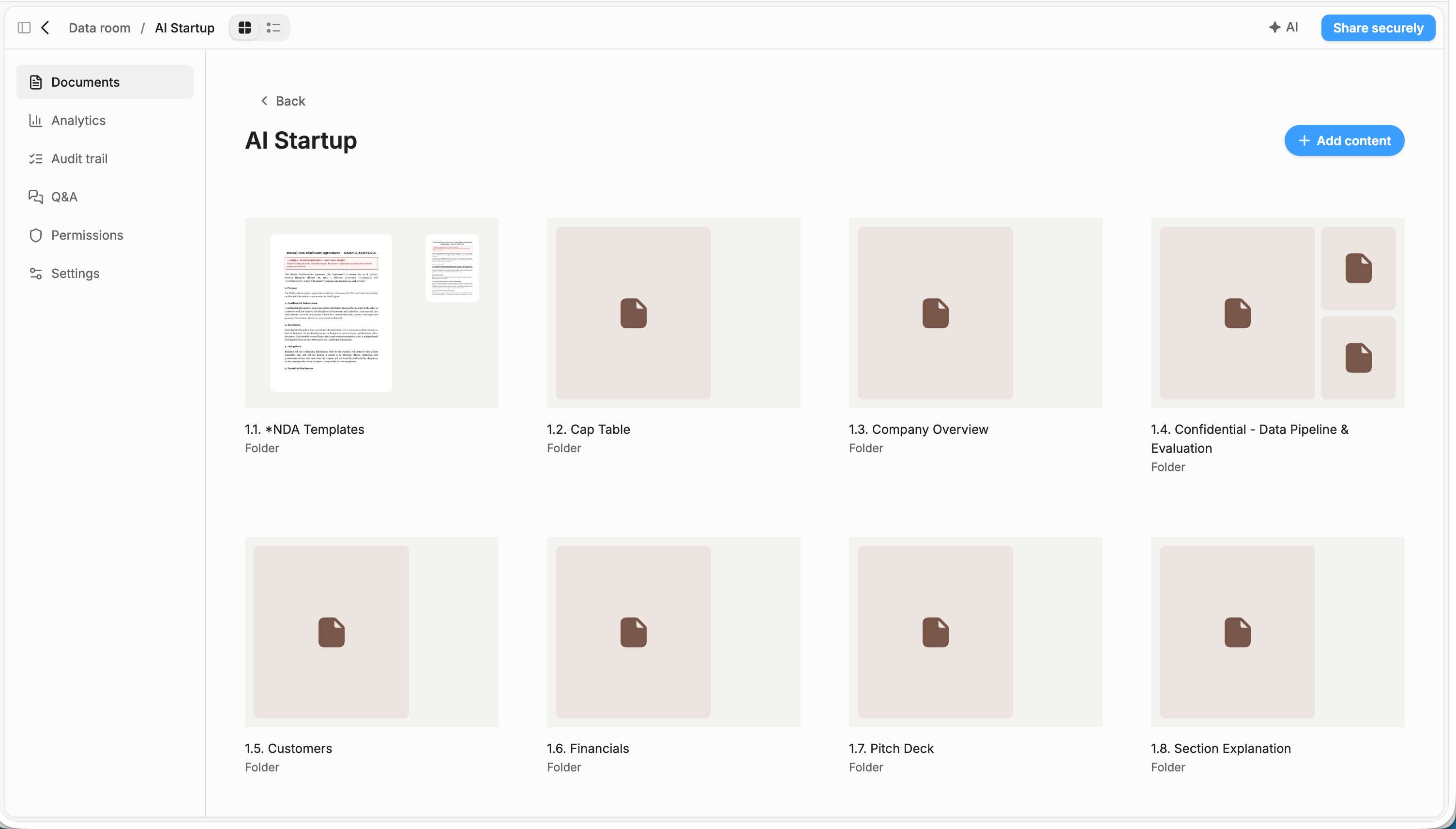
License content without it leaking first
Peony puts an NDA in front of the first page, blocks screenshots, and stamps every page and every playing video with the viewer's identity, so a leaked script or screener traces back to one person.
Your shooting scripts and unreleased content deserve more than a password. Peony blocks screenshots, stamps every page with dynamic watermarks identifying the viewer, and requires NDA signatures before anyone sees a single frame. Screenshield extends screenshot protection to iPhone, iPad and Android, and a PDF a viewer is allowed to download keeps its watermark.
(NDA gate, download blocking and desktop screenshot protection from Business ($30/admin/mo); the signed NDA with audit record, dynamic watermarks over pages and video, and Screenshield on Data Room ($52/admin/mo billed yearly).)
What it replaces: Pre-release content leaks. Shooting scripts, rough cuts, and unannounced project details shared over email or generic drives get leaked constantly. A single leak can tank an entire production.
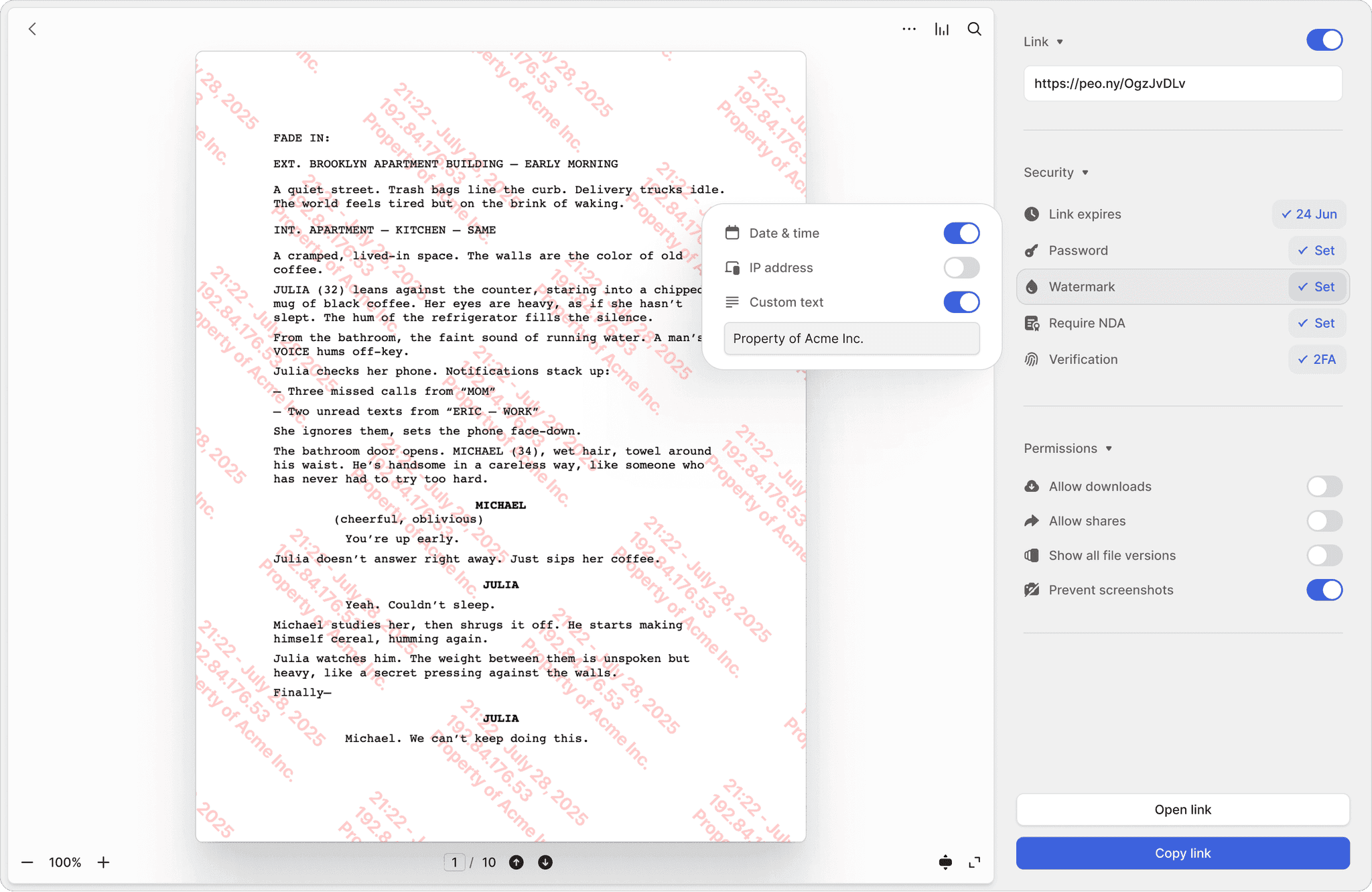
Screenshot protection, watermarks, and NDA gates for every viewer
Screenshot protection
Block screen captures of shooting scripts, call sheets, and unreleased storyboards. Prevent unauthorized copies of content that could spoil a release or compromise a deal.
Dynamic watermarks
Every page stamped with the viewer's identity and timestamp. If a script or pre-release document leaks, you know exactly who shared it and when. On video, the watermark plays over the picture.
NDA-gated access
Require distributors, talent representatives, and production partners to sign an NDA before viewing any materials. Fully integrated e-signatures included.
Give every licensing partner its own track, and see what each one reads
Peony gives each distributor, broadcaster or streaming platform its own group with folder and file permissions, and shows page by page which titles and terms each one opened.
Give each distributor, broadcaster, or streaming platform access to only the content packages relevant to their deal. Page-level analytics show which titles and terms each buyer focused on, and access auto-expires when negotiation windows close. On Data Room, Top files viewed ranks the screeners and title folders drawing the most attention across every buyer. The same per-licensee setup works for brand and consumer-products licensees (style guides and key art) and for software or pipeline tools a studio licenses in or out (technical documentation and demo videos).
(Page-level analytics and link expiry on every plan; CSV export and drop-off reports from Business; granular permissions, the room dashboard and the full audit trail on Data Room ($52/admin/mo billed yearly).)
What it replaces: Multi-party licensing chaos. Distribution agreements, music licensing deals, and territorial rights involve dozens of parties each needing access to different content packages. Managing this manually invites mistakes.
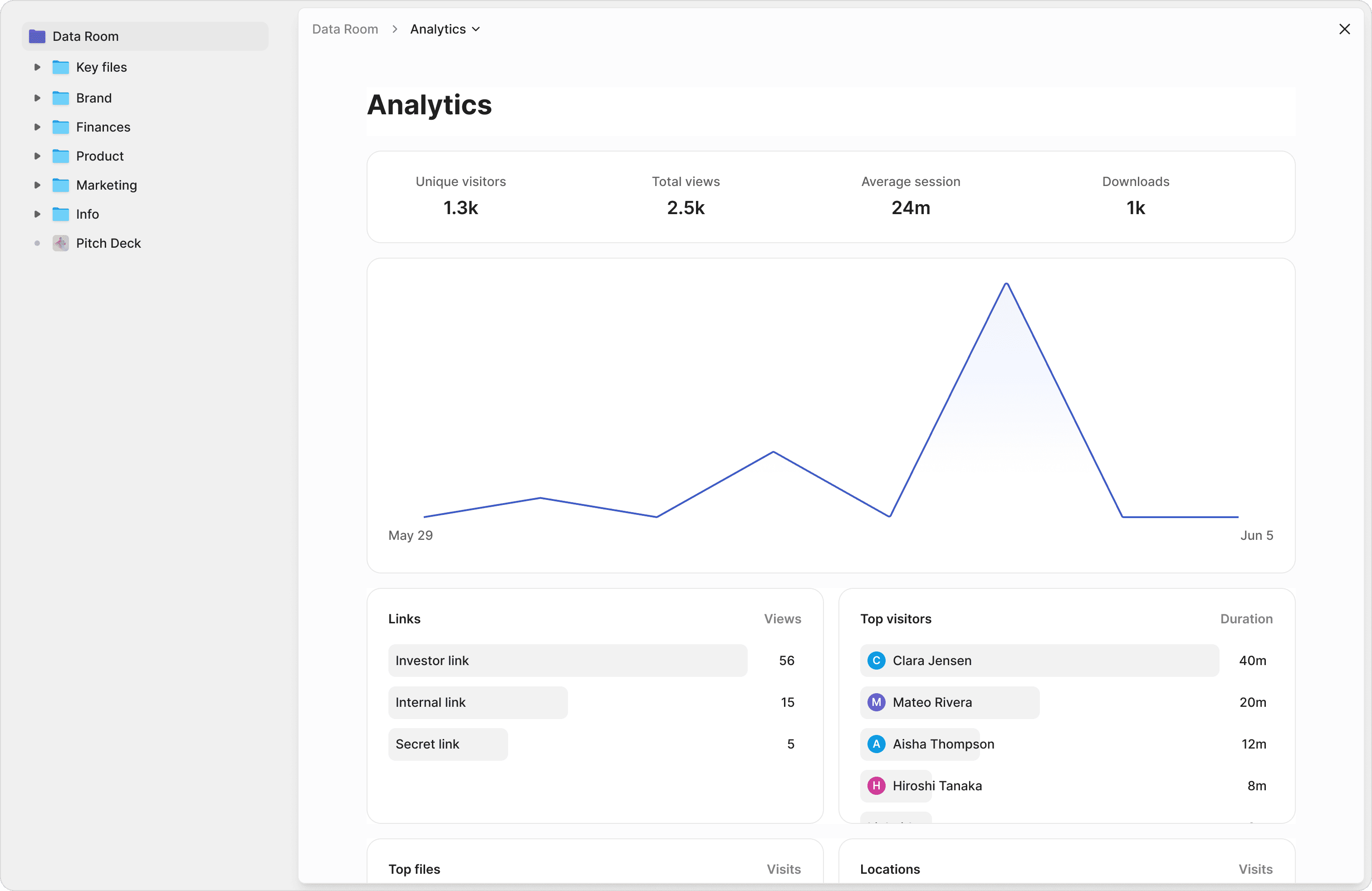
Separate access tracks for every licensing partner
Page-by-page buyer intelligence
See which pages of your content library inventory or distribution agreement each buyer spent the most time on. Understand what titles and terms drive interest.
Auto-expiring access
Set access windows that automatically expire after negotiation deadlines pass. No more chasing revoked permissions across dozens of licensing partners.
Per-partner access tracks
Create isolated views per licensing partner so each sees only the content packages, residual schedules, and territorial rights relevant to their deal — all from one data room.
Can AI find rights windows and terms across scripts, deal memos and licensing agreements?
Yes. Peony's AI document Q&A answers plain-English questions across every document in the room, such as a territory's exclusivity window or a music license's expiry, and cites the source document and page.
Stop digging through hundreds of PDFs. Ask natural language questions across your entire document library and get instant, sourced answers from talent contracts, music licensing deals, and distribution agreements.
(AI document Q&A from Business ($30/admin/mo billed yearly), with 5x the usage on Data Room and 10x on Deal Team. AI features switch on after you upgrade. Your documents aren't used to train AI: Peony's LLM providers work under data-handling agreements that prohibit training on customer content.)
Search across scripts, deal memos, and licensing agreements instantly
Chat with your deal files
Ask questions across talent contracts, residual schedules, and distribution agreements. AI retrieves answers with exact source references from your documents.
Find specific rights and terms
Search your data room in plain English. Find territorial rights, exclusivity windows, or music licensing terms without remembering file names or folder structures.
Automated licensing Q&A
Let AI answer buyer questions about content availability, rights windows, and deal terms 24/7 by switching AI document Q&A on for that buyer's group. Track what each partner asks to prioritize negotiations, with each partner's questions in its own Visitor Q&A question team (Data Room).
Which media files can buyers open in Peony?
In Peony, buyers open screeners (MP4, MOV), audio (MP3, WAV), scripts and contracts (PDF, Word), avails sheets (Excel, CSV), decks, key art and live HTML models in the browser, with no download.
| Media files | Formats | What buyers see |
|---|---|---|
| Screeners, trailers, rough cuts and sizzle reels | MP4 (H.264 recommended), MOV, WebM, OGV; AVI, MPEG, WMV, FLV and 3GP also upload (video uploads on Business and above) | Streams in Peony's player with the download control and right-click menu removed; the viewer's watermark plays over the video on Data Room. |
| Scores, music cues, podcasts and audio masters | MP3, WAV, M4A, AAC, FLAC, AIFF and more (audio uploads on Business and above) | Plays in Peony's own audio player in the browser, with no download unless the group has Download permission. |
| Scripts, treatments, deal memos, licenses and chain-of-title | PDF, Word | In the browser, with the viewer's watermark on every page (Data Room); a downloaded PDF keeps its watermark. |
| Avails, encumbrance schedules, ultimates and residual schedules | Excel (.xlsx, .xls), CSV | Every sheet in the browser, showing values without formulas; the viewer's watermark sits over the grid (Data Room). |
| Pitch decks, sales sheets and lookbooks | PowerPoint, PDF | In the browser, with the viewer's watermark while viewing (Data Room); share a PDF too when you want a downloaded copy to carry it. |
| Key art, stills, storyboards and design files | JPG, PNG, TIFF, WebP, Photoshop (.psd), Illustrator (.ai) | In the browser, image by image, with no download. |
| Waterfall and royalty models built in Claude or ChatGPT | HTML (.html, .htm) | Runs live with JavaScript, so buyers change inputs and outputs recalculate, behind your NDA gate, permissions and analytics. |
Storage and file size are unlimited on Data Room ($52/admin/mo billed yearly); Business holds 100 GB, with no per-file size limit. For screeners, upload MP4 with H.264 video and AAC audio so the file plays for every buyer; the full list is in supported file formats and video in Peony.
How does a catalog sale or licensing round run in a Peony data room, from screener to signed deal?
A media deal in Peony runs in five steps: build the room title by title, gate it with an NDA, open screeners and the manifest, release title detail to the short list, then close.
The first upload takes minutes: the median time on Peony from account creation to first uploaded document is 4 min 19 s (State of M&A Data Rooms, Q3 2026 edition).
Build the room title by title
Describe the deal in one line (say, “120-title TV library sale”) and AI room generation drafts the folders, or drag in a title-by-title tree and its structure comes with it. Index documents numbers every title folder, and Export index downloads the numbered index (Data Room).
Gate it with the NDA
A signed NDA with an audit record stands in front of the first page or frame (Data Room); Business has an acknowledge-only NDA gate. Each buyer or licensee verifies their email and gets its own group and link.
Open screeners and the manifest
Screeners, sizzle reels, the title manifest and summary economics go on View, with each viewer's watermark over every page and every playing video (Data Room); analytics show who is watching and reading.
Release title-level detail to the short list
Move chain-of-title, encumbrance schedules, residual and participation statements and music clearances to View for short-listed groups only (Data Room). Questions run through Visitor Q&A with one question team per buyer (Data Room), or the expert-and-approver workflow on Deal Team.
Negotiate, close and cut access
Upload new version keeps the latest license or purchase agreement at the same link, and advanced redaction strips compensation figures from a PDF (Deal Team). When the deal signs, switch off the other buyers' groups or let their links expire; the audit trail keeps the record, and Deal Team downloads the room archive.
The full catalog version, with the Insurability Test for chain-of-title and the Encumbrance Map for licensed-out windows, is in our film or TV catalog sale guide.
Who supports a media deal team on Peony?
Peony support runs 24/7, handled directly by the Peony team across Europe, US and Asia hours, with no outsourced tier. Everyone you speak to on Peony support has M&A experience at elite boutiques or bulge-bracket banks, VC experience, or has raised $1M+ themselves.
- Mark a deadline blocker as urgent, such as a buyer who can't play a screener the night before bids, and the team typically answers within a few hours.
- Deal Team adds priority support and a dedicated account manager.
- Peony staff can't open, move or edit the documents in your room. Peony has had no data breach since launch.
No credit card · 7-day Data Room trial that never auto-charges · buyers, distributors and partners view free, no account
Can competing buyers or licensees see each other in a Peony room?
No. Peony never shows invitees who else is invited, and on Data Room each buyer or licensee gets its own group, folder permissions and Q&A question team, seeing only its own titles and questions.
- In media, the streamer reviewing your catalog this month may be negotiating a library license with you next month, so walling each buyer off protects your licensing leverage as well as the sale.
- Question teams are the privacy boundary in Visitor Q&A: buyers in different teams can't see each other's questions, while your answer side sees every question with the team it came from (Data Room).
- Revoke one buyer by switching its group off; its link stops working and every other group is untouched (Business and above). Or set an expiry date that matches the screening or negotiation window (every plan).
- On Deal Team, the Advanced Q&A module assigns each question to an expert and an approver, and advanced redaction saves a new PDF with a talent fee or a licensee's terms removed before it's shared.
Is Peony secure enough for unreleased content and talent contracts?
Yes. Peony encrypts files with AES-256 at rest and TLS 1.2 or higher in transit, Peony staff can't open the documents in your room, and Peony has had no data breach since launch.
- Your documents aren't used to train AI: Peony's LLM providers work under data-handling agreements that prohibit training on customer content.
- Viewers read documents in the browser; files never leave Peony unless you allow downloads on a link.
- Peony's incident-response policy commits to telling affected customers within 72 hours of confirming an incident that affects customer data.
- Peony is SOC 2 Type II-ready and ISO 27001-ready, with both audits underway, and GDPR, CCPA, and HIPAA compliant. The standard DPA with SCCs is available on request on Deal Team and Enterprise.
- Admins sign in with an emailed one-time code or Google, with no password fallback.
Sensitive talent data exposure
Talent contracts, deal memos, and compensation schedules are among the most sensitive documents in entertainment. They need far more protection than a shared folder provides. In Peony, per-file permissions keep each contract visible only to the parties to that deal (Data Room), advanced redaction blacks out compensation figures or PII before a counterparty sees the file (Deal Team), and the audit trail logs every view and download (Data Room).
Hosting, access control and audit logs are in the security overview, and the audit status in compliance and certifications.
What goes in a film or TV catalog data room?
In Peony, organize a catalog room by title first, then by rights within each title: chain-of-title, licenses and encumbrances, talent and residuals, participations, music clearances, E&O, financials and screeners.
Title manifest & index
Master title list with formats, years and rights summary; the numbered index buyers work from
Chain-of-title
Underlying-rights, option and writer agreements, assignments, copyright registrations, copyright, UCC and lien searches
Licenses & encumbrances
Existing license schedule by window, territory, language and term; distribution and output agreements
Talent, guilds & residuals
Cast, director and producer agreements, WGA, SAG-AFTRA and DGA residual schedules, guild agreements
Participations
Profit-participation and backend statements, gross and net definitions, current statements
Music & sync
Sync and master-use licenses with scope, term, territory and expiry, music cue sheets
E&O, tax credits & disputes
E&O policies and claims history, production tax-credit certificates, pending or threatened rights disputes
Financials & screeners
Title-level revenue by window and territory, ultimates, the masters inventory, and watermarked screeners
Buyers diligence one title at a time, so a room sorted into generic “Contracts” and “Financials” folders makes them rebuild each title. In Peony, Index documents numbers every title folder (Data Room), and Upload new version swaps in a cured assignment or an amended license at the same link, keeping each earlier version with its date. Camera originals stay in your asset manager; the room holds the masters inventory and watermarked screeners.
The 12-folder version, with what each folder proves to a buyer, is our film or TV catalog sale guide; the screener side is in our secure video data room guide.
What does a media data room cost on Peony?
On Peony, most media rooms run on Data Room at $52 per admin per month billed yearly ($75 monthly), with unlimited rooms, storage and file sizes; buyers, distributors and partners are free.
Per-page and per-GB pricing was built for documents, so a screener library multiplies the bill. Peony's flat per-admin plan has no per-page, per-GB or per-buyer fees, so a room holding a whole catalog costs the same as one holding a single deck.
Legacy VDRs like Ideals overcharge studios for basic file hosting, and Datasite and Ideals charge thousands per month. Peony gives you enterprise-grade content protection, multi-party access management, and AI-powered document intelligence — all at a fraction of legacy VDR pricing.
How do Peony, Datasite, Ideals and Firmex price a studio's data room?
Of the four, only Peony publishes a flat price: $52 per admin per month billed yearly on Data Room, with unlimited storage and no file-size cap; Datasite, Ideals and Firmex are quote-only.
| Provider | Pricing model | Price | Source |
|---|---|---|---|
| Peony | Flat per admin; buyers, distributors and partners view free; no per-page, per-GB, per-room or per-buyer fees | $52/admin/mo billed yearly on Data Room (unlimited rooms and storage, no file-size cap); $30 on Business (3 rooms per admin, 100 GB, no per-file size limit) | Peony pricing |
| Datasite | Quote-only; still offers per-page pricing alongside newer models | No published price; reported $0.40 to $0.85 per page; average contract about $68,000 a year (Vendr) | Datasite pricing review |
| Ideals (iDeals) | Quote-only; each project priced by storage | No published price; Core plan is one project, five administrators and 0.5 to 2 GB; buyers report $100 to $300 per GB per month above the cap | Ideals pricing review |
| Firmex | Quote-only; single-project fee or annual subscription, both sized by data volume | No published price; buyers report $5,000 to $10,000 per 3-month project | Firmex pricing review |
Plans metered by pages, storage or data volume grow as a catalog adds screeners, masters and title folders; on Peony, a room holding a whole catalog costs the same as one holding a single deck. Competitor figures are buyer-reported or taken from each provider's pricing page, re-checked in October 2026 in our virtual data room cost guide.
Business
$30/admin/mo
3 data rooms per admin, 100 GB storage, no per-file size limit
Video and audio uploads, an NDA gate and screenshot protection for a lighter slate
Data Room · Most popular
$52/admin/mo
Unlimited rooms and storage, no file-size cap
Screeners, title files and the whole catalog in one room, with watermarks over every page and frame
Try Data Room
7 days free
No credit card, never auto-charges
Put a live room behind an NDA gate, dynamic watermarks and page-level analytics.
Prices per admin per month, billed yearly. Deal Team ($64, minimum 4 admins) adds advanced redaction, Advanced Q&A routing, OAuth SSO, API access, priority support and a standard DPA with SCCs on request; Enterprise is custom. Free ($0) covers 50 documents and 500 MB as tracked single-file links; data rooms start on Business. Buyers, distributors and partners are free and unlimited on every plan.
Which Peony guide covers your media deal?
Peony publishes guides for the main media deal types, from film and TV catalog sales and secure video rooms to media M&A advisers and investors, setting out the documents and access controls each one needs.
"Peony is a great example of a customer-obsessed company with a fantastic sense of design and UX. We moved on from Docsend in the first week — what we are really excited about is what all Peony does next."
Anish Bharadwaj
Founder & CEO, KiwiQ
Germain Brion
Founder, Veritai
"The team at Peony put craft into everything they do; from the product to their support, they shine through how much they care."
Frequently asked questions
What is Peony, and is it a good fit for studios, distributors and rights holders?
Yes. Peony is a virtual data room that studios, distributors and rights holders use to share screeners, catalogs and contracts under NDA, see which buyers open each title and hold large video files in one room. Data Room, the most popular plan, is $52 per admin per month billed yearly ($75 monthly), with unlimited rooms and storage; inviting buyers is free and unlimited.
Can I try Peony before I pay?
Yes. Peony's Data Room plan has a 7-day free trial you start yourself, with no credit card, and it never converts to paid on its own. Rooms, files, links, analytics and NDA settings carry over when you upgrade. AI features, such as AI document Q&A and AI room generation, switch on once you're on a paid plan.
What is a media data room and how do studios use it for content licensing and catalog deals?
A media data room is a secure virtual environment where studios, production companies, and distributors share screeners, territory rights maps, licensing agreements, and content catalogs during deal negotiations, under NDA and with every view tracked. Studios use Peony's data room to create isolated access tracks per licensing partner — so each distributor or streaming platform sees only the content packages relevant to their deal. Peony adds screenshot protection to prevent pre-release content leaks (Business and above), dynamic watermarks to trace any unauthorized distribution (Data Room), and AI-powered search across all your deal files — deployable in under 5 minutes: the median from sign-up to first uploaded document is 4 min 19 s (State of M&A Data Rooms, Q3 2026 edition). The title-by-title structure for a library sale is in our film or TV catalog data room guide.
What is the best data room for media and entertainment deals?
Peony fits studios, distributors, rights holders and media M&A teams because it covers the three things media deals need: watermarked screener streaming, unlimited storage with no file-size cap, and a walled-off group per buyer. On Data Room ($52 per admin per month billed yearly), screeners and trailers stream in the browser with the player's download control removed and each viewer's identity drawn over every page and playing video, a signed NDA comes before the first frame, and invitees never see who else is invited. You pay per admin, not per viewer and not per data room, with no click, recipient or storage fees on paid plans. Viewers are unlimited and free on every plan, and they don't need a Peony account. Analytics show which buyers opened each screener and title, and when they came back. Peony support runs 24/7. Everyone you speak to on Peony support has M&A experience at elite boutiques or bulge-bracket banks, VC experience, or has raised $1M+ themselves. The median from sign-up to first uploaded document is 4 min 19 s, and the 7-day Data Room trial needs no card and never auto-charges.
What secure screener platform prevents leaked copies for film distribution?
Peony works as a secure screener platform: screeners stream in the browser with the download control removed, behind an NDA, with each viewer's email watermarked over the picture on Data Room. Give each distributor or buyer its own group and link, keep Download off so every play stays inside the watermarked player, and set the link to expire when the screening window closes. Screenshot protection blocks desktop captures from Business, and Screenshield extends it to iPhone, iPad and Android on Data Room ($52 per admin per month billed yearly). The dynamic watermark is the deterrent a phone camera can't remove: it puts the viewer's identity into any photo or recording of the screen, so a leaked screener traces back to one buyer. Analytics show which buyers opened each screener, when, and whether they came back. Video uploads start on Business, and MP4 with H.264 video and AAC audio plays in every modern browser. The full playbook is in our secure video data room guide.
How do studios protect unreleased scripts and pre-release content?
Studios protect unreleased scripts and cuts in Peony with four controls: an NDA before the first page, downloads off, screenshot protection, and dynamic watermarks that stamp each viewer's identity on every page and video. Peony blocks screenshots of shooting scripts, storyboards, and unreleased content, preventing unauthorized digital copies. Dynamic watermarks stamp every page with the viewer's identity and timestamp, so if a script leaks, you trace it instantly. NDA gating requires distributors, talent representatives, and production partners to sign agreements before viewing any materials. Unlike legacy VDRs like Ideals that charge extra for advanced security, Peony's Business plan ($30/admin/month) includes screenshot protection and NDA gating, and the Data Room plan ($52/admin/month) adds dynamic watermarks. On Business the NDA gate is acknowledge-only; the signed NDA with an audit record, Screenshield mobile screenshot protection and per-folder permissions are on Data Room. Peony is SOC 2 Type II-ready and ISO 27001-ready, with both audits underway, and GDPR, CCPA, and HIPAA compliant.
How do production companies manage multi-party content licensing?
Peony lets studios and production companies create isolated access tracks per licensing partner, so each distributor, broadcaster, or streaming platform sees only the content packages relevant to their deal. Page-level analytics reveal which titles and terms each buyer focused on, and access auto-expires when negotiation windows close. This eliminates the risk of one partner seeing another's deal terms — a common problem with legacy VDRs like Firmex. Folder- and file-level permissions (No access, View, Download, Upload) are on Data Room ($52 per admin per month billed yearly), Visitor Q&A keeps each partner's questions in its own question team (Data Room), and invitees never see who else is invited.
Which providers offer secure content, brand and software licensing for entertainment studios?
Peony is a secure licensing data room for studios: each distributor, platform, brand or software licensee gets its own NDA-gated group with folder permissions and watermarks, and invitees never see who else is invited. Peony secures the deal side of licensing, meaning everything a licensee reviews before it signs: screeners and trailers for a content license, avails and rights grids by territory and window, license drafts and term sheets, brand guidelines and key art (JPG, PNG, TIFF, PSD, AI) for a brand or consumer-products license, and technical documentation, security questionnaires and demo videos for software or pipeline tools a studio licenses in or out. Folder- and file-level permissions (No access, View, Download, Upload) are on Data Room ($52 per admin per month billed yearly), with a signed NDA and audit record before the first page, each viewer's identity watermarked over every page and playing video, and Visitor Q&A keeping each licensee's questions in its own question team. Each group's link can expire on the day its negotiation window closes, and switching off one licensee's group disables only that group's link (Business and above). Page-level analytics show which titles, terms and documents each licensee opened and when it came back. Viewers are unlimited and free on every plan, and they don't need a Peony account. Once the deal signs, masters and software builds go out through your delivery or licensing system, and the Peony room keeps the tracked record of what each licensee saw first.
Can AI help search across scripts, deal memos, and licensing agreements?
Yes. Peony's AI document Q&A answers plain-English questions across talent contracts, music licensing deals and distribution agreements, citing the source document and page, on every paid plan from Business. Peony's AI-powered document chat — available on the Business plan ($30/admin/month) — lets you ask natural language questions across your entire document library and get instant, sourced answers. Find specific territorial rights, exclusivity windows, or revenue terms in seconds instead of digging through hundreds of PDFs. Usage is 5x on Data Room and 10x on Deal Team, and you can switch the AI on for one licensee's group so they can ask too, and keep it off for another. Peony also offers auto-indexing: Index documents numbers every folder and file so both sides can say "open 2.3", and AI room generation drafts the folder structure from a one-line description of the deal (Data Room plan). AI features, such as AI document Q&A and AI room generation, switch on once you're on a paid plan. Your documents aren't used to train AI: Peony's LLM providers work under data-handling agreements that prohibit training on customer content.
How does Peony handle talent contract confidentiality?
Peony keeps talent contracts, deal memos and compensation schedules visible only to the parties you choose, with per-file permissions, a record of every view and download, and redaction of pay figures before sharing. Talent contracts, deal memos, and compensation schedules are among the most sensitive documents in entertainment. Peony protects them with granular permissions so only authorized parties see specific contracts (Data Room), two-factor authentication for additional identity verification, and complete audit trails logging every view and download (Data Room). Peony also offers Advanced Redaction (on the Deal Team plan) to permanently black out compensation figures or PII before sharing with counterparties. Dynamic watermarks and screenshot blocking add physical leak deterrence that generic file-sharing tools cannot match. Peony staff can't open, move or edit the documents in your room.
How does Peony compare with Datasite, Ideals and Firmex for studios and production companies?
Peony suits studios better than Datasite, Ideals or Firmex because video doesn't raise the bill: Data Room is $52 per admin per month billed yearly, with unlimited storage, no file-size cap, and buyers view free. None of the three publishes a price. Datasite is quote-only and still offers per-page pricing, reported at $0.40 to $0.85 a page, and Vendr's buyer data puts its average contract at about $68,000 a year (Datasite pricing review). Ideals prices each project by storage, with its Core plan at one project, five administrators and 0.5 to 2 GB, and buyers report overage of roughly $100 to $300 per GB per month above the cap (Ideals pricing review). Firmex sells a single-project fee or an annual subscription, both sized by data volume, and buyers report $5,000 to $10,000 per 3-month project (Firmex pricing review). Plans metered by pages, storage or data volume grow with every screener, master and title folder a catalog adds. You pay per admin, not per viewer and not per data room, with no click, recipient or storage fees on paid plans. On Data Room, screeners and trailers stream in the browser with the player's download control removed and each viewer's identity drawn over the picture, a signed NDA comes before the first frame, and each studio, streamer or distributor gets its own group and never sees who else is invited. Peony sets up in minutes, not days: the median from sign-up to first uploaded document is 4 min 19 s. Peony support runs 24/7. Everyone you speak to on Peony support has M&A experience at elite boutiques or bulge-bracket banks, VC experience, or has raised $1M+ themselves. The provider-by-provider figures, re-checked in October 2026, are in our virtual data room cost guide.
How much does a data room cost for a production company managing distribution agreements?
On Peony, a production company's data room costs $52 per admin per month billed yearly on Data Room, with unlimited rooms and storage, or $30 on Business with 3 rooms per admin; distributors view free. Legacy VDRs like Datasite and Ideals charge thousands per month, often with per-page fees that scale quickly when a production company is managing distribution agreements, screeners, and content catalogs across multiple territories. Vendr's buyer data puts the average Datasite contract at about $68,000 a year, with reported per-page rates of $0.40 to $0.85. Peony offers a free plan ($0) for tracked single-file links (50 documents and 500 MB; data rooms start on Business), a Business plan at $30/admin/month ($44 monthly; up to 3 data rooms per admin, 100 GB of storage, no per-file size limit), and a Data Room plan at $52/admin/month ($75 monthly; unlimited data rooms and unlimited storage, with no per-file size cap). Peony has no per-viewer, per-page, or per-link limits, so costs stay predictable whether you are sharing licensing agreements with 5 distributors or 50. The Business plan ($30/admin/month) includes screenshot protection, NDA gating, and AI-powered Q&A — not sold as add-ons, with dynamic watermarks on the Data Room plan ($52/admin/month). Deal Team ($64, minimum 4 admins) adds advanced redaction, Advanced Q&A routing, priority support and a standard DPA with SCCs on request. The per-provider math is in our virtual data room cost guide.
Can Peony support content library due diligence for media M&A?
Yes. Peony runs content-library diligence title by title: each title gets its own folder for chain-of-title, licenses, residuals and music clearances, and each bidder sees only the titles and stages you release. Peony handles the complexity of media M&A where acquirers must review thousands of titles with residual schedules, rights windows, and revenue histories. Peony's AI-generated due diligence checklists track uploaded versus missing documents with completeness scoring tailored to media transactions. Peony's auto-indexing (Index documents) numbers every title folder and file, and AI room generation drafts the title-by-title folder structure from a one-line description of the deal (both Data Room); full-text search with OCR lets buyers find specific terms instantly, and page-level analytics show which content areas each bidder focused on. Peony sets up in under 5 minutes versus the days legacy VDRs require: the median from sign-up to first uploaded document is 4 min 19 s.
What is the best data room for a film or TV catalog sale?
Peony's Data Room plan fits most film and TV catalog sales: unlimited storage, a signed NDA, per-bidder groups, watermarked screeners and page analytics, at $52 per admin per month billed yearly. Organize the room by title first, then by rights within each title, with a master title manifest as the index; Index documents numbers every title folder, and Export index downloads the numbered index. Each studio, streamer or PE bidder gets its own group, so no bidder sees that another exists, which matters in media because your rival bidders are often also your live licensing counterparties. Screeners stream with each viewer's watermark over the picture, and title-level detail opens to the short list only. Bidders and their counsel view free, with no account. The full Title-Level Room, with the Insurability Test and the Encumbrance Map, is in our film or TV catalog sale guide.
Is there a file-size limit for video, masters and screeners in a data room?
No. Peony has no per-file size cap on any plan, uploads are resumable if a connection drops, and storage is unlimited on Data Room, so mezzanine files, screeners and full title folders upload without splitting. Business includes 3 data rooms per admin, 1,000 documents per admin and 100 GB of storage, with no per-file size cap. Video and audio uploads start on Business. Peony charges no storage, page or per-GB fees on paid plans, and folder upload keeps a title-by-title tree's structure. Multi-GB video uploads best on a stable connection with the tab left open, and very long recordings upload faster as a few shorter clips. Keep camera originals in your asset manager, put the screener in the room for every buyer, and give Download on a mezzanine folder only to the lead bidder's group. See unlimited storage and our large-file data room page.
Which video formats play for every buyer in a Peony data room?
MP4 with H.264 video and AAC audio plays in every modern browser, on desktop and mobile, so it's the format to upload for screeners, trailers and sizzle reels in Peony. Peony's own player also plays WebM, OGV and QuickTime (.mov), and AVI, MPEG, WMV, FLV and 3GP upload too. A file encoded in HEVC/H.265, common from iPhones and recent Macs, or in an older codec such as MPEG-4 Part 2 plays only in some browsers, so convert it to H.264 first (HandBrake's Fast 1080p30 preset or one ffmpeg command), then use Upload new version to swap it in at the same link. Audio (MP3, WAV, M4A, FLAC, AIFF and more) plays in Peony's own player. Video and audio uploads need Business or above. See video in Peony.
Does Peony replace our MAM, DAM or review tool?
Peony works alongside it: Peony is the controlled sharing layer for the files that leave your MAM, DAM or review tool for a deal, so that system stays your library of record. Export the screener, proxy or document set you want a buyer to see, upload it to that buyer's room, and Peony adds the NDA gate, the per-viewer watermark, the per-buyer permissions, expiry and the audit trail a time-boxed deal needs. When the deal closes or a buyer drops out, switch off that group and its link stops working. Transfer tools hand the recipient a permanent copy; a Peony room keeps every view inside the watermarked viewer unless you allow downloads on that group.
How do I set up a media data room in Peony?
In Peony, create a room, upload your title folders, and give each buyer a group with an NDA, watermark and folder permissions; the median from sign-up to first upload is 4 min 19 s. 1. Create a data room from a template, or have AI room generation draft the folders from a one-line description such as "120-title TV library sale" (Data Room plan, once you've upgraded). 2. Drag in the title tree: folder upload keeps its nested structure, and Index documents numbers every title and file. 3. Upload screeners as MP4 (H.264) so they play in every browser; video uploads need Business or above. 4. Create a group for each buyer, distributor or licensee, with a signed NDA, a dynamic watermark and downloads off (Data Room plan, or the 7-day Data Room trial). 5. Set each group's folder permissions and an expiry date, send each group its link, and watch analytics for who is opening which titles. The median comes from Peony's State of M&A Data Rooms report (Q3 2026 edition).
Can I see which buyer watched which screener?
Yes. Peony's analytics show which buyers opened each screener and file, when they opened it, how long they spent in the room, and whether they came back. With email verification on (Business and above), each event is tied to the viewer's verified email. On Data Room, the room dashboard ranks Top files viewed, so you see which screeners and title folders draw the most attention across every buyer, and Most active viewers by duration surfaces the buyers spending real time in the room. Page-level analytics run on every plan; CSV export of views, sessions and downloads and drop-off reports are on Business and above, and the per-viewer audit trail of views, downloads, NDA acceptances and signatures is on Data Room. Logs are kept for 2 years on Data Room and with no time limit on Deal Team and Enterprise. If a screener leaks, the watermark names the viewer and the audit trail shows when they opened it. See page analytics.
How do you keep a catalog sale or licensing deal confidential from talent, guilds and the trades?
Keep the working group small, never email screeners or financials, and share only through a Peony room with an NDA gate, a group per buyer and each viewer's watermark on every page and frame. An emailed screener is a copy you can't take back; a Peony link can be switched off for one buyer without touching the others, and it can expire on the day the process ends. Analytics are the early-warning signal: a buyer reading only your strongest titles, or a viewer you didn't expect, shows up by verified email. Code-name the project, and keep participation and residual statements in a folder that opens only to the lead bidder. The Three-Front Leak (talent and guilds, live licensing counterparties, and the trades) is set out in our film or TV catalog sale guide.
What support does Peony give media teams during a live deal?
Peony support runs 24/7, handled directly by the Peony team across Europe, US and Asia hours, with no outsourced tier. Everyone you speak to on Peony support has M&A experience at elite boutiques or bulge-bracket banks, VC experience, or has raised $1M+ themselves. Mark a deadline blocker as urgent, such as a buyer who can't play a screener the night before bids, and the team typically answers within a few hours; email is answered within 24 hours on Data Room and within 12 hours on Deal Team. Deal Team adds priority support and a dedicated account manager. Peony staff can't open the documents in your room, so you can get help without granting anyone access to your files.
Protect your content. Close deals faster
One secure room per screening, licensing round or catalog sale, with 24/7 support. Peony has had no data breach since launch.
Join media teams already using Peony to safeguard pre-release content, manage multi-party licensing, and run entertainment M&A — securely and affordably.
- Buyers, distributors and partners never need a seat or an account.
- Unlimited rooms and storage on Data Room: ten title rooms cost the same as one.
- Live in minutes: median 4 min 19 s from sign-up to first uploaded document.
No credit card · 7-day Data Room trial that never auto-charges · buyers, distributors and partners view free, no account · 24/7 support
Last updated October 2026