
The energy data room for oil and gas, power and renewables deals
Keep the whole technical file in one room, from reserve reports and well logs to seismic, land files and PPAs; release it bidder by bidder behind a signed NDA; and see who is actually working the data: one secure room per divestiture, farm-out, project sale or raise, with unlimited storage on Data Room.
No credit card · 7-day Data Room trial that never auto-charges · bidders, partners and lenders view free, no account · 24/7 support
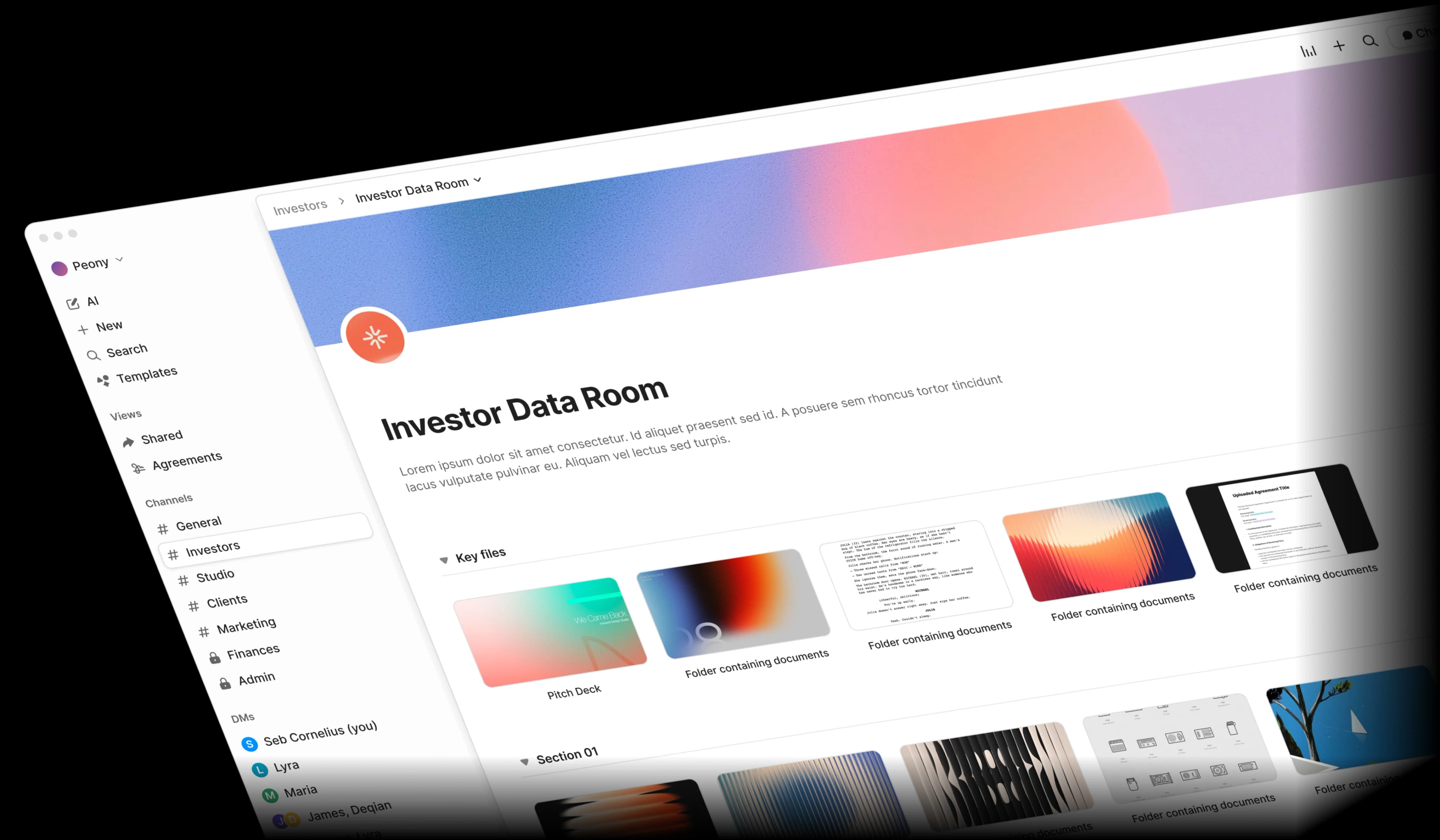
Trusted by 200+ energy, mining and infrastructure companies, including EagleRidge Energy, Twinza Oil and Fuse Energy
8,000+ customers in 60+ countries · $44.7B in client assets
Peony staff can't open your documents, your documents aren't used to train AI, and Peony has had no data breach since launch.
State of M&A Data Rooms (Q3 2026 edition, 733 M&A transactions from $1M to $500M): a sub-$50M room averages 1,206 files and 79 Q&A questions. The same report puts Peony's median time from sign-up to first uploaded document at 4 min 19 s. Read the research
What is Peony's energy data room, and who is it for?
Peony is a virtual data room that oil, gas, power and renewables teams use to share reserve reports, seismic and PPAs under NDA, see who read each page, and hold multi-GB files in one room. Rooms start at $30 per admin per month on Business (3 rooms per admin); Data Room, the most popular plan, is $52 with unlimited rooms, storage and file sizes, billed yearly, and bidders, partners and lenders never pay.
An energy data room is a permissioned online workspace where a seller, developer or sponsor shares the technical, land, contract and financial file on an asset or project with bidders, partners, lenders and their advisers under NDA, with every view tracked. The documents an oil and gas sale needs, stage by stage, are in our oil and gas data room checklist; solar, wind and storage projects are covered in our renewable energy data room guide.
- Hold the full technical file: reserve reports, well files, seismic sections and land records in one room, with unlimited storage and no per-file size cap on Data Room.
- Release data phase by phase: a signed NDA before the first page, a group per bidder or partner, and folder access that opens Phase II data only to the short list.
- See who is working the asset: page-by-page time on the reserve report, PUD schedule and LOS for every bidder, with return visits.
Peony at a glance
- Built for
- Upstream and midstream sellers, buyers and A&D advisers; farm-outs and JVs; solar, wind and storage project sales and financings; LNG and project finance; and energy transition fundraises.
- Typical plan
- Data Room, $52 per admin per month billed yearly ($75 monthly): unlimited rooms, documents and storage with no per-file size cap, a signed NDA with audit record, dynamic watermarks, granular folder and file permissions per bidder group, Visitor Q&A, AI room generation and Index documents.
- Pricing
- Business $30, Data Room $52 and Deal Team $64 (minimum 4 admins) per admin per month billed yearly ($44, $75 and $89 monthly); Enterprise is custom. Free ($0) covers 50 documents and 500 MB as tracked single-file links; data rooms start on Business.
- Bidders, partners and lenders
- Bidders, partners and lenders are unlimited and free on every plan and don't need a Peony account. You pay per admin, not per viewer.
- Rooms and storage
- Unlimited data rooms, documents and storage on Data Room and above, and no per-file size cap on any plan. Business includes 3 data rooms per admin, 1,000 documents per admin and 100 GB of storage, with no per-file size cap.
- Energy files
- Reserve reports, PSAs, JOAs and title opinions (PDF, Word), production and LOS workbooks (Excel, CSV), seismic sections and maps (PDF, TIFF, PNG, JPG), AutoCAD DXF drawings and site video (video uploads on Business and above) open in the browser with no download; raw seismic and well-log volumes upload as ZIP or RAR archives, with no per-file size cap on any plan.
- File management
- Upload new version keeps a file's place and link and keeps every earlier version; AI room generation drafts the folder structure, and Index documents numbers every file (Data Room plan). Export index downloads the numbered list, and drag-and-drop folder upload keeps a well-file tree's structure.
- Live models
- Peony renders .html files live with JavaScript running, so a Claude or ChatGPT artifact (a model, dashboard or calculator) stays interactive for the viewer, behind your NDA gate, permissions and analytics.
- Enterprise and IT review
- Deal Team (minimum 4 admins) adds OAuth SSO, API access, priority support, a dedicated account manager, security documentation and a standard DPA with SCCs on request. Enterprise (custom) adds SAML SSO, BYOK, self-hosted or white-label deployment and custom data residency, including EU-region hosting. See the security overview.
- Security
- AES-256 at rest, TLS 1.2+ in transit. Peony staff can't open your documents, your documents aren't used to train AI, and Peony has had no data breach since launch. Peony's incident-response policy commits to telling affected customers within 72 hours of confirming an incident that affects customer data. SOC 2 Type II-ready and ISO 27001-ready, with both audits underway. Compliance and certifications
- Setup
- Median 4 min 19 s from sign-up to first uploaded document (State of M&A Data Rooms, Q3 2026 edition).
- Trial
- 7-day Data Room trial you start yourself: no credit card, and it never auto-charges. Rooms, files, links, analytics and NDA settings carry over when you upgrade. AI features switch on after you upgrade.
- Support
- 24/7 support, handled directly by the Peony team across Europe, US and Asia hours, with no outsourced tier. Everyone you speak to on Peony support has M&A experience at elite boutiques or bulge-bracket banks, VC experience, or has raised $1M+ themselves.
- Customers
- 8,000+ customers in 60+ countries, with $44.7B in client assets.
Which energy teams use a data room, and for which deals?
Peony's energy data room covers seven deal types: upstream A&D, farm-outs and JVs, midstream sales, power and renewables projects, LNG and project finance, energy transition fundraises, and utility transactions.
Upstream A&D
E&P sellers, buyers and A&D advisers run asset sales and acquisitions: reserve reports, well files, type curves, LOS, land and title, released to bidders in phases. See the upstream divestiture guide.
Farm-outs and JVs
Operators bring in partners: JOAs, AFE history, carry terms and the technical package, each partner in its own group. See the farm-out guide and JV due diligence guide.
Midstream
Pipeline, gathering and storage sales: rights-of-way and easements, tariffs and FERC filings, throughput and minimum-volume contracts, integrity records. See the midstream acquisition guide.
Power and renewables
Solar, wind and storage project sales, portfolio sales and financings: site control, interconnection studies, PPAs and tax-credit records for buyers, lenders and tax-equity investors. See the renewable energy data room guide.
LNG and project finance
FEED-to-FID document sets, EPC bid packs and lender and export-credit packages, with each lender and contractor in its own group. See the LNG project finance guide and infrastructure projects guide.
Energy transition fundraises
Climate-tech and energy transition companies raising from funds and strategics: deck, model, technical diligence and cap table, one tracked link per investor. See top climate tech investors.
Utilities and IPPs
Asset sales, M&A and outside advisers' review: Peony is the controlled sharing layer for the documents that leave your document management system, so that system stays your record.
Mining companies and data center developers have their own pages: mining data rooms and data center data rooms.
What do energy deal teams use Peony's data room for?
Peony handles the three jobs that come up on almost every energy process: holding the full technical file in one room, releasing it bidder by bidder, and showing which bidders are working the data.
Keep the whole technical file in one room
Peony's Data Room plan has unlimited storage and no per-file size cap, so reserve reports, well files, seismic sections and land records sit in one room, and bidders open them in the browser with no download.
Drag a whole well-file tree in and Peony keeps its folder structure; AI room generation drafts the folders from a one-line description of the deal, and Index documents numbers every file (1.1, 1.2…) so a bidder can ask about “3.4” on a call. Upload new version swaps in a revised reserve report or LOS at the same link and keeps every earlier version. Peony charges no per-page, per-GB or per-bidder fees.
(Unlimited storage, AI room generation and Index documents: Data Room ($52/admin/mo billed yearly). Business includes 100 GB, with no per-file size limit.)
What it replaces: Technical data scattered across drives. Reserve reports in email, well files on an FTP site, seismic on a hard drive, and a different folder layout for every bidder.
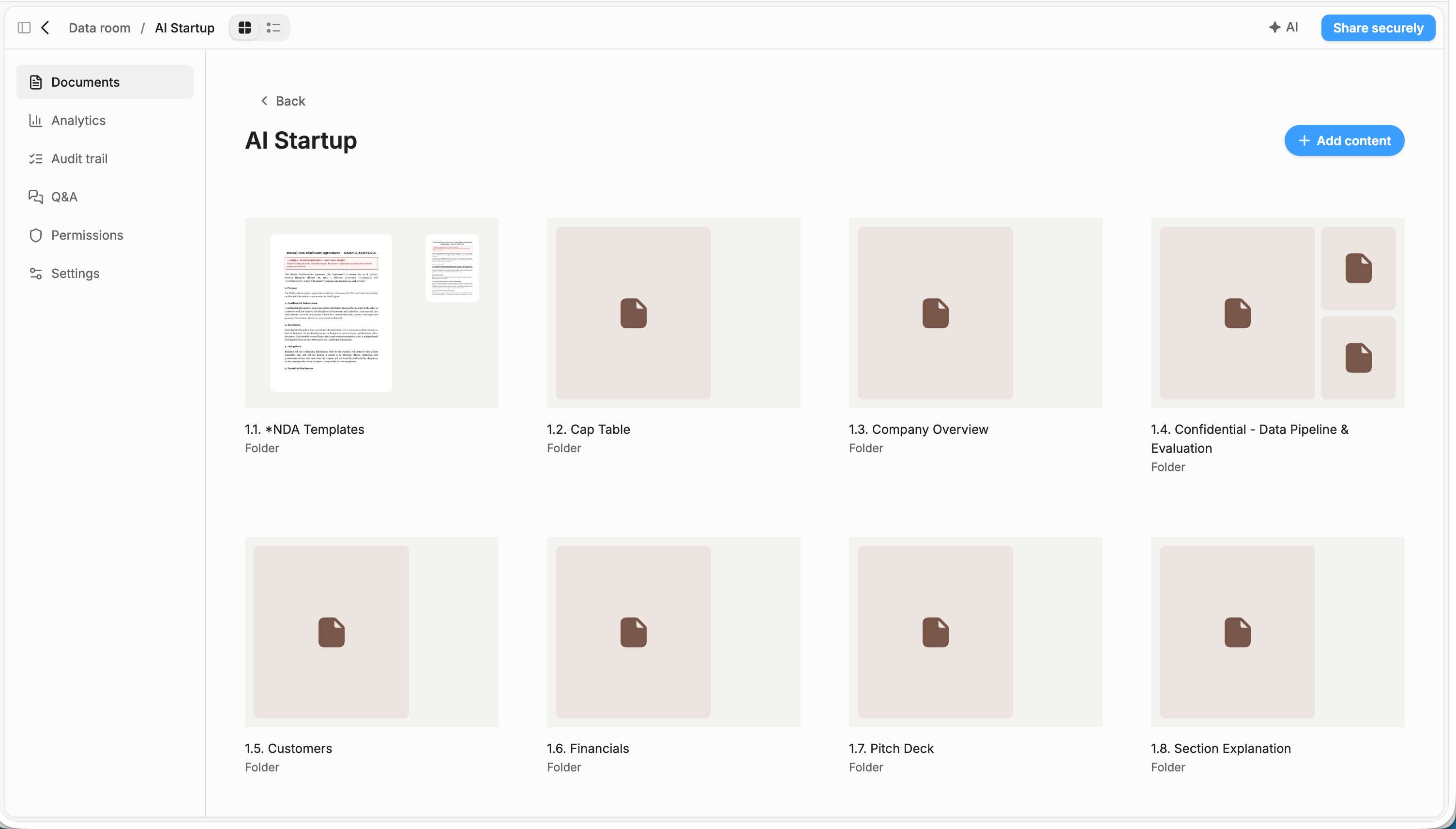
Release the data bidder by bidder
Peony puts a signed NDA in front of the first page, gives each bidder or partner its own group with folder- and file-level permissions, and stamps every page with the viewer's email and IP.
Open the Phase I summary to every bidder who signs, then set the full well files and raw seismic to Download for the short list only. Each group's questions stay in its own Q&A question team, and one switch cuts off a bidder that drops out. Screenshield extends screenshot protection to iPhone, iPad and Android.
(NDA gate, download blocking and desktop screenshot protection from Business; the signed NDA, dynamic watermarks, Screenshield, granular permissions and Visitor Q&A on Data Room ($52/admin/mo billed yearly).)
What it replaces: One file set for every party. Emailing different attachments to each bidder or JV partner, with no record of who signed what or who saw which well file.
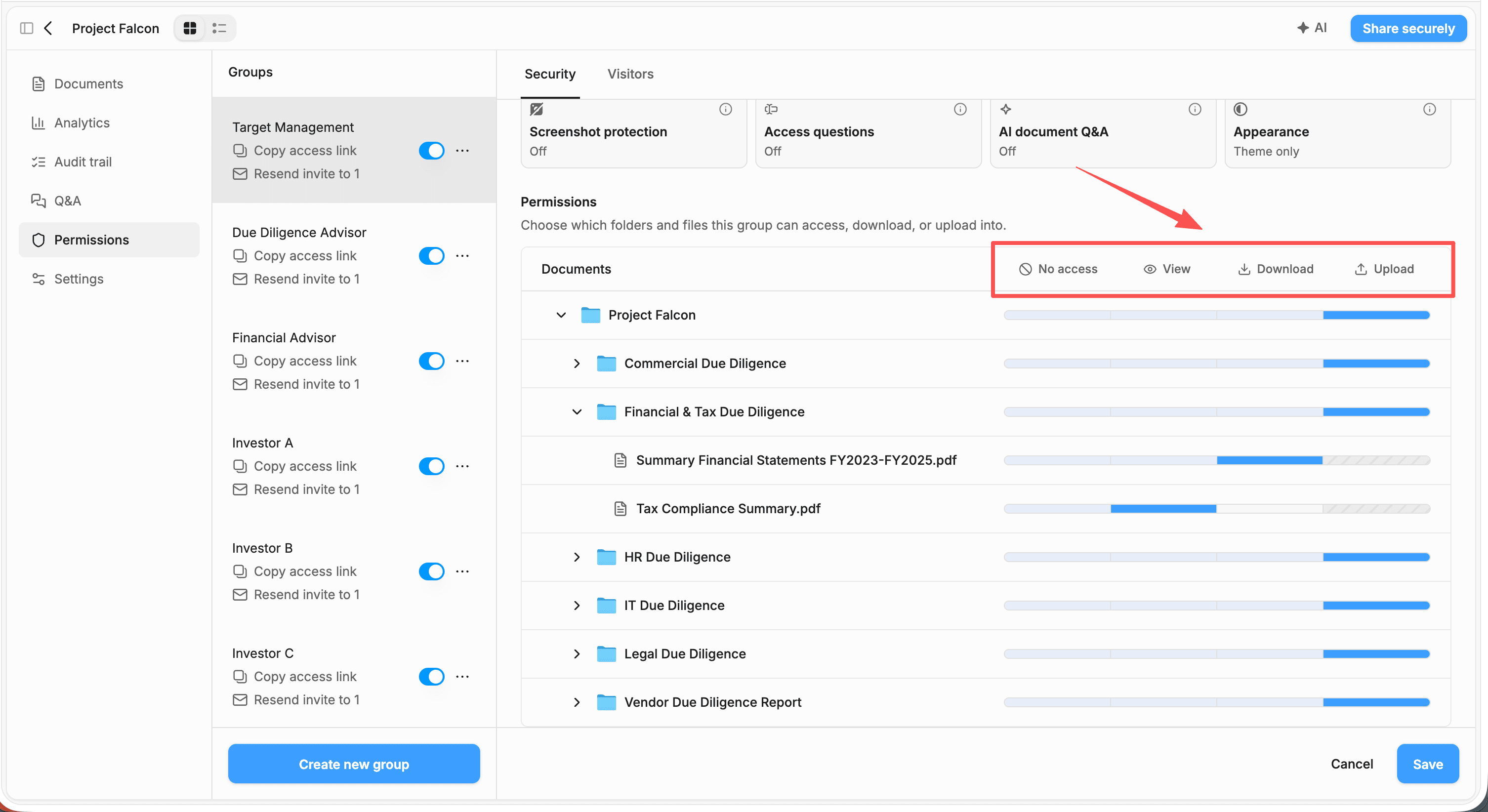
See which bidders are working the asset
Peony shows, page by page, which bidder opened the reserve report, how long they spent on the PUD schedule and the LOS, and when they came back.
Use it to rank the bidder pool before second-round invitations and to see whose engineers are still in the well files the week bids are due. With email verification on, a forwarded link shows up as a new viewer under that person's own verified email. The audit trail keeps a per-viewer timeline of views, downloads, NDA acceptances and signatures for the closing file.
(Page-level analytics on every plan; email verification, CSV export and drop-off reports from Business; the room dashboard and full audit trail on Data Room ($52/admin/mo billed yearly).)
What it replaces: No read on bidder interest. You send the CIM and the reserve summary and wait, with no idea whose engineers actually worked the data.
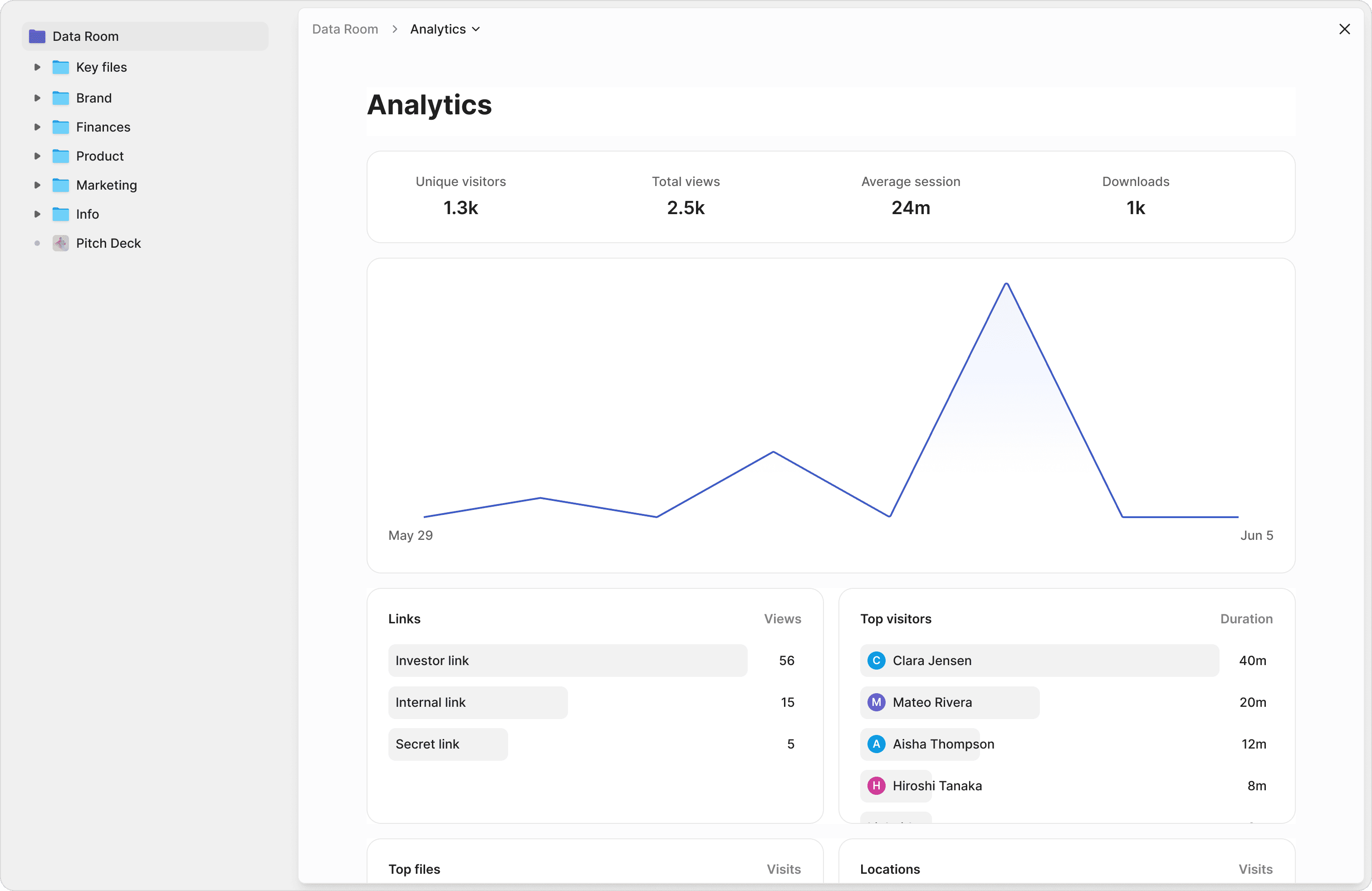
AI document Q&A
Ask across every reserve report, JOA and lease and get answers with the source document and page cited (Business and above).
In-room bidder Q&A
Bidders post questions inside the room, one question team per bidder (Data Room); Deal Team routes each to an expert and an approver before release.
Numbered index
Index documents numbers every folder and file, and Export index downloads the numbered list for the process letter (Data Room).
Version control
Upload new version replaces a revised reserve report or PPA amendment in place, keeping its link and every earlier version.
Redaction
Advanced redaction removes a working interest, carry term or counterparty name from a PDF before it's shared (Deal Team).
Branded rooms
Your logo and cover image on every room from Business, and your own domain on Data Room.
Which energy files can bidders open in Peony?
In Peony, bidders open reserve reports and title opinions (PDF, Word), production workbooks (Excel, CSV), seismic sections (PDF, TIFF, PNG, JPG), DXF drawings, site video and live HTML models in the browser, with no download.
| Energy files | Formats | What bidders see |
|---|---|---|
| Reserve reports, PSAs, JOAs, leases and title opinions | PDF, Word | In the browser, with the viewer's watermark on every page (Data Room); a downloaded PDF keeps its watermark. |
| Production histories, LOS, well lists and economics models | Excel (.xlsx, .xls), CSV | Every sheet in the browser, showing values without formulas; the viewer's watermark sits over the grid (Data Room). |
| Seismic sections, structure maps, plats and cross-sections | PDF, TIFF, PNG, JPG | In the browser, page by page or image by image. |
| Pipeline alignment sheets, plot plans and site layouts | AutoCAD DXF, PDF | PDF drawing sets in Peony's own viewer; DXF in the document viewer. |
| Site walks, drone footage and facility video | MP4, MOV and other video (upload on Business and above) | Streams in place with the download control removed; the watermark plays over the video on Data Room. |
| Type-curve explorers and revenue calculators built in Claude or ChatGPT | HTML (.html, .htm) | Runs live with JavaScript, so bidders change inputs and outputs recalculate, behind your NDA gate, permissions and analytics. |
| Raw seismic volumes and LAS well-log files | ZIP or RAR archive | Upload with no per-file size cap on any plan; give Download on that folder to short-listed bidders only. |
Storage and file size are unlimited on Data Room ($52/admin/mo billed yearly). Peony's own viewers handle PDFs, images, video, CSV and text, and design files such as DXF preview generally up to 25 MB. The full list is in supported file formats.
How does an energy sale run in a Peony data room, from teaser to close?
An energy sale in Peony runs in five steps: build the room, gate it with a confidentiality agreement, open Phase I, release Phase II to the short list, then negotiate, close and revoke.
The first upload takes minutes: the median time on Peony from account creation to first uploaded document is 4 min 19 s (State of M&A Data Rooms, Q3 2026 edition).
Build the room
Describe the deal in one line (say, “Permian non-op package, Phase II”) and AI room generation drafts the folders; drag in the well-file tree and its structure comes with it. Index documents numbers every file, and Export index downloads the numbered list for the process letter (Data Room).
Gate it with the confidentiality agreement
A signed NDA with an audit record stands in front of the first page (Data Room); Business has an acknowledge-only NDA gate. Each bidder verifies their email and gets its own group and link.
Open Phase I to every signed bidder
The management presentation, reserve summary, type curves and land overview go on View, with each viewer's watermark on every page; page analytics show who is working the package.
Release Phase II to the short list
Move full reserve reports, well files, raw seismic and contracts to View or Download for short-listed groups only (Data Room). Questions run through Visitor Q&A with one question team per bidder (Data Room), or the expert-and-approver workflow on Deal Team.
Negotiate, close and cut access
Upload new version keeps the latest PSA draft and schedules at the same link, and advanced redaction strips sensitive terms from a PDF (Deal Team). When the winner signs, switch off the other bidders' groups in one click; the audit trail keeps the record, and Deal Team downloads the room archive for the closing file.
The upstream version, with the 12-month timeline and reserves tiering, is in our upstream divestiture data room guide.
Who supports an energy deal team on Peony?
Peony support runs 24/7, handled directly by the Peony team across Europe, US and Asia hours, with no outsourced tier. Everyone you speak to on Peony support has M&A experience at elite boutiques or bulge-bracket banks, VC experience, or has raised $1M+ themselves.
- Mark a closing-week blocker as urgent, such as a bidder who can't open the reserve report the night before bids, and the team typically answers within a few hours.
- Deal Team adds priority support and a dedicated account manager.
- 24/7 dedicated support for enterprise deals: enterprise support is available to teams who book a demo with our deal infrastructure team, and every plan includes in-app help, documentation, and email support.
- Peony staff can't open, move or edit the documents in your room. Peony has had no data breach since launch.
No credit card · 7-day Data Room trial that never auto-charges · bidders, partners and lenders view free, no account
Can competing bidders or partners see each other in a Peony room?
No. Peony never shows invitees who else is invited, and each bidder or partner gets its own group, link, folder permissions and Q&A question team, so it sees only its own folders and questions.
- Question teams are the privacy boundary in Visitor Q&A: bidders in different teams can't see each other's questions, while your answer side sees every question with the team it came from (Data Room).
- Revoke one bidder by switching its group off; its link stops working and every other group is untouched (Business and above).
- On Deal Team, the Advanced Q&A module assigns each question to an expert and an approver, and the answer stays private until it's published.
- Advanced redaction on Deal Team saves a new PDF with a working interest, carry term or counterparty name removed, so a partner sees the economics without the identity.
Is Peony secure enough for seismic and reserve data?
Yes. Peony encrypts files with AES-256 at rest and TLS 1.2 or higher in transit, Peony staff can't open the documents in your room, and Peony has had no data breach since launch.
- Your documents aren't used to train AI: Peony's LLM providers work under data-handling agreements that prohibit training on customer content.
- Viewers read documents in the browser; files never leave Peony unless you allow downloads on a link.
- Peony's incident-response policy commits to telling affected customers within 72 hours of confirming an incident that affects customer data.
- Peony's infrastructure is SOC 2 Type II-ready, GDPR, CCPA, and HIPAA compliant. Peony is also ISO 27001-ready, with SOC 2 Type II and ISO 27001 audits underway. The standard DPA with SCCs is available on request on Deal Team and Enterprise.
- Admins sign in with an emailed one-time code or Google, with no password fallback; Deal Team adds OAuth SSO (Google and Microsoft), and Enterprise adds SAML SSO, BYOK and EU-region hosting.
Regulatory and environmental compliance
EPA submissions, NEPA reviews, and environmental compliance documents require complete audit trails, and most file-sharing tools cannot prove who accessed what and when. Peony tracks every view, download, and signature with timestamped logs, and page-by-page analytics show exactly which sections of your lease agreements and environmental submissions reviewers focused on. Two-factor authentication protects FERC-regulated materials.
- Compliance-ready logs: exportable audit trails with timestamps, IP addresses, and device details meet EPA and FERC requirements for document access tracking on environmental review submissions.
Hosting, access control and audit logs are in the security overview, and the audit status in compliance and certifications.
What documents go in an energy due diligence data room?
Eight document groups cover nearly every energy transaction: reserves, geology and geophysics, land and title, operations, contracts, regulatory and environmental, financial, and power-project papers.
Reserves & engineering
Reserve reports (SEC and SPE-PRMS bases), type curves, decline analysis, reserves auditor letters
Geology & geophysics
Seismic sections and maps, well logs, cross-sections, raw seismic and log archives
Land & title
Leases, title opinions, division orders, lease schedules, rights-of-way and easements
Operations & production
Production histories, lease operating statements, AFEs, well files, facility data
Contracts
PSAs, JOAs, gathering, transportation and marketing agreements, PPAs and offtake
Regulatory & environmental
Permits, environmental assessments, incident records, plugging and abandonment obligations
Financial & deal
Economics model, management presentation, tax records, CA/NDA, PSA drafts
Power-project papers
Site control, interconnection studies and agreement, independent engineer's report, tax-credit records
Lease and title records stay current in Peony: Index documents numbers every lease, title opinion and division order (Data Room), and Upload new version swaps in a cured title opinion or amended lease at the same link, keeping each earlier version with its date.
The 42-document version, organized by FEED, FID, bid and close, is our oil and gas data room checklist; the four papers a solar or storage project sells on are in our renewable energy data room guide.
What does an energy data room cost on Peony?
On Peony, energy rooms run on Data Room at $52 per admin per month billed yearly ($75 monthly), with unlimited rooms, storage and file sizes; bidders, partners and lenders are free.
Per-project VDRs quote each deal separately, so concurrent processes multiply the bill. Peony's flat per-admin plan has no per-page, per-GB or per-bidder fees, so an admin running ten project rooms pays the same as one running a single sale.
Legacy VDRs like Ideals take weeks to deploy for energy deals, and legacy VDRs like Ideals and Datasite price large energy document sets at thousands per month. Peony gives you enterprise-grade security, AI-powered document intelligence, and complete audit trails — all at a fraction of legacy VDR pricing.
Business
$30/admin/mo
3 data rooms per admin, 100 GB storage, no per-file size limit
For up to three processes per admin with a lighter file set
Data Room · Most popular
$52/admin/mo
Unlimited rooms and storage, no file-size cap
Seismic, well files and reserve reports in one room
Try Data Room
7 days free
No credit card, never auto-charges
Put a live room behind an NDA gate, dynamic watermarks and page-level analytics.
Prices per admin per month, billed yearly. Deal Team ($64, minimum 4 admins) adds advanced redaction, Advanced Q&A routing, OAuth SSO, API access, priority support and a standard DPA with SCCs on request; Enterprise is custom. Bidders, partners and lenders are free and unlimited on every plan.
Which Peony guide covers your energy deal type?
Peony publishes data room guides for the main energy deal types, from upstream divestitures and farm-outs to midstream, LNG and solar, wind and storage projects, setting out the documents and access tiers each one needs.
"Peony has been great for sharing documents with investors, employees, and customers. It's easy to use, good value, and new features are constantly being added. Definitely recommend!"

Ed Harris
Founder & CEO, Ligo Bio (YC S24)
Robi Lin
Founder & CEO, Sepal AI (YC S24)
"Peony is easily the best form factor for sharing client-facing material. It lets us stand out by embedding custom booking and website links into secure deck shares — DocSend and PDFs require 3 extra clicks to book a meeting."
Frequently asked questions
What is Peony, and is it a good fit for oil and gas, power and renewables deal teams?
Yes. Peony is a virtual data room that oil, gas, power and renewables teams use to share reserve reports under NDA, see which bidders open each file and hold large technical files in one room. Peony is trusted by 200+ energy, mining and infrastructure companies. Data Room, the most popular plan, is $52 per admin per month billed yearly, with unlimited rooms and storage; inviting bidders is free and unlimited.
Can I try Peony before I pay?
Yes. Peony's Data Room plan has a 7-day free trial you start yourself, with no credit card, and it never converts to paid on its own. Rooms, files, links, analytics and NDA settings carry over when you upgrade. AI features, such as AI document Q&A and AI room generation, switch on once you're on a paid plan. Book a demo to see them first.
What is the best data room for oil and gas asset divestitures?
Peony's Data Room plan fits most upstream and midstream sales: unlimited storage with no file-size cap, a signed NDA, per-bidder watermarks, page analytics and free bidder access, at $52 per admin per month billed yearly. A sale room carries reserve reports, well files and logs, seismic sections, lease and title records, LOS and production histories, PSAs and JOAs, and on Data Room ($75 if billed monthly) none of it is capped by size or billed by the gigabyte. Each bidder gets its own group with folder-level permissions, so Phase II data opens only to the short list, and Visitor Q&A keeps each bidder's questions in its own question team. Bidders, their engineers and their lenders view free in the browser, with no account and no download, and an economics model built in Claude or ChatGPT runs live as HTML. Peony support runs 24/7. Peony has had no data breach since launch. For a ranked comparison of the platforms upstream and midstream teams shortlist, see our best data rooms for oil and gas companies.
How are virtual data rooms used in oil and gas M&A and E&P acquisitions?
In a Peony data room, the seller releases the asset's technical, land and contract file to bidders under NDA in phases, and sees who reviews what before bids are due. A typical sale runs a teaser and confidentiality agreement first, then a Phase I room with the management presentation, reserve summary and type curves, then Phase II for the short list: well files, full reserve reports, land and title, contracts, environmental records and raw technical data. Each bidder is a group with its own link, its own folder permissions and its own Q&A question team, so no bidder sees another's questions, and page-level analytics show which bidders worked the reserve report and the LOS. Buy-side, an acquirer runs the room the other way round, with upload folders where the seller's team adds its responses. The stage-by-stage version is in our upstream divestiture data room guide.
How do I set up an energy data room in Peony?
In Peony, create a room, upload the well-file tree and give each bidder a group with an NDA, watermark and folder permissions; the median from sign-up to first uploaded document is 4 min 19 s. 1. Create a data room from a template, or have AI room generation draft the folders from a one-line description of the deal (Data Room plan, once you've upgraded). 2. Drag in the well-file tree: folder upload keeps its nested structure, and Index documents numbers every file. 3. Create a group for each bidder or partner, with a signed NDA, a dynamic watermark and downloads off (Data Room plan, or the 7-day Data Room trial). 4. Set each group's folder permissions, keeping Phase II data at No access until the short list. 5. Send each group its link and watch page analytics to see who is working the data. The median comes from Peony's State of M&A Data Rooms report (Q3 2026 edition).
What documents are required in an energy sector due diligence process?
Energy due diligence covers eight document groups: reserves and engineering, geology and geophysics, land and title, operations and production, contracts, regulatory and environmental, financial, and, for power projects, interconnection and offtake. In detail: reserve reports (SEC and SPE-PRMS bases), type curves and decline analysis; seismic sections and maps, well logs and cross-sections; leases, title opinions, division orders and lease schedules; production histories, lease operating statements, AFEs and well files; PSAs, JOAs, and gathering, transportation and marketing agreements; permits, environmental assessments, incident records and plugging and abandonment obligations; the financial model, management presentation and tax records; and for power and renewables, site control, interconnection studies and agreements, PPAs and tax-credit records. On Peony's Data Room plan, storage and file size are unlimited, so the full well file and seismic set sit beside the reserve report, and Index documents numbers every file so a bidder can ask about "4.2" by number. The stage-by-stage version is our oil and gas data room checklist.
How do you keep oil and gas lease records and title opinions organized in a data room?
In a Peony data room, lease and title records sit in one numbered Land & title folder, versioned in place, and each bidder or JV partner sees only the leases you release. Drag in the land file and folder upload keeps its tract-by-tract structure; Index documents numbers every lease, title opinion, division order and lease schedule, and Export index downloads the numbered list for the process letter (Data Room plan, $52 per admin per month billed yearly). When a curative item clears or a lease is amended, Upload new version replaces the file at the same link, so every party opens the current title opinion, and each earlier version stays in your version menu with its upload date. Lease agreements, production data and reserve reports sent by email or a generic cloud drive can reach a competing JV partner; in Peony each partner or bidder is its own group with folder permissions (No access, View, Download, Upload), so the leases in one area go only to the party that needs them. AI document Q&A finds a lease's expiry terms or a title requirement across the whole land file and cites the source document and page (Business and above). Lease scans and title runsheets upload with no per-file size cap on any plan.
Is there a file-size limit for seismic data, well logs and reserve reports in a data room?
No. Peony has no per-file size cap on any plan, uploads are resumable if a connection drops, and storage is unlimited on Data Room, so seismic, well files and multi-GB reserve packages upload without splitting. Business includes 3 data rooms per admin, 1,000 documents per admin and 100 GB of storage, with no per-file size cap. Peony charges no storage, page or per-GB fees on paid plans, and folder upload keeps a well-file tree's nested structure. Seismic sections and maps (PDF, TIFF, PNG, JPG), reserve reports (PDF) and production workbooks (Excel, CSV) open in the browser; raw seismic volumes and LAS well-log files upload as ZIP or RAR archives, with no size cap on any plan, and you give Download on that folder only to the bidders who reach the short list. See unlimited storage and our large-file data room page.
How do I protect seismic data and reserve reports from leaking?
Stack four Peony controls: a signed NDA before the first page, downloads off, screenshot protection, and dynamic watermarks that print each viewer's email and IP on every page. The signed NDA, dynamic watermarks, Screenshield mobile screenshot protection and granular permissions are on the Data Room plan ($52 per admin per month billed yearly); the NDA gate, download blocking and desktop screenshot protection start on Business. A PDF a bidder is allowed to download keeps its watermark, so a leaked reserve report traces back to one person. Give each bidder its own group so you can revoke one party instantly without touching the others, and keep raw seismic in a folder set to No access until a bidder reaches the short list. Two-factor authentication, link expiry and email verification by one-time code add further layers. Peony is SOC 2 Type II-ready and ISO 27001-ready, with both audits underway, and its infrastructure is GDPR, CCPA, and HIPAA compliant. Peony staff can't open the documents in your room, and your documents aren't used to train AI.
Can one data room run a JV or farm-out with several partners?
Yes. Peony gives each partner its own group, with its own link, folder permissions and Q&A question team, so operating partners, investors and advisers each see only their part of the JOA package. Per-folder and per-file permissions (No access, View, Download, Upload) are on the Data Room plan ($52 per admin per month billed yearly), so the AFE history can go to the operating partner while a financial investor sees only the economics. Partners in different question teams can't see each other's questions. On Deal Team ($64, minimum 4 admins), advanced redaction removes carry terms or a partner's working interest from a PDF before it's shared, and the Advanced Q&A module routes each question to an expert and an approver before the answer is released. The farm-out workflow is in our oil and gas farm-out data room guide, and the JV version in our JV due diligence data room guide.
What is a data room for a renewable energy project financing or sale?
A renewable energy data room is the permissioned workspace where a developer proves a solar, wind or storage project to lenders, tax-equity investors and buyers: site control, interconnection, offtake and tax-credit records, under NDA. On Peony, one room per project or portfolio holds the land leases and easements, the interconnection studies and agreement, the PPA or tolling agreement, the independent engineer's report and the tax-credit file, and each lender, tax-equity investor or buyer gets its own group and link. Upload new version replaces a revised study or PPA amendment in place, so every party opens the current version from the same link, and earlier versions stay in the version menu. Data Room ($52 per admin per month billed yearly) has unlimited rooms, so an admin running ten project rooms pays the same as one running a single sale. The four-papers structure is in our renewable energy data room guide, and project-finance raises in data room for infrastructure projects.
What reporting should I expect from a data room in an energy transaction?
Expect page-by-page analytics for every bidder, a room-wide engagement dashboard and a per-viewer audit trail; Peony provides all three, with page analytics on every plan and the dashboard and audit trail on Data Room. Page analytics show which pages each viewer opened and how long they spent on each, so you see who studied the PUD schedule and the LOS and who stopped at the summary. The audit trail is a per-viewer timeline of views, downloads, NDA acceptances and e-signatures. CSV export of views, sessions and downloads, filterable to one bidder, and drop-off reports that show where readers stopped are on Business and above. Logs are kept for 2 years on Data Room and with no time limit on Deal Team and Enterprise. See page analytics.
What audit trail features support EPA and FERC compliance?
Peony generates exportable audit trails with timestamps, IP addresses, and device details for every document interaction. Page-by-page analytics show exactly which sections of your environmental submissions and FERC-regulated materials reviewers focused on — meeting regulatory requirements for document access tracking across jurisdictions.
How much does an energy data room cost?
On Peony, an energy data room costs $52 per admin per month billed yearly ($75 monthly) on Data Room, with unlimited rooms, storage and file sizes, and bidders, lenders and partners join free. Business ($30 billed yearly, $44 monthly) covers 3 rooms per admin with 100 GB of storage. Deal Team ($64, minimum 4 admins) adds advanced redaction, Advanced Q&A routing, priority support and a standard DPA with SCCs on request. Free ($0) covers 50 documents and 500 MB as tracked single-file links but not data rooms. One admin running a divestiture, a farm-out and a project sale at the same time on Data Room pays $624 a year. Midstream pipeline acquisitions generate large document sets (easement agreements, FERC filings, throughput contracts, and environmental permits) that legacy VDRs like Ideals and Datasite price at thousands per month. Per-project VDRs quote each deal separately, so concurrent processes multiply the bill; Peony's flat plan has no per-viewer, per-page, per-link or per-GB fees, so costs stay predictable even when multiple bidders and regulatory counsel access the same data room simultaneously. The per-provider math is in our virtual data room cost guide.
Can bidders work with a type curve or economics model in the data room without downloading it?
Yes. Peony shows Excel models in the browser as values without formulas, and renders an interactive model built in Claude or ChatGPT as live HTML, so bidders change the inputs and the outputs recalculate. An Excel economics model on View permission shows every sheet and its calculated values with no formula bar, so the formulas behind your price deck and decline assumptions stay private; bidders can't change inputs in the grid, so recalculate and save before you upload. For a model bidders should flex, such as a type-curve explorer or a PPA revenue calculator, upload it as an .html file: Peony runs it live with JavaScript, behind your NDA gate, permissions and analytics. HTML uploads on every plan. See the HTML viewer.
How does AI help with energy due diligence?
Peony's AI document Q&A answers plain-English questions across every document in the room, such as a JOA's preferential-right clause or a lease's expiry terms, with the source document and page cited. It's on every paid plan from Business ($30 per admin per month billed yearly), with 5x the usage on Data Room and 10x on Deal Team, and you can switch it on for one bidder group and off for another. Sellers use it to check their own room before bidders do; bidders use it to find a clause or a figure in a long file without opening every document. AI room generation drafts the folder structure from a one-line description of the deal (Data Room plan). AI features, such as AI document Q&A and AI room generation, switch on once you're on a paid plan. Your documents aren't used to train AI: Peony's LLM providers work under data-handling agreements that prohibit training on customer content.
What support does Peony give energy teams during a live transaction?
Peony support runs 24/7, handled directly by the Peony team across Europe, US and Asia hours, with no outsourced tier. Everyone you speak to on Peony support has M&A experience at elite boutiques or bulge-bracket banks, VC experience, or has raised $1M+ themselves. Mark a closing-week blocker as urgent, such as a bidder who can't open the reserve report the night before bids, and the team typically answers within a few hours; email is answered within 24 hours on Data Room and within 12 hours on Deal Team. Deal Team adds priority support and a dedicated account manager. Enterprise support is available to teams who book a demo with our deal infrastructure team, and every plan includes in-app help, documentation, and email support. Peony staff can't open the documents in your room, so you can get help without granting anyone access to your files.
Run your next energy deal on Peony
One secure room per divestiture, farm-out, project sale or raise, with 24/7 support. Peony has had no data breach since launch.
Join energy companies already using Peony to share production data, manage JV negotiations, and run M&A due diligence — securely and affordably.
- Bidders, partners and lenders never need a seat or an account.
- Unlimited rooms and storage on Data Room: ten project rooms cost the same as one.
- Live in minutes: median 4 min 19 s from sign-up to first uploaded document.
No credit card · 7-day Data Room trial that never auto-charges · bidders, partners and lenders view free, no account · 24/7 support
Last updated October 2026