
Data Room for Data Centres & Digital Infrastructure
From a development raise on a Gate 2 grid offer, powered land, and planning, to acquisition diligence on an operating asset, to a GPU-capacity SPV financing — the data room is where a data centre deal lives or stalls. Peony hosts the investor story with granular permissions, dynamic watermarks, page-level analytics, and SOC 2 Type II security, so a five-person developer can look as institutional as the fund across the table. More than 8,000 customers run sensitive document processes this way.
Quick answer · Updated July 2026
What data room do data centre and digital-infrastructure deals use? Peony is the data room for data-centre transactions at every stage — development capital raises (grid connection offers, planning, powered land, power strategy), acquisition diligence on powered land, powered shells, and operating assets, GPU and AI-capacity SPV financings, and family-office direct investments. It is built for both sides of the table: developers and operators hosting a professional investor room, and family offices running buy-side diligence. Who it's for: data-centre and GPU-cloud operators, UK and European digital-infrastructure developers, and direct investors. Security posture: Peony is SOC 2 Type II-ready, with granular folder, file, and page permissions, dynamic watermarks, NDA gating, and page-level analytics on every visitor. AI Q&A runs only against models you connect, with zero retention and no vendor access to room contents. A DPA is available and sub-processors are publicly listed.
No credit card required
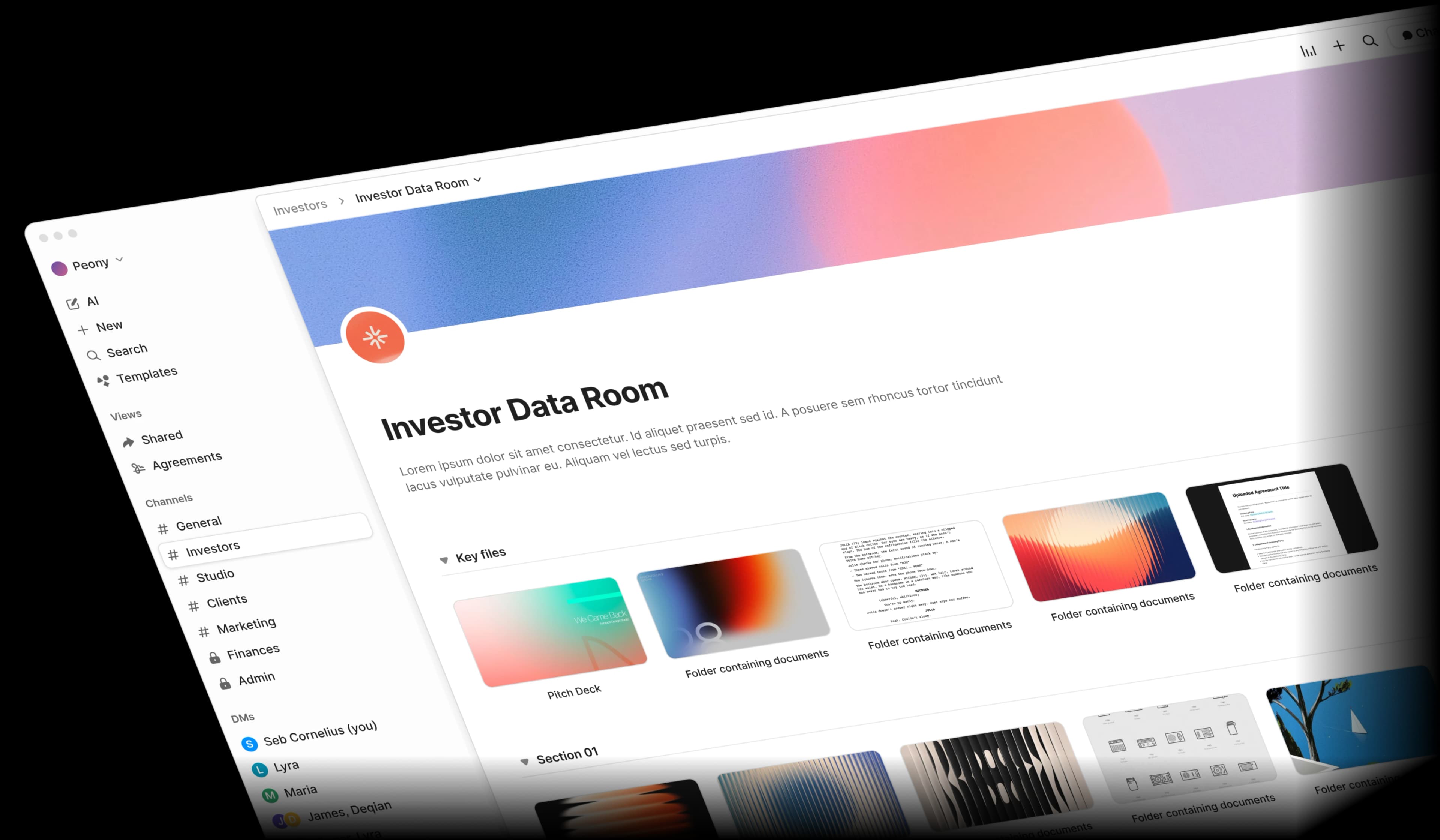
A data centre raise breaks a shared Drive folder
A connection offer is not a newsletter attachment, and a hyperscale pre-let is not a file you email around. The documents that decide a digital-infrastructure deal — the grid offer, consents, land control, the model, the lease — need a room that is gated, watermarked, tracked, and ready for a security questionnaire on day one.
Your grid file is your valuation
The connection offer, planning status, and land control decide the raise — power availability is the binding constraint, not the building. Yet the Gate 2 offer and consents too often leak through email attachments, with no watermark, no view log, and no way to pull them back when a counterparty drops out.
A 5-person developer, a £100M counterparty
For an early-stage data centre developer, the room is the first work product an institutional investor ever sees. A tidy, access-controlled room reads as institutional-grade credibility; a shared Drive folder reads as risk — and the credibility gap is priced into the terms.
Every investor asks the same 40 questions
Infra funds, PE, family offices, and lenders each run the same diligence against the same model, grid offer, and lease — in parallel. Without a structured Q&A trail and per-visitor analytics, the raise becomes an inbox of duplicated questions and no read on who is actually progressing.
The security questionnaire arrives before the demo
SOC 2, GDPR, DPA, sub-processors: serious evaluators expect these answered up front, not promised later. A data room that cannot produce its attestation, transfer safeguards, and sub-processor list on day one stalls the raise before the story is even heard.
One room, from development raise to close
Whether you are a GPU-cloud operator financing capacity through an SPV, a UK developer raising JV equity against a grid offer and powered land, or a family office underwriting a direct data centre investment, Peony gives the diligence a proper home: stage disclosure with granular permissions, read the raise from engagement, and sign and answer in the room. For an investor process, lead with the Data Room plan ($52/admin/month — watermarking and unlimited rooms). See the full plan comparison.
How do you stage disclosure across a data centre investor raise?
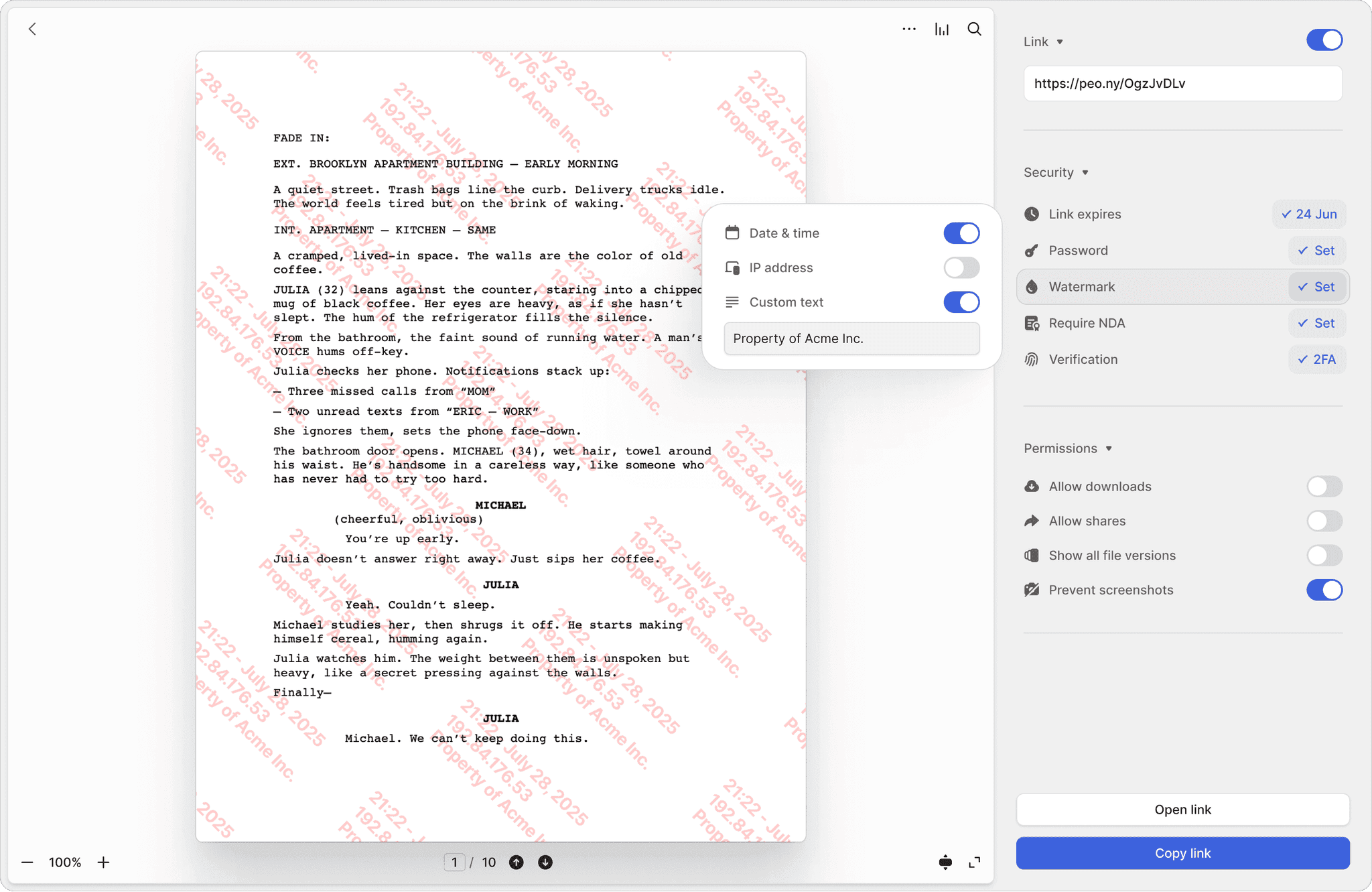
Run a teaser room and a full room from the same source, with granular folder, file, and page permissions deciding exactly what each counterparty sees. An infra fund at NDA stage sees the anonymised overview; a shortlisted bidder in exclusivity sees the grid offer, PPA terms, and pre-let economics. Approved investors land in a visitor group holding precisely their slice, behind an NDA gate, with every open logged and dynamic watermarks stamping each viewer's identity on what they open. The full development-side playbook is in our UK data centre due diligence guide.
Teaser room vs full room
One source, two views — an NDA-stage visitor sees the blind teaser; a bidder in exclusivity sees the connection offer and model. No duplicate rooms, no accidental over-disclosure.
NDA before the crown jewels
The confidentiality agreement is accepted in the room, logged with identity and timestamp, before the Gate 2 grid offer, PPA pricing, or hyperscale pre-let terms are visible.
Watermarked to the viewer
Dynamic watermarks stamp each page with the viewer's identity, so a leaked development appraisal or land option traces back to the counterparty it came from.
How do you tell which investor is actually progressing?
In a competitive process you are running many counterparties through the same room at once. Page-level analytics turn that into an intent radar: you see which fund opened the financial model, how long they sat on the grid connection offer, and which documents trigger the most scrutiny. A bidder deep in the lease and the model is progressing; one who opened the teaser once and vanished is not. That lets a sponsor sequence Q&A, time the term-sheet push, and re-forecast the raise from real behaviour — while exportable audit logs give the IC a clean record of who saw what and when.
Per-visitor page analytics
Views, downloads, and time-per-page for every counterparty — the difference between a fund doing real work in the model and one that has quietly gone cold.
Exportable audit trail
Timestamp, IP, and device on every access, exported clean for the investment committee — the governance record a family office running buy-side diligence expects.
Sequence the process
Read leverage before bids land: prioritise follow-up with the bidders spending real time on the connection offer and pre-let, not the ones going through the motions.
How do you handle NDAs, term sheets, and investor Q&A in one room?
Sign the paperwork and answer the questions where the documents already live. Built-in e-signatures close NDAs and term sheets in the room — no separate tool, no lost thread — and AI Q&A lets an investor interrogate the model and consents in plain language. The AI features run only against the model you connect, with zero retention and zero data pass-through: Peony has no access to your room contents by default. Serve the whole room from your own custom domain with your branding, so a solo developer's raise reads as institutional as the counterparty across the table. More than 8,000 customers run sensitive document processes exactly this way.
E-sign in the room
NDAs and term sheets signed where the documents live, logged with the same audit trail — no bouncing a counterparty out to a separate signing tool mid-raise.
AI Q&A, zero retention
Answers grounded in the room's own documents with citations, running only against the model you connect — no data pass-through, no vendor access to room contents.
Your raise, your name
Custom domain and branding make a lean developer's room look like the institutional platform an infra fund expects to walk into.
Built for both sides of the data centre table
The same room hosts the developer's story and receives the investor's scrutiny. Peony fits the sell-side raise and the buy-side diligence, at development, acquisition, and capacity-SPV stages alike.
GPU-cloud operators financing capacity
An operator financing off-balance-sheet AI infrastructure through an SPV shares the structure charts, hardware supply terms, colocation and MSA agreements, and signed off-take contracts with debt and equity capital partners. Granular permissions keep the contracted-revenue proof gated to serious counterparties, while page-level analytics show which capital partner is doing real work in the model. See our GPU cluster financing data room guide and the broader infrastructure projects guide.
Developers raising JV equity or forward funding
A UK or European developer raising JV equity or forward funding for a campus leads with the crown-jewel documents: the Gate 2 grid connection offer, planning and consents, land control, and power strategy. Because the room is often the first work product an institutional investor sees, its polish is the credibility. Our UK data centre due diligence guide and energy solution walk the full set — and the renewable energy data room covers behind-the-meter power.
Family offices underwriting a direct deal
A family office underwriting a direct data centre investment runs buy-side diligence: it receives the developer's room and layers its own legal, technical, and commercial DD, with strong view-side controls, watermarking, and a clean audit trail for the investment committee. Discretion is the point. See the family offices solution and, for the powered-land angle, the real estate solution.
"Ease of use, drag and drop capabilities, rapid response in support, and great service and value. It was easy to navigate throughout the platform as well as setting up our data room."
Joseph Garcia
Providence Water
Frequently asked questions
Is Peony SOC 2 certified — Type I or Type II?
Peony is SOC 2 Type II-ready — controls aligned to SOC 2, with a formal Type II audit not yet completed. On the Deal Team plan ($64/admin/month) the standard DPA and security documentation are self-serve, so your counsel can pull both without waiting on a sales call. Honest note: SOC 2 is technically an attestation issued by a CPA firm, not a government certification — so a serious evaluator should read the report's period and scope, not just accept the badge. That is exactly what we would tell you to do with any vendor, ours included.
Does Peony hold ISO 27001?
Honest answer: no. Peony is SOC 2 Type II-ready rather than ISO 27001-certified today. The two frameworks overlap substantially on the controls that matter for a data centre investor room, but they are not the same certificate — and if your process requires the ISO 27001 certificate itself as a hard line item, we will tell you that plainly rather than blur the distinction. Our data room security questionnaire guide shows exactly what to check on any vendor, so you can compare like for like.
Where is data processed, and how does UK GDPR compliance work?
Room data is processed in the United States (AWS us-east-1). For UK and EEA transfers we rely on Standard Contractual Clauses and appropriate safeguards, and a DPA is available. Our sub-processors are publicly listed — AWS, Vercel, Cloudflare, and Stripe — and we set only strictly necessary cookies. The contracting entity is Peony (US) Inc., with a registered address in London. Honest line: standard plans are US-hosted; if your counsel mandates UK or EU-soil hosting, our Enterprise plan offers custom data residency (including UK/EU), BYOK, and self-hosted deployment. Most evaluators find transfer safeguards plus document-level controls satisfy the review on standard plans, because a deal room holds corporate documents rather than consumer personal data at scale.
Can investors run AI Q&A with cited sources?
Yes. AI Q&A runs against the models you connect, with answers grounded in the room's own documents and citations back to the source pages. There is zero retention and zero data pass-through by default — the AI features run only against the model you bring, and Peony has no access to your room contents. An investor can ask 'what is the grid connection capacity and date?' and get an answer drawn from the connection offer itself, not a hallucination.
What analytics and audit detail do we get?
You get page-level analytics per visitor — views, downloads, and time spent per page — so you can see which fund opened the financial model and how long they sat on the grid offer. Audit logs are exportable with timestamps, IP, and device detail, and aggregate engagement dashboards are available on the Business plan and up. In a live raise this is your investor-intent radar: it tells you who is genuinely progressing and who has gone cold.
How does pricing work for a single project with a pipeline behind it?
Pricing is per admin seat, not per recipient — Business is $30/admin/month and Data Room is $52/admin/month, and recipients are always free. You can run month-to-month, there are no per-page fees, and a three-admin raise costs low hundreds of dollars a month rather than the $15K+ quotes legacy VDRs attach to a single deal. Median setup time is 4m19s, so a developer can stand up a professional-grade room the same afternoon the term sheet lands.
Who already uses Peony for infrastructure and real-asset work?
More than 8,000 customers use Peony. The UK is Peony's second-largest market, with 140+ customers across the UK and Europe — including real-estate firms, energy companies, infrastructure developers, and family offices. We do not publish client names in marketing, by design, because the discretion that matters to a data centre raise matters to how we treat our own customers. Uptime has been 99.96% since August 2025.
Give your data centre raise a room that reads institutional
Stage disclosure across the grid offer, powered land, and model; read the raise from per-visitor engagement; and sign NDAs and term sheets in the room — on per-admin pricing with recipients free, SOC 2 Type II from day one. Join the 8,000+ customers who run sensitive document processes on Peony. No credit card required.
No credit card required