
The venture capital data room for fund raises, LP reporting and deal diligence
Raise the next fund from LPs who read the PPM before the first meeting, send quarterly reports you can see each LP open, and run diligence on every new deal and co-investment: one secure Peony room per fund, deal or portfolio company, with unlimited rooms on Data Room.
No credit card · 7-day Data Room trial that never auto-charges · LPs, founders and co-investors view free, no account · 24/7 support
Live in under 5 minutes
Last updated October 2026
TL;DR for VCs — Updated October 2026
- 5-minute setup, no sales call (median 4 min 19 s from sign-up to first uploaded document)
- $30/admin/mo, or $52/admin/mo for unlimited rooms (billed yearly), with predictable pricing and no per-deal or per-LP fees (vs DocSend Standard $65/user/mo, $45 billed yearly; Datasite $60K+/yr)
- AI Q&A + page-analytics + NDA gating + auto-indexing
- Free tier: page analytics, 2FA (data rooms start on Business)
Trusted by Telstra Ventures

8,000+ customers in 60+ countries · $44.7B in client assets
Peony staff can't open your documents, your documents aren't used to train AI, and Peony has had no data breach since launch.
What is Peony's venture capital data room, and who is it for?
Peony is a virtual data room that VC firms and emerging managers use to raise funds from LPs, send quarterly reports and capital-call notices with page-level tracking, and diligence new deals and portfolio companies. Data Room, Peony's most popular plan, is $52 per admin per month billed yearly with unlimited rooms and storage, and LPs, founders and co-investors never pay.
A venture capital data room is the permissioned online workspace a VC firm uses to share fund and deal documents (the PPM, LPA, track record, DDQ responses, quarterly reports and deal diligence files) with LPs, founders and co-investors under NDA. This page covers the fund side: founders raising from VCs should see fundraising data rooms, and a standing LP reporting portal is covered on investor relations. What LPs expect to find in a fund room is in the VC fund data room checklist.
- Fund raising: a tracked, NDA-gated link per prospective LP into the fund room, page-by-page reading of the PPM, track record and DDQ responses, and e-signed subscription agreements in the same workspace.
- LP reporting: quarterly reports, capital-call notices and K-1s at each LP's link, with who opened them, how long they read and who hasn't opened them yet.
- Deal flow and portfolio diligence: a room per deal, co-investment or portfolio company, with AI document Q&A that answers across the deck, model and cap table with page citations.
Peony at a glance
- Built for
- Venture capital firms from solo GPs and Fund I emerging managers to multi-fund platforms, with their IR and fund-operations teams, syndicate leads and corporate venture arms: fund raises, LP reporting, deal diligence, co-investments, SPVs and GP-led secondaries.
- Typical plan
- Data Room, $52 per admin per month billed yearly ($75 monthly): unlimited rooms, documents and storage with no per-file size cap, a signed NDA with audit record, dynamic watermarks, a group with its own folder and file permissions per LP, access questions, Visitor Q&A, a custom domain, AI room generation, Index documents and a per-visitor audit trail.
- Pricing
- Business $30, Data Room $52 and Deal Team $64 (minimum 4 admins) per admin per month billed yearly ($44, $75 and $89 monthly); Enterprise is custom. Free ($0) covers 50 documents and 500 MB as tracked single-file links; data rooms start on Business.
- LPs, founders and co-investors
- LPs, founders and co-investors are unlimited and free on every plan and don't need a Peony account. You pay per admin, not per viewer.
- Rooms and storage
- Unlimited data rooms, documents and storage on Data Room and above, and no per-file size cap on any plan. Business includes 3 data rooms per admin, 1,000 documents per admin and 100 GB of storage, with no per-file size cap.
- Versus DocSend and legacy VDRs
- From $30/admin/month, or $52/admin/month for unlimited data rooms, with no per-deal, per-LP or per-page fees. DocSend Standard is $65 per user per month billed monthly ($45 yearly) and puts data rooms and NDAs on its Advanced tier (checked October 2026); Datasite runs $60K+/yr.
- LP reporting
- Page-level analytics on every plan show which LPs opened each quarterly report and for how long. Upload new version replaces a report at the same link, with earlier versions in the version menu; New file notifications (Deal Team) email LPs a daily summary of what was added.
- Deal flow
- AI document Q&A answers across every file in a deal room with page citations (Business and above; 5x usage on Data Room). AI room generation drafts the folder tree and Index documents numbers every file (Data Room).
- File management
- Upload new version keeps a file's place and link and keeps every earlier version; AI room generation drafts the folder structure, and Index documents numbers every file (Data Room plan). Duplicate a data room copies its files and folders into a fresh room; groups, links and analytics start clean.
- Live models
- Peony renders .html files live with JavaScript running, so a Claude or ChatGPT artifact (a model, dashboard or calculator) stays interactive for the viewer, behind your NDA gate, permissions and analytics.
- Enterprise
- Deal Team ($64 per admin per month billed yearly, minimum 4 admins) adds OAuth SSO, API access, room archive download, advanced redaction, Advanced Q&A routing, New file notifications, priority support and a dedicated account manager. Enterprise (custom pricing) adds SAML SSO, BYOK, self-hosted or white-label deployment, and custom data residency including EU-region hosting. Deal Team and Enterprise provide a standard DPA with SCCs on request.
- Security
- AES-256 at rest, TLS 1.2+ in transit. Peony staff can't open your documents, your documents aren't used to train AI, and Peony has had no data breach since launch. Peony's incident-response policy commits to telling affected customers within 72 hours of confirming an incident that affects customer data. SOC 2 Type II-ready and ISO 27001-ready, with both audits underway. Compliance and certifications
- Setup
- Median 4 min 19 s from sign-up to first uploaded document (State of M&A Data Rooms, Q3 2026 edition).
- Trial
- 7-day Data Room trial you start yourself: no credit card, and it never auto-charges. Rooms, files, links, analytics and NDA settings carry over when you upgrade. AI features switch on after you upgrade.
- Support
- 24/7 support, handled directly by the Peony team across Europe, US and Asia hours, with no outsourced tier. Everyone you speak to on Peony support has M&A experience at elite boutiques or bulge-bracket banks, VC experience, or has raised $1M+ themselves.
- Customers
- 8,000+ customers in 60+ countries, with $44.7B in client assets.
Which venture capital teams use a data room, and for what?
Venture capital firms use a data room wherever the fund shares confidential documents: raising the fund, reporting to LPs, diligencing deals, co-investing and supporting portfolio companies, and Peony runs all of them from one workspace. These are the six teams that run rooms in Peony, and what each uses them for.
Emerging managers (Fund I and II)
A fund room for the deck, PPM, LPA and track record, often raised from family offices and high-net-worth LPs before institutions arrive. See data room for emerging managers.
Established GPs raising Fund III and beyond
Institutional LP diligence: the DDQ, track record, valuation policy and compliance manual behind an NDA, a link per LP. Checklist: VC fund data room checklist.
Investor relations and fund operations
Quarterly reports, capital-call notices and K-1s with page-level read tracking per LP. See the VC LP reporting guide; for a standing LP portal, see investor relations.
Investment teams
Deal flow screening and diligence on new investments: a room per deal with the deck, model, cap table and legal documents, and AI document Q&A with page citations.
Syndicate leads and co-investors
A room per SPV or co-investment, so each partner sees one deal and never the pipeline. See the SPV data room playbook.
Platform teams and portfolio companies
Board packs and portfolio reporting in a room per company. When a portfolio company raises its own round, the founder-side page is fundraising data rooms.
Why do VC firms need a dedicated data room?
VC firms need a dedicated data room such as Peony because deal memos, LP reports, term sheets, and portfolio updates demand NDA-gated access, page-level tracking, and audit trails that generic file-sharing tools cannot provide. Between deal flow memos, LP quarterly reports, term sheets, and portfolio company updates, VC firms juggle confidential documents across dozens of tools. One misshared file can derail a deal.
Deal flow document sprawl
Pitch decks, financial models, and due diligence materials for dozens of deals scattered across email, Dropbox, and Google Drive. Finding the right file wastes hours.
LP report confidentiality
Fund performance data, IRR calculations, and capital call notices sent via email attachments. No way to track who opened them or prevent forwarding.
Co-investment coordination
Sharing term sheets and deal memos with syndicate partners requires strict access control. Generic sharing tools make it impossible to enforce confidentiality.
Fundraising without infrastructure
PPMs, subscription agreements, and DDQ responses shared over email with no tracking. No way to know which prospective LPs are serious and which are just browsing.
What does a VC-purpose-built data room include?
A VC-purpose-built data room like Peony includes NDA-gated LP portals with page-level analytics, branded fund reporting, deal-screening AI Q&A, isolated co-investment rooms and auto-indexing, at per-admin pricing rather than per-deal or per-LP fees.
Legacy VDRs like Ideals, Firmex, and Digify charge enterprise prices for glorified file hosting. Peony gives you dedicated data rooms for deal screening, fund raising, LP reporting, and co-investments, with page-level analytics on every plan, AI document Q&A on the Business plan, and unlimited rooms plus auto-indexing on the Data Room plan.
Raise your next fund with a data room that closes LPs faster
Peony gives every prospective LP its own tracked link into the fund room and shows, page by page, who read the PPM, track record and DDQ responses, for how long, and who came back.
When you are raising a new fund, prospective LPs expect a professional, secure experience. Peony lets you distribute PPMs, answer due diligence questionnaires with cited drafts from AI document Q&A, and give each prospective LP their own branded portal with page-level analytics, so you know who is serious before the first call. Access questions ask each visitor for its LP type and target commitment before the room opens, and subscription agreements go out for e-signature from the same workspace. The full list of what LPs diligence is in the VC fund data room checklist.
(Page-level analytics on every plan; NDA gate, email verification, logo and unlimited e-signatures from Business ($30/admin/mo); access questions, the signed NDA, dynamic watermarks and a custom domain on Data Room ($52/admin/mo), billed yearly.)
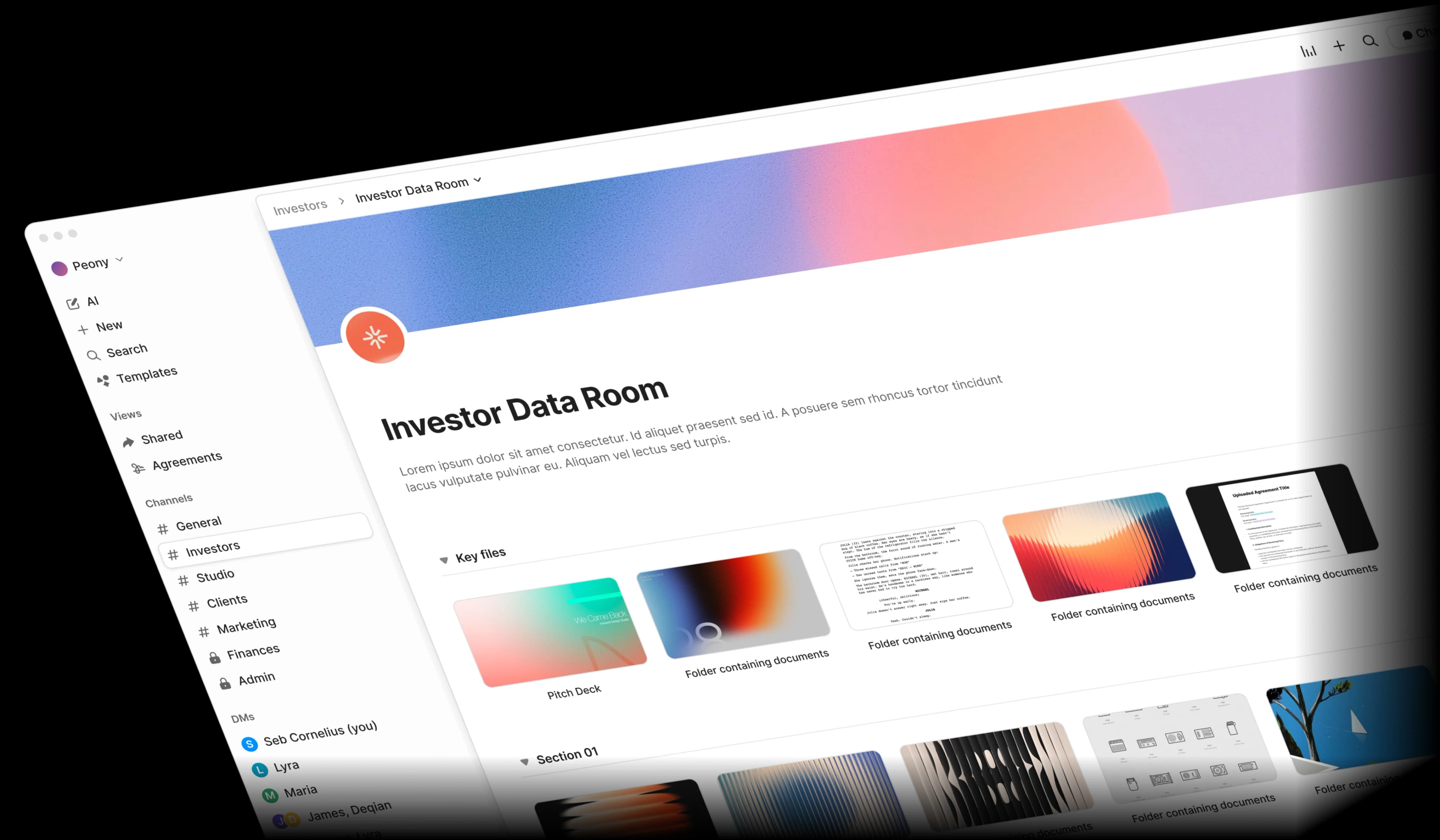
PPM & fund document distribution
Share your Private Placement Memorandum, subscription agreements, and fund terms through branded, NDA-gated links. Each prospective LP gets their own access link so you can track who reviewed which sections and for how long.
AI-powered DDQ responses
LPs send due diligence questionnaires with hundreds of questions. Ask Peony's AI document Q&A each question and it answers from your fund documents (track record, strategy memos, compliance policies) with page citations, so your team reviews and approves a cited draft instead of writing from scratch every time (Business and above, once on a paid plan).
LP commitment tracking
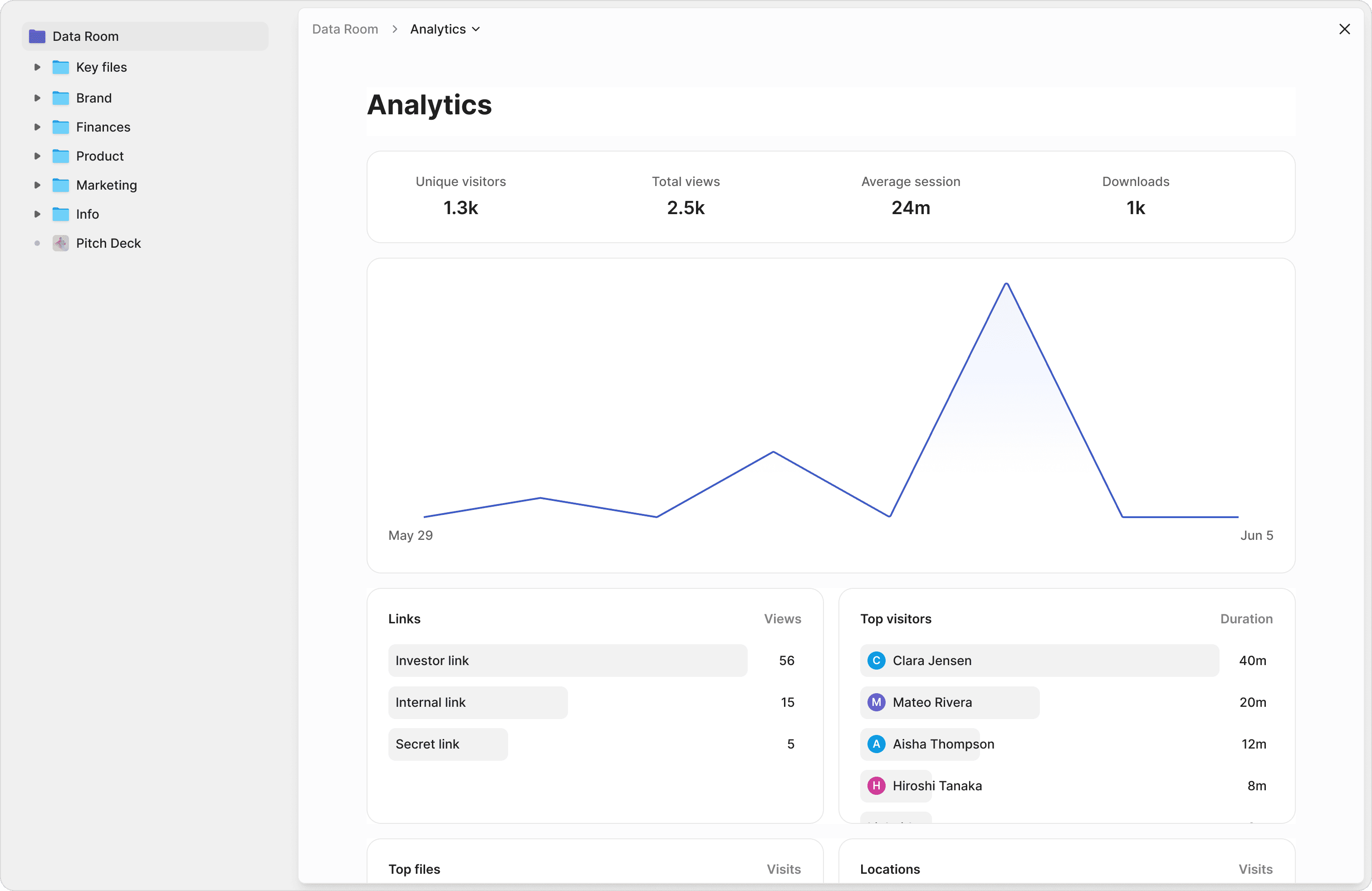
Page-level analytics show which prospective LPs are deep in your PPM versus just browsing the summary. Prioritize follow-ups with the LPs most likely to commit, and know exactly when to schedule that partner meeting.
Personalized reporting, fund branding, and LP engagement tracking
Peony keeps each quarterly report, capital-call notice and K-1 at every LP's link and shows which LPs opened it, how long they spent on each page and who has not opened it at all.
Give every LP a branded experience that reflects your fund. Post quarterly updates once, track who read what, and know exactly which LPs need a follow-up call before they even ask. Upload new version swaps a corrected report in at the same link, and an interactive LP report built as a Claude or ChatGPT HTML artifact runs live in the room behind the same NDA gate; see how to share an interactive LP report. For a standing LP portal across funds, see investor relations.
(Logo, cover image and theme from Business ($30/admin/mo); custom domain on Data Room ($52/admin/mo); New file notifications to LPs on Deal Team ($64/admin/mo, minimum 4 admins), billed yearly.)
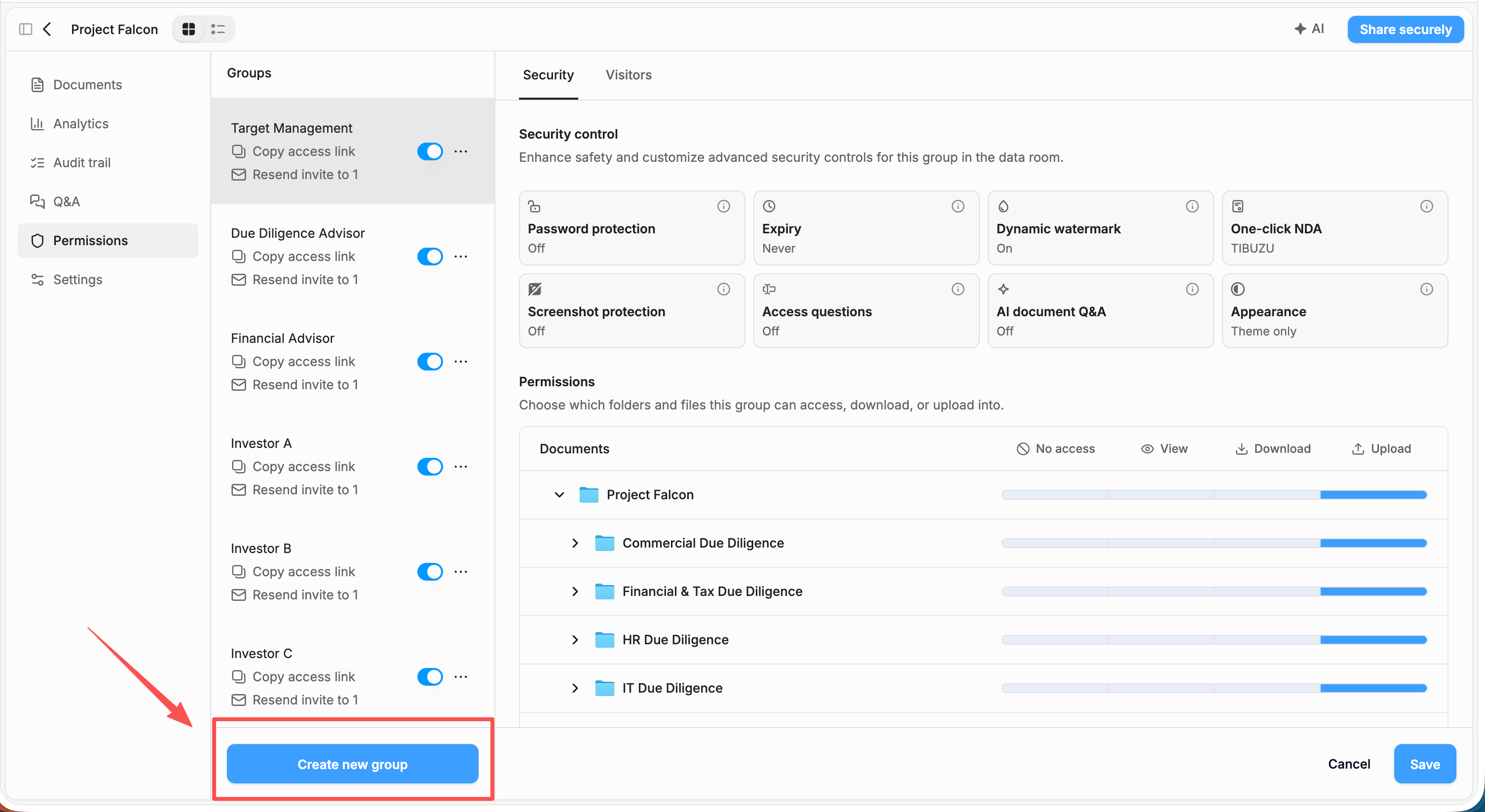
Branded LP portals
Each LP gets a personalized, branded experience matching your fund identity: your logo, cover image and theme from Business, and your own domain on Data Room. No generic file-sharing links.
Quarterly report distribution
Upload the quarterly report once to the LP room and every LP's link shows it, with individual tracking. Replace the manual email-and-attachment workflow that eats up your IR team's time every quarter; New file notifications (Deal Team) email LPs a daily summary of what was added.
LP engagement ranking
See which LPs are most engaged, ranked by time in the room and by return visits, who has not opened your latest report, and when it is time to reach out. Prioritize re-up conversations with data, not guesswork (room-wide rankings on Data Room).
Screen 10x more deals without 10x the analysts
Peony's AI document Q&A reads every document in a deal room and answers questions about revenue, burn or the cap table with a citation to the source page, so partners spend their time on the deals worth it.
Your team reviews hundreds of pitch decks, financial models, and cap tables every quarter. Peony's AI-powered Q&A reads every uploaded document so you can ask questions across an entire data room instantly: spot red flags in minutes, not days, and pass on weak deals before they consume partner time.
(AI document Q&A from Business ($30/admin/mo), with 5x usage on Data Room ($52/admin/mo); AI room generation, Index documents and unlimited rooms on Data Room, billed yearly. AI features switch on after you upgrade.)
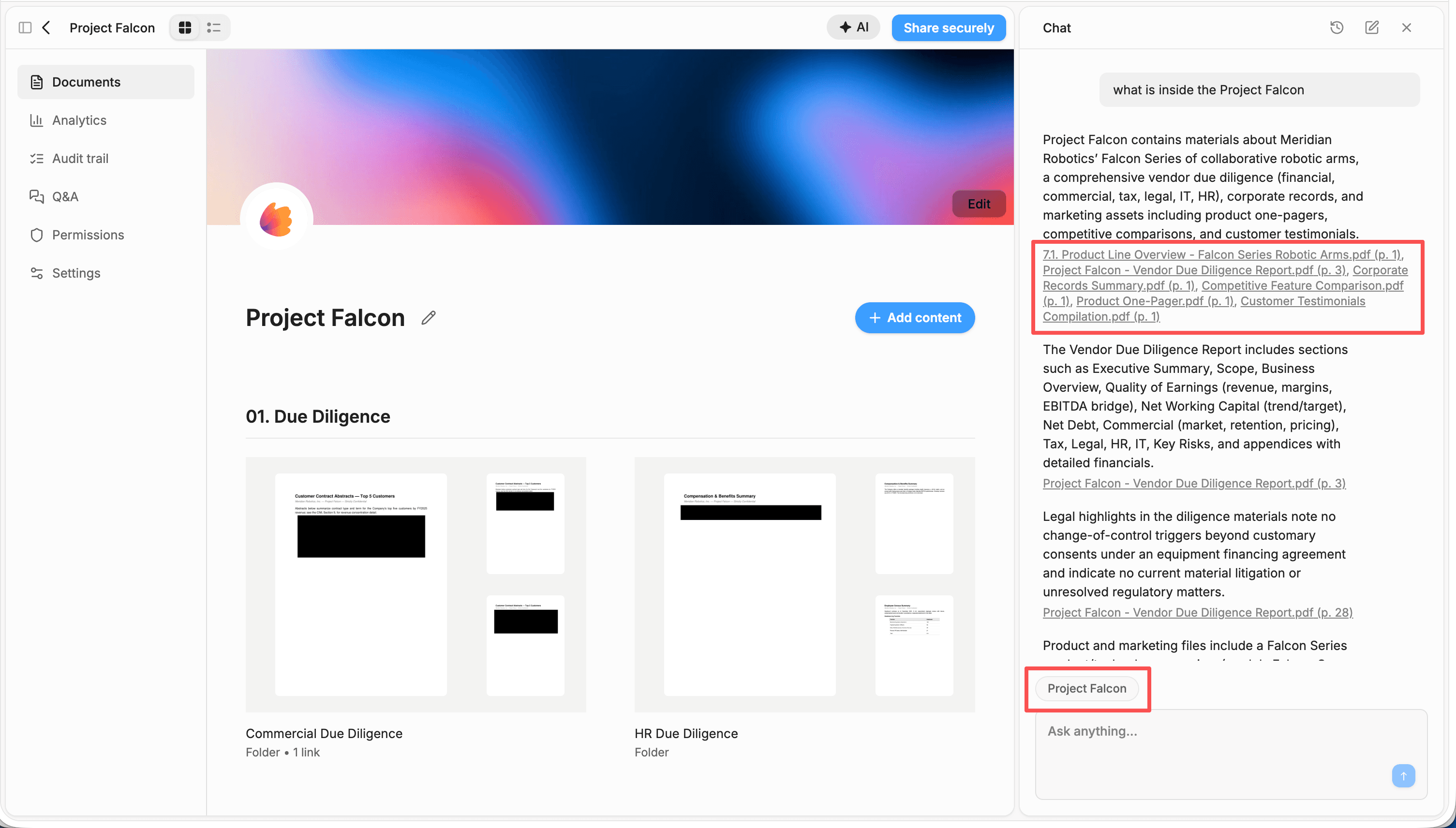
AI-powered deal assessment
Upload a startup's pitch deck, financials, and legal docs into a data room. Ask Peony's AI any question (revenue growth, burn rate, cap table issues) and get sourced answers in seconds instead of hours of manual review.
Red flag detection
Ask the AI to compare figures across documents and it surfaces inconsistencies, such as revenue figures that do not match between the deck and financials, unusual cap table structures, or missing key disclosures, each cited to its page. Discard bad deals faster so your partners focus on the winners.
Auto-indexed data rooms
AI room generation drafts the folder tree from a one-line description, and Index documents numbers every folder and file (1, 1.1, 1.2) the moment it lands, so everyone can say "open 2.3". Uploaded files are processed so every deal room is searchable and citable by AI Q&A from day one.
AI that reads your portfolio so you do not have to
Peony's AI document Q&A answers across every portfolio company update and board deck in a room at once, with each answer cited to its source page.
Peony's AI-powered Q&A and auto-indexing work across every portfolio company update, board deck, and fund document in a room at once. Surface key metrics, flag risks, and draft LP answers using your actual data. AI document Q&A starts on the Business plan ($30/admin/month), with auto-indexing and 5x AI usage on the Data Room plan ($52/admin/month), not an enterprise upsell like Ideals or Firmex charge.
(AI document Q&A from Business ($30/admin/mo); 5x usage, AI room generation and Index documents on Data Room ($52/admin/mo), billed yearly.)
Cross-portfolio search
Keep portfolio company updates in one room and ask questions across all of them at once. Compare revenue growth, burn rates, or hiring plans across your entire fund without opening a single PDF.
Board deck summarization
AI extracts key metrics and flags from portfolio company board materials. Get a one-page summary of every board deck before your next partner meeting.
LP question autopilot
AI document Q&A answers LP questions from your actual fund documents, with page citations, for your team to review before replying. Stop spending hours pulling numbers for LP advisory committee meetings.
Every question, answer, and document access in one audit trail
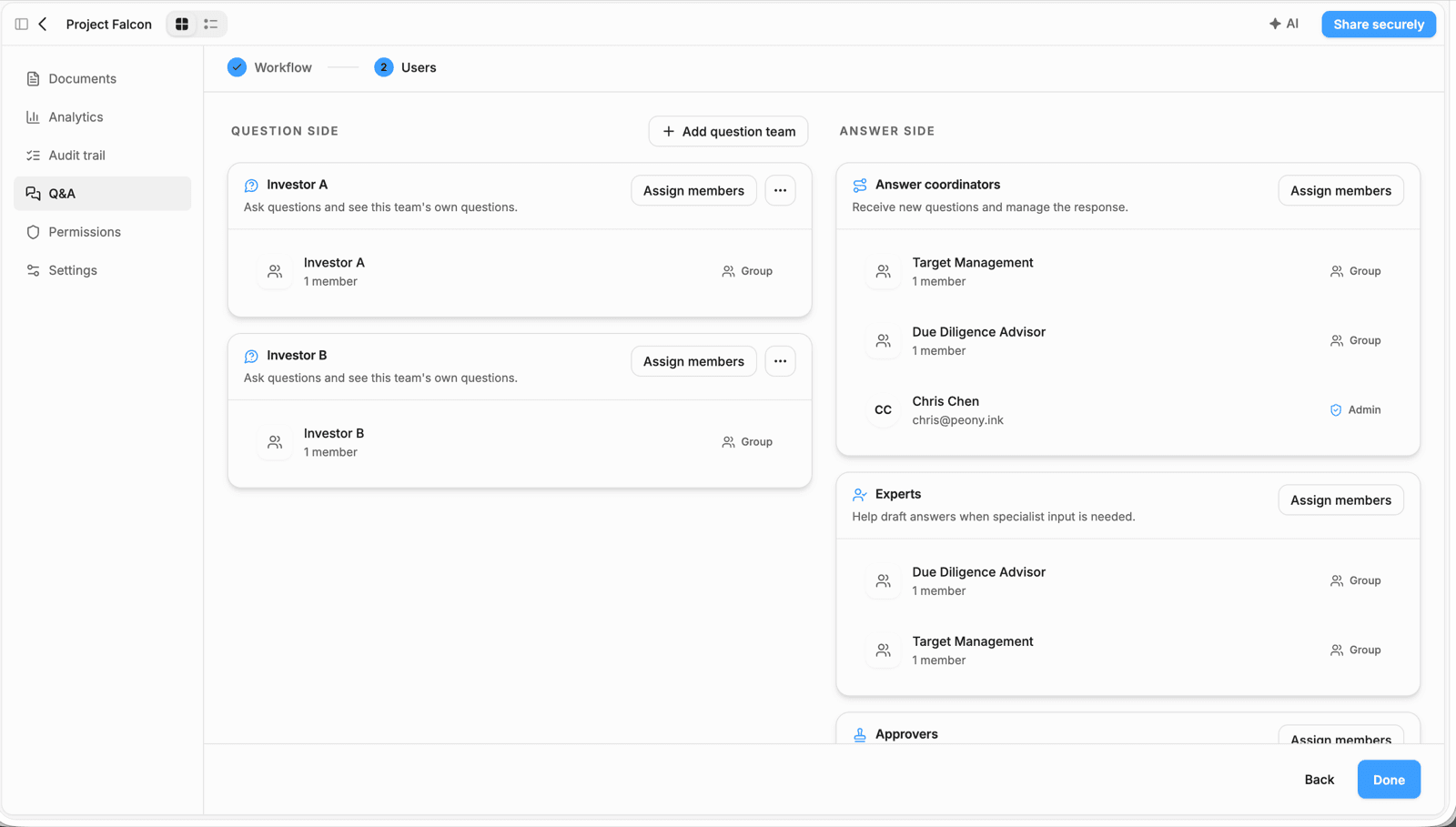
Peony gives each deal and co-investment its own room, keeps each counterparty's questions in its own question team, and records every file each person opened in a per-visitor audit trail.
Legacy VDRs give you a folder and a prayer. Peony gives you isolated data rooms, structured Q&A workflows with role-based permissions, and a complete audit trail of every view, download, and question, so diligence communications stay organized, secured, and defensible.
(Unlimited rooms, Visitor Q&A with question teams and the audit trail: Data Room ($52/admin/mo). Assign-and-approve Q&A routing: Deal Team ($64/admin/mo, minimum 4 admins), billed yearly.)
Deal-specific access rooms
Spin up isolated rooms per deal so no LP or co-investor sees another deal's materials. Each room has its own permissions, NDA requirements, and audit trail.
Structured Q&A workflows
Diligence questions and answers flow through a permission-controlled Q&A module, not scattered email threads. Assign questions to the right team member, track response status, and keep every exchange in a single, auditable record (assign and approve routing on Deal Team).
Co-investment sharing controls
Invite syndicate partners to specific deals without exposing your full pipeline. Grant time-limited access and revoke it the moment a deal closes or falls through.
How do GPs give LPs secure access to fund-specific documents?
GPs give each LP its own Peony link into the fund room, with email verification, an NDA gate and folder permissions, so every LP opens only the documents it is cleared for. Run one room per fund or vehicle, so a Fund III prospect never sees Fund II reporting or a co-invest SPV's materials; inside a room, No access removes a folder from an LP's view, file names included. Access questions record each LP's type and target commitment before the room opens, an allow list keeps a forwarded link from opening for anyone you didn't list, and dynamic watermarks and a per-visitor audit trail record who saw what. Rooms are unlimited on the Data Room plan ($52 per admin per month billed yearly), and LPs view free with no Peony account.
One room per fund or vehicle
Rooms are unlimited on Data Room, so Fund II, Fund III, each SPV and each continuation vehicle gets its own room, NDA and audit trail. Duplicate a fund room to reuse its folder tree; groups, links and analytics start clean.
A group and link per LP
Each LP gets its own group with its own link, NDA record, analytics and on/off switch. Add an LP's firm domain to its group so colleagues at that LP get in under their own verified email (Data Room).
Check who is opening
Email verification sends each viewer a one-time code and an allow list admits only the addresses you listed (Business); access questions ask for LP type and target commitment before entry (Data Room).
Permissions by folder and file
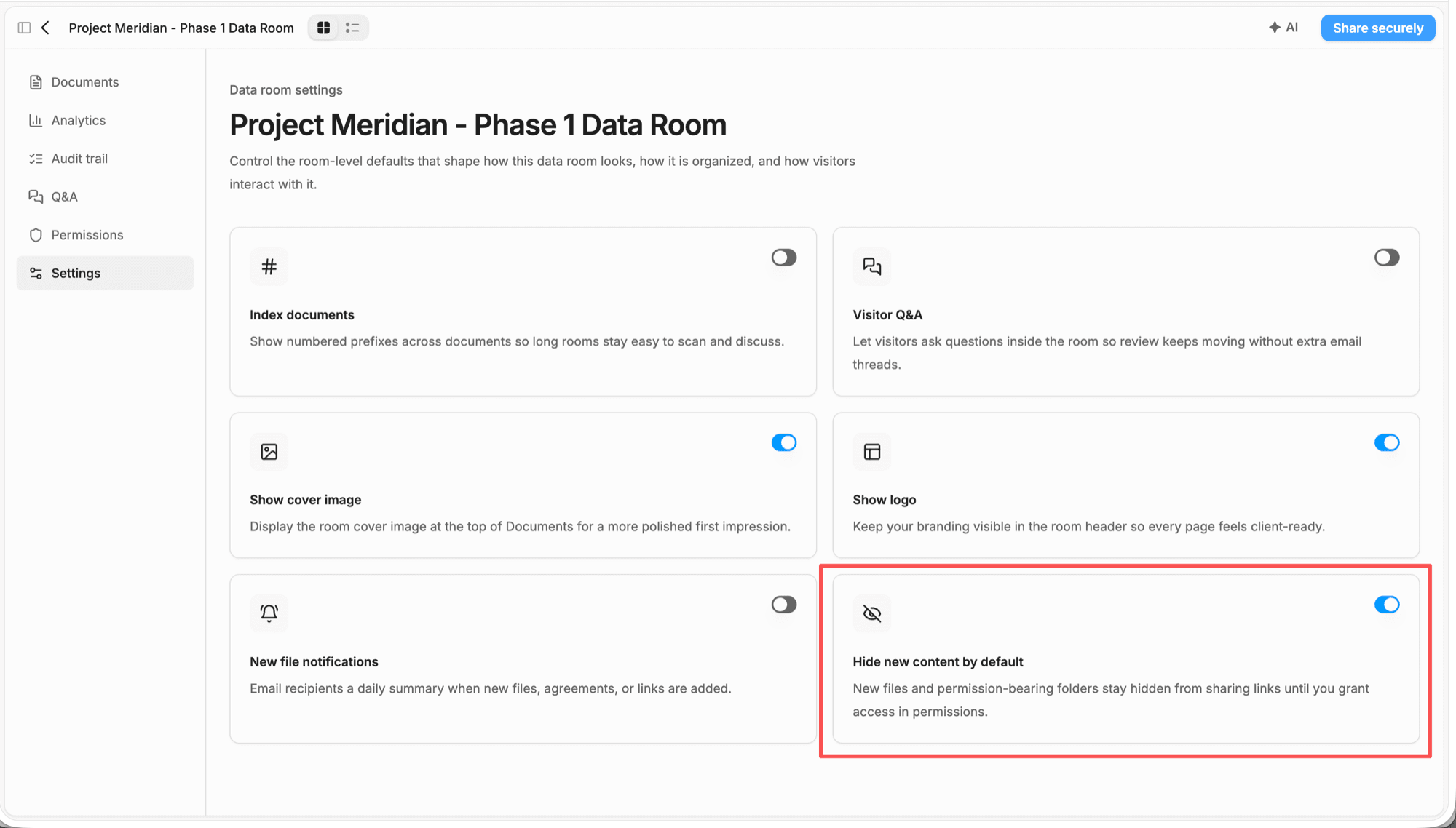
Set No access, View or Download per folder and file for each LP group, and turn on Hide new content by default so a new side letter or capital account statement stays hidden until you grant it (Data Room).
Switch off and keep the record
Set an expiry date on any link, switch a group off and its link stops opening, and the audit trail keeps a timestamped, file-by-file record of what each LP opened (Data Room).
How does a venture fund run in Peony, from first LP meeting to quarterly reporting?
A venture fund moves from fund marketing to LP diligence, the close, investing and LP reporting; in Peony each stage is a room, group or folder setting on one plan.
- Fund marketing. Share the deck and a teaser as tracked links, then invite interested LPs into the fund room behind an NDA gate; access questions record LP type and target commitment before entry (Data Room).
- LP due diligence. Open the PPM, LPA, track record and DDQ responses group by group; AI document Q&A answers DDQ questions from your own fund documents with page citations, and Visitor Q&A keeps each LP's questions in its own question team (Data Room).
- Closing. Send subscription agreements and side letters for e-signature from the same workspace (unlimited e-signatures from Business); signed copies land in the Signatures view with an audit log.
- Investing. Run a room per new investment, co-investment or SPV, give founders Upload access to request folders, and give each syndicate partner its own group (Data Room: unlimited rooms).
- LP reporting. Post quarterly reports, capital-call notices and K-1s to the LP room; Upload new version keeps each report at the same link, page-level analytics show who opened it, and New file notifications email LPs a daily summary (Deal Team).
- The next fund. Duplicate the Fund I room into a Fund II room: files and folders copy over, while groups, links and analytics start clean.
The LP-side checklist is in the VC fund data room checklist, and what LPs want in each quarterly report is in the VC LP reporting guide.
How do venture capital teams run their rooms in Peony?
VC teams run Peony with one room per fund, deal or co-investment and a tracked group link per LP or counterparty; four common situations follow, each with its setup and plan.
Emerging manager: a $20M Fund I with 12 target LPs.
Your LPs will judge your operational maturity before they wire capital, and a shared Google Drive folder signals exactly the wrong thing. Give each of the 12 LPs its own NDA-gated link into a branded fund room, and page-level analytics show which LPs actually read your PPM and who skimmed the executive summary. Business adds e-signatures for subscription agreements, email verification, screenshot protection, and AI document Q&A for LP due diligence questions; Data Room adds unlimited rooms, dynamic watermarks, signed-PDF Advanced NDAs with an audit trail, Screenshield and a custom domain. That is a fraction of what Ideals or Firmex charge for enterprise onboarding, and you never pay per-LP or per-page fees on any plan. More in data room for emerging managers.
Business ($30/admin/mo) or Data Room ($52/admin/mo)
Investor relations, Fund III: a $250M fund with 40+ LPs expecting quarterly reports in a branded portal.
Put the quarterly reports in an LP room with your logo, cover image and custom domain, one group and link per LP, with an NDA gate in front. Page-level analytics show which LPs opened the Q4 update, how long they spent on the portfolio summary versus the IRR waterfall, and who has not opened it at all, so IR calls the right LPs before the re-up conversation. Upload new version swaps a corrected report in at the same link, and there are no per-LP, per-page or per-link limits, so costs stay flat whether you report to 40 LPs or 80 after your next close.
Data Room plan
Seed partner: 50+ companies screened every quarter.
Spin up a room per deal, upload the deck, model and cap table, and ask AI document Q&A about burn, revenue growth or unusual cap table terms, with each answer cited to its page. AI room generation drafts each room's folders and Index documents numbers every file, and every room keeps its own permissions and audit trail. Unlimited rooms mean the fiftieth deal costs the same as the first.
Data Room plan: unlimited rooms; AI features once you're on a paid plan
Associate: a lead Series B diligence room by tomorrow morning.
Create the room, let AI room generation draft the folders, and upload the CIM, financials, legal documents and cap table; set folder-level permissions for your deal team and co-investors and send the founder a branded link with Upload access to the request folders. No sales call, no IT ticket and no onboarding process: the median Peony customer goes from sign-up to first uploaded document in 4 min 19 s (State of M&A Data Rooms, Q3 2026 edition). Legacy VDRs like Ideals and Firmex require multi-day onboarding that would blow your deadline.
Data Room plan
"Peony is a standout for data rooms and gated file sharing — it gave us the control and visibility needed to close the deal with a great viewer experience."
Michael Hui
Managing Director, Piton Partners
Robi Lin
Founder & CEO, Sepal AI (YC S24)
Peony is easily the best form factor for sharing client-facing material. It lets us stand out by embedding custom booking and website links into secure deck shares — DocSend and PDFs require 3 extra clicks to book a meeting.
No credit card · 7-day Data Room trial that never auto-charges · LPs, founders and co-investors view free, no account
How do venture capital firms keep confidential decks and LP data from leaking?
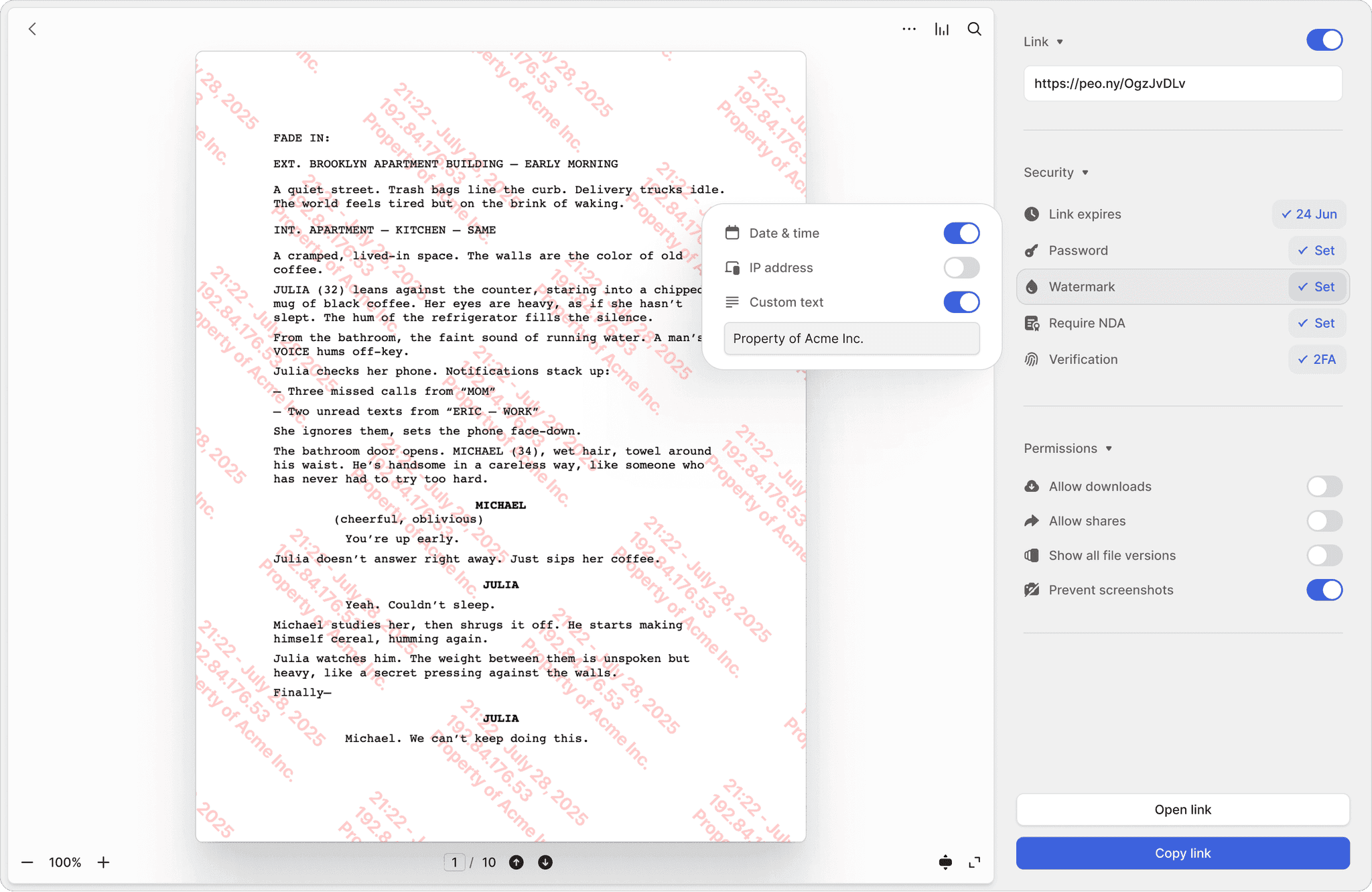
VC firms keep confidential decks, term sheets and LP reports in Peony behind NDA gates, with downloads off, screenshot protection on, a dynamic watermark naming each viewer on every page, and instant access revocation. Screenshot protection blocks desktop captures from Business ($30 per admin per month billed yearly), and Screenshield extends it to iPhone, iPad and Android on Data Room ($52); the watermark carries the viewer's email, IP and timestamp, so a leaked valuation memo traces back to one person. Before you share an LP letter or deal memo that must not show another LP's terms or a valuation, advanced redaction on Deal Team ($64 per admin per month billed yearly, minimum 4 admins) removes the text from the file rather than covering it. Peony staff can't open, move or edit the documents in your room.
Term sheet leak prevention
Watermark and screenshot-protect sensitive deal terms with per-viewer tracking. If a valuation memo surfaces where it should not, you know exactly who leaked it.
Screenshot protection
Block screen captures of decks, LP reports and models on desktop from Business, and log attempts; Screenshield extends protection to iPhone, iPad and Android on Data Room.
Dynamic watermarks
Every page carries the viewer's email, IP and timestamp, so a leaked page traces back to one LP, founder or co-investor (Data Room).
NDA-gated access
An acknowledge-only NDA from Business, or a signed e-signature NDA with a stored PDF and audit record on Data Room, set per group.
Instant access revocation
When a deal closes or a co-investor drops out, switch its group off and its link stops opening; every other group is untouched. Expiry dates work on every plan.
Advanced redaction
Take another LP's terms, a valuation or a founder's personal data out of a PDF before it is shared; the redacted copy has the text removed from the file, not covered (Deal Team).
Peony staff can't open your documents, your documents aren't used to train AI, and Peony has had no data breach since launch. The current audit status is on Compliance and certifications.
How does Peony compare to other VC data rooms?
Peony delivers AI Q&A, page-level analytics and NDA gating from $30/admin/month, features legacy VDRs like Datasite charge $60K+/year for. DocSend offers no in-room AI document Q&A or screenshot protection on any plan, and puts NDAs and data rooms on its Advanced tier.
| Capability | Peony | DocSend | Ideals | Firmex | Datasite |
|---|---|---|---|---|---|
| Price | From $30/admin/mo | $65/user/mo Standard ($45 yearly); data rooms from $250/mo for 3 users | Enterprise pricing | Enterprise pricing | $60,000+/yr |
| AI Q&A | Yes (Business plan) | No | No | No | Limited |
| Page analytics | Every plan (incl. free) | Paid plans only (no free plan) | Enterprise tier | No | Yes |
| NDA gating | Yes (Business plan) | Advanced tier and up | Yes | Yes | Yes |
| Setup time | Under 5 minutes | Same-day | Multi-day onboarding | Multi-day onboarding | Multi-day onboarding |
| Per-LP fees | None | Per-user | Per-page/per-user common | Per-page/per-user common | Per-page/per-user common |
Peony prices from Peony's plans and pricing docs; DocSend prices from DocSend's published pricing, checked October 2026. Pricing models for the other providers are in our virtual data room cost guide. Side-by-side pages: Peony vs DocSend, Datasite, iDeals and Firmex.
What does a venture capital data room cost on Peony?
On Peony, venture capital rooms run on Data Room at $52 per admin per month billed yearly ($75 monthly), with unlimited rooms, documents and storage, and LPs, founders and co-investors view free.
You pay per admin, not per LP and not per data room: a two-partner fund on Data Room pays $1,248 a year whether it reports to 12 LPs or 120, and a solo GP on Business pays $360 a year for 3 data rooms and 100 GB of storage. Deal Team ($64 per admin per month billed yearly, minimum 4 admins) adds advanced redaction, Advanced Q&A routing, New file notifications, OAuth SSO and API access.
Business
100 GB storage, no per-file size limit
$30 /admin/mo billed yearly
$44 billed monthly
3 data rooms per admin, an NDA gate, viewer email verification, download prevention, desktop screenshot protection, drop-off reports and AI document Q&A.
Data Room
Peony's most popular plan
$52 /admin/mo billed yearly
$75 billed monthly
Unlimited rooms, documents and storage, a signed NDA with audit record, dynamic watermarks, granular folder and file permissions, Visitor Q&A, a custom domain, AI room generation and Index documents.
Deal Team
Minimum 4 admins
$64 /admin/mo billed yearly
$89 billed monthly
Everything in Data Room plus advanced redaction, Advanced Q&A routing, custom invite emails, new-file notifications, API access, OAuth SSO, room archive download, a standard DPA and priority support (minimum 4 admins).
Prices are per admin per month billed yearly; monthly billing costs more. Free ($0) covers 50 documents and 500 MB as tracked single-file links; data rooms start on Business. Compare every feature on the pricing page.
Frequently asked questions
What is Peony, and is it a good fit for venture capital firms and emerging managers?
Yes. Peony is a virtual data room that VC firms and emerging managers use to raise a fund from LPs, send LP reports with page-level tracking and run deal and portfolio diligence rooms. Data Room, the most popular plan, is $52 per admin per month billed yearly ($75 monthly), with unlimited rooms and storage; inviting LPs, founders and co-investors is free and unlimited.
What is a venture capital data room?
A venture capital data room is the permissioned online workspace a VC firm uses to share confidential fund and deal documents with LPs, founders and co-investors under NDA, with every view recorded. A firm runs several kinds: a fund room for the PPM, LPA, track record and DDQ responses during a raise; an LP reporting room for quarterly reports, capital-call notices and K-1s after the close; and deal rooms for diligence on new investments, co-investments and portfolio companies. On Peony all of them run from one account: Data Room is $52 per admin per month billed yearly with unlimited rooms, and LPs, founders and co-investors view free. What LPs expect to find in the fund room is in the VC fund data room checklist.
What is the best data room for a VC firm raising a fund?
Peony is a strong fit for a VC firm raising a fund: Data Room is $52 per admin per month billed yearly, with unlimited rooms, a tracked NDA-gated link per LP, and free LP access. LPs view with no Peony account. A raise means two or three admins and dozens or hundreds of LP readers, so paying per admin ties the cost to your team, not your LP list: two partners on Data Room pay $1,248 a year. Page-level analytics show which LPs read the PPM, track record and DDQ and who came back; access questions record each LP's type and target commitment; the signed NDA, dynamic watermarks and your own custom domain are on the same plan, and Business ($30/admin/month) already covers e-signatures for subscription agreements. You never pay per-LP or per-page fees on any plan. Everyone you speak to on Peony support has M&A experience at elite boutiques or bulge-bracket banks, VC experience, or has raised $1M+ themselves. What institutional LPs check is in the VC fund data room checklist.
Can a VC firm track which LPs read its quarterly report, page by page?
Yes. Peony's page-level analytics, on every plan including Free, show which LPs opened the quarterly letter, how long each spent on every page and which sections they skipped entirely. That means you can see which of 40+ LPs opened the Q4 update, whether they spent their time on the portfolio summary or the IRR waterfall, and who has not opened it at all. On the Business plan ($30/admin/month) you can add an NDA gate so LPs acknowledge it before reaching sensitive performance data; dynamic watermarks that stamp each viewer's identity on every page and signed-PDF Advanced NDAs with an audit record come with the Data Room plan ($52/admin/month), along with your logo, cover image and custom domain for a fully branded LP portal. DocSend's Standard plan, at $65 per user per month billed monthly ($45 yearly), has no folder-level permissions, NDAs or watermarks; on its published pricing (checked October 2026) those start on its Advanced tier, and Ideals charges enterprise pricing to unlock comparable controls. Peony has no per-LP, per-page or per-link fees, so your cost stays flat whether you report to 40 LPs or 80 after your next close.
Is Peony a DocSend alternative for VC firms that need a real data room?
Yes. Peony replaces DocSend and does more: page-level analytics on every plan, data rooms from Business at $30 per admin per month billed yearly, and in-room AI document Q&A that DocSend does not offer. DocSend's Standard plan is $65 per user per month billed monthly ($45 yearly) with no folders, NDAs or watermarks; on its published pricing (checked October 2026), data rooms, NDAs, visitor email authentication, folder-level security and dynamic watermarking start on Advanced, at $250 a month for 3 users billed monthly, and the audit log sits on Advanced Data Rooms at $300 a month. DocSend has no redaction on any self-serve plan and no screenshot protection on any tier, which leaves it closer to a pitch deck tracker than a data room. Peony's Business plan gives you everything DocSend does for a pitch deck (page-level analytics, branded links, e-signatures) plus AI document Q&A, screenshot protection and NDA-gated access; the Data Room plan ($52/admin/month) adds dynamic watermarks, auto-indexing, unlimited rooms and a custom domain. You can move your decks over in an afternoon and have a full fundraise data room live by end of day.
Is a data room overkill for a solo GP or micro-fund?
No. A data room is not overkill even for a $7M micro-fund: it is table stakes for showing LPs you run a professional operation, and Peony Business costs $30 per admin per month billed yearly. Peony's free tier gives you page-level analytics, 2FA and link expiry on tracked links, which covers sending a PPM, subscription documents and quarterly letters one file at a time; data rooms, access revocation, unlimited e-signatures for subscription agreements, AI document Q&A and screenshot protection come with Business ($360 a year for one admin). You only step up to Data Room ($52/admin/month) when you want dynamic watermarks, unlimited rooms, auto-indexing or a custom domain. DocSend's Standard plan is $65 per user per month billed monthly ($45 yearly) with fewer features, and its data rooms start on Advanced; Datasite does not return your call under $60,000 per year.
How do VC firms use a data room for deal flow and portfolio company diligence?
VC firms run one Peony room per deal or portfolio company, upload the deck, financials and cap table, and ask AI document Q&A questions across every file, with answers cited to the source page. That lets a partner screening 50+ companies a quarter spot red flags in a 50-page financial model in minutes instead of hours. AI room generation drafts the folder tree from a one-line description and Index documents numbers every file, and unlimited rooms on the Data Room plan ($52/admin/month billed yearly) give each deal its own permissions and audit trail; AI document Q&A also starts one tier down on Business ($30/admin/month) if you run fewer rooms. Give the founder Upload access to request folders so diligence files land in your room rather than your inbox (Data Room). Firmex has no AI features and no page-level analytics, and Datasite charges $60,000+ per year. Peony sets up in under 5 minutes with no sales call (median 4 min 19 s from sign-up to first uploaded document, State of M&A Data Rooms, Q3 2026 edition), so your team can start screening the same day a founder sends materials. AI features, such as AI document Q&A and AI room generation, switch on once you're on a paid plan.
How does a lead investor share deal materials with syndicate partners without exposing its pipeline?
Peony gives each co-investment its own room with its own NDA gate, permissions and audit trail, so each syndicate partner sees only the deal you invite it to and never your broader pipeline. Unlimited rooms come with the Data Room plan ($52/admin/month billed yearly), and a group per co-investor inside the room keeps each partner's questions and activity separate. When you need to permanently remove sensitive terms or valuations from a deal memo before sharing it, advanced redaction is on the Deal Team plan ($64/admin/month, minimum 4 admins). Revoke access the moment a deal closes: switch the group off and its link stops opening. Screenshot protection from Business ($30/admin/month) and dynamic watermarks from Data Room make a leaked document traceable back to the source. DocSend's Standard plan has no folder-level permissions at all (on its published pricing, checked October 2026, they start on Advanced), which makes syndicate coordination on it a security risk. The syndicate lead's setup is in the SPV data room playbook.
Can a venture fund run a continuation vehicle or GP-led secondary in Peony?
Yes. Peony gives rolling LPs and secondary buyers separate rooms or permission groups, each with its own NDA gate, permissions and audit trail, so each group sees only the materials relevant to its election decision. Unlimited rooms, granular permissions and dynamic watermarks that trace a leaked document back to its viewer come with the Data Room plan ($52/admin/month billed yearly). For workstreams that need advanced redaction to remove sensitive terms before secondary buyers see them, plus the Advanced Q&A module, where counterparties submit questions, an expert on your team drafts each answer (AI document Q&A can pull the cited figures from your documents), your team reviews it and only approved responses are published, the Deal Team plan ($64/admin/month, minimum 4 admins) covers it. That structured, reviewed Q&A is critical when you are managing ILPA-compliant information parity across multiple LP groups during a 30-day election window. The full CV setup is on private equity data rooms.
How do fund managers handle LP document requests during an audit or operational due diligence?
Fund managers keep a Peony room per fund with numbered folders for the LPA, financials, valuation policy and compliance manual, and give each LP or auditor a group seeing only what it needs. Index documents numbers every file, so an LP's ODD team can say "open 3.2", and Export index downloads the numbered list (Data Room). Give the auditor Upload access to a requests folder for anything it sends back; Upload new version keeps each file at the same link, with earlier versions in the version menu. Session and analytics logs export as CSV on paid plans, and the per-visitor audit trail shows what each LP or auditor opened (Data Room, $52 per admin per month billed yearly). Peony is the controlled sharing layer for documents that leave your fund administrator's systems, so the administrator stays your record. What institutional LPs test is in LP operational due diligence.
How do I set up a venture capital fund data room in Peony?
Set up a Peony fund data room in five steps; the median customer goes from sign-up to first uploaded document in 4 min 19 s (State of M&A Data Rooms, Q3 2026 edition). No sales call is needed. 1. Create the room and, on the Data Room plan, describe it in one line ("Fund II LP data room") so AI room generation drafts the folder tree. 2. Upload the PPM, LPA, track record, DDQ responses and subscription documents; Index documents numbers every file. 3. Turn on email verification, an NDA gate and dynamic watermarks for the room. 4. Create a group per LP with its own folder permissions, plus access questions for LP type and target commitment. 5. Copy each group's link and send it, then watch the Analytics tab for who reads the PPM and who comes back. AI features, such as AI document Q&A and AI room generation, switch on once you're on a paid plan.
Can Peony staff see our fund documents?
No. Peony staff can't open, move or edit the documents in your room. Your documents aren't used to train AI: Peony's LLM providers work under data-handling agreements that prohibit training on customer content. Viewers read documents in the browser; files never leave Peony unless you allow downloads on a link. Peony has had no data breach since launch.
What support does Peony give VC firms during a raise?
Peony support runs 24/7 through in-app chat, handled directly by the Peony team across Europe, US and Asia hours, with no outsourced tier. Everyone you speak to on Peony support has M&A experience at elite boutiques or bulge-bracket banks, VC experience, or has raised $1M+ themselves. Email is answered within 24 hours on Data Room and within 12 hours on Deal Team, and an urgent blocker, such as an LP locked out the week of a final close, is typically answered within a few hours. Deal Team adds priority support and a dedicated account manager.
What does Peony provide for an LP's or IT team's vendor security review?
Peony encrypts documents with AES-256 at rest and TLS 1.2 or higher in transit, and is SOC 2 Type II-ready and ISO 27001-ready, with both audits underway. Deal Team and Enterprise provide a standard DPA with SCCs on request. Deal Team adds OAuth SSO (Google and Microsoft), API access and room archive download; Enterprise adds SAML SSO, BYOK, self-hosted or white-label deployment and EU-region hosting. Peony's incident-response policy commits to telling affected customers within 72 hours of confirming an incident that affects customer data. Peony has had no data breach since launch. Admins sign in with an emailed one-time code or Google, with no password fallback. The current status is on Compliance and certifications.
Can I try Peony before I pay?
Yes. Peony's Data Room plan has a 7-day free trial you start yourself, with no credit card, and it never converts to paid on its own. Rooms, files, links, analytics and NDA settings carry over when you upgrade. AI features, such as AI document Q&A and AI room generation, switch on once you're on a paid plan.
Related guides for venture capital firms
- What LPs diligence in a fund room: the VC fund data room checklist and LP operational due diligence.
- Reporting to LPs: the VC LP reporting guide and how to share an interactive LP report.
- Raising Fund I? See data room for emerging managers. Leading a syndicate? See the SPV data room playbook.
- The wider tool stack: best venture capital software and best investor portal software.
- Founders raising from VCs: fundraising data rooms and startup data rooms. LP reporting portal: investor relations. Buyout funds: private equity data rooms. Plans and the trial: pricing.
Where do these figures come from?
- DocSend pricing (Standard, Advanced and Advanced Data Rooms tiers), checked October 2026
- Peony, DocSend pricing review (October 2026): DocSend's tiers, its MCP beta, and what it lacks: visitor-facing AI document Q&A and screenshot protection on any tier, and redaction on self-serve plans
- Peony, State of M&A Data Rooms (Q3 2026 edition): median 4 min 19 s from sign-up to first uploaded document
- Peony docs, Plans and Pricing
- Peony docs, Compliance and Certifications
Sources checked October 2026.
Screen deals. Raise your fund. Report to your LPs
Join VC firms already using Peony to screen deals with AI-powered Q&A, raise funds with branded LP data rooms, and share quarterly reports with page-level analytics — with enterprise-grade security at a fraction of legacy VDR pricing.
- LPs, founders and co-investors never need a seat or an account.
- Unlimited rooms on Data Room: every fund, deal and SPV costs the same as one.
- Live in minutes; the 7-day trial never auto-charges.
No credit card · 7-day Data Room trial that never auto-charges · LPs, founders and co-investors view free, no account
Live in under 5 minutes
Last updated: October 2026