
Attract bidders. Protect exploration data. Close deals
The data room purpose-built for mining and natural resources companies. Package project data rooms that attract qualified bidders, manage NI 43-101 reports and geological surveys, and run competitive bid processes with enterprise-grade security.Set up in under 5 minutes.
24/7 dedicated support for enterprise deals
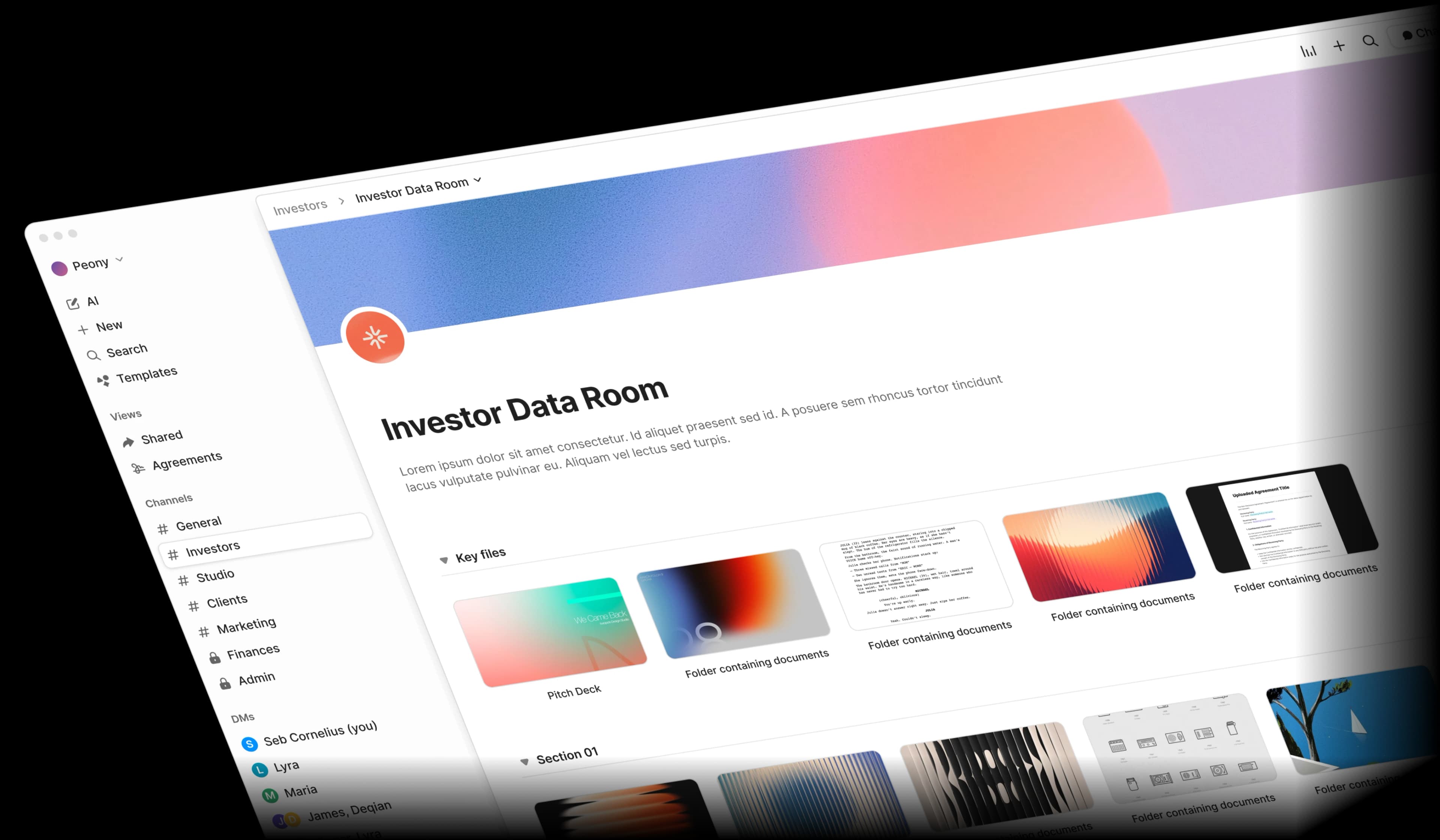
Why mining and natural resources companies need a dedicated data room
Mining companies, exploration firms, and natural resources operators use data rooms at every stage of the project lifecycle — from raising exploration capital and attracting bidders for project divestitures, to managing JV partner reviews and running competitive tender processes for mine assets. A mining data room differs from generic cloud storage because it provides the document-level security controls, audit trails, and access management that mining transactions require.
When a mining company divests a project or runs a competitive bid process, the data room serves as the central hub where prospective buyers review NI 43-101 technical reports, PEA and DFS studies, geological surveys, environmental impact assessments, mineral rights documentation, offtake agreements, and financial models — all under NDA-gated access with dynamic watermarks, screenshot protection, and page-by-page analytics that show the seller exactly which bidders are conducting serious diligence.
Peony is a mining data room built for how modern natural resources teams actually work. It sets up in under 5 minutes, includes AI-powered document Q&A so bidders can query technical reports in natural language, and the Data Room plan costs a flat $52 per admin per month — with unlimited data rooms and no per-page, per-viewer, or per-link charges — compared to legacy VDR providers like Intralinks, Datasite, and Ideals that charge $25,000 to $50,000 or more per deal for mining transactions.
Mining document sharing is broken
Whether you're attracting bidders for a project divestiture or sharing exploration data with JV partners, mining teams handle sensitive technical data across too many insecure tools. One leak can tank a bid process or compromise an entire project.
Exploration data leaks
Geological surveys, core sample reports, and proprietary resource estimates shared via email or generic cloud drives are easy targets for competitors and unauthorized copying.
Multi-jurisdiction permits
Permit applications across different jurisdictions require controlled access for regulators, environmental agencies, and indigenous community stakeholders.
Environmental review complexity
Environmental impact assessments need multi-party review with complete audit trails. Generic tools cannot prove who reviewed which sections and when.
No way to run a proper bid process
You want qualified bidders reviewing your project data — not passing it around. Without controlled access, watermarks, and audit trails, you can't run a competitive bid process and still protect proprietary technical data.
Built for how mining teams actually work
Mining data rooms need three things that generic file-sharing tools don't provide: security that protects multi-million-dollar exploration data, analytics that reveal which bidders are serious, and AI that lets deal teams manage technical Q&A at scale. Peony delivers all three at a fraction of legacy VDR pricing.
Watermarks, screenshot protection, and NDA gates
Geological surveys, drill results, and resource estimates are among the highest-value intellectual property in mining — unauthorized access can trigger speculative land staking or destroy deal leverage during a bid process. Peony blocks screenshots, stamps every page with dynamic watermarks showing the viewer's identity, and requires NDA signatures before bidders or JV partners can access any documents.
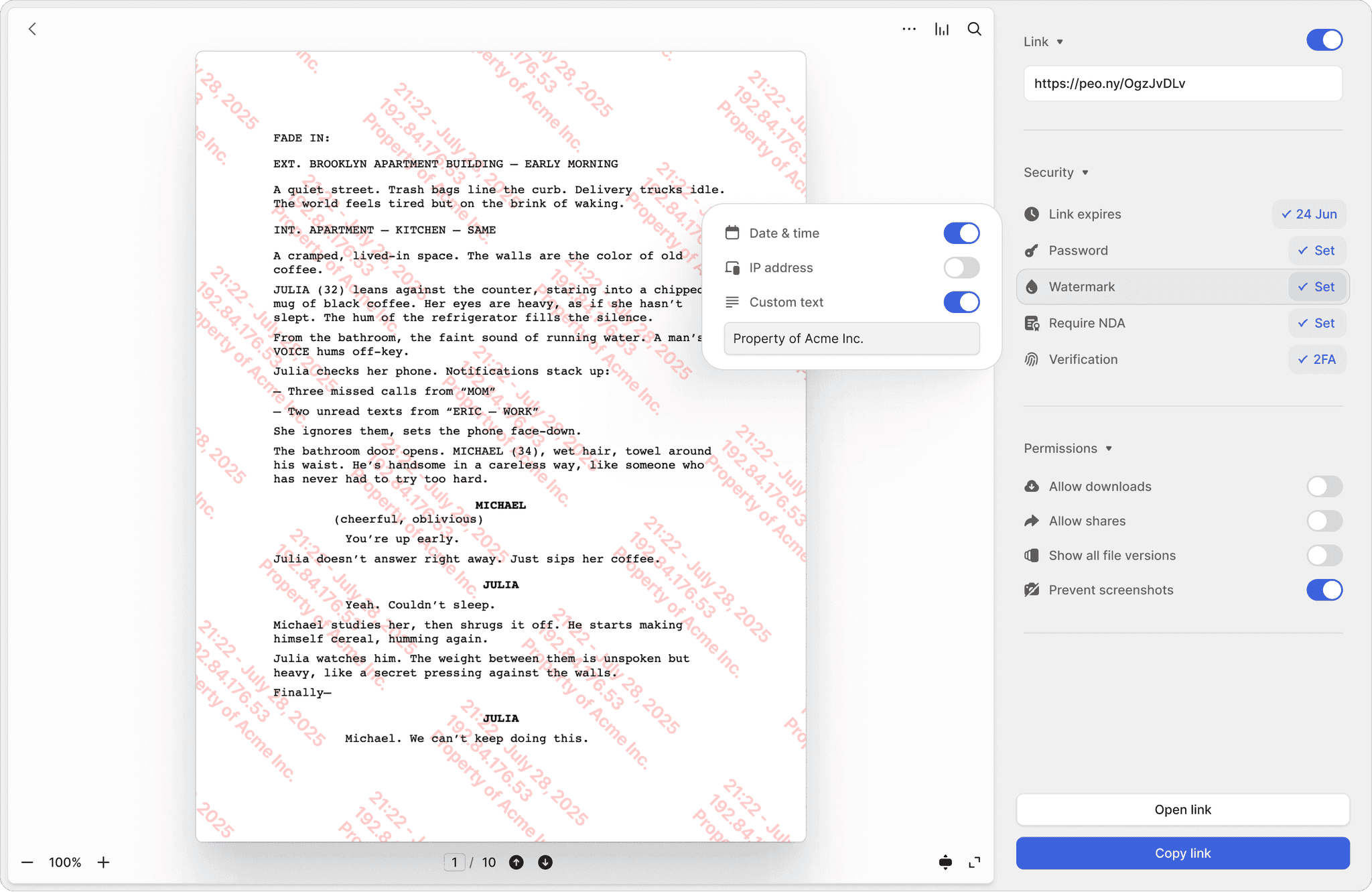
Screenshot protection
Block screen captures of geological maps, core sample reports, and proprietary resource estimates. Prevent unauthorized duplication of your most valuable exploration assets.
Dynamic watermarks
Every page stamped with the viewer's identity and timestamp. If an NI 43-101 report or assay certificate leaks, you know exactly who shared it and when.
NDA-gated access
Require prospective bidders and JV partners to sign an NDA before viewing exploration data or project financials. Gate your bid process properly with fully integrated e-signatures.
Complete audit trails for every permit and review
Track every view, download, and signature with timestamped logs. When you're running a bid process, page-by-page analytics show exactly which sections prospective bidders spent the most time on — so you know who's serious and what's driving their valuation.
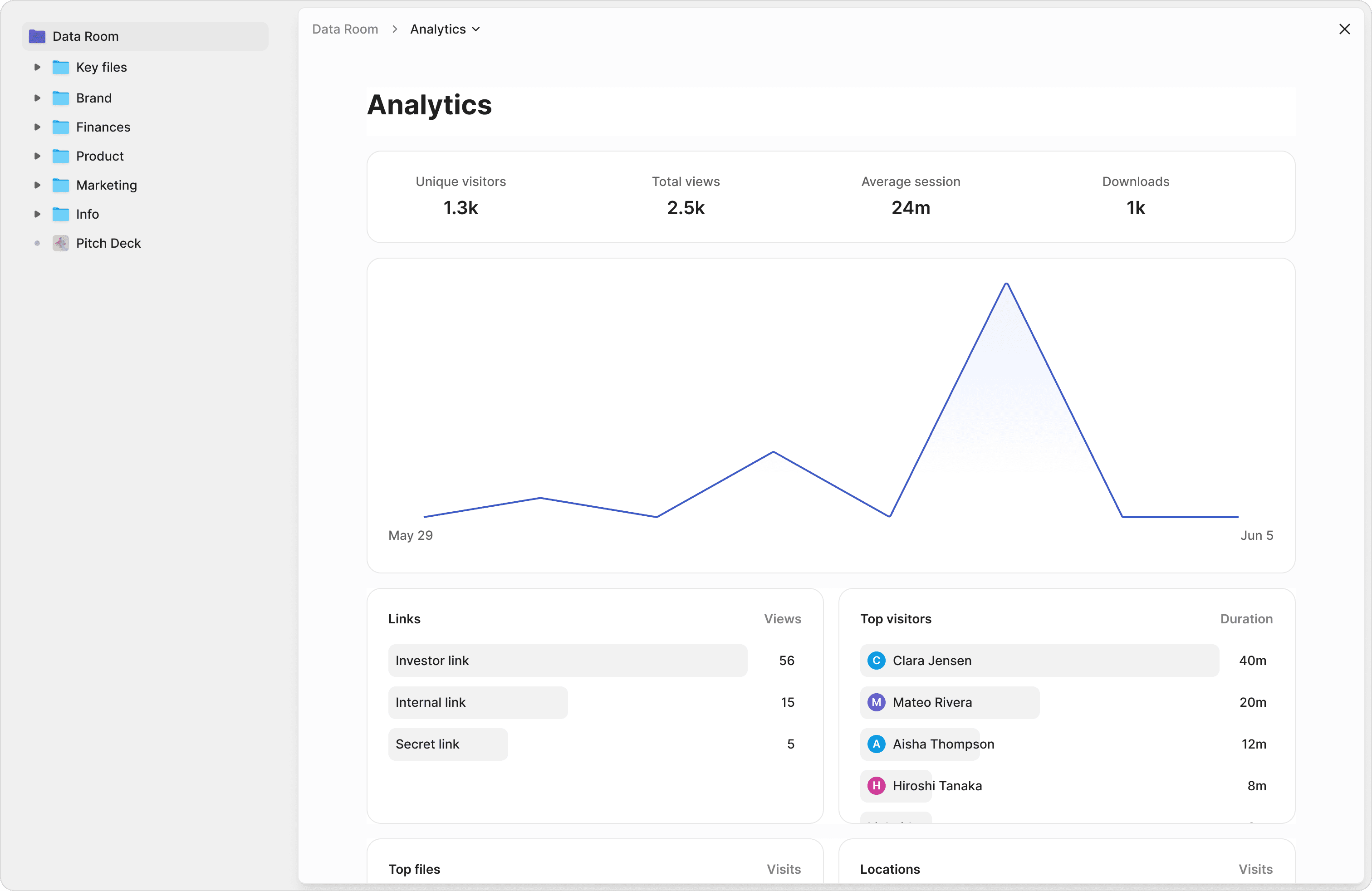
Page-by-page tracking
See which pages of your technical reports bidders and JV partners spent the most time on. Know who's doing real diligence and who's just browsing.
Compliance-ready logs
Exportable audit trails with timestamps, IP addresses, and device details. Meet regulatory requirements for permit reviews and environmental compliance across jurisdictions.
2FA for sensitive data
Add two-factor authentication for access to mineral rights documents, mine closure plans, and sensitive financial models. Control who sees what across every jurisdiction.
Chat with your geological reports and technical files
Mining due diligence typically involves thousands of technical documents — NI 43-101 reports, PEA/PFS studies, geological maps, assay certificates, and environmental permits. Instead of manually searching through PDFs, ask questions across your entire data room in natural language and get instant, sourced answers with exact page references from your technical files.
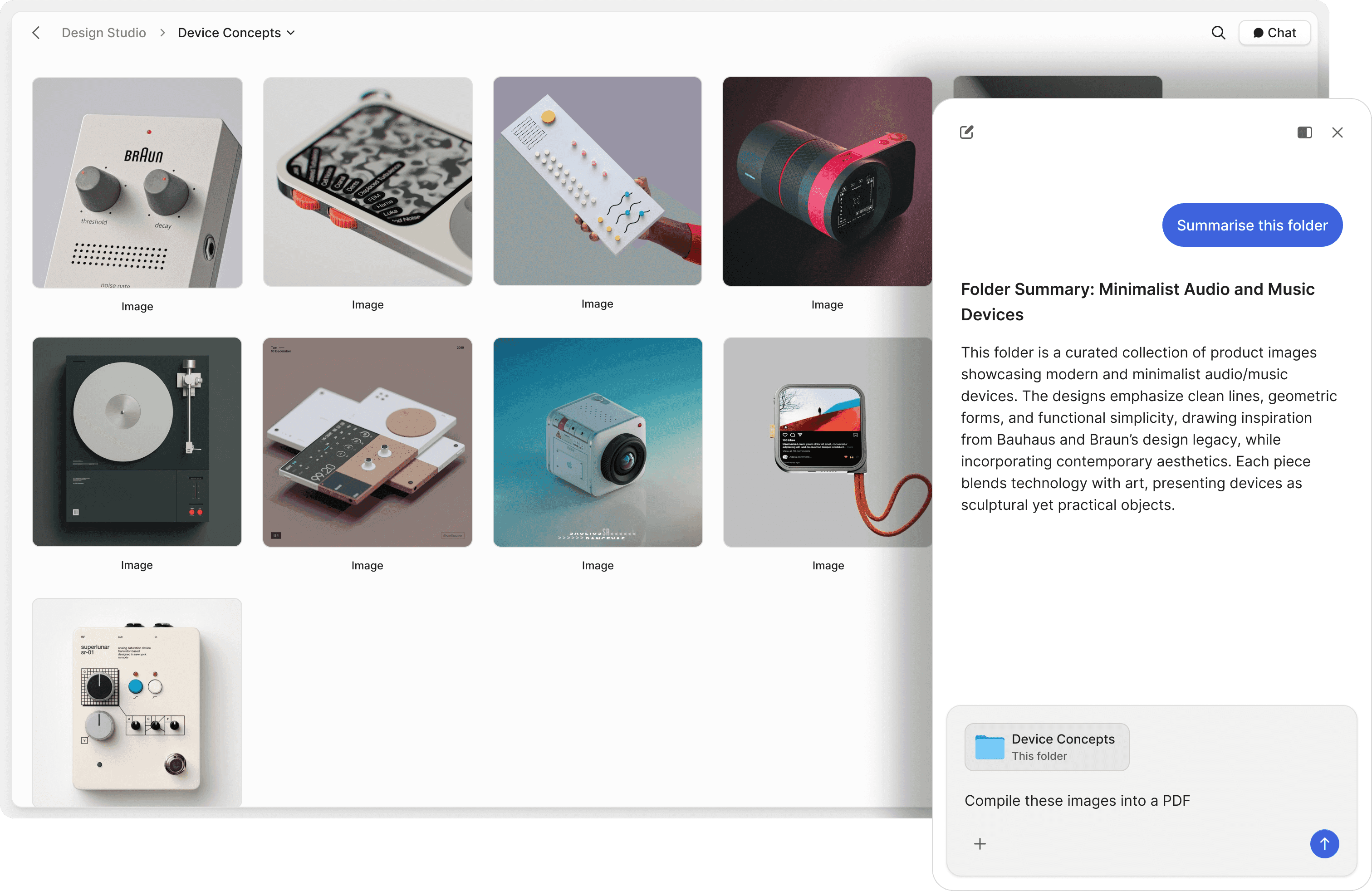
Chat with technical files
Ask questions across NI 43-101 reports, PEA/PFS studies, and environmental assessments. AI retrieves answers with exact source references from your geological data.
Natural language search
Search your data room in plain English. Find specific assay results, permit conditions, or resource estimates without remembering file names or folder structures.
Bidder Q&A on autopilot
Let AI answer bidder questions about project economics, resource estimates, and permit status 24/7. Track what prospective buyers ask to gauge their intent and refine your information memorandum.
The buy-side workflow that legacy VDRs were never priced for
Mining-focused investment funds — specialty credit funds, royalty and streaming funds, mining-merchant banks — sit squarely above the 10GB cliff where legacy VDR pricing breaks down. A typical fund runs 8–15 buy-side reviews per year on prospective portfolio investments, and each prospect's diligence package routinely runs 25GB–50GB: NI 43-101 technical reports, drill databases, drone imagery of the asset, drilling videos, 3D resource models, environmental impact assessments, and CAD models of processing facilities. Above 10GB, the economics shift hard.
Firmex's drag-and-drop ceiling caps at 10GB — your team splits drone imagery and drilling videos or moves to slower API uploads. Intralinks' 25GB single-file cap forces splits on common 30GB+ engineering deliverables. Datasite's per-page billing renders a 35GB review as 30,000–60,000 pages at roughly $0.60 each — pushing single-deal cost to $20,000–$40,000 before storage overages. A fund running 12 deals per year clears $240,000–$480,000 in data room spend alone.
Peony Data Room at $52 per admin per month gives a 4-person fund unlimited buy-side data rooms, NDA gates with integrated e-signatures, dynamic watermarks tied to viewer identity, Screenshield protection across desktop and mobile, and unlimited storage per admin — for $2,496 per year total. The cost gap against legacy VDRs (typically a 95% reduction) drops straight to fund net returns. For full breakdown, see Best Data Rooms for Large Files.
Unlimited buy-side rooms
Spin up a separate data room per prospect with no incremental cost. A specialty fund evaluating 8 prospects per quarter runs 8 NDA-gated rooms for the same flat per-admin fee.
35 GB+ deal data, no per-page billing
Drone imagery, drilling videos, and 3D resource models upload at full size. Unlimited storage per admin handles 25 concurrent prospects with room to spare. No per-page or per-GB surcharges, ever.
NDA gates for syndicate partners
External advisors, mining engineers, and syndicate members sign your fund's NDA template via integrated e-signatures before viewing any documents. Every page they view is watermarked and trackable.
"Peony has been great for sharing documents with investors, employees, and customers. It's easy to use, good value, and new features are constantly being added. Definitely recommend!"

Ed Harris
Founder & CEO, Ligo Bio (YC S24)
Akash Ghavalkar
Co-founder & COO, Third Space
"We'd been searching for a solution like Peony for ages, and it has completely transformed our workflows. What used to take hours every week is now effortless — Peony saves us so much time that we were finally able to move away from Dropbox Sign. It's been a total game changer!"
Frequently asked questions
What is a mining data room?
A mining data room is a secure virtual environment where mining and natural resources companies store, organize, and share confidential project documents with prospective bidders, JV partners, lenders, and regulators. Unlike general-purpose cloud storage like Google Drive or Dropbox, a mining data room provides document-level access controls, dynamic watermarks, screenshot protection, NDA-gated entry, and page-by-page audit trails — all critical when sharing proprietary geological data, NI 43-101 technical reports, or resource estimates during a project divestiture, financing round, or competitive bid process. Peony is a mining data room that sets up in under 5 minutes, includes AI-powered document Q&A, and charges a flat monthly fee with no per-page or per-viewer limits.
How do mining companies use data rooms to attract bidders for project divestitures?
Mining and natural resources companies use data rooms to run structured bid processes for asset divestitures by packaging all project documentation — NI 43-101 reports, PEA/DFS studies, geological surveys, environmental permits, offtake agreements, and financial models — into a single secure data room that prospective buyers can access under controlled conditions. The typical process works in four stages: (1) the seller prepares an information memorandum and populates the data room with technical and financial documents organized by category, (2) qualified bidders sign an NDA through integrated e-signatures before gaining access, (3) bidders review documents while the seller monitors engagement through page-by-page analytics to identify who is conducting serious diligence, and (4) the seller uses bidder activity data — which sections were reviewed, how long each party spent, what questions they asked — to prioritize negotiations and evaluate bid quality. Peony supports this entire workflow with NDA gates, dynamic watermarks that trace any leaked documents back to the specific viewer, granular folder-level permissions so different bidders see different document sets, and AI-powered Smart Q&A where bidders submit questions, AI drafts answers from your documents, your team reviews, and only approved responses are published.
What documents do mining companies include in a data room for project financing or asset sales?
A complete mining project data room typically contains seven categories of documents: (1) Technical reports — NI 43-101 compliant technical reports, preliminary economic assessments (PEA), pre-feasibility studies (PFS), and definitive feasibility studies (DFS); (2) Geological data — geological surveys, drill hole databases, core sample assay certificates, resource and reserve estimates, and geological maps; (3) Mineral rights — mining leases, mineral rights agreements, surface rights, royalty agreements, and title opinions; (4) Environmental — environmental impact assessments (EIA), water use permits, tailings management plans, mine closure cost estimates, and rehabilitation bonds; (5) Commercial — offtake agreements, streaming agreements, toll processing contracts, and customer commitments; (6) Financial — financial models, capital expenditure schedules, operating cost breakdowns, tax rulings, and project financing term sheets; (7) Corporate — organizational charts, key personnel CVs, insurance policies, litigation summaries, and regulatory correspondence. Peony lets you organize all seven categories with folder-level permissions so lenders, JV partners, and prospective bidders each see only the documents relevant to their review stage.
How do I protect geological surveys and exploration data from leaking during a bid process?
Geological surveys, proprietary resource estimates, and drill results are among the most valuable assets a mining company holds — a single leak during a competitive bid process can destroy deal leverage and invite speculative staking by competitors. Protecting this data requires five layers of security: (1) NDA-gated access — require every bidder to sign a confidentiality agreement via integrated e-signatures before they can view any documents; (2) Dynamic watermarks — every page is stamped with the viewer's name, email, and timestamp so leaked documents are traceable to the exact individual; (3) Screenshot protection — block screen captures of geological maps, assay certificates, and resource models; (4) Granular permissions — control which bidders can see which folders, so early-stage bidders get teaser materials while shortlisted parties get full technical packages; (5) Instant revocation — cut off access immediately when a bidder drops out or a term sheet expires. Peony provides all five layers, plus AES-256 encryption at rest, TLS 1.3 in transit, and SOC 2 Type II-ready infrastructure. Peony is GDPR, CCPA, and HIPAA compliant.
What is NI 43-101 and why does it matter for mining data rooms?
NI 43-101 (National Instrument 43-101) is the Canadian securities regulation that governs public disclosure of scientific and technical information about mineral projects. It requires that all technical reports be prepared or supervised by a Qualified Person (QP) — an engineer or geoscientist with relevant experience and professional registration — and mandates strict standards for data verification, resource classification, and economic analysis. NI 43-101 matters for mining data rooms because any company listed on the TSX, TSX-V, or other Canadian exchanges must ensure that access to these reports is tracked and auditable. Peony's audit trails record every view, download, print, and signature on NI 43-101 documents with timestamps and IP addresses, providing compliance-ready logs that prove exactly who accessed technical disclosures and when — critical during securities reviews, project financings, and M&A transactions.
How does AI help with mining due diligence and bidder Q&A?
Mining M&A and project bid processes generate thousands of technical documents that bidders need to review under tight timelines — NI 43-101 reports, PEA/PFS studies, geological maps, assay certificates, environmental permits, and financial models. AI accelerates this process in two ways. First, AI-powered document chat lets bidders and internal teams ask natural language questions across the entire data room — for example, 'What is the indicated resource estimate for Zone B?' or 'Which permits expire before 2028?' — and get sourced answers with exact page references from the relevant technical documents. Second, Peony's Smart Q&A provides a structured 4-step workflow for managing bidder questions during a competitive process: (1) bidders submit questions through the data room, (2) AI drafts answers by searching your uploaded documents, (3) your deal team reviews and edits each response, and (4) only approved answers are published back to the bidder. This gives sellers full control over what information goes out while dramatically reducing the time spent answering repetitive technical questions from multiple bidding parties.
What is the difference between a mining data room and a general virtual data room?
A general virtual data room (VDR) handles document storage and sharing for any industry, while a mining data room is optimized for the specific workflows, document types, and compliance requirements of mining and natural resources transactions. Key differences include: document organization suited to mining deal structures (technical reports, geological data, environmental permits, mineral rights, and offtake agreements rather than generic folder hierarchies); security controls calibrated for high-value exploration data (screenshot blocking, dynamic watermarks, and NDA gates — not just password protection); analytics that show which sections of technical reports bidders focused on (page-by-page dwell time, not just file-level download counts); and AI that understands mining terminology so bidders can query resource estimates, permit conditions, and geological data in natural language. Legacy mining VDRs like Intralinks, Datasite, and Ideals charge $15,000+ per deal, take weeks to deploy, and bill per page. Peony is purpose-built for mining teams, sets up in under 5 minutes, includes AI document Q&A, and the Data Room plan costs $52 per admin per month with unlimited data rooms and no per-page, per-viewer, or per-link limits.
How do natural resources companies run a competitive bid process using a data room?
Natural resources companies — including mining, oil and gas, timber, and mineral exploration firms — run competitive bid processes through data rooms by following a structured six-step workflow: (1) Prepare the data room — upload the information memorandum, technical reports (NI 43-101, JORC, or S-K 1300 depending on jurisdiction), geological data, environmental permits, commercial agreements, and financial models into organized folders; (2) Set access tiers — create separate permission groups for teaser-level access (summary documents only) and full data room access (complete technical packages), so you can qualify bidders before revealing sensitive data; (3) Gate entry with NDAs — require each prospective bidder to execute a confidentiality agreement through integrated e-signatures before they can view any documents; (4) Monitor bidder engagement — use page-by-page analytics to track which bidders are reviewing which documents, how long they spend on each section, and what questions they submit through the Q&A module; (5) Manage Q&A centrally — route all bidder questions through the data room's Smart Q&A system so your deal team controls exactly what information is disclosed and to whom; (6) Compare and shortlist — use engagement analytics to identify the most serious bidders, then grant shortlisted parties access to additional due diligence materials in restricted folders. Peony supports all six steps out of the box, with dynamic watermarks tracing every viewed page back to the specific bidder.
How much does a mining data room cost compared to legacy VDR providers?
Legacy virtual data room providers charge mining companies significantly more than modern alternatives. Datasite and Intralinks typically charge $25,000 to $50,000 or more per deal, plus per-page upload fees and per-user surcharges that scale with the number of bidders reviewing your data room. Ideals charges $15,000+ per project, and most legacy providers require multi-week setup and training periods. Peony offers a fundamentally different pricing model: a free plan ($0) for early-stage exploration companies, Business at $30 per admin per month (up to 3 data rooms per admin), and Data Room at $52 per admin per month with unlimited data rooms and unlimited storage — all with unlimited viewers, unlimited links, and no per-page charges. A junior explorer running a project financing with 50 potential investors pays the same $30/month on the Business plan regardless of how many parties access the data room, versus $15,000+ per deal at a legacy provider. Peony also includes AI-powered document chat at no extra cost, plus a structured Smart Q&A workflow on the Data Room plan — features that legacy providers either don't offer or charge separately for.
How do I manage access for multiple bidders or JV partners reviewing the same mining assets?
Managing multiple bidders or JV partners reviewing the same mining assets requires granular access controls that go beyond simple file sharing. Peony provides document-level and folder-level permissions that let you create separate access profiles for each party: one bidder might see geological data for a specific tenement, another sees environmental assessments only, a financial advisor gets full access to models, and a shortlisted acquirer gets everything including the restricted commercial terms folder. Each party's activity is tracked independently — you see separate audit trails showing exactly which documents each bidder viewed, which pages they spent time on, and what questions they submitted. This is particularly important during competitive bid processes where information asymmetry between bidders needs to be carefully managed. Peony also supports link-level controls: you can set expiry dates, download limits, and access passwords on a per-bidder basis, and instantly revoke access when a party withdraws from the process.
Can a data room handle environmental review and permit compliance for mining projects?
Yes. Environmental impact assessments (EIA), water use permits, tailings management plans, and mine closure bonds all require multi-party review with complete audit trails proving who reviewed which sections and when — a requirement that generic file-sharing tools cannot meet. Mining projects operating across multiple jurisdictions face additional complexity: Australian projects must comply with EPBC Act requirements, Canadian projects with CEAA, and US projects with NEPA, each with different disclosure and review standards. Peony provides page-by-page analytics showing exactly which pages of your environmental documents regulators, environmental agencies, and indigenous community stakeholders focused on, with exportable timestamped logs that satisfy compliance requirements across jurisdictions. Dynamic watermarks and screenshot protection prevent unauthorized distribution of sensitive environmental data, and NDA-gated access ensures that only authorized parties can view permit applications and remediation plans.
What security features prevent unauthorized copying of assay data and resource estimates?
Assay certificates, drill results, and resource estimates represent some of the highest-value intellectual property in the mining industry — unauthorized access can trigger speculative land staking, insider trading, or competitive intelligence exploitation. Peony protects this data with six integrated security layers: (1) Screenshot protection that blocks screen captures across desktop and mobile devices; (2) Dynamic watermarks that stamp every page with the viewer's full name, email address, and exact timestamp, making any leaked document immediately traceable; (3) NDA-gated access with integrated e-signatures that create a legally binding confidentiality record before any document is viewable; (4) Two-factor authentication (2FA) that adds a second verification step for access to the most sensitive technical data; (5) Link-level controls including expiry dates, download restrictions, and per-recipient passwords; and (6) Instant access revocation that cuts off a viewer's access in real time when they leave the bid process or their review period ends. All data is protected with AES-256 encryption at rest and TLS 1.3 encryption in transit.