
A PPM discloses. The data room proves
A private placement runs on antifraud liability and a registration exemption — so your real need isn't just to send the PPM, but to scope who can see it and to prove exactly what every investor received and when. Peony gates the PPM, keeps a 506(b) raise inside its exemption, intakes 506(c) verification evidence, and produces a per-investor audit trail. More than 6,800 customers run sensitive processes this way.
Quick answer · Updated June 2026
What is a private placement data room? It's a permissioned, audit-logged room where an issuer or sponsor shares the PPM, subscription documents, and diligence materials with qualified investors in a Regulation D (or Reg S) offering. It does three jobs a shared drive can't: it scopes access so a 506(b) raise doesn't become general solicitation (which would break the exemption), it acts as the secure intake for 506(c) accredited-investor verification evidence, and it produces a per-investor, version-aware record proving what each investor saw — the antifraud-defensible answer under Rule 10b-5. On Peony, NDA gating starts on Business ($30/admin/month); dynamic watermarks and granular permissions are on Data Room ($52/admin/month). Peony does not itself certify accreditation — your verifier does — but it holds and logs the evidence. Peony is SOC 2 Type II-ready.
No credit card required
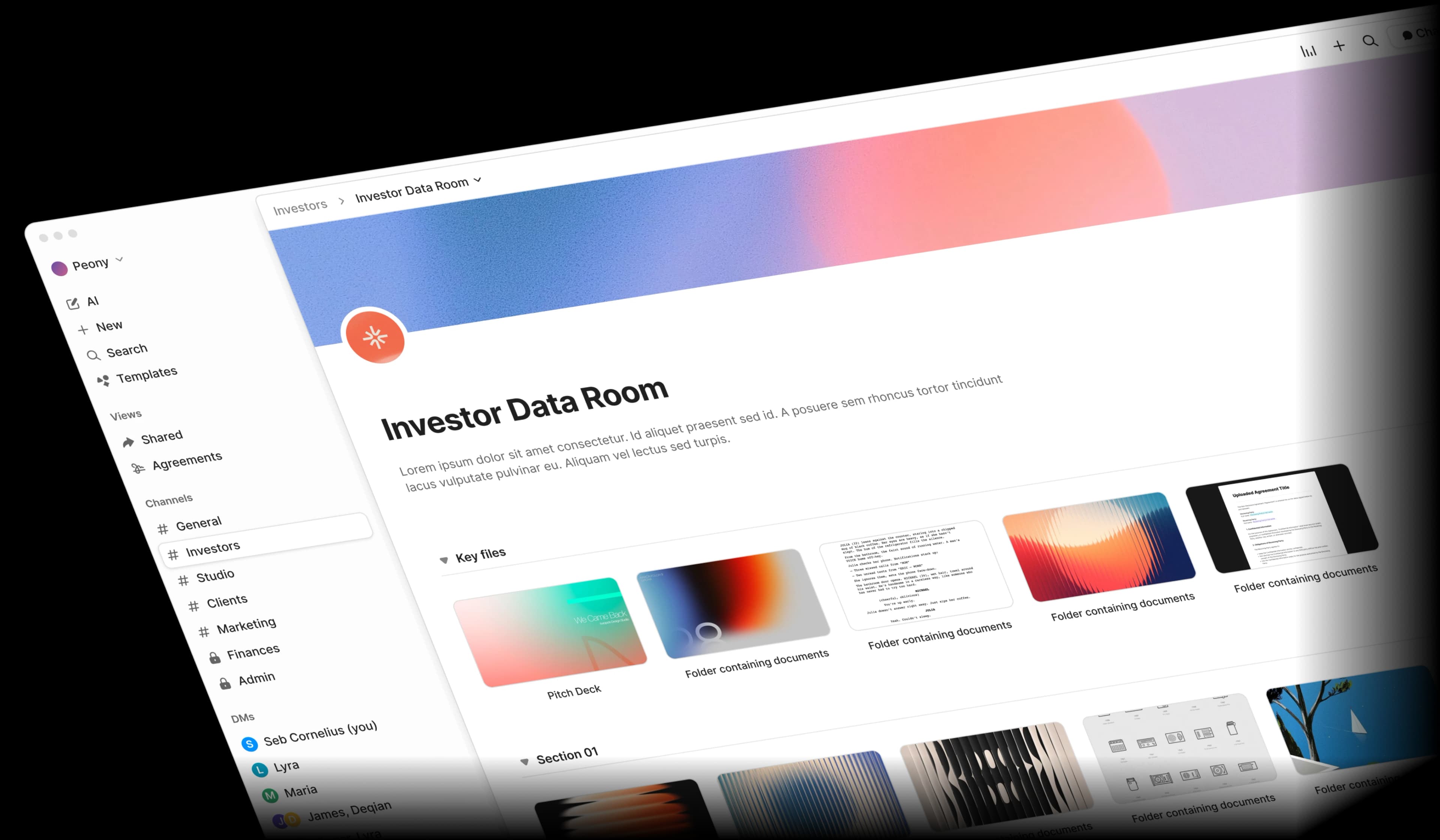
A private placement punishes the tools founders reach for first
It's the same room as a fundraising or M&A data room, doing a more regulated job. Three things are true at once: how you distribute the PPM can affect whether your exemption survives, what each investor received is an antifraud question, and 506(c) verification means handling sensitive personal financial documents. Emailing the PPM, a shared drive, or a link-tracking deck tool fails on all three.
Accidental general solicitation breaks your 506(b) exemption
Under Rule 506(b) you can't advertise and can only sell to pre-existing relationships. A forwardable link or an "anyone with the link" folder can be argued as solicitation — and blow the exemption. Access scoping isn't a convenience here; it's compliance-load-bearing.
An emailed PPM you can't recall — or prove was read
Securities law runs on antifraud liability (Rule 10b-5). An emailed PPM gives you no proof of receipt, no version control, and no recall if terms change. The room is what turns disclosure into a defensible record.
506(c) verification means sensitive PII flying around insecurely
For a 506(c) raise, investors submit tax forms, brokerage statements, and CPA letters. Collecting those over email scatters PII across inboxes. The room should be the secure intake point that logs the evidence — even though your verifier, not the platform, makes the accreditation call.
A shared drive can't show who saw which version of the PPM
Email and consumer cloud give you no per-investor walls, no current-version guarantee, and no defensible log. If an investor later disputes what they received, "who saw what version, and when" stops being a convenience and becomes the record your tooling has to produce.
Distribute the PPM on terms that protect your offering
Peony treats the room as a control surface for a securities offering, not a filing cabinet. Prove what every investor saw, scope access so a 506(b) raise stays inside its exemption, and intake 506(c) verification evidence securely — with the offering's financial model shared live, not flattened to a dead PDF. For a serious raise, lead with the Data Room plan ($52/admin/month). Start from the private placement data room guide.
How do I prove what every investor saw — and that it was the current PPM?
Treat the room as your contemporaneous evidence file, not a filing cabinet. Every investor accepts an NDA, is served only the current version of the PPM, and generates a per-investor, timestamped log of exactly which documents and which version they opened. If disclosure is ever questioned, you produce the record — the difference between a PPM that discloses and a data room that proves.
Per-investor, version-aware audit trail
Every view, NDA acceptance, and document open is timestamped and attributed to a specific investor, scoped to the exact PPM version shown. The defensible answer to "did this investor receive the risk factors?"
Current-version control
When terms change, the room serves only the live PPM — an investor can never be shown a superseded version, which is its own source of antifraud exposure.
NDA acceptance on the record
Click-to-accept NDA gating starts on Business ($30/admin/month); Advanced NDA on Data Room ($52/admin/month) produces a signed PDF and full audit trail per investor.
How do I scope access so a 506(b) raise doesn't become general solicitation?
Make access scoping the thing that protects your exemption. Issue per-recipient links that can't be forwarded into the wild, gate the PPM behind an NDA, and wall investor types into groups — so the room enforces the pre-existing-relationship discipline 506(b) requires, and your log proves you stayed inside it. For a 506(b) deal that includes up to 35 non-accredited sophisticated purchasers, the same groups give you the extra disclosure tier those investors are owed.
A visitor group per investor type
Accredited prospects, sophisticated non-accredited purchasers, existing investors — each is a container with its own permissions and NDA. Per-group document isolation is a Business-plan capability.
Non-forwardable personalised links
Each investor gets their own tracked link — not a public URL. If access needs to end, revoke it cleanly and keep the log as proof.
NDA + pre-qualification before the PPM loads
Nothing is visible until an investor accepts the NDA and clears your pre-qualification questionnaire — the gate that keeps a 506(b) room inside its pre-existing-relationship perimeter.
How do I collect 506(c) verification evidence — and share the model — without it leaking?
Use the room as the secure intake and the live exhibit viewer. For a 506(c) raise, investors submit sensitive financial documents to one controlled place that logs what was collected and when — Peony holds and logs the evidence; your verifier, CPA, attorney, or broker-dealer makes the accreditation determination. And the offering's financial model goes in live, not as a dead PDF.
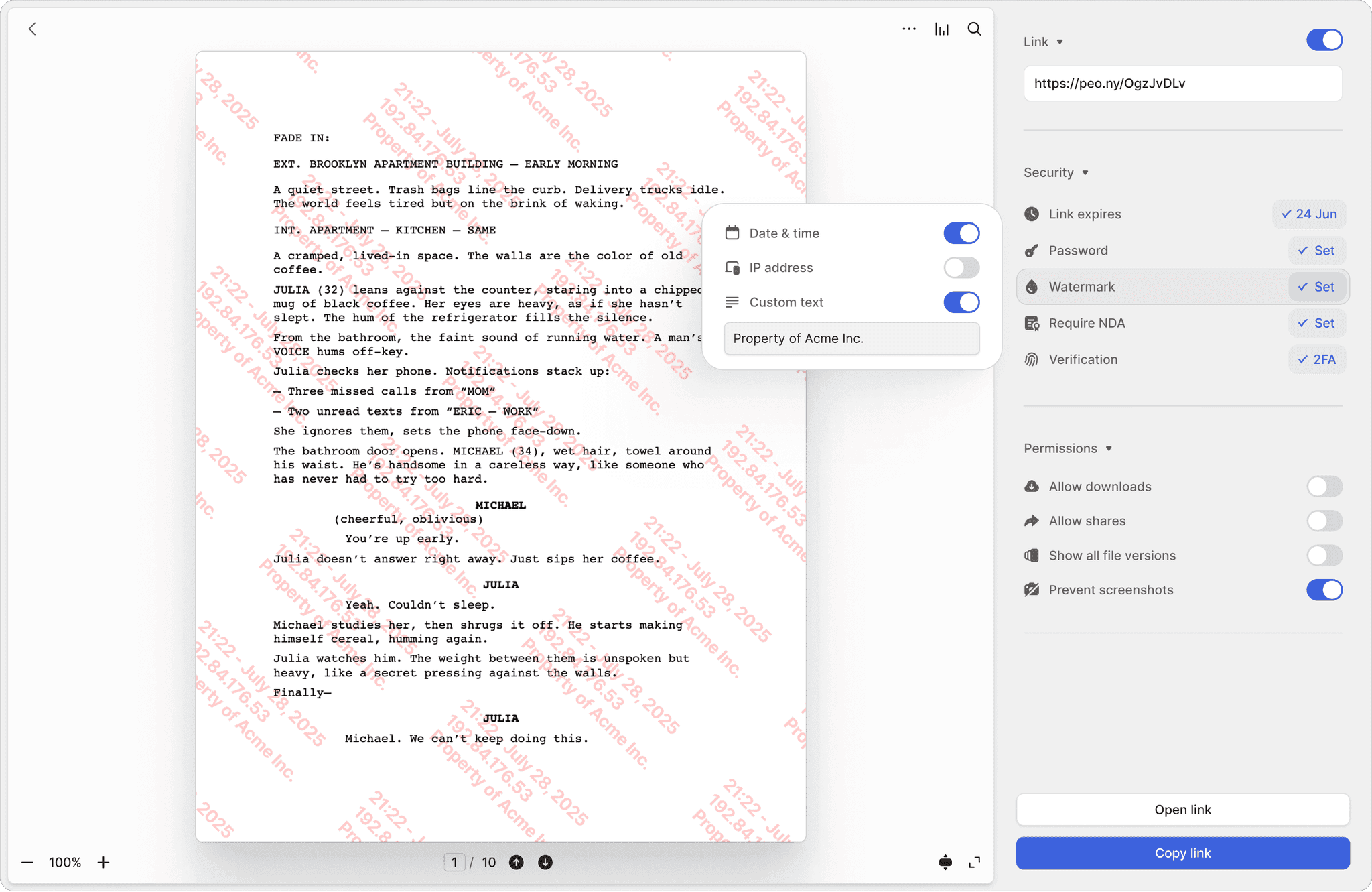
Secure verification-evidence intake
Tax forms, brokerage statements, and CPA/attorney letters land in one access-controlled room with a retained evidence trail — never scattered across inboxes. Peony logs the evidence; it does not itself certify accreditation.
Subscription agreements, signed in place
Collect e-signatures on subscription documents inside the room (Business and above), tied to the same per-investor record.
Live, watermarked financial model
Share your model as a live interactive spreadsheet (formulas compute) or HTML artifact that runs in the viewer — wrapped in dynamic watermarks (Data Room, $52/admin/month), screenshot protection, and instant revoke.
"Ease of use, drag and drop capabilities, rapid response in support, and great service and value. It was easy to navigate throughout the platform as well as setting up our data room."
Joseph Garcia
Providence Water
Frequently asked questions
We're running a Reg D 506(b) raise — can a data room actually help us avoid blowing the exemption with accidental general solicitation?
Yes, and this is the single most underrated reason to use one. Rule 506(b) bans general solicitation and limits you to investors with whom you have a pre-existing, substantive relationship — so a forwardable link, a public download page, or an "anyone with the link" share can be argued as solicitation that breaks the exemption. A permissioned data room makes access scoping compliance-load-bearing instead of a convenience: gate the PPM behind a click-to-accept NDA (Business, $30/admin/month), issue per-recipient personalised links so nothing is forwardable, and wall investor types into visitor groups. Then your audit trail shows exactly who was invited and what they saw — the record that demonstrates you stayed inside the exemption. We walk through the mechanics in Reg D 506(b) vs 506(c): the data room implications.
What's actually different between a private placement data room and just emailing the PPM to investors?
Email discloses; it can't prove, control, or recall. The premise of a private placement is antifraud liability — under Rule 10b-5, an issuer is exposed if an investor can later claim they didn't receive the risk factors or saw a stale version. An emailed PPM gives you no proof of receipt, no version control, and no way to pull it back if the deal terms change. A data room turns disclosure into a record: every investor accepts an NDA, sees only the current PPM, and generates a per-investor, timestamped log of exactly which documents and which version they opened. That's the difference between "a PPM discloses" and "the data room proves." The full picture is in our private placement memorandum guide.
For a 506(c) offering, can Peony verify that my investors are accredited?
Peony does not itself certify accreditation — that determination is made by you or a third-party verification service (or your CPA, attorney, or broker-dealer letter). What Peony does is make the verification workflow secure and defensible: gate the room behind an NDA plus a pre-qualification questionnaire and email identity verification before the PPM is visible, act as the secure intake point for the sensitive financial documents an investor submits (tax forms, brokerage statements, CPA/attorney letters), and retain a per-investor evidence trail of what was collected and when. Note that 506(c) requires the issuer to take "reasonable steps to verify" accreditation — self-certification alone is not enough — and the SEC's March 2025 no-action letter added a high-minimum-investment-plus-written-representation path. Use Peony to hold and log the evidence; use your verifier to make the call. Details in our Reg D guide.
How do I prove, later, that every investor actually received the PPM and the risk factors?
Through the per-investor audit trail. Every view, NDA acceptance, and document open is timestamped and attributed to a specific investor, scoped to the exact version of the PPM they were shown. If an investor later disputes what they received — or a regulator or counsel asks — you can produce a record showing that this person accepted the NDA, opened the current PPM, and spent time on the risk-factors section. Combined with current-version control (an investor can never be served a superseded PPM) and dynamic watermarks on the Data Room plan ($52/admin/month) that stamp every page with the viewer's identity, the room becomes your contemporaneous evidence file. This is the antifraud-defensibility angle no generic file-share gives you.
Can I share my offering's financial model live instead of flattening it to a dead PDF?
Yes — this is a real differentiator. Peony renders your Excel model as a live, interactive spreadsheet right in the browser: the formulas compute, so an investor can change an assumption and watch the outputs move, essentially a Google-Sheets experience inside the room, with no download and no emailed file. For a fully bespoke model you can also publish it as an HTML artifact, which Peony renders live with the JavaScript executing. Both stay wrapped in the same control layer — dynamic watermarking, screenshot protection, per-viewer permissions, and instant revoke — and there's exactly one current version in the room, so no investor circulates a stale model from their inbox. Most VDRs convert every upload to a flat PDF, which kills the model and forces you to re-email the real file — exactly the leak you were trying to prevent.
Should the placement agent run the data room, or should the issuer own it?
Own the room; let your placement agent or counsel operate inside it. The broker-dealer or banker running the raise should manage the day-to-day — investor invites, Q&A, advancing prospects — but the room should sit on an account the issuer controls, not be locked inside an agent's platform you lose when the engagement ends. Offerings change agents, and a follow-on round shouldn't mean rebuilding your indexed PPM room, subscription package, and audit trail from scratch. A flat-rate room you own and grant your agent admin access to gives you professional operation without vendor lock-in or a per-deal data-room bill. See pricing.
How much does a private placement data room cost, and is flat-rate better than per-page?
For an offering, prefer flat-rate. A raise is typically open for months, accessed by many investors, and often followed by a second round — every variable a per-page or per-deal VDR bills against. Peony's Data Room plan is $52/admin/month with unlimited rooms, unlimited storage, and no per-page metering, and it carries the controls an offering needs (dynamic watermarks, screenshot protection, granular per-file permissions, single-viewer instant revoke). If your needs are lighter — gate the PPM and track engagement without watermarking — Business at $30/admin/month covers NDA gating, e-signatures, and analytics. Compare that to Datasite or Intralinks at $50,000–$80,000+ per deal at enterprise tier. We break the math down in how to set up a private placement data room.
Run the offering. Keep the proof
Gate the PPM, scope access to protect your exemption, intake 506(c) evidence securely, and keep a per-investor record of exactly what each investor saw — on flat-rate pricing built for a months-long, many-investor raise. Join the 6,800+ customers who run sensitive processes on Peony. No credit card required.
No credit card required