
Best M&A Data Rooms (I Built One, Then Tested 6 More) in 2026

Co-founder at Peony — I built the data room platform, with a background in document security, file systems, and AI.
Connect with me on LinkedIn! I want to help you :)TL;DR: Most M&A data rooms fail not because of missing documents, but because of poor structure, weak security defaults, and no analytics to read buyer intent. After helping set up data rooms for founders, PE firms, and corporate development teams, I have seen the same mistakes repeat across deals of every size. This guide covers the complete playbook — folder structure, document checklist, stage-gate permissions, Q&A workflow, and the analytics that actually move negotiations forward. Peony handles the hardest part: AI auto-indexing sorts your documents into due diligence categories on upload, so you go from file dump to buyer-ready room in under 30 minutes.
Last updated: April 2026 (decision framework and FAQ update)
I run Peony, a data room company. The best M&A data room is one that combines AI-powered document indexing, page-level buyer analytics, stage-gate permissions for multiple bidder groups, and transparent pricing — without the weeks-long onboarding and per-page fees that legacy VDR providers charge. After testing every major platform on real transactions, I ranked the top options in the scored comparison table below.
Last quarter alone, I helped set up rooms for a $12M SaaS acqui-hire, a $180M PE-backed carve-out, and three competitive auction processes. The acqui-hire took 22 minutes to set up. The carve-out — with 1,400 documents across 6 jurisdictions — took an afternoon. Every deal is different, but the M&A data room mistakes are almost always the same.
This guide merges everything I have learned into a single reference — the complete M&A data room playbook plus a head-to-head platform comparison. Whether you are a founder selling for the first time, a corp dev lead running your tenth deal, or counsel advising either side, this is the playbook I wish someone had handed me before my first transaction.
Why Data Rooms Matter in M&A (And Why Most Are Set Up Wrong)
M&A transactions involve reviewing thousands of documents — financial records, contracts, IP documentation, HR files, operational procedures — across compressed timelines. A mid-market deal typically requires reviewing 2,000 to 10,000 pages of documentation, with large-cap and cross-border transactions exceeding 50,000 pages.
Without proper infrastructure, this becomes chaos: scattered files across email threads and shared drives, version confusion on financial models, security gaps that risk deal leaks, and coordination breakdowns across buyers, sellers, lawyers, and advisors.
A well-built data room solves all of this. But "well-built" is doing heavy lifting in that sentence. Most teams stand up a data room, dump files into it, and call it done. That is where deals slow down, re-trades appear, and buyers lose confidence.
Here is what a properly structured M&A data room actually looks like.
The Folder Structure That Works (Sell-Side Default)
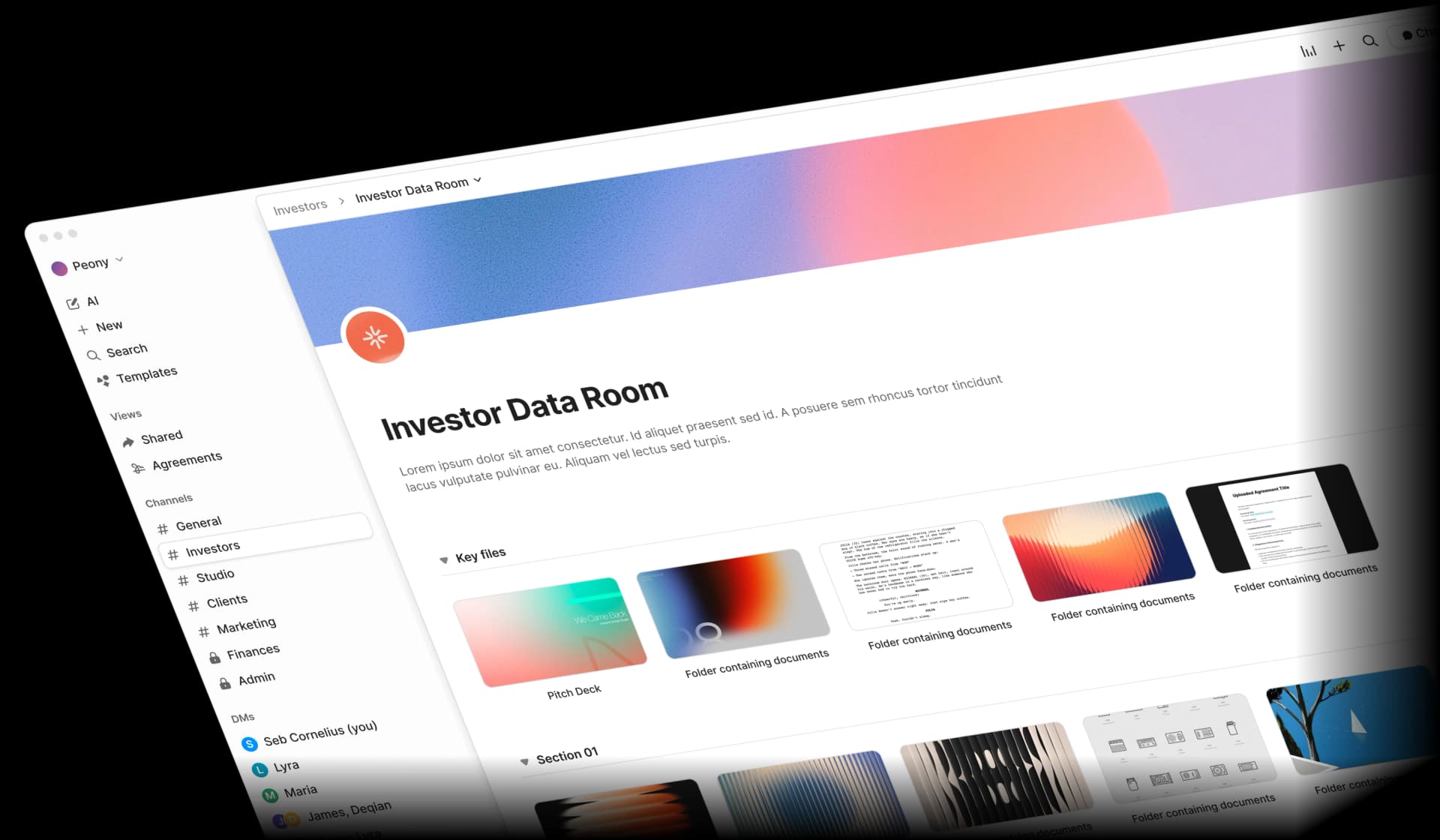
After setting up rooms across dozens of transactions, this is the folder structure I recommend as a starting point. Adjust names to match your company's taxonomy, but keep the numbered prefixes — buyers expect them.
00_Intro & Process
   /Teaser & NDA
   /Process Letter & Timeline
   /Contacts & Q&A Rules

01_Corporate & Cap Table
02_Financials & KPIs
03_Tax
04_Legal & Key Contracts
05_HR & Payroll
06_IP & Technology
07_Product & Roadmap
08_Sales, Customers & RevOps
09_Operations & Supply Chain
10_Privacy, InfoSec & Compliance
11_Litigation & Claims
12_Insurance
13_Real Estate & Facilities
14_Environmental/ESG (as relevant)
15_Regulatory/Industry (as relevant)
16_Market & Competitive
17_Board, Governance & Policies
18_Misc. / Supplemental / Buyer Requests
99_Confirmatory / Disclosure Schedules (gated)
The numbered prefix system is not just organizational polish. It controls how buyers navigate the room, ensures nothing gets buried, and makes audit trail references unambiguous ("document 04-017" is clearer than "that contract PDF somewhere in the legal folder").
Peony shortcut: Start with the built-in M&A (Sell-Side) template and the entire structure appears in one click. Peony's AI auto-indexing then recognizes document types as you upload — financial statements go to 02, employment agreements to 05, patent filings to 06 — so your team spends minutes on organization instead of days.
The Complete Document Checklist
This is the sell-side checklist I walk teams through. For the full 174-document version organized by 10 categories with industry overlays, see the due diligence data room checklist. Not every section applies to every deal, but it is far better to over-prepare than to scramble mid-diligence when a buyer requests something you have not uploaded.
01. Corporate & Cap Table
- Charter, bylaws, amendments; subsidiary list; good-standing certificates
- Cap table (current and fully diluted), option plans, investors' rights, ROFR agreements
- Board minutes and consents; major shareholder agreements; voting agreements
02. Financials & KPIs
- Audited and unaudited financial statements (3 to 5 years), monthly and quarterly data year-to-date, trial balance
- Quality of Earnings report (if available), revenue recognition policy, AR/AP aging
- Cohort analysis, retention metrics, gross margin build, working capital bridges, forecast model
03. Tax
- Federal, state, and international filings (3 to 5 years), NOLs and credits
- Sales and indirect taxes, payroll taxes, transfer pricing, nexus analyses
- Tax audits, disputes, correspondence, and settlements
04. Legal & Key Contracts
- Customer MSAs and top contracts, vendor MSAs, partner and licensing agreements
- Debt instruments, leases, guarantees, liens and UCC filings
- Standard terms (ToS, EULA), clickwrap records, warranties and indemnities
05. HR & Payroll
- Organization chart, headcount, employment and contractor templates
- Equity grants and vesting schedules, bonus plans, benefits plans, immigration files
- Claims and complaints, separation agreements, handbooks and policies
06. IP & Technology
- Patents, trademarks, copyrights, assignments, open-source disclosures
- Architecture overview, data flows, infrastructure diagrams, SLOs and SLAs
- Vendor list (cloud providers, processors and sub-processors), license keys, escrow agreements
07. Product & Roadmap
- Product roadmap, backlog summaries, user research highlights
- QA test plans, release notes, incident postmortems
- Accessibility, localization, and safety documentation
08. Sales, Customers & RevOps
- Pipeline by stage, win/loss analysis, pricing and discount policy, channel and partner motions
- Top customers: contracts, term, ARR/MRR, churn notes, renewal calendar
- Marketing compliance (consent records), brand asset usage rights
09. Operations & Supply Chain
- Supplier agreements, SLAs, capacity and utilization data, lead times
- Business continuity and disaster recovery plans, incident logs, vendor risk assessments
10. Privacy, InfoSec & Compliance
- Security policies, risk register, vulnerability scan results
- Data map, PII inventories, privacy compliance documentation, sub-processor list
- Security awareness training records, access control matrices, audit log summaries
11. Litigation & Claims
- Pending and threatened matters, settlements, counsel letters, insurance notifications
12. Insurance
- D&O, cyber, E&O, general liability, property; claims history; broker summaries
13. Real Estate & Facilities
- Leases, amendments, site plans, compliance inspections
14. Environmental/ESG (as applicable)
- Environmental permits, audits, remediation records, ESG policies and metrics
- Supply-chain ESG diligence and statements
99. Confirmatory / Disclosure Schedules (gate this until late-stage)
- Schedules to the definitive agreement; sensitive side letters; change-of-control consents
Tip: For PE acquirers and public-company buyers, expect an extra lens on cyber governance and incident history due to SEC cybersecurity disclosure rules and insurer scrutiny. Keep a concise Cyber Diligence Pack ready — controls summary, incident history, remediation actions, and board-level reporting. For compliance framework requirements across SOC 2, GDPR, HIPAA, and CCPA, see the document sharing compliance guide.
Step-by-Step Setup: From Empty Room to Buyer-Ready
Here is the exact sequence I walk teams through. With Peony, steps 2 through 4 take under 30 minutes total for a typical 200-to-500-document room.
1. Define the rules of engagement
Upload the process letter, NDA, and a one-pager on communication protocols — how to request new documents, response timelines, and contact information for each workstream lead.
2. Build the folder tree
Create the numbered structure above. Add placeholder README files in each folder explaining what belongs there. This saves enormous back-and-forth with your team during the upload sprint.
A lesson I learned the hard way: the first time I set up a multi-jurisdictional room, I mixed German employment contracts in with the US ones under a single HR folder. A German buyer's counsel flagged it within hours — apparently, mixing jurisdictions in a single folder signals carelessness to experienced deal teams. Now I always create sub-folders by jurisdiction (05_HR/DE, 05_HR/US, 05_HR/UK) whenever a target operates in more than one country.
3. Upload core packs first
Start with Corporate, Financials (last 3 years plus year-to-date), top 20 customer and vendor contracts, and the Privacy/InfoSec pack. Normalize filenames: YYYY-MM Topic - Counterparty - Version.
Peony's AI auto-indexing handles the classification. Upload a batch of mixed documents and the AI sorts them into the correct numbered folders — financial statements to 02, employment agreements to 05, patent filings to 06. Based on timing data across our platform, this cuts first-day setup time by approximately 80% compared to manual filing.
Where Peony may not fit: if your deal team picks tools based on brand legacy rather than speed and capability, Peony may not be the right choice — and that is fine.
4. Set security defaults
This is where most teams get it wrong. Do not start open and lock down later — start locked and open selectively.
- Default: View-only, dynamic watermark on every page, download and print disabled, link expiration enabled
- Authentication: Two-factor authentication for all users, SSO for internal team members
- Audit logging: Enable full audit trails from day one — page-level analytics recording who viewed which page, for how long, and in what order
5. Configure stage-gate permissions
This is the single most important structural decision in an M&A data room, and it is the one I see teams skip most often.
- Stage 1 (broad buyer pool): High-level packs only — corporate overview, summary financials, product overview
- Stage 2 (shortlist): Unlock detailed contracts, revenue data, customer information — with PII redacted using AI redaction
- Stage 3 (winning bidder): Open confirmatory folders and disclosure schedules
Peony's multi-level gating lets you create separate bidder groups with different permission sets. Each group sees only what you have authorized for their stage, without duplicating files or maintaining parallel folder structures.
6. Run AI redaction on PII and sensitive terms
Before expanding access from Stage 1 to Stage 2, redact names, email addresses, personal IDs, and your custom dictionary (customer names, internal project codenames) across all documents. Peony's AI redaction processes documents in bulk and keeps a reversible single source of truth — so you can un-redact for the winning bidder at Stage 3 without re-uploading.
7. Set up Q&A workflow
M&A due diligence generates hundreds of questions. Without structured Q&A, these scatter across email threads, Slack messages, and phone calls — creating disclosure gaps that surface during reps-and-warranties negotiations.
Peony's advanced Q&A workflow organizes questions by category, routes specialist queries to the right team members, tracks open versus answered items, prevents duplicate questions, and builds a searchable knowledge base. Every exchange is logged for audit trail purposes — critical for defending disclosure adequacy after closing.
8. Invite buyers and monitor analytics
This is where a good data room becomes a strategic tool, not just a file host. Track who opens which documents, for how long, where interest clusters, and where engagement drops off.
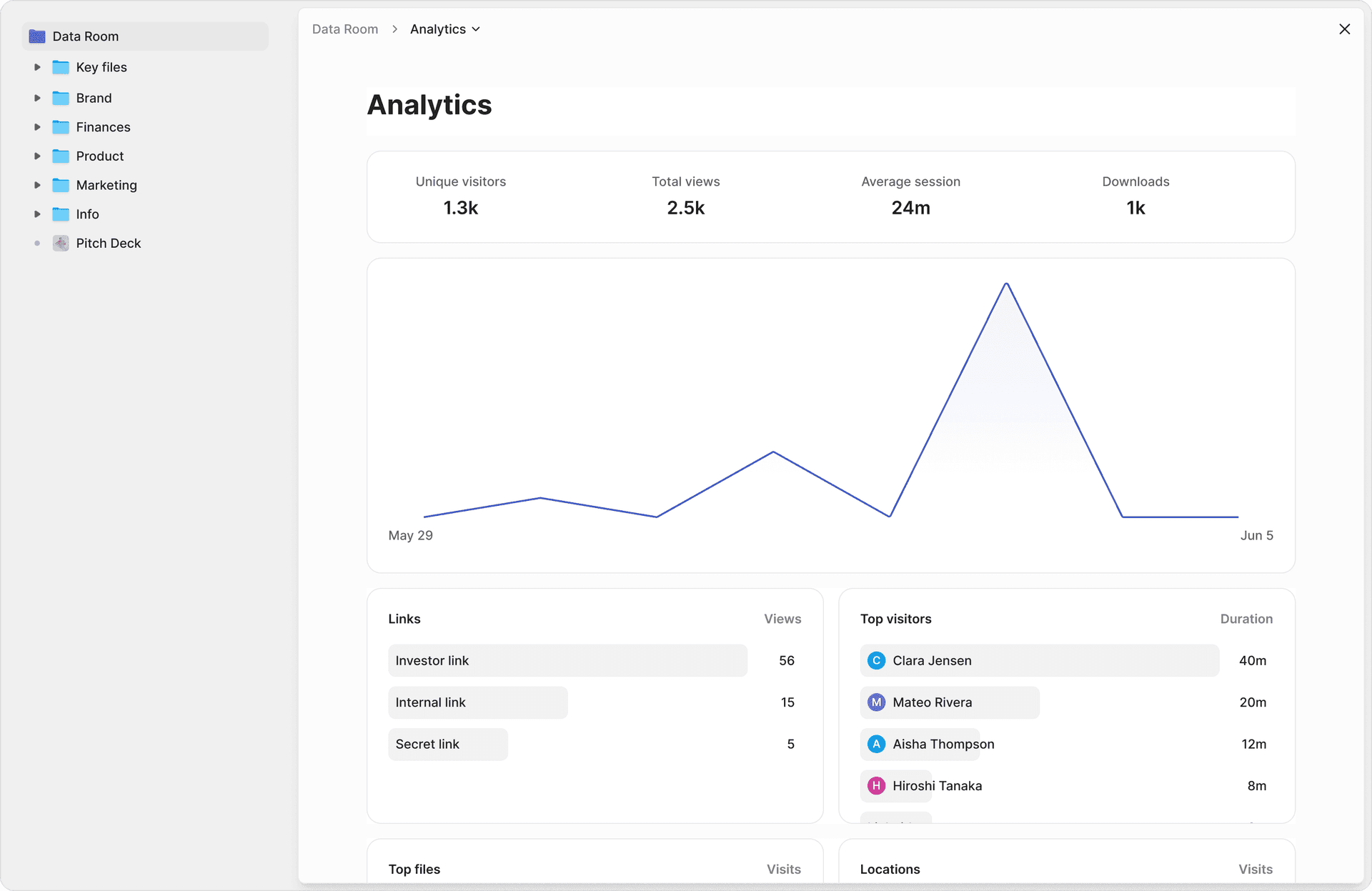
Buyer spending disproportionate time on litigation files? That signals a concern you should address proactively in the management presentation. Three bidders repeatedly revisiting your financial projections but ignoring your product section? That tells you what the negotiation will focus on.
Peony's per-page analytics and heatmaps surface exactly this intelligence. The "analytics" in Datasite, Intralinks, and Firmex show download counts and login timestamps — they do not come close to page-level dwell-time data.
Buy-Side Additions: What to Request if You Are the Acquirer
If you are on the buy side, here is what I recommend requesting beyond the standard checklist:
- Revenue quality and churn math — cohort analysis, gross-to-net revenue bridges, net dollar retention
- Customer concentration — top 10 customers by ARR, renewal calendar, churn risk assessment
- Contract risk — change-of-control provisions, assignment restrictions, MFN clauses, unlimited liability exposure, auto-renew traps
- Security posture — controls summary, vulnerability assessment results, incident history, remediation actions, and board-level reporting
- Data map and DPAs — sub-processors, cross-border transfer mechanisms, consent framework
- Tax — nexus analysis, indirect tax exposure, transfer pricing documentation, audit history
- Working capital peg analysis — normal working capital versus seasonal variation
- Key person and key IP reliance — bus factor analysis, open-source usage and license compliance
Common Mistakes (And How to Fix Them)
After watching deal teams make the same errors repeatedly, here are the patterns I see most often:
Over-sharing too early. A PE firm I worked with gave all six bidders full access from day one. One of the losing bidders referenced the target's customer concentration data in a competitive pitch within two weeks of the process closing. No NDA violation was provable — they had just memorized the numbers. Fix: stage-gate permissions from the start, with PII redacted until shortlist.
No communication protocols. On one deal I advised, the seller's CFO answered a material question about revenue recognition via a Saturday morning text message. That answer never made it into the formal disclosure record. Eighteen months later, the buyer's lawyers cited the discrepancy during an indemnity claim. Fix: route all Q&A through the data room's structured workflow. Peony's Q&A system ensures every question and response is logged and searchable.
Skipping watermarks and screenshot controls. Confidential deal materials end up in competitor inboxes or on social media. Fix: enable dynamic watermarking and screenshot protection as default settings before any buyer gets access.
Weak audit trail. When a dispute arises 18 months after closing about what was disclosed, "we sent an email with the attachment" is not defensible. Fix: ensure immutable logs on views, downloads, prints, and Q&A exchanges from day one.
Ignoring buyer analytics. The data room has analytics, but nobody looks at them. This wastes the single best source of negotiation intelligence in the entire deal process. Fix: assign someone on the sell-side team to review analytics weekly and brief the deal lead on buyer behavior patterns.
Flat permissions for all buyers. Giving every bidder identical access means the losing bidders saw everything the winning bidder did — including competitively sensitive material. Fix: create separate bidder groups with multi-level gating.
By the Numbers
- $4.8 trillion — global M&A deal value in 2025, up 36% from 2024 and the second-highest total on record, driven by a wave of megadeals worth $5 billion or more (Bain & Company, 2026)
- 59% — percentage of dealmakers reporting that due diligence timelines have extended by 1 to 3 months, with half of all deals now taking at least six months from initial information-sharing to close (SRS Acquiom, 2025)
- 45% — percentage of investment bankers who identify technology reviews as the most costly and onerous facet of M&A due diligence, with cybersecurity now overtaking ESG as the top scrutiny area (SRS Acquiom, 2025)
- 10% — share of large M&A transactions (over 1 billion euros) canceled in any given year, with deals over 10 billion euros failing more than twice as often as smaller ones (McKinsey, 2025)
- 90% of PE and 80% of corporate respondents expect to close more deals in 2026, with 87% of PE leaders anticipating higher aggregate deal values — signaling a sustained M&A supercycle (Deloitte M&A Trends Survey, 2026)
- $3.4 billion — global virtual data room market size in 2025, projected to reach $17.46 billion by 2034 at 19.8% CAGR, fueled by increasing M&A complexity (Fortune Business Insights, 2025)
- 30% — share of data breaches involving a third party in 2025, double the prior year, making secure document sharing during due diligence a board-level concern (Verizon DBIR, 2025)
M&A Due Diligence Timeline: Data Room Impact
| Deal Size | Without Data Room | With Structured Data Room | Time Saved |
|---|---|---|---|
| Sub-$10M | 6 to 8 weeks | 3 to 4 weeks | ~50% |
| $10M to $50M | 10 to 14 weeks | 5 to 7 weeks | ~50% |
| $50M and above | 16 to 24 weeks | 8 to 12 weeks | ~50% |
These estimates are based on deals I have worked on through Peony. The time savings are consistent across deal sizes because the bottleneck is always the same: finding, organizing, and sharing the right documents with the right people at the right time. A well-structured data room with AI auto-indexing, stage-gate permissions, and structured Q&A eliminates the manual coordination that consumes most of the timeline. For a deeper look at how due diligence workflows benefit from structured rooms, and how private equity teams run multi-deal processes, see our solution guides.
What a 2026-Grade VDR Must Do
The baseline has shifted significantly in the past two years. Here is what buyers and their advisors now expect as table stakes:
Security and compliance foundations. Granular permissions, dynamic watermarking, screenshot protection, full audit trails, MFA, and SSO. These are no longer premium features — they are minimum requirements.
AI-powered document management. Auto-indexing that classifies documents on upload, full-text OCR search across every page, and bulk operations that handle hundreds of files at once. Manual filing — still the default workflow in Firmex and many Intralinks deployments — is a liability when deal timelines are compressed.
Document redaction. Automated PII and sensitive-term redaction with reversible, single-source-of-truth architecture. You should not be maintaining separate redacted and unredacted file sets.
Regulatory awareness. Public-company buyers operate under SEC cybersecurity disclosure rules requiring material incident reporting on Form 8-K and governance disclosure in 10-K. Expect sharper cyber diligence questions — and make sure your data room's own security posture is defensible.
Page-level analytics. Not login counts. Not download tallies. Per-page dwell time, revisit patterns, and engagement heatmaps that tell you what buyers actually care about.
How to Think About Choosing an M&A Data Room
The right M&A data room depends on two variables: your role in the transaction and the deal size. A sell-side founder on a $15M deal has completely different needs than buy-side PE counsel evaluating a $500M carve-out. Before you look at any comparison table, run through the logic below to narrow the field.
Sell-Side Founder (First-Time Seller, $5M to $50M)
If this is your first exit and your deal is under $50M, you need three things above all else: speed (data room live in hours, not weeks), AI auto-indexing (you do not have a deal team to organize 500-plus documents manually), and page-level analytics (understanding which buyers are genuinely engaged versus tire-kicking directly impacts whether you accept the first LOI or wait for competing bids).
You do NOT need per-page pricing, dedicated project managers, or multi-language support. Those are enterprise features that add $20,000 or more to the cost without adding value to your transaction.
If this is you: Start with Peony Business at $40 per admin per month — set up the sell-side template, upload your documents, and let AI auto-indexing handle the organization. Your total data room cost for the entire process will be under $500.
Sell-Side Advisor / Investment Banker ($10M to $500M)
If you are running a competitive auction with 5 to 15 bidder groups, multi-level gating and bidder-group permissions are non-negotiable. You need separate permission tiers for Phase 1 (teaser and CIM), Phase 2 (detailed financials and contracts), and Phase 3 (confirmatory and disclosure schedules for the winning bidder only).
Advanced Q&A workflow matters here because disclosure consistency across bidder groups is a legal obligation — informal email Q&A creates exposure your client cannot afford.
If your client's board mandates Datasite because "that is what Goldman uses": push back if the deal is under $200M. The security and feature gap between modern and legacy platforms has closed. The price gap has not — Datasite's per-page fees and setup charges can run $25,000 to $50,000 for a mid-market process that costs under $500 on Peony.
Buy-Side PE / Corporate Development ($10M to $500M)
If you are evaluating 3 to 5 acquisitions simultaneously, per-deal VDR pricing destroys your budget. Five concurrent deals at $5,000 per month each equals $300,000 per year in data room costs alone. Unlimited-room pricing — like Peony Business at $40 per admin per month — eliminates this scaling problem entirely.
Page-level analytics on the buy side tell you something different than they tell sellers: which of YOUR team members are actually completing diligence assignments versus falling behind. That is project management intelligence, not just seller intelligence.
Legal Counsel (Representing Either Side, $1M to $500M)
If you are counsel, audit trails are your number-one requirement. Every document view, download, and Q&A exchange must be logged immutably for post-closing defense. When a dispute arises 18 months after closing about what was disclosed and when, your client's position depends on the quality of those records.
Dynamic watermarks with viewer identity make leaked documents traceable — critical when you are advising the seller on remedies against a buyer who shared confidential materials.
If you handle 10 or more transactions per year: you need a standing platform relationship, not per-deal procurement. The time spent on VDR vendor selection for each deal is billable time wasted on administrative overhead.
Independent Sponsor ($5M to $75M, Deal-by-Deal Capital Raise)
If you are raising capital after signing the LOI, your data room must be live and polished before capital partner conversations begin. There is no fund to absorb a $25,000 VDR cost on a deal that might not close — broken-deal costs come out of your pocket.
Speed and cost are existential for your model, not just convenient. A data room that takes 2 weeks to set up and costs $5,000 per month is incompatible with deal-by-deal economics. Peony Free or Business gets you from zero to buyer-ready in under 30 minutes.
Role x Deal Size Summary
| Sub-$10M | $10M to $50M | $50M to $200M | $200M and above | |
|---|---|---|---|---|
| Sell-side founder | Peony Free or Business | Peony Business | Peony Business or iDeals | Peony Business or Firmex |
| Sell-side advisor | Peony Business | Peony Business | Peony Business or iDeals | Datasite or iDeals |
| Buy-side PE | Peony Business | Peony Business | Peony Business | Evaluate Datasite alongside Peony |
| Legal counsel | Peony Business | Peony Business | Peony Business or Firmex | Client's choice (typically Datasite) |
| Independent sponsor | Peony Free or Business | Peony Business | Peony Business | N/A (rare at this size) |
The common thread: For deals under $200M — regardless of your role — modern platforms match or exceed legacy VDR security and features at a fraction of the cost. The decision to use Datasite or Intralinks at $200M and above should be deliberate (because your specific counterparty requires it), not default.
Best M&A Data Room Platforms: Scored Comparison
I have tested every platform on this list with real M&A document sets — uploading financials, contracts, and IP files, running Q&A workflows, and timing how long each takes to go from empty room to buyer-ready. Here is how they rank for M&A-specific workflows in 2026.
| Rank | Platform | Starting Price | M&A Security (/5) | DD Workflow (/5) | Analytics and AI (/5) | M&A Value (/5) | Best For |
|---|---|---|---|---|---|---|---|
| 1 | Peony | Free / $40 admin/mo | 4.8 | 4.8 | 4.9 | 4.9 | Lower-to-mid-market M&A, competitive auctions, sell-side advisory |
| 2 | Datasite | $5,000+/mo | 4.6 | 4.3 | 4.0 | 2.2 | Billion-dollar cross-border M&A with multi-language needs |
| 3 | iDeals | $2,000+/mo | 4.3 | 4.2 | 3.8 | 2.5 | Mid-market M&A where institutional brand recognition matters |
| 4 | Firmex | ~$3,500/mo | 4.1 | 4.0 | 3.0 | 2.8 | Mid-market restructuring, multi-language Q&A |
| 5 | Intralinks | Custom | 4.4 | 4.1 | 3.5 | 1.8 | Cross-border banking transactions, regulatory-heavy deals |
| 6 | DealRoom | Custom | 3.5 | 4.0 | 3.0 | 3.5 | M&A advisory firms managing pipeline and diligence together |
| 7 | Ansarada | $229/mo (250 MB, annual) | 3.7 | 3.8 | 3.6 | 4.0 | Deal readiness scoring, APAC-market transactions |
Methodology: Platforms scored across four criteria based on hands-on M&A workflow testing as of April 2026. M&A Security evaluates encryption, dynamic watermarking, screenshot protection, NDA gating, audit trails, and bidder-group access controls. DD Workflow measures Q&A management, staged disclosure, folder structure tools, document indexing, and version control. Analytics and AI assesses page-level engagement tracking, AI-powered Q&A, auto-indexing, AI redaction, and search quality. M&A Value compares total cost of ownership against feature breadth for a 3-person deal team running a mid-market sell-side process.
Why Peony scores highest for M&A value: Legacy VDR providers charge $5,000 to $25,000 per month with per-page fees, storage overages, and multi-week onboarding. Peony starts free and the Business plan at $40 per admin per month includes every feature — AI auto-indexing, page-level analytics, advanced Q&A, AI redaction, e-signatures, and multi-level gating — with setup in under 5 minutes. For a detailed comparison of all 10 major VDR providers, see the best data rooms for private equity guide.
Why Peony for M&A
I built Peony to solve the specific problems I kept running into when helping teams set up data rooms. Here is what makes it different:
AI auto-indexing for M&A document sets. Upload a batch of mixed documents and Peony's AI classifies and files them into the correct due diligence folders. Financial statements go to Financials, employment agreements to HR, patent filings to IP. What used to take days of manual sorting happens in minutes. Peony's AI-powered rooms handle the classification, search, and organization layer end to end.
Advanced Q&A workflow. Questions route to the right subject-matter experts, status is tracked in real time, duplicates are flagged, and every exchange is logged for audit purposes. This is the feature that saves the most time during active diligence — and the one that protects you most after closing.
Multi-level gating for bidder groups. Create separate permission groups for Stage 1, Stage 2, and Stage 3 buyers. Each group sees only what you have authorized, without file duplication or parallel folder structures.
Page-level analytics for buyer intent signals. See which pages each buyer reviewed, for how long, in what order, and how often they came back. This is negotiation intelligence that Datasite's or Intralinks' aggregate download reports cannot provide.
AI redaction for PII in deal documents. Automated detection and redaction of personal information, customer names, and custom terms — with reversible architecture so you can un-redact for the winning bidder.
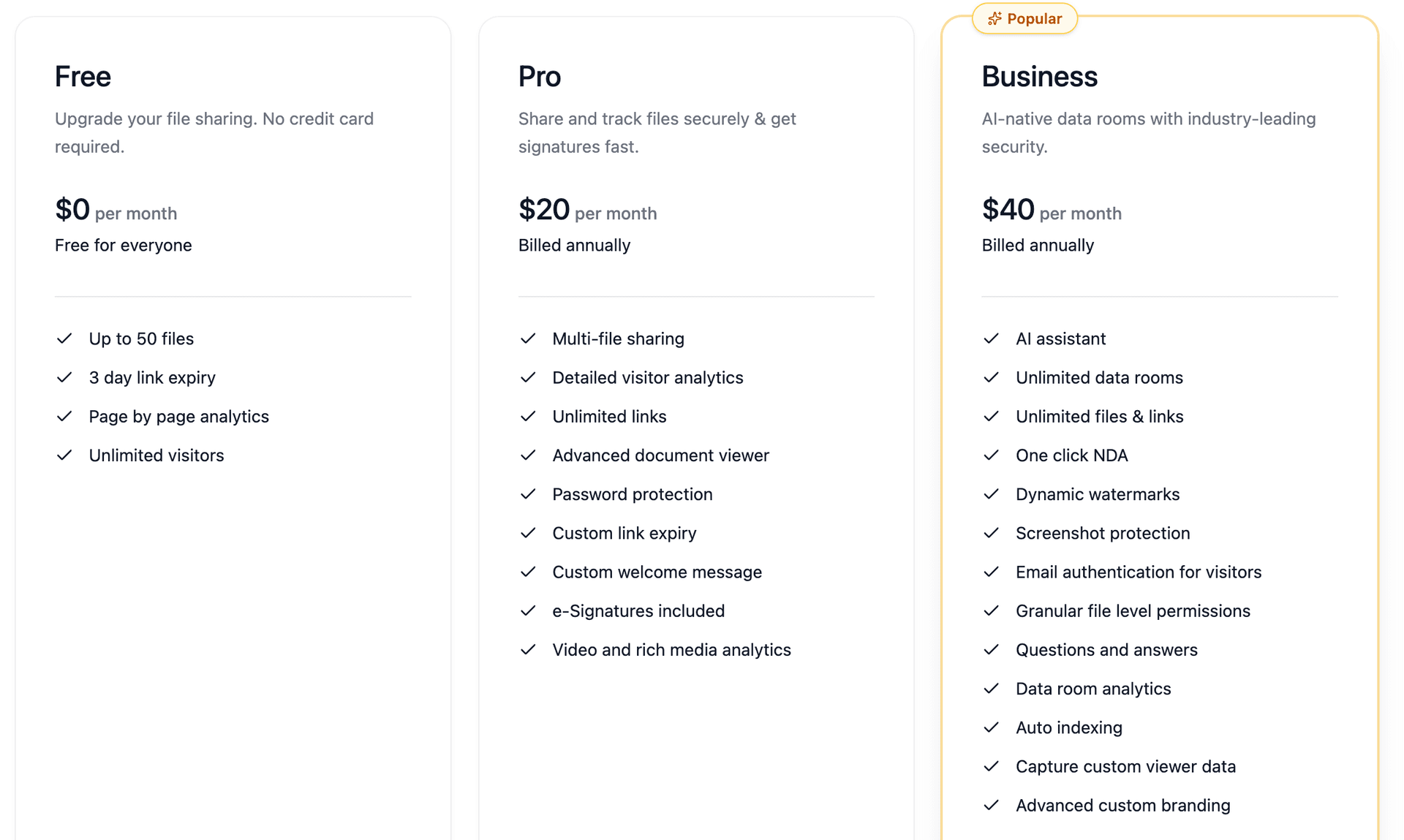
Transparent pricing. Free tier includes page-level analytics and core security. Business plan at $40 per admin per month adds dynamic watermarking, screenshot protection, data rooms, advanced Q&A, multi-level gating, and e-signatures. No per-page fees, no storage overages, no setup charges. For a full comparison, see the VDR cost guide.
Bottom Line
A clean, well-structured M&A data room does more than host files. It shortens diligence timelines, reduces re-trade risk, raises buyer confidence, and gives the sell-side team real-time intelligence on buyer behavior.
The mistakes I see most often — flat permissions, no stage gates, poor Q&A discipline, ignored analytics — are all structural. They are not about the documents themselves. They are about how the room is built and how it is managed throughout the deal lifecycle.
If you are running an M&A process, start with the folder structure and checklist in this guide. Lock down security defaults before any buyer gets access. Implement stage-gate permissions from day one. Route all Q&A through the data room. And actually look at the analytics — they are the best negotiation tool you have.
Peony was built to make all of this easy. Start free, set up your M&A data room in under 30 minutes, and run a tighter deal process.
Frequently Asked Questions
I'm a founder selling my SaaS company for $20M — what's the best M&A data room for a deal this size?
For a $20M SaaS exit, you need a data room that gets you buyer-ready in hours, not weeks — because at this deal size you probably do not have a dedicated deal team handling document organization. Peony is the best fit for your situation. AI auto-indexing sorts your financials, contracts, and IP documents into standard due diligence folders in under 3 minutes, so you skip the days of manual filing that legacy platforms require. At $40 per admin per month on the Business plan, your total data room cost for a 3-month process is under $500 — compared to $15,000 to $75,000 on Datasite or Intralinks. For deals above $500M with multi-language requirements and 50-person cross-border deal teams, Datasite remains the enterprise standard. For your $20M exit, modern platforms deliver the same security at a fraction of the cost.
Our board just said we need an 'M&A data room' for the acquisition — what exactly is that and how is it different from Dropbox?
An M&A data room is a secure virtual repository purpose-built for buyer due diligence — where you organize financial records, contracts, IP documentation, HR files, and operational materials so potential acquirers can review everything under controlled conditions. For a 4-person team running a $25M acquisition, the difference from Dropbox is not just security theater — it is the difference between a defensible process and an indemnity risk. Your data room needs page-level analytics showing which buyers reviewed which documents and for how long, dynamic watermarking that embeds each viewer's identity into every page they see, screenshot protection that blocks and logs capture attempts, staged permissions so different bidders see different documents based on where they are in your process, and a structured Q&A workflow that logs every disclosure for post-closing defense. Dropbox has none of this. Peony provides all of it out of the box, with AI auto-indexing that organizes your documents into due diligence categories on upload — something no general-purpose file-sharing tool can replicate.
Our investment banker recommends Datasite but it costs $25K — for a $40M deal, is Peony a credible alternative?
For a $40M deal, yes — Peony is not just a credible alternative, it is likely the better choice. Datasite charges $5,000 or more per month with per-page fees and 1 to 4 week setup timelines because it was built for billion-dollar cross-border transactions with 50-person deal teams and multi-language requirements. Your $40M deal does not need that infrastructure. Peony Business at $40 per admin per month includes every feature Datasite offers for mid-market M&A — multi-level bidder-group permissions, advanced Q&A workflow with AI-drafted answers, dynamic watermarking, screenshot protection, NDA gating, and e-signatures — plus page-level analytics and AI auto-indexing that Datasite does not match. The security gap between modern and legacy platforms has closed. The price gap has not. Ask your banker what specific Datasite feature justifies the 50x cost difference on a $40M transaction.
One of our potential buyers has a portfolio company that competes with us — how do we protect our financials if they leak?
This is exactly the scenario that separates purpose-built M&A data rooms from shared drives. For a $30M sell-side process with 4 bidder groups — one of which has a competing portfolio company — your data room security is the only thing standing between your margins and a competitor's pricing strategy. In Peony, every page rendered to every viewer carries a dynamic watermark with their identity embedded into the frame — so if your financials surface in a competitor's hands, you can trace the leak to the exact person. Screenshot protection blocks and logs capture attempts in real time, and the full audit trail records which documents each buyer accessed, when, and from which device. Legacy platforms like Firmex offer basic watermarking but cannot match Peony's screenshot-blocking and per-page traceability. For the competing portfolio company specifically, use staged permissions: give them access only to the high-level CIM and summary financials in Stage 1. Detailed revenue breakdowns, customer concentration data, and margin builds stay gated until Stage 2 — after your counsel has assessed the competitive risk. You can revoke access with one click if anything looks wrong.
We have 800 documents for our sell-side process and no idea how to organize them — what folder structure do M&A data rooms use?
Use numbered top-level categories that buyers and their counsel expect to see: 00 Intro and Process, 01 Corporate and Cap Table, 02 Financials and KPIs, 03 Tax, 04 Legal and Key Contracts, 05 HR and Payroll, 06 IP and Technology, through to 99 Confirmatory (gated until late-stage). For a 2-person team running a $15M to $40M sell-side process, organizing 800 documents manually would consume 3 to 5 full days — time you cannot afford when buyers are already scheduling management presentations. Peony ships with a built-in M&A sell-side template that creates the entire folder structure in one click — then AI auto-indexing classifies your documents as you upload them, routing financial statements to 02, employment agreements to 05, and patent filings to 06 automatically. Datasite and Firmex require manual filing or expensive managed-service add-ons to achieve the same result. See the full folder tree earlier in this guide.
We're running a competitive auction with 6 bidder groups — how do we handle diligence questions without disclosing one buyer's questions to another?
With 6 bidder groups in a competitive auction, Q&A isolation is a legal requirement — not a convenience feature. Each bidder's questions and your responses must be siloed so that no group sees what another group asked, because disclosure consistency across bidders is an obligation your counsel will enforce. Peony Smart Q&A handles this natively: questions are organized by bidder group and category, routed to the right subject-matter experts on your sell-side team, and tracked with open versus answered status per group. AI drafts initial answers from your uploaded documents with exact page citations, so your team reviews and approves rather than writing from scratch. Every exchange is timestamped and logged for your audit trail — critical if a bidder later claims selective disclosure.
Three bidders are at different stages of diligence — how do I show different documents to each group without maintaining separate data rooms?
You do not need separate data rooms — that approach doubles your work and creates version-control nightmares. For a $35M sell-side process with a 3-person deal team managing three bidder groups simultaneously, use staged disclosure with per-folder permissions in a single room. In Peony, create bidder groups and assign each group to a permission tier. Your Stage 1 group sees the CIM, management presentation, and market overview. Your Stage 2 bidders unlock detailed financials, key contracts, and customer data after signing an NDA. Stage 3 access opens confirmatory documents like employee-level compensation, pending litigation, and disclosure schedules for the final bidder only. Multi-level gating means the same data room serves all three stages through permission-level controls — no file duplication, no parallel folder structures, and a single audit trail across your entire process. Datasite offers similar gating but charges $5,000 or more per month for it — on a $35M deal, that overhead is hard to justify.
We have 8 bidders in our process and need to set a bid deadline — how do I tell which buyers are serious from their data room activity?
With 8 bidders and a deadline approaching on a $50M competitive auction, page-level analytics are your best signal of buyer intent — and the difference between extending the deadline for the right reasons and wasting your team's time. Serious buyers review financials, key contracts, and IP documentation in depth — spending 30 to 60 minutes per session across multiple visits. Tire-kickers log in once, skim the CIM, and disappear. Peony's per-page analytics and heatmaps show exactly which pages each bidder reviewed, for how long, and in what order — intelligence that Datasite and Intralinks cannot match because their analytics stop at login counts and download tallies. If a bidder has spent 4 hours in your financials folder and keeps revisiting your customer concentration data, they are building a model. If another bidder has not opened anything beyond the management presentation after two weeks, they are not submitting a competitive bid. This intelligence directly informs whether you extend the deadline or narrow the field.
Our CFO just approved $10,000 for data room costs on a $30M deal — is that realistic, or are we going to get hit with overages?
Your CFO's $10,000 budget is realistic only if you avoid legacy VDR providers. Datasite, Intralinks, and Firmex charge $1,000 to $10,000 per month as a base — then add per-page fees, storage overages, user seat charges, and setup fees on top. A 4-month sell-side process on these platforms routinely exceeds $25,000 to $50,000 in total cost. With Peony, your total cost for a $30M deal is a fraction of that budget. The platform starts free with page-level analytics and core security included. The Business plan at $40 per admin per month adds dynamic watermarking, screenshot protection, advanced Q&A, multi-level gating, and e-signatures — no per-page fees, no storage overages, no setup charges. A 3-person deal team running a 4-month process costs $480 total.
Buyers keep emailing diligence questions to random people on our team — is there a better way to manage Q&A during M&A?
Yes — and the scattered-email approach is not just inefficient, it is a legal liability. For a 5-person sell-side team fielding questions from 3 bidder groups on a $25M deal, unstructured Q&A creates disclosure gaps that surface during reps-and-warranties negotiations. When your CFO answers a material question about revenue recognition via email and that answer never makes it into the formal disclosure record, you have created an indemnity risk that surfaces 18 months after closing. Peony's advanced Q&A workflow replaces this with structured disclosure: questions are organized by category, routed to the right team members, tracked with open versus answered status, and logged in a searchable audit trail. Unlike Datasite's Q&A module — which charges extra for advanced features — Peony includes the full workflow on the Business plan at $40 per admin per month. Every exchange is timestamped and immutable — so when the buyer's lawyers ask what was disclosed, you have a single defensible record instead of scattered email threads.
We're preparing to sell and have no idea how many documents buyers will expect — what's normal for a mid-market M&A data room?
A mid-market M&A data room typically contains 2,000 to 10,000 pages across 500 to 2,000 individual documents, organized into 10 to 12 top-level categories. For a $20M to $50M transaction with a 3-person deal team, expect to populate 8 to 10 of those categories for your first buyer meeting — the rest fill in as diligence progresses. Large-cap and cross-border transactions can exceed 50,000 pages. The standard Bloomberg Law due diligence request list includes 174 document types — though most mid-market deals require a subset of these. Do not let the volume intimidate you. Peony AI auto-indexing handles document sets of any size: bulk upload everything and the AI categorizes each file into the correct due diligence folder in under 3 minutes, regardless of whether you have 200 documents or 20,000. Legacy platforms like Intralinks still rely on manual filing workflows that make this a multi-day exercise. Start with the core packs — corporate, financials, top contracts, and privacy — and expand from there as buyer requests come in.
I'm sell-side counsel on a $15M acquisition — do I really need a dedicated VDR, or can we use the buyer's platform?
As sell-side counsel, you need your own platform — using the buyer's data room means the buyer controls the audit trail, the access logs, and the permission structure. If a post-closing dispute arises over what was disclosed and when, your client's defense depends on records the opposing party administers. That is an untenable position. At $15M, cost is not a valid reason to cede this control. Peony Business at $40 per admin per month gives you an immutable audit trail that your client owns, dynamic watermarking that traces any leaked document to the specific viewer, and NDA gating that documents each buyer's agreement before they access a single page. For deals of this size, the data room cost is a rounding error compared to the liability exposure of relying on the buyer's infrastructure.
Our PE fund runs 6 deals per year in the $20M to $100M range — should we use one standing VDR platform or procure per deal?
At 6 deals per year, per-deal procurement is destroying your budget and your team's time. If you are paying $5,000 per month per deal on legacy platforms, that is $360,000 per year in data room costs alone — plus the overhead of vendor selection, procurement, and onboarding on every transaction. A standing platform relationship eliminates all of this. Peony Business at $40 per admin per month supports unlimited data rooms, so your 6 concurrent deals run on a single subscription. Your team learns one interface, your compliance team audits one vendor, and your associates stop wasting billable hours on VDR setup for each new transaction. Page-level analytics across all your deals also give you pattern recognition — you start to see which document categories consistently slow diligence across your portfolio, so you can address those upstream.
Related Resources
- 12 Best Boutique M&A Advisors in SF/Bay Area for $5M-$200M Deals (2026) — West Coast Tier S equivalent, Bay Area boutiques covering Tech / SaaS / AI / Healthcare / Biotech / Fintech
- Oil and Gas Data Room Checklist — 42 documents across 12 canonical folders, FEED-to-FID file mass, and 4-tier farm-out access matrix
- M&A Process Explained (8 Phases, Real Deliverables)
- Best M&A Advisors in Dallas — 14 verified Dallas boutiques for $1M-$300M deals
- Best M&A Advisors in Chicago — 18 verified Chicago boutiques across $1M-$2B+ EV
- Best M&A Advisors in Atlanta — 14 verified Atlanta boutiques for $1M-$300M deals (healthcare + ESOP specialty)
- 12 Best Boutique M&A Advisors in Boston — companion city guide; 12 Boston/Cambridge boutiques across $5M-$200M EV (biotech / life sciences / healthcare / SaaS specialty bench)
- 12 Best Boutique M&A Advisors in Seattle — companion city guide; 12 Seattle/PNW boutiques across $5M-$200M EV (SaaS / software / aerospace specialty bench)
- 12 Best Boutique M&A Advisors in Miami — companion city guide; 12 Miami boutiques across $5M-$200M EV (LatAm cross-border / hospitality / healthcare-services specialty bench)
- Best M&A Advisors in Washington DC — companion city guide; DC boutiques across the cleared-deal-handling tier (KippsDeSanto, The McLean Group, Renaissance Strategic Advisors, FOCUS Investment Banking, Houlihan Lokey ADG, Lincoln International DC, Cain Brothers DC) covering federal-services, GovCon, Defense Industrial Base, and NIH-proximity Bethesda biotech specialty benches
- Due Diligence Checklist (174 Documents)
- Best Data Rooms for Private Equity
- Best Data Room for Oil and Gas Companies — 10 platforms tested for upstream E&P, midstream, and LNG project finance
- My Honest Review of Datasite Alternatives
- My Honest Review of Firmex Alternatives
- Virtual Data Room Cost Guide
- State of M&A Data Rooms in Q1 2026 — benchmarks on cost, setup, and due diligence
- Best Data Room Software Ranked
- VDR Redaction Guide for Due Diligence
- VDR Permissions Guide for Due Diligence
- Document Sharing Compliance Guide
- VDR Features That Actually Matter
- Document Security Software Guide
- Document Tracking Software Guide
- Dynamic Watermarking Explained
- M&A Solutions
- Due Diligence Solutions
- Private Equity Solutions
- See Pricing