
How to Password Protect a Video (7 Methods — Only 1 Tracks Views) in 2026

Co-founder and CEO at Peony. I built the data room platform with a background in document security, file systems, and AI. Founded Peony in 2021 in San Francisco.
Last updated: March 2026
I have been building Peony — an AI-powered data room for secure document and video sharing — since 2023. Before that, I spent an embarrassing amount of time trying to password protect pitch recordings, product demos, and training videos with tools that were never designed for it. I have tested every method in this guide myself.
TL;DR — Free methods (Vimeo, zip encryption, Google Drive restricted sharing) can put a password or access gate in front of a video. But none of them tell you who actually watched, which sections they viewed, or whether someone screenshotted your content. Verizon's 2025 DBIR reports that around 60-68% of breaches still involve a human element — misdirected sharing, bad access settings, or forwarding to the wrong person. If your video matters, a password alone is not enough.
Password protecting a video means restricting playback so that only people who pass an access check — a password, an email verification, or both — can view your content. In 2026, the real question is not "how do I add a password" but "how do I share a video securely AND know who actually watched it."
This guide covers seven methods — from completely free to professional-grade — so you can pick the one that fits your situation.
Quick Guide: 7 Methods Compared
| Method | Cost | Password Gate | Viewer Tracking | Best For |
|---|---|---|---|---|
| Vimeo | From $20/mo | Yes | Aggregate only | Polished video hosting |
| YouTube (Unlisted/Private) | Free | No | Aggregate only | Low-stakes sharing |
| Google Drive | Free | No (account-based) | No | Quick internal shares |
| OneDrive / Dropbox | From $7/mo | Yes | No | File delivery |
| Zip file encryption | Free | Yes (local) | No | Offline delivery |
| Loom | From $15/user/mo | Yes (Business+) | Basic | Async team recordings |
| Peony (data room) | Free | Yes | Per-viewer, per-section | Investor videos, client demos, confidential content |
Method 1 — Vimeo (Password-Protected Streaming)
Vimeo is the most well-known platform for password-protected video hosting.
How it works:
- Upload your video to Vimeo.
- Go to your video's privacy settings.
- Select "Only people with a password" and set your password.
- Share the Vimeo link plus the password (ideally through separate channels).
What you get:
- Clean, professional video player.
- Password gate before playback.
- Domain-level embed restrictions (paid plans).
- Basic aggregate analytics (total views, play rate).
What you do not get:
- Per-viewer analytics showing who watched and which sections they viewed.
- Dynamic watermarking with each viewer's identity baked into the video frame.
- Screenshot protection or screenshot attempt logging.
- Instant revocation of a specific person's access — once the password is shared, anyone who knows it can watch.
Pricing: Starts at $20/mo (Starter). The free plan does not include password protection.
Vimeo is a solid choice when you need polished streaming for marketing or client-facing video and aggregate analytics are enough. But if you need to know exactly who watched, it falls short.
Method 2 — YouTube (Unlisted or Private)
YouTube does not support password protection at all. What it does offer:
- Public — anyone can find and watch it.
- Unlisted — anyone with the link can watch, but it does not appear in search or on your channel.
- Private — only specific Google accounts you invite can watch.
How to set it up:
- Upload your video to YouTube.
- In visibility settings, choose Unlisted or Private.
- For Private, add the Gmail addresses of your intended viewers.
The catch: Unlisted links get forwarded through Slack threads, email chains, and shared docs — fast. There is no password, no identity verification, and no way to see who forwarded the link. Private mode requires viewers to have Google accounts, and you still get no per-viewer analytics beyond aggregate counts.
Best for: Low-stakes content, internal team updates where you do not care about tracking, or drafts you want to share quickly.
Not suitable for: Investor pitch recordings, confidential product demos, HR training with sensitive processes, or anything you would not want forwarded.
Method 3 — Google Drive (Restricted Sharing)
Google Drive does not offer password protection for files or folders. What you can do:
- Upload your video to Google Drive.
- Right-click the file, select Share, and change access to "Restricted."
- Add specific email addresses of people who should have access.
What you get:
- Google account-based access control.
- View-only permissions (disable downloading if you want, though it is easily bypassed).
- Integration with Google Workspace.
What you do not get:
- A password gate — it relies entirely on Google account authentication.
- Per-viewer engagement analytics (you cannot see who watched versus who just opened the link).
- Watermarking or screenshot deterrence.
- Easy revocation for external users who are not part of your Google Workspace.
If you need to password protect a Google Drive folder, we wrote a separate guide — but the short answer is Google Drive does not support it natively.
Best for: Quick, internal shares within a Google Workspace organization where everyone already has a Google account.
Method 4 — OneDrive or Dropbox (Password-Protected Links)
Both OneDrive and Dropbox support password-protected sharing links on paid plans.
OneDrive:
- Upload your video.
- Create a sharing link with "Anyone with the link" access.
- Enable "Set password" and "Set expiration date."
Dropbox:
- Upload your video.
- Create a shared link.
- In link settings, enable password protection and link expiration. Disable downloads if needed.
What you get:
- Real password gate before the recipient can access the file.
- Link expiration (auto-disables after a date).
- Download controls (Dropbox).
What you do not get:
- Per-viewer analytics — you cannot see who watched or for how long.
- Dynamic watermarking or identity-bound viewing.
- A dedicated video player — recipients download and play locally.
- Screenshot protection.
Pricing: OneDrive is included with Microsoft 365 (from $7/mo). Dropbox Professional starts at $16.58/mo.
Best for: Delivering raw video files when the recipient genuinely needs the file, not just viewing access.
Method 5 — Zip File Encryption (Free, Local Method)
This is the most low-tech approach, and it works offline.
On Mac (see our full Mac file protection guide for more methods):
- Open Terminal.
- Run:
zip -e protected-video.zip your-video.mp4 - Enter and confirm your password when prompted.
- Send the zip file via email, cloud storage, or a file transfer service.
On Windows (see our full Windows file protection guide for more methods):
- Use 7-Zip (free). Right-click your video file, select 7-Zip, then "Add to archive."
- Set a password and choose AES-256 encryption.
- Send the encrypted zip file.
What you get:
- AES-256 encryption (with 7-Zip on Windows; macOS zip uses weaker ZipCrypto by default — use
opensslfor stronger encryption). - No account needed — works entirely offline.
- Free.
What you do not get:
- Any form of analytics — you have no idea if or when the recipient opened it.
- Access revocation — once the file is sent, you cannot take it back.
- Watermarking, screenshot protection, or any viewing controls.
- A streaming experience — the recipient has to download, extract, and play the file locally.
Best for: One-off file transfers where you trust the recipient and just need basic encryption in transit.
For more on zip encryption, see our complete guide to password-protecting zip files.
Method 6 — Loom (Password-Protected Screen Recordings)
Loom (now part of Atlassian) is widely used for async video communication.
How it works:
- Record or upload your video in Loom.
- In the video's share settings, add a password (requires Business plan at $15/user/mo or above).
- Share the Loom link and send the password separately.
What you get:
- Password gate on Business plan and above.
- Basic engagement tracking (who viewed, view count, CTA clicks).
- AI-generated summaries and transcripts.
What you do not get:
- Per-section analytics showing which parts of the video each viewer watched.
- Dynamic watermarking with each viewer's identity.
- Screenshot protection.
- A data room structure for organizing multiple videos and supporting documents.
- Granular access revocation beyond the individual video.
Best for: Async team communication, quick product walkthroughs, and sales follow-ups within a team that already uses Loom.
Method 7 — Peony (Password + Identity + Tracking in One)
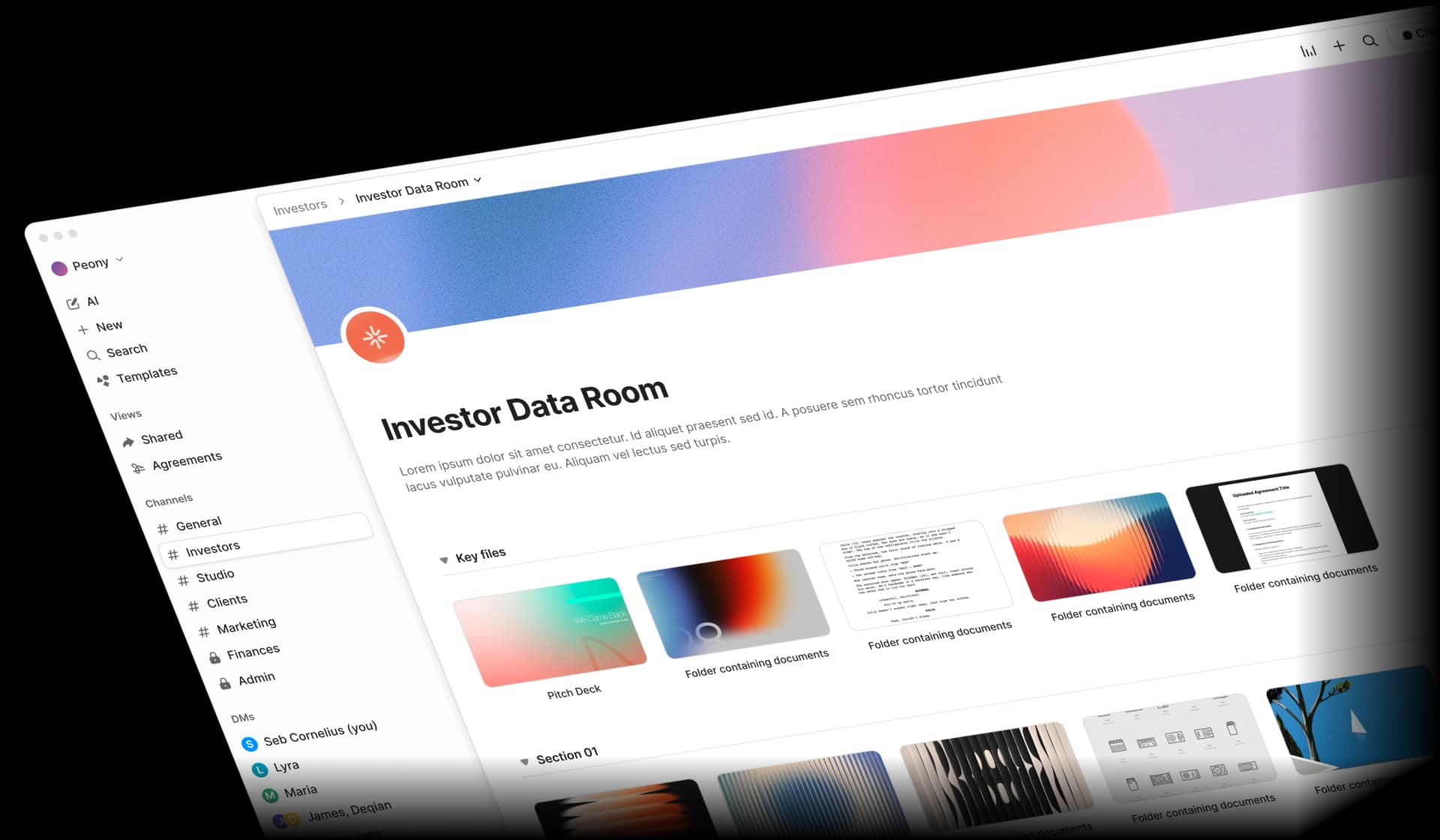
This is where I am biased — I built Peony. But I built it precisely because the six methods above all have the same blind spot: you share a video and then have no idea what actually happened.
Peony is an AI-powered data room designed for secure file sharing. Here is how password-protected video sharing works:
Step 1 — Create a room and upload
- Create a room in Peony (name it by context — "Series A — Pitch Video," "Client X — Product Demo," "Internal — Q1 Training").
- Upload your video (and any supporting documents). AI auto-indexes everything in under 3 minutes.
Step 2 — Set access controls
- Grant access to specific email addresses or trusted domains (e.g.,
@fund.com) using identity-bound access. - Add a password to the shared link for an additional layer using password protection.
- Optionally enable NDA gating — viewers must accept your NDA before seeing anything.
- Set link expiration so access auto-disables after a deadline.
- Choose whether to allow downloads or keep it view-only.
Step 3 — Share one link
Send the Peony link in your email or message. Share the password through a separate channel (SMS, Signal, phone call).
"Here's a secure link to the recording. It's behind a passcode — I'll send that separately."
Step 4 — Watch the analytics
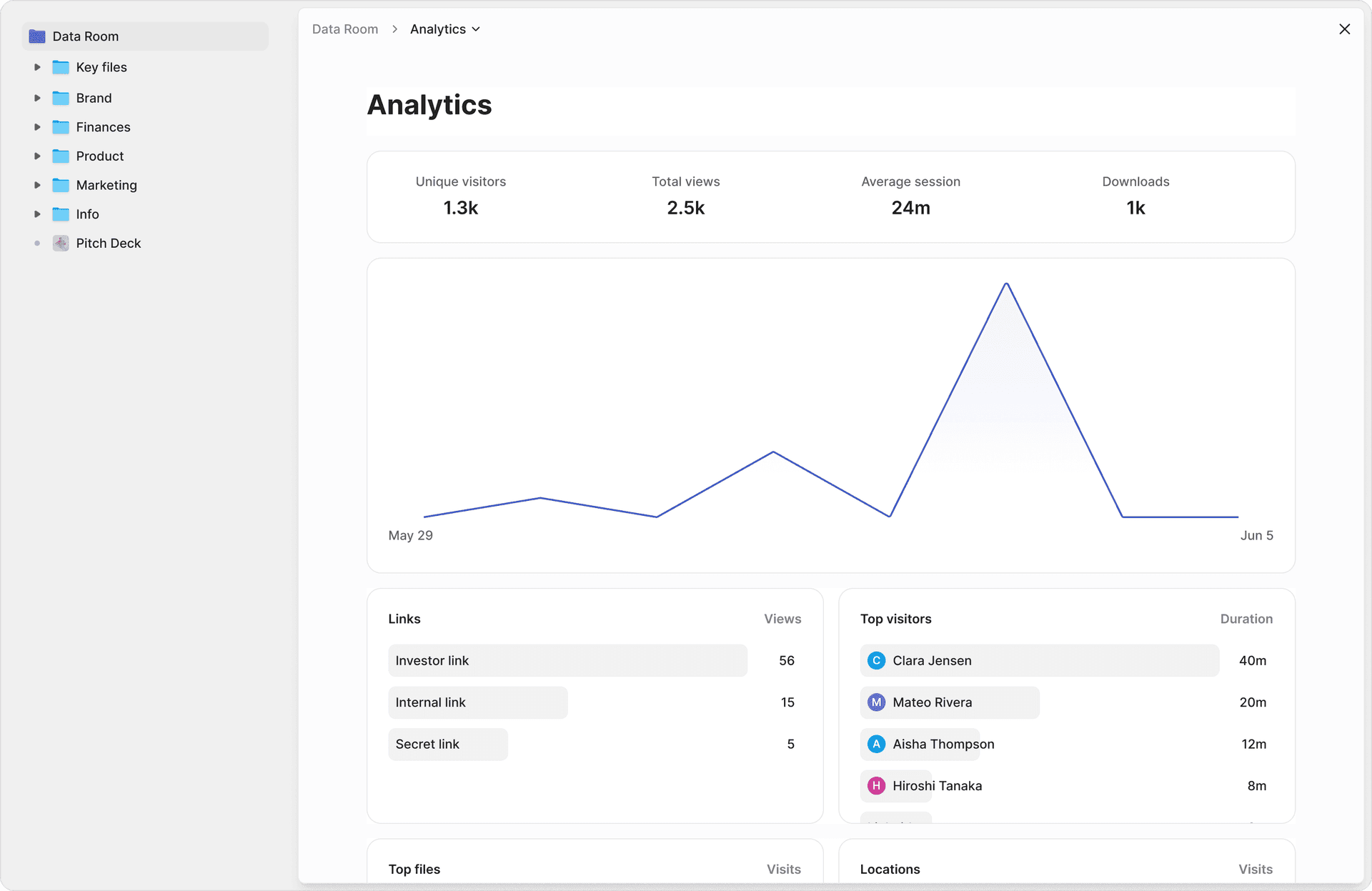
This is the part that no other method on this list can match. Peony's page-level analytics show you:
- Who accessed the video (by verified email).
- When they watched.
- How long they spent on each section.
- Whether they came back for a second or third viewing.
- Screenshot attempts — Peony blocks screenshots AND logs the attempt.
If you are sharing a pitch recording with investors, this tells you which investors are genuinely interested (they rewatched the financial projections) versus which ones skimmed for 30 seconds and moved on.
Step 5 — Update or revoke anytime
- Replace the video with a new version — the link stays the same. No more "latest version?" threads.
- Revoke access for specific viewers or shut down the entire room when the deal, project, or process ends.
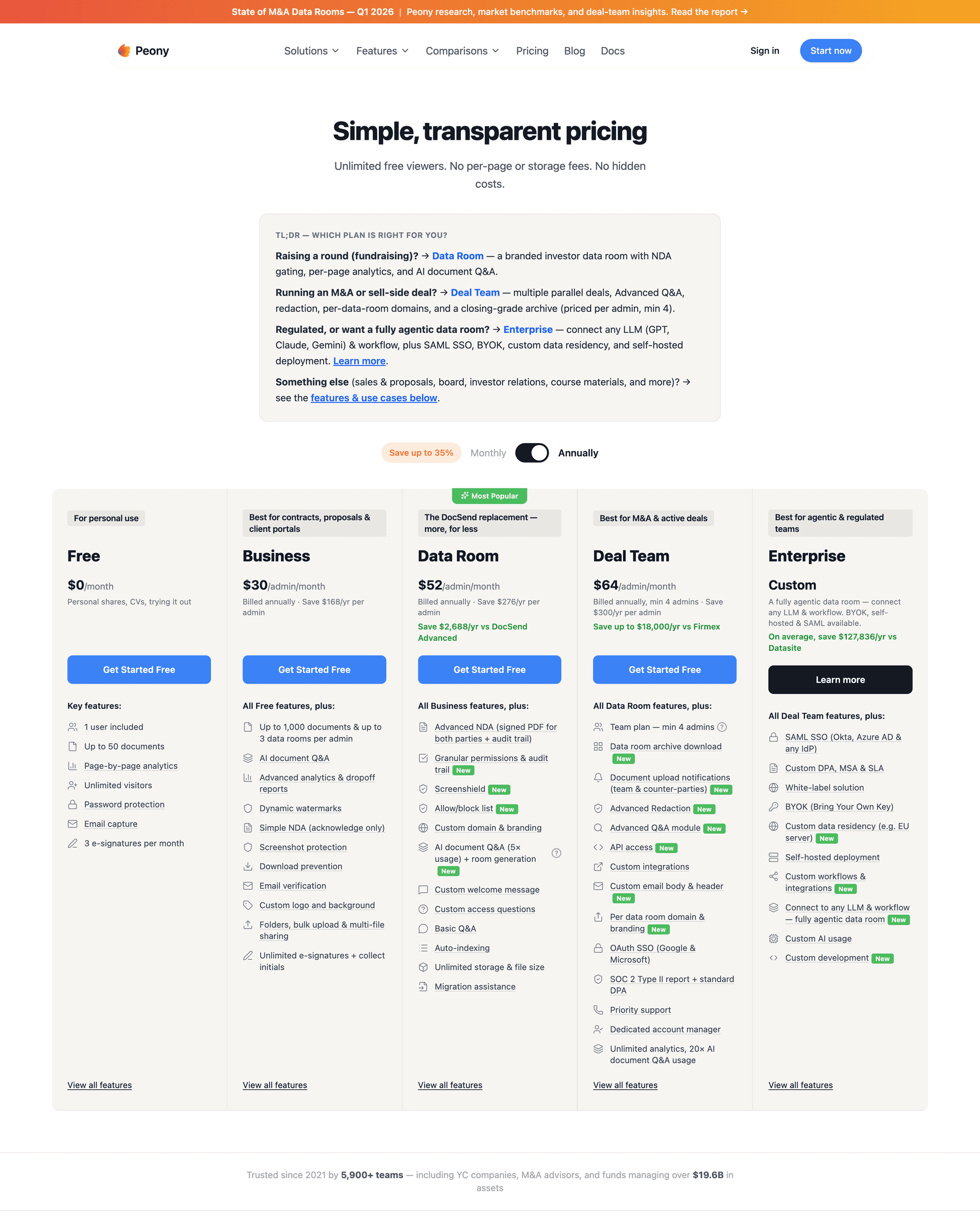
Pricing: Free tier includes per-page analytics and link expiry. Business ($30/admin/month) adds password protection, screenshot blocking, and data rooms. Data Room ($52/admin/month) adds dynamic watermarks, advanced signed-NDA e-signatures, custom domains, AI room generation, and unlimited rooms.
Best for: Investor pitch recordings, client product demos, board update videos, M&A due diligence materials, training content with sensitive processes — any video where knowing who watched is as important as controlling who can watch.
One honest note: Peony is a data room platform, not a video hosting service. If you need public video hosting with SEO, embeds, and a video player widget, Vimeo or YouTube are purpose-built for that. Peony is for when the video is confidential and you need to control exactly who sees it, track their engagement, and protect it from screenshots and unauthorized sharing.
Full Platform Comparison Table
| Feature | Peony | Vimeo | YouTube | Google Drive | OneDrive / Dropbox | Loom |
|---|---|---|---|---|---|---|
| Password protection | Yes (Business and up) | Yes (from $20/mo) | No | No | Yes (paid plans) | Yes (Business+) |
| Starting price | Free ($0) | $20/mo | Free | Free | From $7/mo | $15/user/mo |
| Per-viewer analytics | Yes (per-section) | Aggregate only | Aggregate only | No | No | Basic |
| Dynamic watermarks | Yes (viewer identity) | No | No | No | No | No |
| Screenshot protection | Yes (blocks + logs) | No | No | No | No | No |
| Identity-bound access | Yes (email/domain) | No | Google account only | Google account only | Account-based | Workspace only |
| Instant revocation | Yes (per-viewer) | No | Remove from list | Remove permissions | Manual | Per-video |
| NDA gating | Yes | No | No | No | No | No |
| Link expiration | Yes | No | No | No | Yes | Yes |
| Download control | Yes | Yes | No | Weak | Yes | Yes |
| AI auto-indexing | Yes (under 3 min) | No | No | No | No | AI summaries |
| E-signatures built in | Yes | No | No | No | No | No |
By the Numbers
- 60-68% of data breaches involve a human element — misdirected sharing, misconfigurations, or social engineering. (Verizon 2025 DBIR)
- $4.88 million — global average cost of a data breach in 2024. (IBM Cost of a Data Breach Report 2024)
- The enterprise video platform market is projected to reach $10.7 billion by 2026, with security cited as a top purchasing differentiator. (Fortune Business Insights)
- 78% of organizations experienced email-based data exfiltration in the past year — videos attached as raw files are part of this surface. (Tessian research)
Practical Tips for Secure Video Sharing
-
Always separate the link and the password. Send the video link in one channel (email) and the password in another (SMS, Signal, phone call). This is the single most effective habit you can build.
-
Default to streaming, not downloading. If the recipient does not genuinely need the raw file, keep the video in a viewer. Downloads create uncontrolled copies you can never recall.
-
Set link expirations. Whether you use Peony, Dropbox, or OneDrive, auto-expire links after the relevant deadline. Forgotten links from months-old deals are a real attack surface.
-
Use one "home" per context. For investor updates, create a single Peony room. For client demos, another. People always know where to find the current version.
-
Revoke access when the process ends. When a fundraising round closes, a hiring process wraps up, or a client relationship ends, shut down access. Verizon's breach data consistently shows that lingering access is a major risk factor.
-
Watermark confidential recordings. If your video contains financial projections, product roadmaps, or strategy discussions, dynamic watermarking with the viewer's identity deters casual screenshotting and forwarding.
-
Test the recipient experience. Before sending a protected video to an important viewer, open the link in an incognito window yourself. Confirm the password gate works, the video streams smoothly, and the experience is not frustrating enough to make them ask you to "just send the file."
The Bottom Line
Here is how I think about it:
- Casual sharing (team updates, low-stakes demos): YouTube Unlisted or Google Drive restricted sharing. Free, fast, good enough.
- Password protection without tracking (file delivery, one-off transfers): Zip encryption, OneDrive, or Dropbox password-protected links. Simple and functional.
- Professional video hosting with a password gate (marketing, polished presentations): Vimeo. Clean player, reliable streaming.
- Confidential videos where you need to know who watched (investor pitches, client demos, board updates, M&A materials, training with sensitive processes): Peony. Password protection is the minimum. Knowing exactly who watched, which sections held their attention, and whether someone tried to screenshot your content — that is the actual security.
Free methods protect with a password. Peony protects with a password AND tells you who watched, which sections they viewed, watermarks their identity, and blocks screenshots.
If your video is worth protecting, it is worth knowing what happened after you shared it.
Frequently Asked Questions
How do I password protect a video for free?
You can password protect a video for free using Vimeo (basic password on paid plans), a password-protected zip file, or Google Drive restricted sharing. For password protection with per-viewer analytics, Peony offers password gating from Business ($30/admin/month), which also includes screenshot blocking, with dynamic watermarks on the Data Room plan ($52/admin/month). Page-level analytics are included on every plan.
Can you password protect a video on YouTube?
No. YouTube does not offer password protection. You can set a video to Unlisted (anyone with the link can watch) or Private (invite specific Google accounts), but neither option supports a password gate. For password-protected video sharing with viewer tracking, use Peony, which starts free and shows exactly who watched and for how long.
Can you password protect a video on Vimeo?
Yes. Vimeo supports password-protected videos on paid plans starting at $20 per month (Starter). However, Vimeo does not offer per-viewer analytics that show which sections each person watched, dynamic watermarking with viewer identity, or screenshot blocking. Peony includes page-level analytics on every plan, plus password protection and screenshot blocking on Business ($30/admin/month), with dynamic watermarks on the Data Room plan ($52/admin/month).
How do I see who watched my password-protected video?
Most platforms show aggregate view counts at best. Peony provides page-level analytics that show exactly who accessed your video, when they watched, how long they spent on each section, and whether they returned for a second viewing. This works on the free plan with no per-viewer fees.
What is the most secure way to share a video online?
The most secure approach layers multiple controls: email-verified identity access, password protection, dynamic watermarking with the viewer's name baked into every frame, screenshot blocking that logs attempts, link expiration, and instant access revocation. Peony combines all six in one platform — page-level analytics and access revocation on every plan, plus password protection and screenshot blocking on Business ($30/admin/month), with dynamic watermarks on the Data Room plan ($52/admin/month).
Can I revoke access to a password-protected video after sharing?
With password-only platforms like Vimeo, you cannot truly revoke access because anyone who knows the password can still watch. Peony uses identity-bound access, so you can revoke a specific viewer or shut down an entire room instantly, even after someone has already accessed the link.
Is Google Drive good for sharing password-protected videos?
Google Drive does not support password protection for files or folders. You can restrict access to specific Google accounts, but there is no password gate, no per-viewer analytics, and no watermarking. For videos that need real protection and tracking, Peony provides viewer-level analytics on every plan, plus password gating on Business ($30/admin/month) and dynamic watermarks on the Data Room plan ($52/admin/month).
How do I share a confidential video with investors?
Upload the video to a secure data room like Peony, enable password protection and NDA gating, and share one link. Peony shows which investors watched, which sections held their attention, and how long they spent reviewing. AI auto-indexes supporting documents in under 3 minutes, so your entire deal room is ready fast.
Related Resources
- How to Password Protect Files on Mac (5 Ways)
- How to Password Protect Files on Windows
- How to Protect Your Pitch Deck from Unauthorized Sharing
- Secure File Sharing: The Complete Guide
- How to Send a Pitch Deck to Investors
- How to Track Pitch Deck Engagement
- Startup Data Room Checklist
- Best Data Rooms for Startups
- How to Password Protect a Google Drive Folder
- Password Protect PDF Without Adobe
- How to Password Protect Zip Files
- Secure Video Data Room — the deal-grade version of this problem: streaming 100GB+ of screeners to buyers with per-viewer watermarks and NDA gates
You might also like
Jun 17, 2026
How to Password-Protect an HTML File in 2026 (5 Methods, Ranked)
Jun 5, 2026
How to Protect Course Materials From Theft, Leaks, and Counterfeiting (2026)
Jun 3, 2026
Secure Video Data Room: Share Large Footage With Buyers (2026)