
Startup NDAs: When You Need One and When to Skip in 2026

Co-founder at Peony. Former VC at Backed VC and growth-equity investor at Target Global — I write about investors, fundraising, and deal advisors from the deal-side perspective I spent years in.
Set up my next data room with SeanVerdict: Fewer than 5 percent of seed-stage VCs will sign an NDA before looking at a pitch deck. Forcing the issue signals inexperience and kills deal momentum. The practical approach in 2026 is staged disclosure backed by technical controls — dynamic watermarks, page-level analytics, screenshot protection, and identity-bound links — so you stay protected without asking investors to sign anything upfront. Save NDAs for post-term-sheet diligence and deep-tech IP reviews. Peony handles both sides: free data rooms for early sharing and one-click NDA gates for the sensitive stuff.
Last updated: March 2026
We run Peony, a data room company. The NDA question comes up in almost every founder conversation I have — usually right before a raise, when someone realizes they are about to hand their financials to a stranger on the internet. The anxiety is completely rational. But after watching hundreds of founders navigate this, I have seen NDAs kill more conversations than they protect. The goal of this guide is to give you a concrete framework so you know exactly when an NDA adds value, when it costs you a meeting, and how to stay safe either way.
What an NDA Actually Does in a Fundraising Context
A non-disclosure agreement is a contract that says: "I will share non-public information with you; you promise not to misuse or disclose it."
In fundraising, that "you" could be an angel, a VC, a family office, or a corporate strategic investor.
NDAs come in two flavors:
- One-way NDA — the founder shares, the investor promises confidentiality.
- Mutual NDA — both sides exchange sensitive information, common in later-stage or strategic deals and M&A conversations.
What an NDA does not do:
- It does not prevent anyone from reading, remembering, or being influenced by what you shared.
- It does not make enforcement easy. Litigating an NDA breach in US courts can cost tens of thousands of dollars before discovery begins, and you must prove that specific confidential information was misused and caused measurable damages.
- It does not replace good judgment about what to share with whom.
Sophisticated founders treat NDAs as one layer of protection — useful at the right moment, expensive and counterproductive at the wrong one.
Why Most VCs Will Not Sign an NDA Before a Pitch
This is the part nobody tells first-time founders gently enough. The vast majority of professional VCs and many angels will not sign an NDA just to see your deck or take an intro meeting. That is not personal — it is the norm.
The reasons are structural:
1. Volume conflict. A mid-size fund sees 2,000 to 3,000 pitches a year, many in overlapping verticals. If they signed NDAs with every founder building "AI for X," they would face constant accusation risk whenever they invested in one.
2. Legal overhead does not scale. Tracking hundreds of slightly different NDAs, cross-referencing them before every new investment, and looping in counsel for each one would grind deal flow to a halt.
3. Friction kills momentum. Investors want to open a deck quickly, share it with a partner, and decide whether to take a meeting. A pre-pitch NDA slows that entire funnel.
4. Signal problem. Experienced investors and startup lawyers have said it plainly: asking a VC to sign an NDA at the intro stage can make you look inexperienced. About 40 percent of first-time founders try it, and many quietly lose the meeting before it starts.
5. Reputation is self-enforcing. If a fund became known for leaking decks or copying ideas, strong founders would stop sending them deals. That social consequence is often more powerful than any legal threat.
So no, you are not failing if investors refuse to sign. That is how the game works.
When to Skip the NDA
Intro decks and first meetings
For cold outreach, a first Zoom call, or a quick coffee at a conference — do not ask for an NDA. Treat your intro deck as if it might be forwarded and design it accordingly: problem, solution, market size, traction, and team. Do not paste raw code, exact architecture, or proprietary datasets into a deck that could end up in someone else's inbox.
Top-of-funnel data room access
Some founders gate their data room behind an NDA from day one. The result is predictable: many VCs walk away instead of fighting through paperwork, especially early in the relationship. A better pattern is tiered access — open the high-level materials, gate the sensitive ones later.
Peony's identity-bound links let you share a data room without requiring a signature. Every viewer is verified by email, every page view is logged, and every document carries a dynamic watermark with the viewer's identity. That is more protective than an unenforceable NDA sitting in a spam folder.
Demo days, pitch events, and casual mentoring
If someone is giving you 20 minutes of friendly feedback at an accelerator office hour, asking them to sign a legal document first shifts the vibe from "help me think" to "you are a legal risk." Save the paperwork for when it matters.
When an NDA Makes Sense
NDAs are not useless. They are just for specific moments in the fundraising lifecycle.
Deep tech and life sciences with genuinely secret IP
If your competitive edge is a non-obvious algorithm, unpublished research, a patentable chemical process, or proprietary hardware design — and a serious investor needs to see the internals to evaluate the deal — it is reasonable to say: "Happy to walk through the architecture; can we put a short NDA in place first?"
Even here, most founders share the "what" and "why" openly and only introduce an NDA when the conversation moves into "show me the actual internals."
Post-term-sheet due diligence
Once a lead investor has issued a term sheet and you are in binding diligence, they will need access to:
- Detailed financial statements and board decks
- Customer contracts, pricing schedules, and revenue cohorts
- Security architecture, access logs, and sometimes limited code review
- Cap table details and outstanding SAFEs or convertible notes
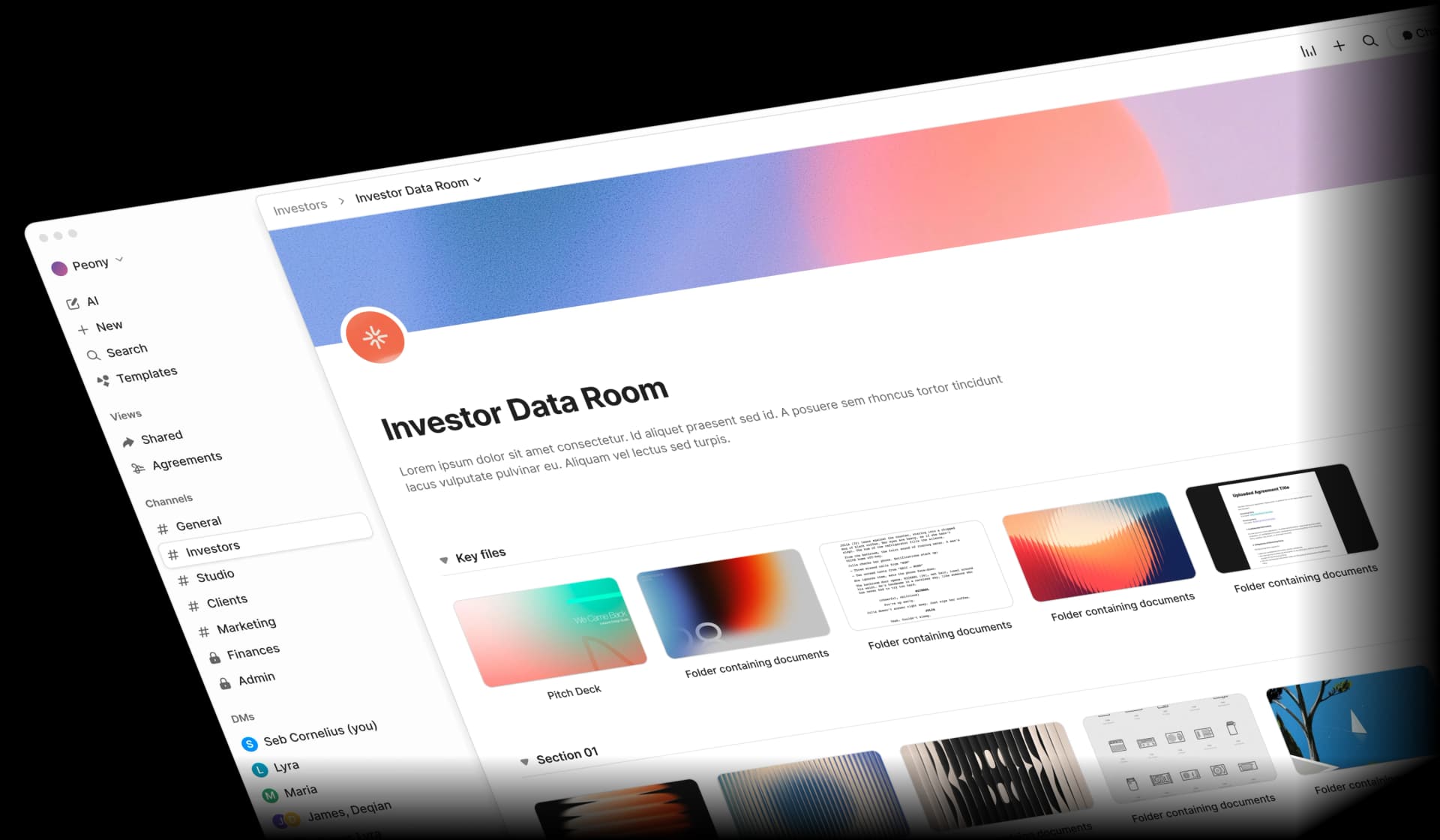
At this stage, NDAs or explicit confidentiality clauses are normal practice, especially with strategic or corporate investors. This is exactly the workflow Peony's NDA feature was designed for: attach a one-click NDA gate to a data room folder, collect e-signatures electronically, and grant access — all tracked with page-level analytics.
Corporate strategics and M&A conversations
Corporate development teams are more likely than traditional VCs to sign NDAs early because they already operate in heavier legal environments and may compete with you in adjacent markets. A short mutual NDA before a deep technical review is standard in M&A and strategic partnership contexts.
How to Protect Yourself Without Killing the Round
If most investors will not sign NDAs at the intro stage, you need a different protection strategy. Here is the framework I recommend to every founder I work with.
Layer 1: Staged disclosure
Think of your fundraising information as four tiers:
| Tier | What it includes | Who gets access | NDA needed? |
|---|---|---|---|
| Story | Problem, solution, market, team, high-level traction | Everyone | No |
| Numbers | Revenue, retention, CAC/LTV, runway, cap table summary | Interested investors | No |
| Operational | Dashboards, detailed cohorts, internal KPIs, board decks | Serious investors in late conversations | Usually no, but via secure data room |
| Inner sanctum | Raw code, proprietary algorithms, customer-identifying data, full contracts | Leads in binding diligence only | Yes — NDA or contractual confidentiality |
The key insight: you do not need to hand over tier four to every fund that glances at your deck. Most seed rounds close with investors never seeing anything beyond tier two.
Layer 2: Technical controls that replace NDA friction
This is where the game has changed since 2020. Modern data rooms provide protections that are more practical than a piece of paper most investors will not sign.
Dynamic watermarks. Every page of your deck carries the viewer's name, email, and a timestamp. If a page leaks, you know exactly who leaked it. The psychological deterrent alone is worth more than an NDA in a filing cabinet. Peony adds watermarks automatically — no setup required.
Identity-bound links. Instead of emailing PDF attachments, share a secure link that requires email verification. You can expire or revoke access at any time. If a conversation goes cold, cut off access with one click.
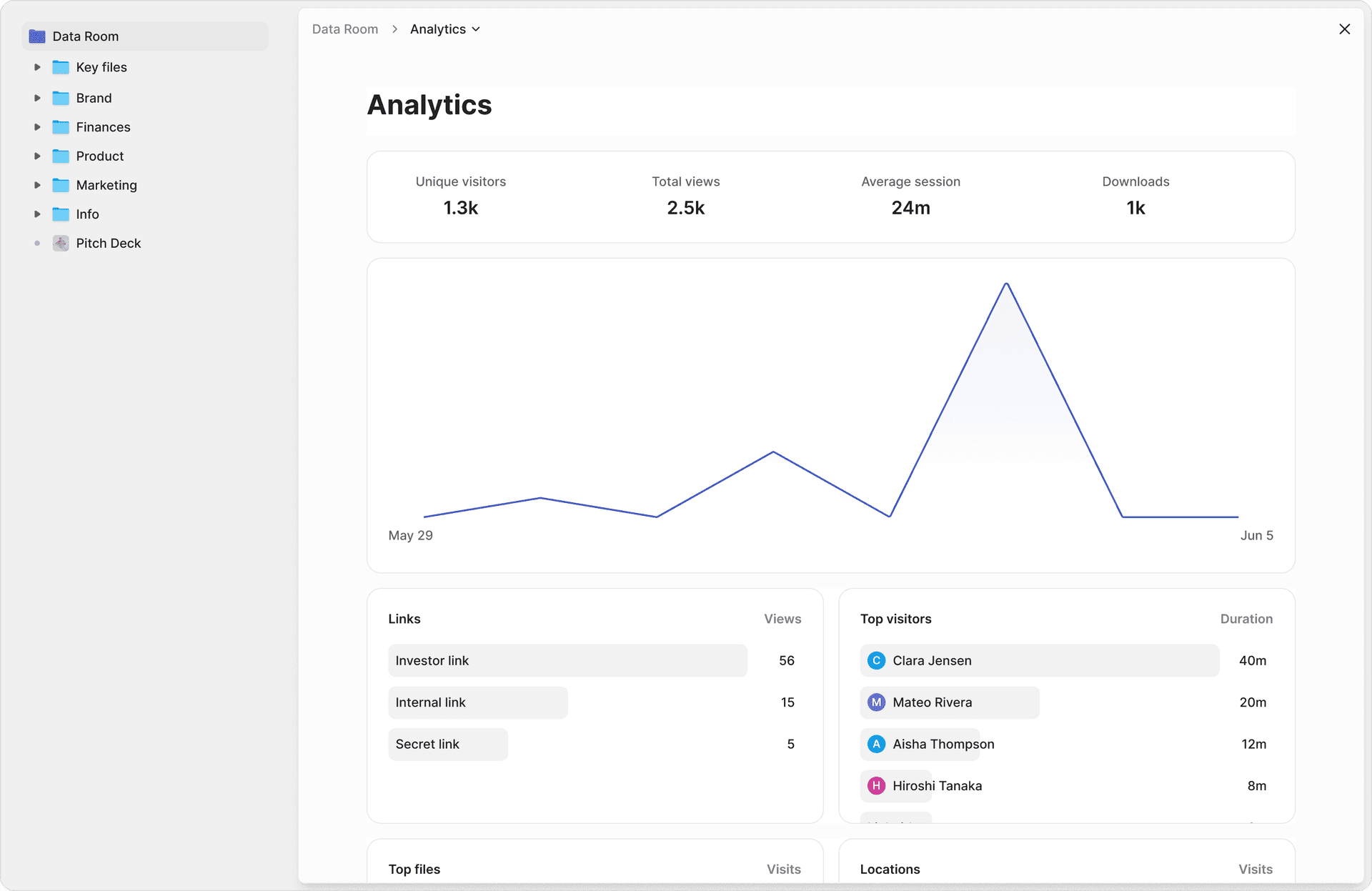
Page-level analytics. See who opened what, which pages they read, how long they spent on each page, and whether they attempted a screenshot. This gives you both better fundraising intelligence — knowing which investors are genuinely engaged — and an evidentiary trail if you ever need one.
Screenshot protection. Peony blocks and logs screenshot attempts, showing the reviewer's email and exact timestamp in your admin dashboard. This is prevention, not just detection.
Layer 3: Ask about conflicts directly
A simple, human question often gives you more protection than a formal NDA:
"Are you currently invested in, or seriously considering, anything directly competitive?"
VCs care deeply about their reputation in the founder community. That social pressure is often stronger than a legal threat you would never actually follow through on.
Layer 4: Protect what really matters with IP strategy
For genuinely defensible innovations, patents and IP filings are more powerful than NDAs:
- File a provisional patent before sharing technical details.
- Document prior art and invention dates.
- Use NDAs as a supporting layer, not the core protection.
If You Do Send an NDA, Keep It Investor-Friendly
When you reach a point where an NDA is appropriate — deep-tech review, post-term-sheet diligence, or a strategic conversation — keep the document short and reasonable:
- Clear purpose clause — for example, "evaluating a potential investment in [Company]."
- Reasonable term — 1 to 2 years for investor conversations, not 5 to 10.
- Standard exclusions — information that is already public, independently developed, already known to the recipient, or disclosed under legal obligation is not covered.
- Simple signature flow — e-signature, one click, no printing.
Peony's NDA feature lets you embed a pre-approved template directly into a data room folder. Investors sign in one click before accessing gated documents — no email attachments, no chasing signatures, no six-page PDFs landing in spam.
NDA Decision Framework: A Quick Checklist
Before you send an NDA to anyone in your fundraising process, walk through four questions:
1. What stage is this conversation?
- First deck or first call: skip the NDA.
- Post-interest, moving into proprietary technical details: maybe.
- Term sheet signed, entering formal diligence: yes, this is expected.
2. What are you actually sharing?
- High-level roadmap, traction metrics, team bios: no NDA needed.
- Specific IP, unreleased inventions, raw customer data, detailed financial models: NDA or at minimum tightly controlled, watermarked access through a data room.
3. Who is on the other side?
- Traditional VC or angel: very NDA-averse before a term sheet. Do not push it.
- Corporate strategic, acquirer, or M&A team: more open to mutual NDAs, especially for technical deep dives.
4. Would you realistically enforce this if something went wrong?
- If the honest answer is no, invest your energy in how you share — watermarks, tracked links, staged access, screenshot protection — instead of collecting signatures you will never act on.
Common Mistakes Founders Make with NDAs
Gating the intro deck behind a signature. This kills your top of funnel. Investors who would have taken the meeting never respond. Share the intro deck freely through a tracked, watermarked link instead.
Using a 10-page NDA for a coffee meeting. Length signals distrust. If you do need an NDA, keep it under two pages. Better yet, use Peony's one-click NDA built into the data room.
Treating the NDA as the security strategy. An NDA without technical controls is a piece of paper that costs six figures to enforce. An NDA combined with watermarks, analytics, and access revocation is a real security stack.
Sending the same NDA to VCs and strategics. Corporate investors expect mutual NDAs. Traditional VCs do not want any NDA at the intro stage. Tailor your approach to the counterparty.
Forgetting that your best protection is what you choose to share. No legal document can un-ring a bell. Design every deck and data room tier with the assumption that it might be seen by someone you did not intend.
Bottom Line
You do not have to choose between trusting everyone blindly and requiring every human you meet to sign a legal document.
The mature 2026 approach:
- Use NDAs sparingly — for post-term-sheet diligence, deep-tech IP reviews, and strategic conversations where the counterparty expects one.
- Assume most investors will not sign upfront — and design your process so that is perfectly fine.
- Rely on staged disclosure and technical controls — Peony's data rooms with dynamic watermarks, page-level analytics, screenshot protection, and identity-bound access protect your materials without adding friction.
- When NDAs are appropriate, make them frictionless — one-click NDA gates and built-in e-signatures keep the process moving.
If you are raising a seed round, sending a deck to investors, or protecting a pitch deck you have spent months perfecting — the question is not "NDA or no NDA." The question is "what is the right level of protection at each stage of this relationship?" Get that right, and you will feel a lot less anxious the next time someone says, "Sure, send the deck."
Frequently Asked Questions
When should startups use NDAs during fundraising?
Use NDAs after a term sheet is signed and the investor needs access to proprietary code, raw customer data, or unpublished research. Skip NDAs for intro decks, first meetings, and top-of-funnel data room access. Peony replaces early-stage NDA friction with secure data rooms, dynamic watermarks, and page-level analytics so investors can review materials without signing anything upfront.
Why do most VCs refuse to sign NDAs before a pitch?
VCs review hundreds of pitches annually, often in overlapping verticals. Signing an NDA for every intro meeting would create unmanageable legal exposure and slow their deal flow. Reputation already keeps them honest — a fund known for leaking decks would stop seeing quality deals. Peony helps founders share pitch materials safely through identity-bound links, watermarks, and viewer tracking without requiring any legal signature.
What is the best alternative to NDAs for startup fundraising?
Staged disclosure combined with technical controls is the best alternative. Share high-level traction first, then gate deeper materials behind identity-verified links with dynamic watermarks and page-level analytics. Peony is purpose-built for this workflow: free data rooms with screenshot protection, viewer tracking, password protection, and one-click NDA workflows when you do reach the diligence stage.
Can you track who views your pitch deck without an NDA?
Yes. Peony shows exactly who opened each document, which pages they read, how long they spent on each page, and whether they attempted a screenshot. Dynamic watermarks embed the viewer's email and a timestamp on every page, creating a forensic trail that is more enforceable than a generic NDA in most practical scenarios.
How do I protect confidential information without an NDA?
Layer your fundraising materials: story and traction in the intro deck, detailed financials in a second-tier data room, and proprietary IP only for leads in binding diligence. Use Peony's identity-bound links, dynamic watermarks, screenshot protection, and access revocation to control exactly who sees what — and cut off access instantly if a conversation goes cold.
Does Peony support one-click NDA workflows for due diligence?
Yes. Peony's NDA gate attaches to any data room folder so investors accept your agreement electronically before seeing a single page — no email attachments, no printing. For the step-by-step mechanic (uploading your NDA text, wiring the gate to specific folders, and pulling the acceptance audit trail), follow our dedicated how-to guide on requiring an NDA before sharing a pitch deck. Combined with built-in e-signatures, watermarks, and page-level analytics, Peony handles the full due diligence security stack from first deck to signed term sheet.
What should a startup NDA include for investor meetings?
Keep it short: a clear purpose clause tied to evaluating an investment, a 1-to-2-year term, standard exclusions for public or independently developed information, and a simple e-signature flow. Peony's NDA feature lets you embed a pre-approved template directly into your data room so investors sign in one click before accessing gated folders — no back-and-forth with lawyers.
Should I require an NDA before sharing my data room?
Not for top-of-funnel access. Gating your entire data room behind an NDA causes investor drop-off — many VCs will simply move to the next company. Instead, use Peony's tiered access: open folders for the intro deck and high-level metrics via secure links, and NDA-gated folders for customer contracts, financial models, and proprietary IP. This keeps momentum while protecting what matters.
How much does it cost to enforce an NDA against an investor?
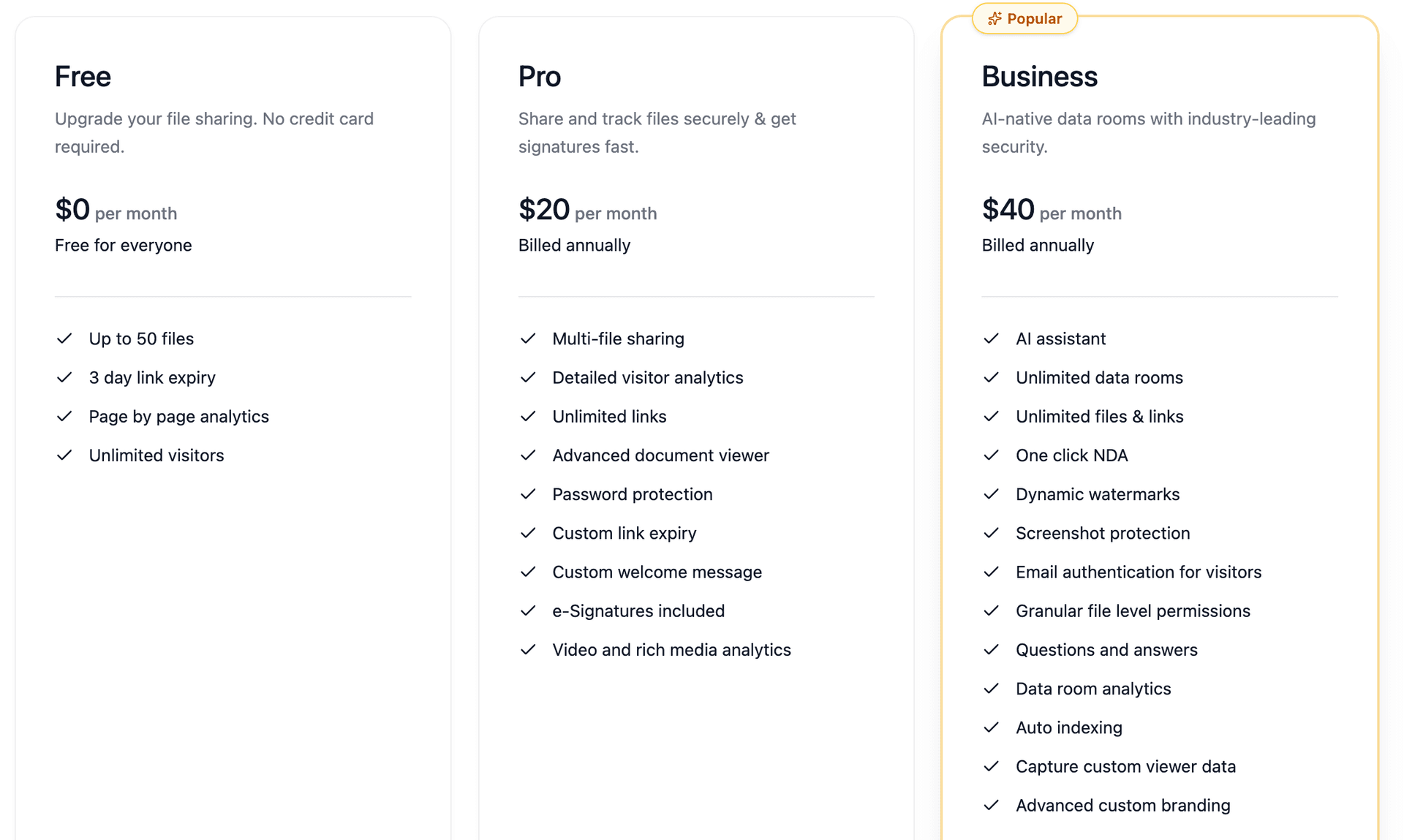
Enforcing an NDA in US courts typically costs tens of thousands of dollars in legal fees before discovery even begins, and you must prove that specific confidential information was misused and caused measurable damages. Prevention is cheaper than enforcement. Peony's watermarks and screenshot protection (Business plan, $40/admin/month) plus access logs and page-level analytics (every plan including the free tier) create a deterrent and evidence trail.
When do corporate or strategic investors expect NDAs?
Corporate development teams and strategic investors are more accustomed to NDAs than traditional VCs because they often operate in adjacent or competing markets. A short mutual NDA before a deep technical review is standard practice in M&A and strategic partnership conversations. Peony's data rooms support this workflow: attach a mutual NDA template to the room, collect e-signatures, and then grant access to sensitive folders — all tracked with page-level analytics.
Related Resources
You might also like
Apr 22, 2026
How to Require an NDA on a Pitch Deck (Click-Through) in 2026
Apr 30, 2026
How to Block Pitch Deck Screenshots on Mac and iPhone (2026)
Apr 29, 2026
Top 8 Boston Investors in 2026: The Founder's Complete Guide to Raising in Boston & Cambridge