
Investor Data Room: What to Include, Best Practices & Top Providers (2026)

Co-founder and CEO at Peony. I built the data room platform with a background in document security, file systems, and AI. Founded Peony in 2021 in San Francisco.
Investor Data Room: What to Include, Best Practices & Top Providers (2026)
Last updated: May 2026
Quick answer: An investor data room is a permissioned online repository where founders and fund managers share confidential documents — cap table, financials, contracts, IP, team, product — with VCs, PE firms, or LPs during due diligence, typically during fundraising or M&A. Done right, a well-prepared room compresses the diligence cycle from roughly 8 weeks to 3. The 6 standard folders are: pitch deck, financials, corporate documents, legal & IP, team & HR, and product & tech.
I run Peony, a data room platform, and I have spent the last two years helping investors — VCs, PE firms, independent sponsors, family offices, LPs — set up and evaluate data rooms for due diligence, fundraising, and portfolio management. Peony has hosted 5,900+ customer data rooms across seed rounds, Series Bs, growth equity, and M&A. I have also signed up for every major competing platform, uploaded real document sets, and tested what each one actually delivers versus what the marketing page claims.
This guide is written from that vantage point — informed by our own platform data and hands-on comparison testing. Where Peony is the right fit I will say so; where another provider is genuinely better suited (Datasite for $5B+ M&A, iDeals for cross-border mid-market, Firmex for concurrent advisor rooms), I will say that too.
TL;DR: Investors need data rooms that surface engagement signals, protect sensitive information, and respect everyone's time. Peony (free, $0) offers AI-powered rooms with page-level analytics, dynamic watermarks, and enterprise security at $40/admin/month — features that legacy VDR providers charge $500–$2,500/month for. For large-cap M&A, Datasite is the enterprise default. For mid-market PE, Firmex or iDeals are proven workhorse options. For the simplest possible data room, SecureDocs ($250/month flat) or Peony Free ($0) get you running in under 5 minutes.
By the Numbers
- $3.4 billion — global VDR market size in 2025, projected to reach $17.46B by 2034 (Fortune Business Insights)
- 19.80% CAGR — projected VDR market growth rate through 2034
- 2–10x — how much actual VDR costs exceed initial quotes on legacy platforms (SRS Acquiom, 3,800+ M&A deals analyzed)
- 68% of data breaches involve a human element — social engineering, errors, or misuse (Verizon 2024 DBIR)
- Under 5 minutes — setup time for modern VDR platforms like Peony, vs. 1–2 weeks for enterprise platforms like Datasite or Intralinks
What Is an Investor Data Room?
An investor data room is a single, permissioned online folder where a startup, fund, or seller shares the documents an investor needs to make a yes-or-no decision during due diligence. It replaces ad-hoc Google Drive links, email attachments, and Dropbox shares with a controlled environment where every viewer is authenticated, every page view is logged, and sensitive documents stay traceable.
Investor data rooms are used at two main stages:
- Fundraising — Seed through Growth-stage rounds, where VCs, angels, and PE firms diligence the company before issuing a term sheet
- M&A — sell-side, buy-side, or strategic acquisition, where the seller shares the full company data set with one or more bidders
A well-prepared investor data room serves three functions: it speeds up diligence (one source of truth instead of weekly document requests), surfaces real engagement signals (page-level analytics show which sections each investor actually read), and protects sensitive information (dynamic watermarks, NDA gates, and screenshot protection prevent the cap table from leaking to a competitor).
Across the 5,900+ data rooms hosted on Peony, founders who built and populated their room before investor outreach closed seed rounds an average of 2–4 weeks faster than founders who built rooms reactively after the first investor meeting.
Investor Data Room vs. M&A Data Room
The two overlap heavily but differ in scope, audience, and security posture:
- Investor data room (fundraising): smaller (40–80 documents), audience is friendly (VCs you chose to share with), security focus is on watermarking and per-viewer tracking. Typical NDA: lightweight or none for early-stage outreach.
- M&A data room: larger (150–500+ documents), audience can include adversarial bidders, security focus extends to redaction, granular per-bidder permissions, and strict NDA gates before any access. Q&A workflows are essential.
For an M&A-specific walkthrough, see our M&A data room guide.
Why Do You Need a Dedicated Investor Data Room?
A note on terminology: "Data room for investors" is a fundraising term — it refers to a room a founder or fund manager builds for investors (VCs, PE firms, LPs, family offices) to review during due diligence. In M&A contexts, the equivalent room is built for buyers or bidders instead, and the structure, security, and audience differ. If you are running a sell-side M&A process, see our M&A data room guide.
If you are an investor in 2026, your bottleneck is not deal flow — it is time and signal. You are skimming 50+ decks a month, jumping into multiple data rooms a week, and context-switching between NDAs, Q&A threads, and internal IC memos.
The last thing you need is a slow, clunky VDR that makes it harder to see what actually matters in a deal. And the last thing a founder needs is to share their cap table through a Google Drive link that anyone can forward. For a full walkthrough of secure file sharing approaches, we cover 7 methods in a separate guide.
Three reasons a purpose-built data room is non-negotiable for serious investor work:
1. Security that protects both sides. Investor due diligence involves the most sensitive documents a company has — cap tables, financials, IP assignments, customer contracts, litigation. A forwarded link or an unprotected screenshot can cause real damage. Data rooms enforce dynamic watermarking, screenshot protection, NDA gates, and granular permissions so that every viewer is authenticated, every page is traced, and every access can be revoked instantly.
2. Analytics that drive conviction. The difference between a good data room and a generic file share is signal. When I can see that an investor spent 14 minutes on the customer contracts but skipped the management bios entirely, I know exactly where to focus the follow-up call. Page-level analytics transform a passive document dump into an active intelligence tool for both sides of the deal.
3. Organization that respects everyone's time. A messy data room signals sloppiness — and investors notice. Clean folder structures, logical indexing, and fast document viewers reduce friction and build trust. Modern platforms with AI auto-indexing create professional-grade organization in minutes, not the 20–40 hours of manual work that legacy VDRs demand.
What Do Investors Actually Look For in a Data Room?
After hundreds of conversations with VCs, PE deal teams, and fund administrators, these are the criteria that actually matter — not the feature lists on marketing pages.
Speed and Frictionless Access
Slow or over-locked rooms kill momentum. Look for:
- No plugins or Java applets (still a real problem in some legacy VDRs)
- Fast web viewer for PDFs, spreadsheets, and slides
- Works smoothly on laptop, tablet, and phone
- Minimal friction for invited users — email login is fine; 8-step onboarding is not
If your associates are downloading everything to review locally because the viewer is painful, the tool has already failed.
Signal-Rich Analytics
This is where the gap between modern and legacy platforms is widest. You want more than "someone opened the link":
- Page-level engagement — which sections did they read, for how long, where did they drop off?
- Per-investor breakdown — who is doing real work vs. politeness clicks?
- Repeat visit patterns — are they coming back to the financials before IC?
- Exportable reports — for internal memos and partner meetings
Legacy VDRs often have basic view-count reports. Modern platforms like Peony offer fine-grained, real-time analytics that help you prioritize which deals deserve a live call today.
Security and Compliance
Your LPs and legal team care about:
- Dynamic, per-viewer watermarks (name, email, timestamp, IP)
- Screenshot protection — not just watermarking after the fact, but blocking captures entirely
- Granular permissions at the document level (view, download, print controls)
- NDA gates before any content is visible
- Link expiry and one-click access revocation
- Full audit trails for compliance and LP reporting
- SOC 2 / ISO 27001 alignment for institutional mandates
Multi-Workstream Support
Real deals are not linear. Legal is reviewing contracts, finance is deep in projections, and product is analyzing the tech stack — all at the same time. You need:
- Clear folder structures (corporate, financials, legal, operations, compliance)
- Powerful search, including inside documents
- Ability to run multiple rooms in parallel without confusion
- Unlimited data rooms so you never agonize over whether a deal "justifies" another room
Pricing Transparency
If a VDR provider will not show you a price before a sales call, expect to pay 5–10x what transparent providers charge for equivalent features. Compare:
- Per-seat SaaS (Peony) — predictable, scales with team size, best for ongoing investor work and multi-deal use
- Flat-rate per project (SecureDocs, Firmex) — predictable for one transaction, expensive for concurrent rooms
- Per-page or custom quotes (Datasite, Intralinks) — opaque, typically five figures, justified only for enterprise mega-deals
Investor Data Room Providers Compared (2026)
Common investor data room providers include Datasite, iDeals, Firmex, Peony, Intralinks, Ansarada, DealRoom, and SecureDocs — each serves a different deal stage, budget, and workflow. Below is a side-by-side comparison based on hands-on testing of each platform, followed by a deeper write-up of where each one fits best.
| Platform | Starting Price | Security (/5) | Analytics (/5) | Ease of Use (/5) | Value (/5) | Best Fit |
|---|---|---|---|---|---|---|
| Peony | Free ($0) | 4.8 | 4.9 | 4.7 | 4.9 | VC, PE, fundraising, LP comms, growth equity |
| Datasite | Custom ($25K+/yr) | 4.6 | 4.0 | 3.4 | 2.5 | Large-cap M&A, investment banking, enterprise |
| iDeals | ~$500+/mo | 4.3 | 3.9 | 4.2 | 3.5 | Mid-market M&A, PE, cross-border deals |
| Firmex | ~$650+/mo | 3.5 | 3.1 | 3.7 | 3.2 | Advisory firms, PE funds with multiple concurrent deals |
| Intralinks | Custom ($10K+/yr) | 4.4 | 3.6 | 3.3 | 2.6 | Cross-border enterprise M&A, regulatory-heavy transactions |
| Ansarada | $229/mo (250 MB, annual) | 3.7 | 3.8 | 4.1 | 4.2 | Sell-side advisors, AI-assisted deal preparation |
| DealRoom | $1,000/mo flat | 4.1 | 4.3 | 3.9 | 3.0 | Corporate development, serial acquirers |
| SecureDocs | $250/mo flat | 3.3 | 2.9 | 4.0 | 4.0 | Simple fundraising, early-stage, single-purpose rooms |
Scoring methodology: Each platform scored independently out of 5.0 based on hands-on testing and publicly available features as of March 2026. Security evaluates watermarking, screenshot protection, access controls, and compliance certifications. Analytics measures engagement tracking depth — from page-level heatmaps to basic view counts. Ease of Use reflects setup time, UI quality, and learning curve. Value compares feature breadth against starting price. Scores reflect Peony's testing and are inherently non-neutral — pair this with G2 and Capterra reviews for a fuller picture.
Peony — Best for VC/PE Fundraising & LP Communications
Peony was the fastest platform I tested — 3 minutes and 40 seconds from first click to sharing a live data room link. No sales call, no onboarding form, no waiting for a "dedicated project manager" to email me back. For context, Datasite took four business days of back-and-forth before I even got sandbox access.
What separates Peony from every other platform is the analytics. After sharing a test room with five reviewers, I could see exactly which pages each person spent time on, where they re-read sections, and when they dropped off. When one reviewer spent 14 minutes on the cap table but skipped the financials entirely, I knew exactly where to follow up. Legacy VDRs show views and downloads — Peony shows behavior. That is a fundamentally different level of insight for investor work.
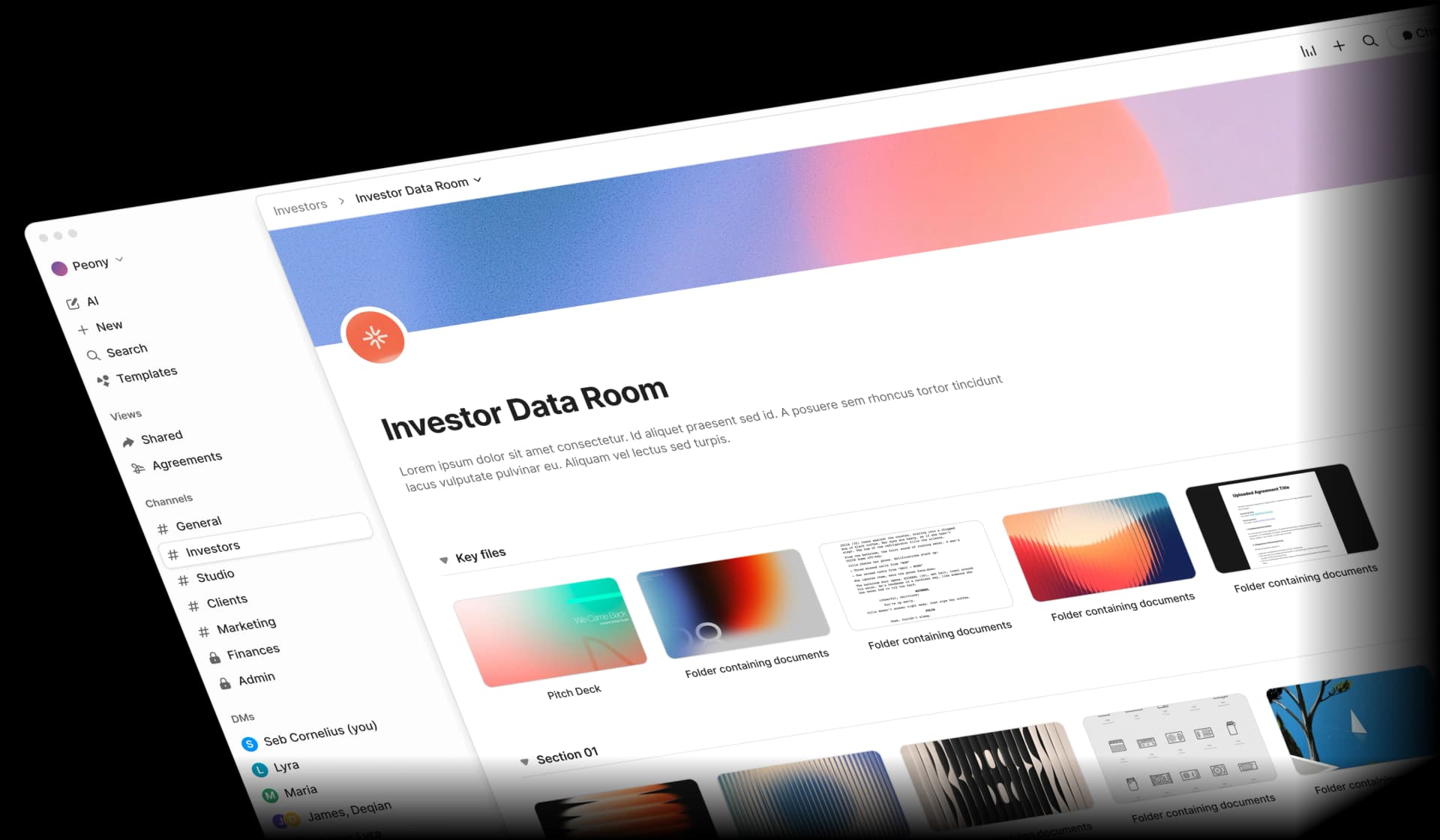
The security features also stood out in testing. I tried to screenshot a watermarked document — Peony blocked it and logged the attempt. I tested the NDA gate — reviewers had to sign before seeing a single page. I revoked a link and confirmed the reviewer lost access within seconds. These are features that Datasite and Intralinks charge five figures for, and Peony includes them on the Business plan at $40/admin/month.
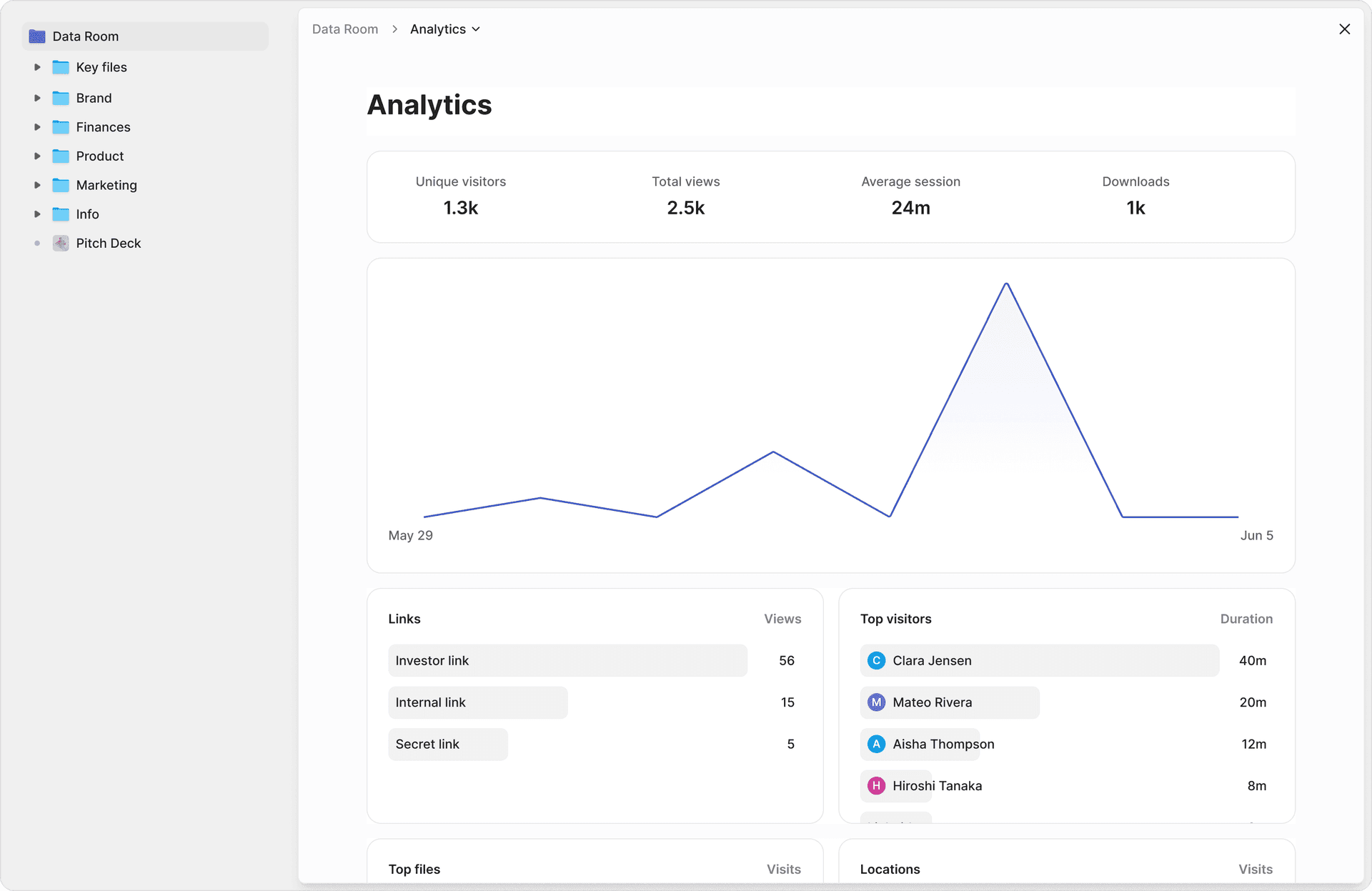
Why investors like it:
- Page-level analytics — See exactly which sections of the deck, metrics pack, or data book each reviewer reads, for how long, and where they drop off. Explore analytics
- AI auto-indexing — Drop a messy folder dump and Peony structures it into a clean investor-friendly layout in under 3 minutes. Try AI rooms
- Security by default — Dynamic watermarks, screenshot protection, and NDA gates on the Business plan ($40/admin/month). Email authentication, link expiry, and one-click access revocation on every plan
- Investor-friendly UX — Fast viewer, no plugins, polished custom branding with custom domains (yourfund.peony.ink)
- Unlimited data rooms — Run buy-side diligence, LP updates, and co-investment rooms simultaneously without per-room charges
What users are saying:
"We looked at DocSend etc. but the cost and clunkiness just put us off." — Anthony Gale, Founder & CEO, PromoLens
"Been using Peony for a few weeks now — it's a standout for the gated file sharing and data room functions. Intuitive, secure, beautifully designed, and an actually working AI, all while being very well priced versus competitors." — Michael Hui, Managing Director, Piton Partners
Pricing:
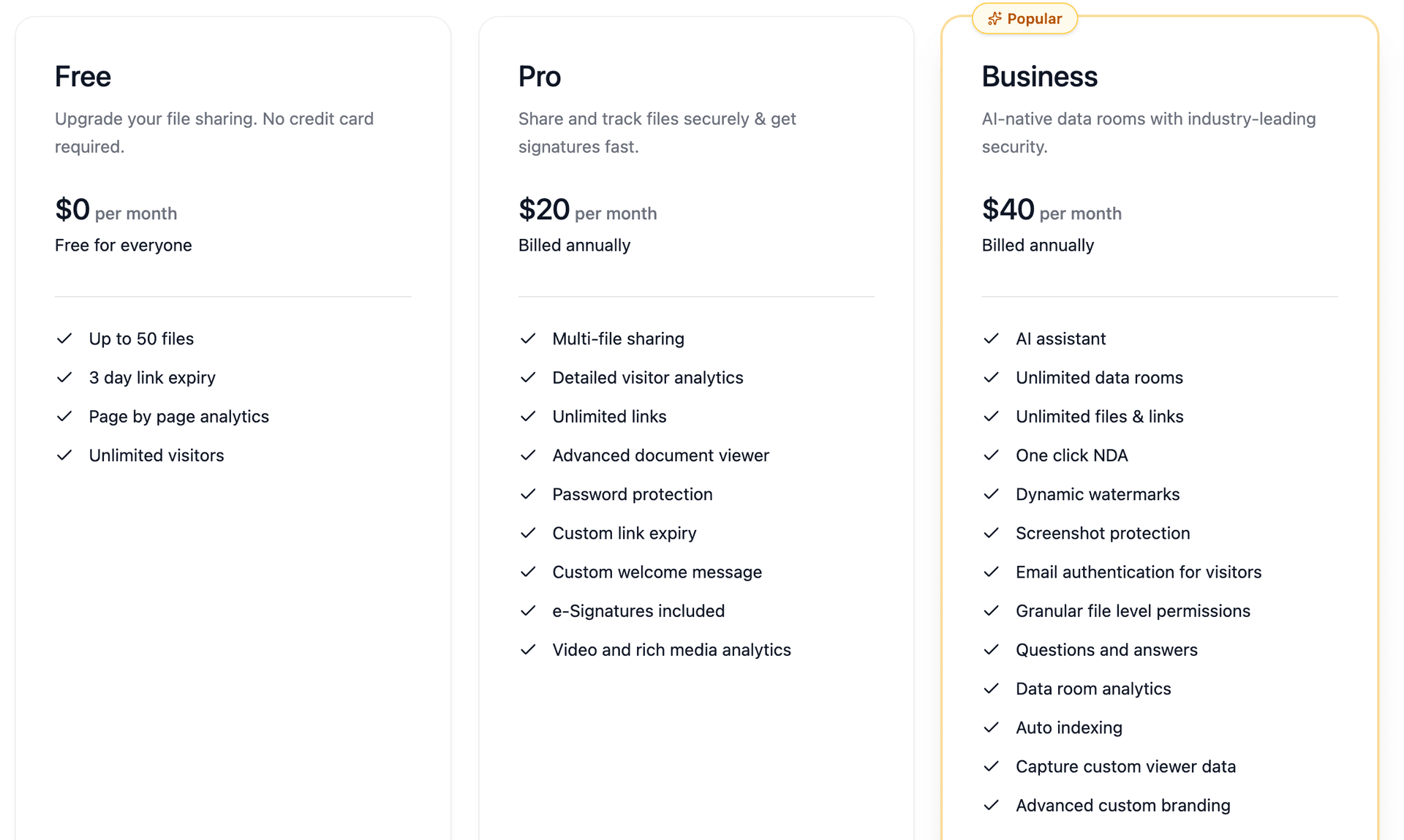
- Free: $0/month — up to 50 files, page-level analytics, unlimited visitors
- Pro: $20/admin/month — e-signatures, detailed visitor analytics, unlimited links, password protection
- Business: $40/admin/month — AI auto-indexing, unlimited data rooms, dynamic watermarks, screenshot protection, NDA gates, granular permissions, Q&A, advanced custom branding
Best for: VC deal flow, PE due diligence, fundraising data rooms, LP communications, growth equity, family offices, and any investor who needs enterprise-grade security without enterprise pricing.
Explore Peony features | See pricing
Datasite — Best for Large-Cap Enterprise M&A
Getting into Datasite required a sales call, a qualification form, and a follow-up email chain that lasted four business days before I got sandbox access. Once inside, the AI capabilities are genuinely impressive — I uploaded 200 mixed documents and the auto-classification sorted them into the right categories with roughly 90% accuracy. The redaction tool caught PII types I would have missed manually.
Datasite (formerly Merrill DataSite) has been the default choice for investment banks and large law firms for decades. In 2026, they have invested heavily in AI — document classification, AI-powered redaction across 100+ PII types, and generative AI tools for summarization. They were the first VDR to earn ISO/IEC 42001 certification for AI governance.
Pricing: Custom/quote-based. Per-page model (~$0.60/page by third-party estimates). Typical range: $25,000–$100,000+/year. Smaller deals still start at five figures.
Strengths: Deep AI capabilities, strongest institutional credibility, sophisticated permissioning, ISO 42001-certified AI governance, G2 leader (4.5/5, 332 reviews).
Limitations: Pricing is significantly higher than alternatives — G2 reviewers rate value-for-money lowest at 4.2/5. Steep learning curve. Setup takes days, not minutes.
Best for: Multi-billion-dollar M&A transactions, investment banks managing multiple concurrent deals, and firms where budget is secondary to institutional credibility.
iDeals — Best Mid-Market Workhorse
I tested iDeals' support response time and they were not exaggerating — my first chat was answered in 22 seconds. The platform feels like a polished Toyota: nothing flashy, everything works. Bulk upload was smooth, permissions were intuitive, and the Q&A management is the cleanest I tested among traditional VDRs. Where iDeals fell short: the analytics dashboard shows views and downloads but nothing approaching page-level engagement data.
With over 1 million users across 175,000+ companies, iDeals is one of the most widely adopted VDR platforms globally and a G2 Leader for five consecutive years.
Pricing: Quote-based, not publicly listed. Third-party estimates: ~$500+/month. Tiered by project.
Strengths: Best-in-class support (24/7 in 10+ languages), robust Q&A management, strong compliance (SOC 2, ISO 27001, HIPAA, GDPR), multi-language support, 9 global data centers.
Limitations: No meaningful AI capabilities. Analytics are solid but traditional — no page-level engagement. Pricing is per-deal or per-workspace, not designed for continuous portfolio needs.
Best for: Mid-market M&A, PE firms, and legal teams that value responsive support and a proven track record over cutting-edge analytics.
Firmex — Best for Repeat Mid-Market Deals
Firmex impressed me with how quickly I could spin up multiple data rooms — the unlimited rooms model on annual subscriptions means no mental overhead about whether a deal "justifies" another room. The drag-and-drop interface is clean, the watermarking is solid, and the dedicated customer success manager responded to my test query within two hours.
Firmex has served 223,000+ companies since 2006, carving out a strong position in mid-market M&A and PE.
Pricing: Quote-based with a transparent structure. Annual subscription for unlimited rooms based on storage. Third-party estimates: ~$7,800/year average, individual deals up to ~$18,000.
Strengths: Unlimited data rooms on subscription (saves 25%+ for active deal teams), strong security (SOC 2 Type II, bank-grade encryption), practical Q&A and task assignment, dedicated customer success manager included, G2 4.6/5 rating.
Limitations: No AI features. UI noticeably slows with 500+ documents. Permission management becomes challenging at scale. Interface is solid but not modern.
Best for: Advisory firms, PE funds, and legal teams managing multiple concurrent deals where unlimited rooms make the subscription model economical.
Intralinks — Best for Cross-Border Enterprise Deals
Intralinks was the hardest platform to evaluate. The sales process took over a week, pricing was deliberately opaque, and the demo environment felt like it was designed years ago. That said, the IRM (information rights management) controls are best-in-class — I could revoke access to a downloaded document after the fact, something no other platform I tested can do.
SS&C Intralinks created the world's first virtual data room in 2002 and claims to have facilitated over $35 trillion in transactions.
Pricing: Custom/quote-based, per-page model. Typical range: $10,000/year (small projects) to $200,000+ for enterprise deployments.
Strengths: IRM controls that persist after download, first VDR with ISO 27701 (data privacy) certification, AI redaction (70+ PII presets), recognized globally by banks, law firms, and regulators.
Limitations: UI is consistently described as dated in reviews. Opaque pricing. Lower user satisfaction (Capterra 4.1/5). Overkill for anything smaller than a complex cross-border transaction.
Best for: Cross-border enterprise M&A, financial services firms managing regulatory-heavy transactions, and deals where IRM controls on downloaded files are a hard requirement.
Ansarada — Best for Sell-Side Deal Preparation
Ansarada's free preparation phase is genuinely useful — I organized an entire data room during the free period before deciding whether to activate. The bidder engagement scoring was the most interesting analytics feature I tested outside of Peony: it predicted which of my test reviewers were "highly engaged" based on viewing patterns, and it was right.
Important note: Datasite acquired Ansarada in August 2024 for approximately AUD $240 million. The brand still operates independently, but long-term product strategy is uncertain.
Pricing: Storage-tiered: $499/month (250 MB), scaling to $2,499/month (4 GB). Free preparation phase before deal activation.
Strengths: AI bidder engagement scoring (97% accuracy by day 7), free deal prep phase, readiness checklists and scorecards, Smart Sort document classification.
Limitations: Storage limits are punishing — 250 MB at $499/month. Browser compatibility issues reported. Datasite acquisition creates uncertainty about the platform's independent future.
Best for: Sell-side advisors who want AI-assisted deal preparation and are comfortable with storage-based pricing.
DealRoom — Best for Full M&A Lifecycle
DealRoom surprised me — I expected a VDR and got a full project management tool for M&A. The pipeline tracker, diligence request lists, and integration planning are features I have not seen in any other data room. For corporate development teams running four acquisitions simultaneously, this is genuinely the right tool.
Pricing: $1,000/month flat (billed annually). Unlimited users and storage.
Strengths: M&A pipeline management, due diligence request tracking, integration management, unlimited users at flat rate.
Limitations: Smaller company (~2,000 customers). Customer support weaker than Firmex or iDeals. $1,000/month is steep if you only need VDR functionality.
Best for: Corporate development teams and serial acquirers who need pipeline-to-integration tooling, not just document sharing.
SecureDocs — Best Budget Option
SecureDocs was the second-fastest setup I tested — about 8 minutes from signup to sharing a live room. The interface is deliberately simple: upload, set permissions, share. For a straightforward seed-round data room or a single-purpose deal, $250/month flat with unlimited users is hard to argue with.
Pricing: $250/month flat — unlimited users, unlimited documents, 24/7 support.
Strengths: Simplest setup, flat-rate pricing, unlimited users and documents, SOC 2 compliant, highest Capterra satisfaction (4.9/5, 161 reviews).
Limitations: Basic reporting (no page-level analytics). No AI features. No SSO/SAML. Limited collaboration tools. You will outgrow this platform if deals get complex.
Best for: Simple fundraising rounds, early-stage startup data rooms, and single-purpose data rooms where basic security at the lowest cost is the priority.
How Much Does an Investor Data Room Actually Cost (3-Month Fundraise)?
Platform pricing is only part of the picture. Hidden fees (per-page charges, overage billing, setup fees) and the hours you spend manually organizing documents add up fast. Here is a realistic total cost of ownership comparison for a typical 3-month fundraise, calculated at $300/hour founder time for manual setup work.
| Platform | Base Cost (3 mo) | Hidden Fees | Setup Time | Total TCO |
|---|---|---|---|---|
| Peony | $0–$120 | $0 | 5 min | $0–$120 |
| SecureDocs | $750 | $0 | 1–2 hours | $1,050–$1,350 |
| Firmex | $1,950+ | $0–$500 | 4–8 hours | $3,150–$4,850 |
| iDeals | $1,500–$6,000 | $500–$1,500 | 20–40 hours | $8,000–$19,500 |
| Datasite | $6,250–$25,000+ | $1,000–$5,000 | 20–40 hours | $13,250–$42,000 |
| Intralinks | $3,000–$15,000 | $2,000–$5,000 | 40+ hours | $17,000–$32,000 |
The biggest hidden cost is not on the invoice — it is the 20–40 hours of manual folder setup, document renaming, and permission configuration that legacy VDRs demand. Peony's AI auto-indexing eliminates that entirely, which is why the total cost gap between modern and legacy platforms is even wider than the sticker prices suggest.
What Should Be in an Investor Data Room?
A complete investor data room contains documents across six standard categories, plus a compliance/tax annex for later-stage rounds. This is the structure VCs and PE firms expect when they say "send me your data room." For the comprehensive 174-document version including M&A-specific items, see our due diligence data room checklist.
1. Pitch Deck
- Current investor pitch deck (always the most recent version, dated)
- One-page executive summary
- Founder bios with photos and LinkedIn links
- Product demo video or interactive sandbox link
- Recent press coverage or customer testimonials (optional, but moves emotion early)
2. Financials
- Audited financial statements (last 3 years, or since inception)
- Monthly/quarterly management accounts (last 12–18 months)
- Revenue breakdown by customer, product, and geography
- Financial projections and model assumptions (3–5 year)
- Bank statements (last 6–12 months)
- Accounts receivable and payable aging schedules
- Debt schedule (all outstanding loans, lines of credit, convertible instruments)
- Burn rate and runway calculation
3. Corporate Documents
- Articles of incorporation and amendments
- Bylaws or operating agreement
- Cap table (fully diluted, including SAFEs, convertible notes, and option pool)
- Board meeting minutes (last 12–24 months)
- Board and committee resolutions
- Shareholder agreements, voting agreements, ROFR provisions
- Certificate of good standing (current)
4. Legal & IP
- Material contracts (customer, vendor, partner — any contract representing more than 5% of revenue)
- IP assignments (founders, employees, and contractors — the most commonly missed document)
- Patent portfolio and trademark filings
- Pending or threatened litigation
- Regulatory filings and licenses
- Privacy policy and terms of service
- Data processing agreements (DPA) for GDPR/CCPA/HIPAA compliance
- Insurance policies (D&O, E&O, general liability, cyber)
5. Team & HR
- Management team bios and employment agreements
- Organizational chart with reporting lines
- Key employee non-compete and non-solicitation agreements
- Employee stock option plan (ESOP) and grant schedule
- Recent hires (last 12 months) and key open roles
- Compensation philosophy (band structure, equity vesting)
6. Product & Tech
- Product roadmap (next 12 months)
- Technical architecture overview
- Key performance indicators (KPIs) — monthly, with clear definitions
- Customer acquisition cost (CAC) and lifetime value (LTV) analysis
- Customer references and case studies
- Demo video or sandbox access link
Compliance & Tax (Series A+)
Beyond the six standard folders, later-stage rounds typically include a compliance annex:
- Federal and state tax returns (last 3 years)
- Tax opinion letters or rulings
- Sales tax nexus analysis
- 409A valuation (most recent)
- SOC 2 or ISO 27001 reports (if applicable)
- Environmental or industry-specific compliance certificates
Pro tip: Peony's AI auto-indexing creates this entire folder structure automatically. Upload everything in a ZIP file, and the AI sorts it into due diligence categories in under 5 minutes — IP assignments go to legal, the cap table goes to corporate governance, and financial projections go to financials. It is the difference between 40 minutes of manual drag-and-drop and 3 minutes of letting the AI work.
What Are the Best Practices for an Investor Data Room?
After watching how investors actually use these rooms across 5,900+ deals, six practices separate the rooms that get to term sheets quickly from the ones that stall.
Structure Folders Clearly
Use the standard 6-category folder structure above (Pitch Deck, Financials, Corporate, Legal & IP, Team & HR, Product & Tech). Number folders 01_, 02_, etc. so they sort consistently across operating systems. Inside each folder, name files with dates (cap-table-2026-05.xlsx, not cap_table_FINAL_v3.xlsx). Research from data-rooms.org shows 20–30% of bidder questions come from inability to find documents in a messy room — every one of those questions is friction that delays your close.
Use a Secure Platform
Skip consumer file-sharing tools for any documents you would not paste into a public tweet. Common investor data room platforms include Datasite, iDeals, Firmex, Peony, FirmRoom, and Juniper Square — each suited to a different deal stage and budget. Pick by use case: Datasite for enterprise M&A, iDeals or Firmex for mid-market PE, Peony for Seed through Series B and ongoing LP comms, FirmRoom or Juniper Square for specific advisor workflows. Detailed comparison further down.
Maintain Version Control
Keep only the current version of any document in the room. Remove outdated cap tables, superseded contracts, and prior board decks. A reviewer who finds three different "final" versions of your financial model will trust none of them. Version every file in the filename (board-deck-2026-05-15.pdf) and archive prior versions in a separate non-shared folder.
Enable Security Measures
Every document should be protected by dynamic per-viewer watermarks, screenshot protection where supported, and granular view/download/print permissions. NDA gates before any access. Link expiry and one-click access revocation when a deal falls through. Email authentication on every viewer. Full audit logs for compliance and LP reporting. See Peony's security features for the full stack.
Set Up NDA Gates Before Access
For sensitive documents (cap table, customer contracts, technical IP), gate access behind an NDA the investor signs in-flow before they see a single page. This is standard practice at Series A+ and increasingly common for Seed rounds where the cap table reveals founder ownership. Peony NDA gates embed the signing flow directly in the access link — no DocuSign round-trip.
Track Page-Level Engagement
The most under-used data room feature is also the most useful: which investor read which page, for how long. If a partner spent 14 minutes on your customer cohort analysis but skipped the founder bios, you know exactly what to bring to the follow-up call. Most legacy VDRs show only "link opened" — modern platforms like Peony show per-page heatmaps. This is the difference between guessing and knowing who is serious.
How Do You Choose the Right Investor Data Room?
Still deciding? Here is the simplest way to think about it based on who you are.
You are a VC or growth fund: You want fast setup, modern UX, page-level analytics, clean LP-facing presentation, and predictable cost. Start with Peony. It is built for exactly this world. See VC solutions.
You are doing PE buyouts or mid-market M&A: You want granular permissions, structured Q&A, reliable support, and the ability to handle multiple concurrent deals. Firmex (unlimited rooms on subscription) or iDeals (best support) are proven. If budget matters, Peony Business at $40/admin/month includes comparable features at a fraction of the cost. See PE solutions.
You are doing large-cap enterprise M&A: You need maximum AI capability, the deepest permission models, and institutional credibility that no one questions. Datasite is the market leader. Intralinks is the alternative for cross-border deals with complex regulatory requirements.
You are a fund manager running LP communications: You want unlimited rooms (one per fund vintage, one per LP group), custom branding, NDA gates, and analytics showing which LPs actually reviewed the quarterly update. Peony with unlimited rooms and custom domains is the cleanest solution. See fundraising solutions.
You need the simplest, cheapest option: Upload, share, track who viewed what. SecureDocs ($250/month flat, unlimited everything) or Peony Free ($0, up to 50 files with analytics) get you running in under 5 minutes.
By Fundraising Stage
If you are picking a platform based on round size and stage, here is the shortcut:
- Pre-Seed / Seed (sub-$3M): Peony Free or Pro ($0–$20/month). You need professional presentation and analytics without burning runway. Enterprise VDRs are massive overkill at this stage.
- Series A ($3–$10M): Peony Business ($40/admin/month). Page-level analytics become critical for identifying which investors are genuinely diligencing versus politely browsing. Custom branding signals operational maturity.
- Series B ($10–$30M): Peony Business or iDeals, depending on whether your lead investor has a legacy VDR preference. Most institutional VCs in 2026 accept modern platforms.
- Series C+ ($30M+): Peony, iDeals, or Datasite — driven largely by buyer-side preferences. At this stage, your CFO or counsel often has a preference.
- Growth / PE ($50M+): If the buy-side firm mandates Datasite or Intralinks, use it — fighting that battle is not worth the capital relationship. Otherwise, Peony Business delivers comparable security at a fraction of the cost.
What Security Features Must Every Investor Data Room Have?
I have reviewed data rooms where founders shared their entire cap table through an unprotected Google Drive link. I have seen investor decks forwarded to competitors because the sharing platform had no access controls. These are not hypothetical risks — they happen constantly.
Here is the minimum security stack for any data room handling investor materials:
- Dynamic, per-viewer watermarks — Every page displays the viewer's name, email, and timestamp. If a document leaks, you can trace it to the exact person and session. Peony watermarking
- Screenshot protection — Not just watermarking after the fact, but blocking screen captures entirely and logging the attempt. Peony screenshot protection
- NDA gates — Require reviewers to sign a non-disclosure agreement before seeing a single page. Built directly into the sharing flow. Peony NDA gates
- Email authentication — Verify every visitor's identity before granting access. No anonymous viewing.
- Granular permissions — Control view, download, and print at the document level, not just the room level. Different reviewers get different access.
- Link expiry and access revocation — Set automatic expiration dates and revoke access instantly when a deal falls through or a reviewer's role changes.
- Full audit logs — Every view, download, print attempt, and screenshot attempt is logged with timestamp and viewer identity. Essential for LP compliance and regulatory reporting.
Peony includes all of these features on the Business plan at $40/admin/month. Legacy VDRs typically gate screenshot protection and advanced watermarking behind enterprise tiers costing $500+/month.
Frequently Asked Questions
What is the best data room for investors in 2026?
Based on hands-on testing, Peony is the best data room for investors in 2026. It offers page-level analytics that show exactly which sections reviewers spend time on, AI-powered auto-indexing, dynamic watermarking, screenshot protection, and NDA gates — all starting free. For large-cap M&A, Datasite remains the enterprise default. For mid-market PE, Firmex and iDeals are proven choices.
What features do VCs look for in a data room?
VCs prioritize page-level analytics (not just open rates), fast setup, clean presentation, and transparent pricing. Peony delivers all four — AI auto-indexing gets a room ready in under 5 minutes, page-level engagement tracking shows which sections each reviewer reads, and custom branding makes your room look institutional. Security features like NDA gates and dynamic watermarks are standard on every Peony plan.
How much does an investor data room cost?
Investor data room costs range from $0 (Peony Free) to $100,000+/year (Datasite for enterprise M&A). Peony Business at $40/admin/month includes unlimited data rooms, AI auto-indexing, page-level analytics, screenshot protection, and dynamic watermarks — features that legacy VDRs charge $500–$2,500/month for. Mid-range options like SecureDocs ($250/month flat) and Firmex ($650+/month) offer solid but more limited functionality. See our VDR cost guide for a detailed breakdown.
What documents should be in an investor data room?
A complete investor data room should include: corporate documents (articles of incorporation, cap table, board resolutions), financials (audited statements, projections, bank statements), legal (material contracts, IP assignments, litigation), operations (org chart, key hire bios, KPIs), and compliance (tax filings, regulatory licenses). Peony's AI auto-indexing creates this folder structure automatically — upload everything and the AI sorts it in under 5 minutes.
What do investors notice first about a data room?
Investors notice three things within the first 30 seconds: folder structure, document completeness, and visual presentation. A messy room with generic file names signals sloppiness — research from data-rooms.org shows 20 to 30 percent of bidder questions come from inability to find documents. Peony's AI auto-indexing creates professional folder structures automatically, and custom branding with your company logo makes the room look institutional. For the full setup process, see our step-by-step data room setup guide.
Can I track which investors actually read my data room documents?
Yes — but only if your platform offers page-level analytics. Most legacy VDRs show only that a link was opened. Peony shows exactly which pages each investor read, how long they spent on each section, and where they dropped off. This lets you prioritize follow-ups with investors who spent 20 minutes on your financials versus those who glanced at the cover page and left.
What security features should an investor data room have?
Essential features: dynamic watermarking (name, email, timestamp on every page), screenshot protection, NDA gates, email authentication, granular view/download/print permissions, link expiry, access revocation, and full audit logs. Peony includes all of these on the Business plan ($40/admin/month). Legacy VDRs typically gate screenshot protection and advanced watermarking behind enterprise tiers costing $500+/month.
Should I use Google Drive or Dropbox instead of a data room for investors?
No. Google Drive and Dropbox lack the security and analytics that investor due diligence requires. They have no dynamic watermarking, no screenshot protection, no NDA gates, no page-level analytics, and no granular per-document permissions. A single forwarded link can expose your entire cap table. Peony provides all of these VDR features starting free — enterprise-grade security without the enterprise price tag.
How do LP communications work in a data room?
Fund managers use data rooms to share quarterly reports, capital call notices, distribution notices, and K-1s with LPs in a secure, auditable environment. Peony's unlimited rooms model means you can maintain separate rooms per fund vintage, per LP group, or per co-investment — each with custom branding, NDA gates, and page-level analytics that show which LPs actually reviewed the materials.
What is the difference between a data room and a pitch deck sharing tool?
A pitch deck sharing tool is designed for one-way document delivery with basic link tracking. A data room is a full secure repository with folder structures, granular permissions, Q&A workflows, NDA enforcement, and deep analytics. For early outreach, a pitch deck tool works. For due diligence, you need a data room. Peony does both — share individual decks with link tracking on the Free plan, or spin up a full data room with AI auto-indexing when a deal moves to diligence.
Related Resources
- Q1 2026 Startup Fundraising Benchmarks — what the current data says about seed and Series A medians, dilution, and timing
- How to Convert Your Pitch Deck Into a Data Room (5-Step Founder Sequence) — the conversion sequence from deck to room
- Virtual Data Room Cost Guide
- I Tested 10 VDR Providers — Here's My Ranking
- Due Diligence Data Room Checklist
- Startup Due Diligence Guide
- Startup Data Room Checklist
- What Is a Virtual Data Room?
- Notion Data Room Guide
- Secure File Sharing Guide
- VC Fund Data Room Checklist
- VC LP Reporting Guide
- Startup Fundraising Rounds Guide
- Real Estate Due Diligence Checklist
- Fundraising Data Rooms
- Venture Capital Data Rooms
- Private Equity Data Rooms
- Data Room Features
- Peony Pricing