
Top 15 Deep Tech VCs Writing $2M-$100M Checks (Sizes Inside) in 2026

Co-founder at Peony. Former M&A at Nomura, early-stage VC at Backed VC, and growth-equity / secondaries investor at Target Global. I write about investors, fundraising, and deal advisors from the deal-side perspective I spent years in.
TL;DR: Global VC deployed $512.6B in 2025 with deep tech claiming over 20% of all venture capital globally (BCG). European deep tech hit $20.3B — an all-time high of 32% of EU VC (FoundEvo 2026 Report). Lux Capital closed $1.5B for Fund IX, Eclipse raised $1.23B across two vehicles, and Khosla is targeting $3.5B in fresh capital. The 15 firms below manage a combined $50B+ in AUM and are actively deploying into AI compute, quantum, robotics, defense, climate, and advanced materials.
Last updated: April 2026
Deep tech is not a tourist market. The diligence is heavier, the timelines are longer, and most generalist VCs will pass after the first meeting because they cannot evaluate your cost curve, pilot reliability data, or supply chain assumptions.
I built this directory because I kept seeing founders waste months pitching the wrong investors. The 15 firms below actually understand labs, scale-up economics, and the gap between a working prototype and a first-of-a-kind (FOAK) plant. I verified every fund close, checked recent deal activity, and confirmed that each firm is writing checks right now — not coasting on a legacy portfolio.
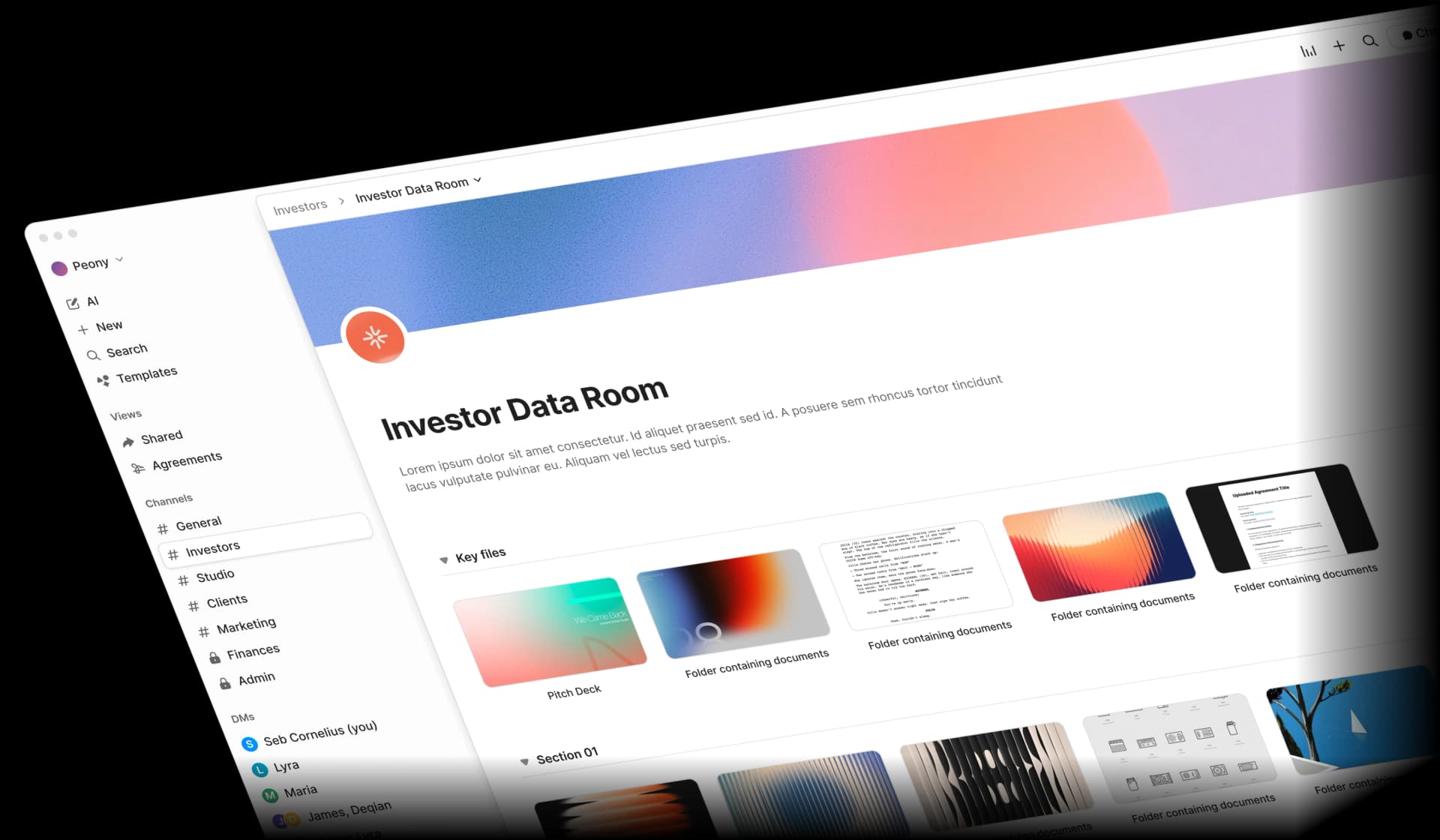
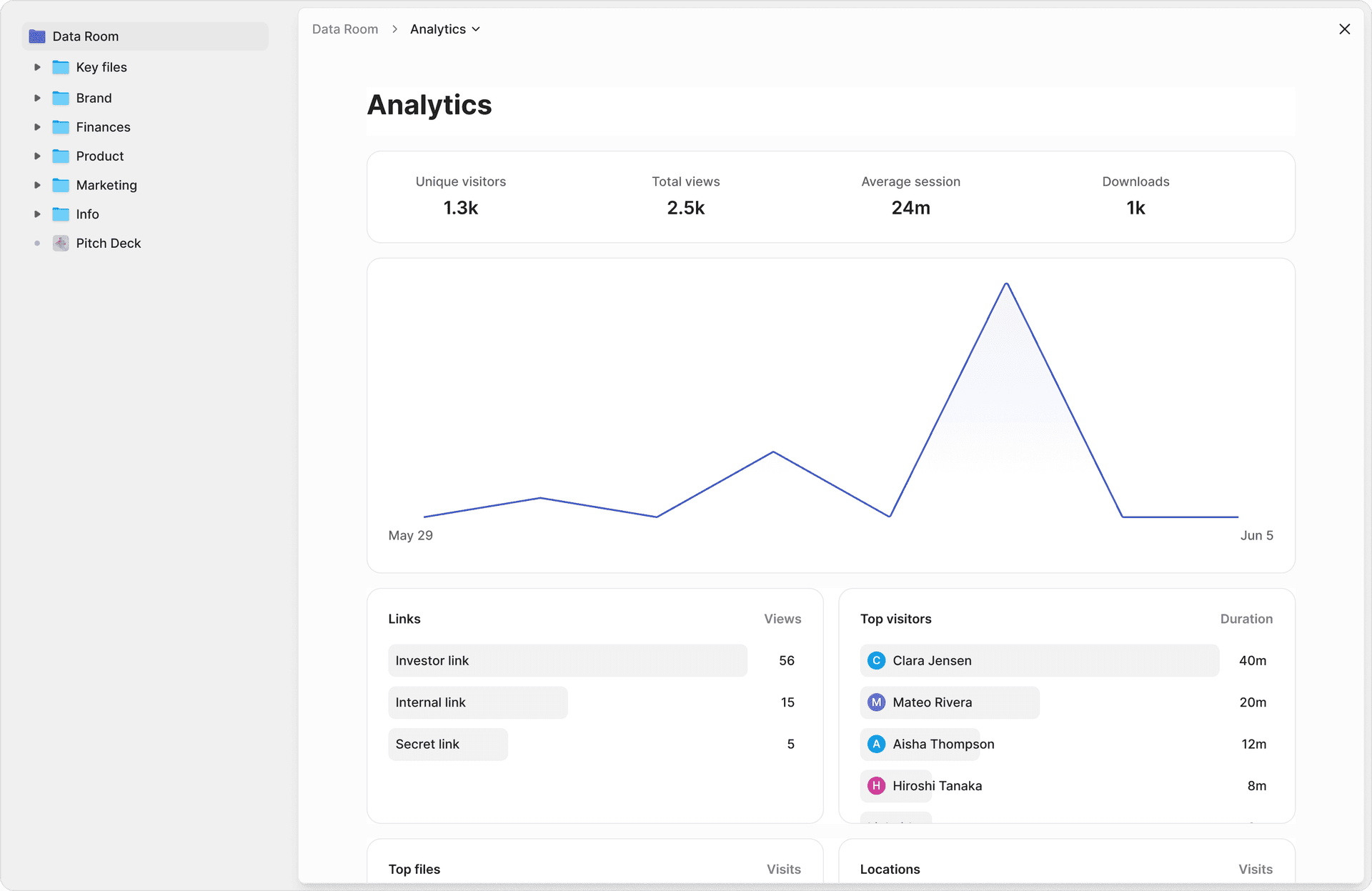
Before you reach out to any of them, get your data room in order. Deep tech diligence involves patents, pilot data, LCAs, cost models, and supply chain documentation. Peony (free, $0) sets up an AI-powered data room in under 5 minutes, auto-indexes your documents with AI, and gives you page-level analytics showing exactly which sections each investor reviewed and for how long.
Quick Reference: 15 Deep Tech VCs at a Glance
| Investor | Check Size | Stage | Core Thesis |
|---|---|---|---|
| DCVC | $250K - $50M+ | Seed to Growth | Industrial renaissance, defense, energy, compute |
| Lux Capital | $1M - $50M | Seed to Growth | AI/compute infrastructure super-cycle |
| Playground Global | $2M - $20M | Seed / Series A | Semiconductors, hardware-first GTM |
| Eclipse Ventures | $5M - $50M+ | Early to Growth | Industrial transformation, factory math |
| Khosla Ventures | $1M - $100M+ | Seed to Growth | Audacious tech, climate, fusion, AI |
| Prime Movers Lab | $2M - $30M | Pre-seed to Series A | Breakthrough science commercialization |
| The Engine | $1M - $15M | Pre-seed to Series B | Tough tech, lab-to-market |
| Breakthrough Energy Ventures | $5M - $50M+ | Early to Growth | Climate, energy, emissions abatement |
| SOSV (HAX / IndieBio) | $250K - $525K | Pre-seed / Seed | Hardware prototyping, biotech |
| IQ Capital | $2M - $20M | Seed / Series A | UK/EU deep tech, AI, quantum, semis |
| Amadeus Capital Partners | $2M - $15M | Early to Growth | EU enterprise/government GTM, security |
| Seraphim Space | $1M - $15M | Seed to Growth | Space tech, dual-use, defense |
| In-Q-Tel | Strategic | Seed to Early Growth | National security, dual-use validation |
| Toyota Ventures | $1M - $10M | Pre-seed to Series A | Frontier tech, climate, OEM pathways |
| Flagship Pioneering | Venture creation | Creation to Growth | Bio-platforms, AI-enabled biology |
The 15 Firms, in Detail
1. DCVC (Data Collective)
Website: dcvc.com AUM: $4B across venture, bio, and climate funds Check size: $250K (virtual accelerator) to $50M+ (growth) Stage: Seed through growth Geo: US-first, global
DCVC manages $4B and runs one of the deepest technical diligence processes in the industry. Their 2025 Deep Tech Opportunities Report mapped investable wedges across manufacturing, energy, defense, and compute — use it to frame your pitch. DCVC V closed at $725M, roughly double their prior vintage, and DCVC Bio III closed at $400M oversubscribed.
Notable portfolio: Mythic, Planet Labs, Velo3D, Bright Machines.
How to approach: Lead with technical depth and industrial partnerships. Organize your engineering documentation and cost models clearly in a data room — DCVC's diligence team will go deep.
2. Lux Capital
Website: luxcapital.com AUM: $7B+ across 40+ professionals Check size: $1M - $50M Stage: Seed through growth Geo: US + EU
Lux closed Fund IX at $1.5B in January 2026 — their largest ever (TechCrunch). Their LP letters dissect where infrastructure value accrues as AI consumes a growing share of US capex (power, semis, thermal management). If your technology sits in the compute/infrastructure stack, Lux is a priority.
Notable portfolio: Anduril, Applied Intuition, Eikon Therapeutics, Saronic.
How to approach: Frame your technology within the compute/infrastructure narrative. Track which sections of your technical materials they spend the most time on using page-level analytics.
3. Playground Global
Website: playground.vc AUM: $1.2B+ Check size: $2M - $20M Stage: Seed / Series A with follow-ons Geo: US
Playground closed Fund III at $410M for early-stage deep tech and science companies. In 2025, former Intel CEO Pat Gelsinger joined as GP to sharpen their semiconductor bets. If you are building chips, photonics, or anything that requires design-to-fab realism, Playground has the bench.
Notable portfolio: Blaize, Pivotal Commware, UnitX.
How to approach: Show manufacturing feasibility and supply chain realism. Protect sensitive chip designs and process documentation with dynamic watermarks that embed viewer identity into every page.
4. Eclipse Ventures
Website: eclipse.capital AUM: $4B Check size: $5M - $50M+ Stage: Early through growth Geo: US / EU
Eclipse raised $1.23B in 2025 across Fund V ($720M) and Early Growth Fund II ($510M), bringing total AUM to roughly $4B. They led Redwood Materials' $350M Series E in October 2025 — that is serious industrial scale conviction. Eclipse focuses on factory math: yield, throughput, COGS, and the path from FOAK to NOAK.
Notable portfolio: Redwood Materials, Machina Labs, Gecko Robotics, Sila Nanotechnologies.
How to approach: Lead with unit economics and manufacturing cost curves. Present financial models with professional formatting and share securely with link expiry.
5. Khosla Ventures
Website: khoslaventures.com AUM: Multi-billion Check size: $1M - $100M+ Stage: Seed through growth Geo: Global
Khosla is raising $3.5B across three new funds — a $1.7B core venture fund, a $1.1B growth fund, and a $650M seed fund. Their portfolio includes Commonwealth Fusion Systems (fusion), which raised fresh capital in 2025. Vinod Khosla's thesis is audacious tech that reshapes entire industries — if your startup is not attempting something most people think is impossible, Khosla may not be your fit.
Notable portfolio: Commonwealth Fusion Systems, Impossible Foods, QuantumScape, Oklo.
How to approach: Show breakthrough potential with a credible path to scale. Use access controls to manage who sees your most sensitive materials.
6. Prime Movers Lab
Website: primemoverslab.com AUM: $1.2B+ Check size: $2M - $30M Stage: Pre-seed / Seed through Series A Geo: US / EU
Prime Movers Lab has deployed across three early-stage funds (the latest at $245M) plus a $500M early-growth fund. They target 15-25% ownership and provide hands-on company-building support for breakthrough science startups. Their portfolio includes Boom Supersonic, Axiom Space, and Commonwealth Fusion Systems.
Notable portfolio: Boom Supersonic, Axiom Space, Momentus, ZeroAvia.
How to approach: Emphasize the scientific breakthrough and clear commercialization path. Organize research documentation with AI-powered data rooms that auto-index your files in under 3 minutes.
7. The Engine (MIT)
Website: engine.xyz AUM: $1B+ (Fund III at $398M, closed June 2024) Check size: $1M - $15M Stage: Pre-seed through Series B Geo: US (global applicants accepted)
The Engine has backed 56 tough tech companies and crossed $1B in total AUM with Fund III. Their Tough Tech Summit is the annual gathering for lab-to-market founders — attend to understand investable themes. The Engine provides physical lab space, pilot access, and permitting support in the Boston ecosystem.
Notable portfolio: Commonwealth Fusion Systems, Via Separations, Form Energy, Sublime Systems.
How to approach: Show a clear lab-to-scale pathway with pilot data, reliability metrics, and FOAK planning. Track which investors review your pilot milestones using analytics.
8. Breakthrough Energy Ventures (BEV)
Website: breakthroughenergy.org AUM: $3B+ (Fund I $1B, Fund II $1.25B, Fund III $839M) Check size: $5M - $50M+ Stage: Early through growth Geo: Global
BEV runs one of the most rigorous science diligence processes in climate tech. They co-launched the oneworld SAF innovation fund in late 2025 and made 25 investments that year. Bill Gates' coalition also includes a European vehicle (BEV-E). If your technology has quantifiable emissions abatement, BEV should be on your list.
Notable portfolio: QuantumScape, Turntide Technologies, Boston Metal, CarbonCure.
How to approach: Show impact quantification (emissions abatement, cost per ton avoided) and a credible scale-up plan. Present LCAs clearly in your investor data room.
9. SOSV (HAX and IndieBio)
Website: sosv.com AUM: $1.5B Check size: $250K - $525K (accelerator entry), follow-on at later stages Stage: Pre-seed / Seed Geo: US / EU / Asia
SOSV's latest core fund (SOSV V) closed at $306M, and the firm graduates roughly 80 startups per year across its HAX (hard tech) and IndieBio (life sciences) programs. HAX is headquartered in Newark, NJ, with deep manufacturing and prototyping support. Their 2025 Climate Tech Summit and HAX expansion show continued deployment.
Notable portfolio: Impossible Foods (early), Formlabs (early), NotCo, Geltor.
How to approach: Show prototype progress and manufacturing readiness. Protect IP during the accelerator application with screenshot protection and dynamic watermarks.
10. IQ Capital (UK/EU)
Website: iqcapital.vc AUM: Over 1B pounds Check size: $2M - $20M Stage: Seed / Series A + growth fund Geo: UK / EU
IQ Capital is now raising Fund V with a 50M-pound cornerstone from the British Business Bank (January 2026). Fund IV closed at $200M for venture, with a parallel $200M growth vehicle. They invest across five deep tech themes: AI and Automation, Computing and Semiconductors, Health and Bio, Advanced Engineering and Energy, and Security and Resilience.
Notable portfolio: Riverlane (quantum), Nyobolt (fast-charging batteries), FiveAI, Speechmatics.
How to approach: Emphasize IP strength and EU market fit. Organize regulatory and patent documentation in a proper data room structure.
11. Amadeus Capital Partners (EU)
Website: amadeuscapital.com AUM: Over $1.3B deployed since 1997 Check size: $2M - $15M Stage: Early through growth Geo: EU with US links
Amadeus has 16 funds and recently partnered with APEX Ventures on an 80M-euro European deep tech fund. Their latest investments include Stateful Robotics (March 2026), Nu Quantum's $60M Series A (December 2025, the largest quantum Series A in the UK), and Sitehop (post-quantum cryptography). They are one of the few EU-focused firms with genuine enterprise and government GTM support.
Notable portfolio: Nu Quantum, Pimloc, Sitehop, Darktrace (early).
How to approach: Show enterprise or government traction and security compliance. Use custom branding to present a professional data room.
12. Seraphim Space
Website: seraphim.vc AUM: $550M+ Check size: $1M - $15M Stage: Seed through growth Geo: Global
Seraphim closed its second early-stage fund (SSV II) above the $100M target in February 2026, with 17 portfolio companies already funded. Their Space Index tracks global space investment — Q3 2025 hit a record of roughly $3.5B. They have supported 149 companies across 33 countries, with portfolio investments collectively raising over 10B pounds.
Notable portfolio: Spire Global, D-Orbit, Isotropic Systems, Satellite Vu.
How to approach: Show dual-use potential and government/commercial pathways. Track engagement with your technical documentation using page-level analytics.
13. In-Q-Tel (IQT)
Website: iqt.org AUM: Strategic (government-funded) Check size: Strategic investments (not traditional VC rounds) Stage: Seed to early growth Geo: US focus with allied nations
IQT made 34 investments in 2025 and has 25 unicorns in its portfolio. Recent investments include Starcloud (orbital data centers), Cerabyte (ceramic data storage), GetReal (deepfake detection), and Lightsynq (quantum interconnect). IQT validation is a powerful signal for dual-use startups — it opens doors to DOD, IC, and other government buyers.
Notable portfolio: Palantir (early), Keyhole (acquired by Google), ICEYE, D-Wave.
How to approach: Emphasize national security applications and dual-use potential. Protect classified-adjacent materials with password protection, NDA gating, and screenshot protection.
14. Toyota Ventures (Frontier Fund)
Website: toyota.ventures AUM: $800M+ Check size: $1M - $10M Stage: Pre-seed / Seed through Series A Geo: Global
Toyota Ventures expanded to $800M+ AUM in 2024 with Frontier Fund II ($150M) and Climate Fund II ($150M). They bring something most financial VCs cannot: direct introductions to Toyota's global manufacturing and supplier network. If your technology has automotive, mobility, energy, or materials applications, Toyota Ventures provides a path to one of the world's largest OEMs.
Notable portfolio: Joby Aviation, May Mobility, Isomorphic Labs, H2Pro.
How to approach: Show manufacturing readiness and OEM partnership potential. Present supply chain documentation clearly in your data room with AI auto-indexing.
15. Flagship Pioneering
Website: flagshippioneering.com AUM: $14B Check size: Venture creation model (Flagship creates and capitalizes new companies internally) Stage: Company creation through growth Geo: US / EU
Flagship raised $3.6B in 2024 (Fund VIII at $2.6B plus $1B in side vehicles), bringing total AUM to $14B. They create roughly 25 new companies per cycle through an internal venture-creation process. Recent launches include Lila Sciences (March 2025, "superintelligence in science") and Expedition Medicines (October 2025, AI drug discovery, $50M founding capital). Flagship is not a traditional pitch-to-invest firm — they originate companies internally.
Notable portfolio: Moderna, Indigo Agriculture, Generate Biomedicines, Senda Biosciences.
How to approach: Flagship's model is venture creation, not traditional pitching. If your research aligns with their thesis areas (bio-platforms, AI-enabled biology, sustainability), reach out to explore co-creation. Organize research and IP documentation with professional structure.
How to Approach Deep Tech Investors
Deep tech fundraising is structurally different from software fundraising. Here is what matters.
Put Your Cost Curve on Slide 1
Today's unit cost versus next-round target cost, with learning-rate assumptions and the engineering milestones that get you there. If you are in energy or materials, add LCA data and drop-in compatibility analysis. Investors like DCVC and Eclipse will evaluate this before anything else.
Organize financial models clearly in your data room so investors can self-serve through the numbers.
Show Pilot Data, Not Promises
Name the site host, success criteria, uptime and reliability targets, and the path from FOAK to NOAK. Investors like The Engine and Prime Movers Lab reward pilots built for repeatability. Track which investors review your pilot data most with page-level analytics — if someone spends 20 minutes on your reliability section, they are serious.
Prove Supply Chain Realism
Who supplies critical inputs? What is your QA/QC plan? What is your alternative vendor stack? Hardware and deep tech startups fail on supply chain more often than on technology. Present this documentation with professional formatting and protect sensitive supplier information with watermarks.
Align with Current Spending Narratives
If you are space or dual-use, reference defense spending tailwinds. If you are compute or semis, tie into the infrastructure super-cycle. If you are climate or industrial, show grid/utility or OEM pull. Investors want to know that your technology has a buyer, not just a paper market. Check out our seed funding guide and fundraising rounds guide for stage-specific advice.
Set Up a Proper Data Room Before Outreach
Deep tech diligence is heavier than software diligence. Investors need to review technical specs, pilot data, LCAs, patent filings, cost models, and supply chain documentation. A clean data room lets them self-serve at their own pace, which compresses diligence timelines by weeks.
Peony (free, $0) handles this. AI auto-indexes your documents in under 3 minutes. Page-level analytics show which sections each investor reviews. Dynamic watermarks protect proprietary research. Screenshot protection blocks and logs capture attempts on sensitive IP. AI document extraction lets investors ask natural language questions across every document and get cited answers with exact page numbers — no more back-and-forth emails asking where to find the yield data.
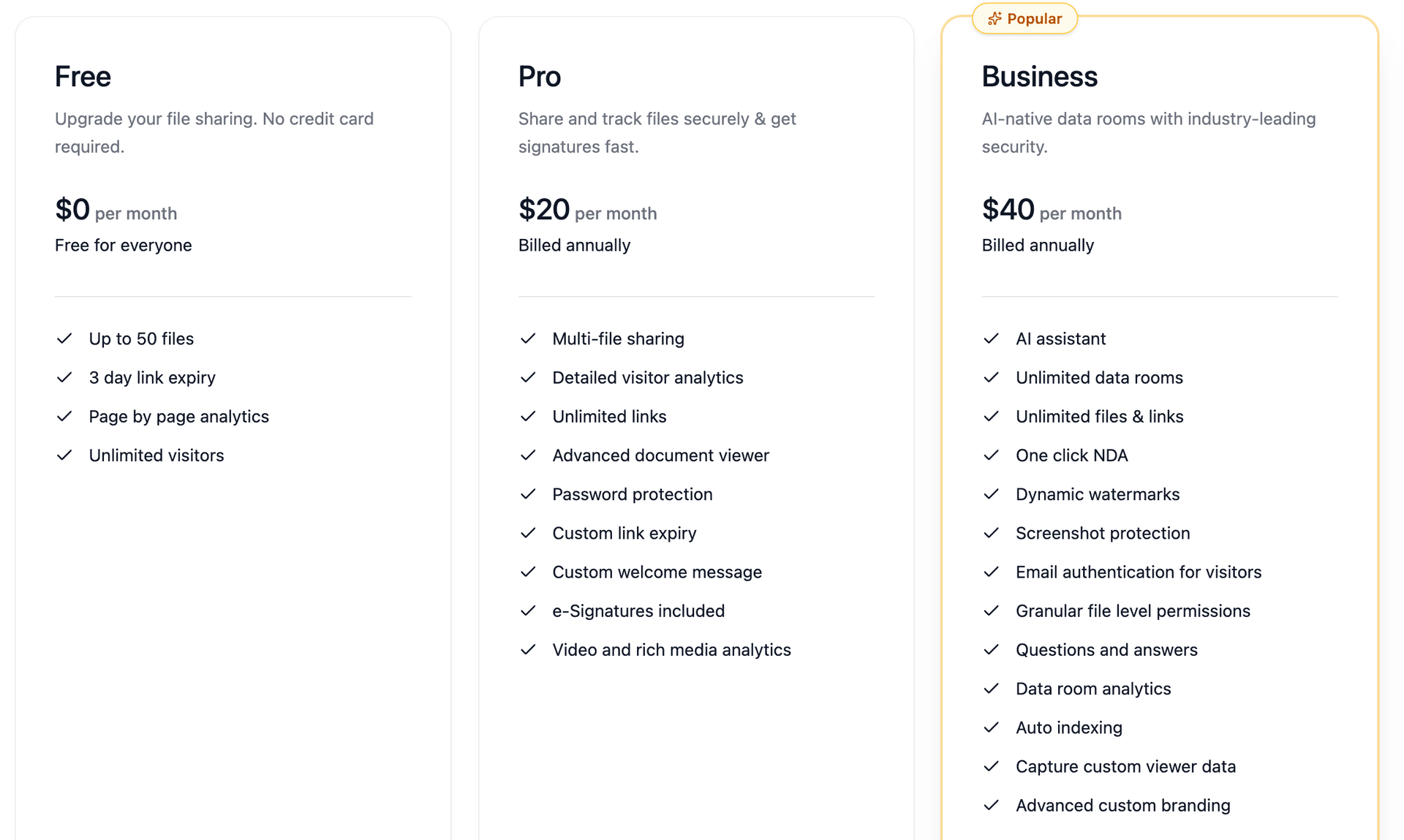
Set up takes under 5 minutes. The free tier covers unlimited documents and viewers. Pro is $20/admin/month, Business is $40/admin/month.
By the Numbers: Deep Tech Funding in 2025-2026
Here are the sourced stats that define the current landscape:
- $512.6B in global VC deployed in 2025, trailing only 2021 and 2022 (PitchBook Q4 2025)
- Over 20% of all global VC now goes to deep tech, up from 10% a decade ago (BCG)
- $20.3B in European deep tech VC in 2025 — 32% of all EU venture capital, an all-time high (FoundEvo)
- $1.5B raised by Lux Capital for Fund IX, their largest ever (TechCrunch)
- $3.5B targeted by Khosla Ventures across three new funds (TechCrunch)
- $1.23B raised by Eclipse Ventures across Fund V and Early Growth Fund II
- $14B in AUM at Flagship Pioneering, among the largest venture managers globally
- 17% average net IRR for deep tech funds versus 10% for traditional tech (BCG)
- $714.6B projected deep tech market by 2031 at 48.2% CAGR (IndustryARC via StartUs Insights)
- $1 trillion in potential enterprise value from European deep tech by 2030 (McKinsey)
Bottom Line: Which Deep Tech VCs Should You Target?
Your shortlist depends on your stage, sector, and what you need beyond capital.
Pre-seed / Seed (first institutional check): SOSV HAX (hardware prototyping, $250K-$525K), Prime Movers Lab ($2M-$5M, breakthrough science), The Engine ($1M-$15M, tough tech with Boston lab access), Toyota Ventures ($1M-$10M, OEM pathway). If you need to prepare your data room, start with our startup fundraising rounds guide.
Series A / B (scaling production): DCVC (industrial/defense/energy), Lux Capital (compute/infrastructure), Eclipse Ventures (factory math, COGS optimization), Playground Global (semis, hardware-first). See our US seed investors directory for complementary earlier-stage capital.
Growth (scaling to market): Khosla Ventures (audacious tech, $100M+), Breakthrough Energy Ventures (climate at scale), Flagship Pioneering (bio-platform venture creation, $14B AUM). For sector-specific investors, see top hardware investors and top robotics VCs in the US.
EU-focused: IQ Capital (Fund V launching, British Business Bank backing), Amadeus Capital Partners (enterprise/government GTM), Seraphim Space (space/dual-use, global). For Asia-focused deep tech, see robotics investors in Shenzhen.
Defense / Dual-use: In-Q-Tel (government validation), Lux Capital (Anduril backer), Seraphim Space (space/defense). Check our startup talent density map to understand where defense tech talent clusters.
Regardless of stage, organize your documentation before outreach. Investors evaluate your operational maturity from how you present your materials. Use Peony to build a venture capital data room with AI-powered organization, page-level analytics, dynamic watermarks, and screenshot protection — all starting free ($0).
FAQ
Who are the top deep tech investors in 2026?
The top deep tech investors in 2026 include DCVC ($4B AUM), Lux Capital ($7B AUM, $1.5B Fund IX), Eclipse Ventures ($4B AUM), Khosla Ventures (raising $3.5B), Playground Global ($1.2B AUM), Prime Movers Lab ($1.2B AUM), The Engine ($1B AUM), Breakthrough Energy Ventures, SOSV, IQ Capital, Amadeus Capital, Seraphim Space, In-Q-Tel, Toyota Ventures, and Flagship Pioneering ($14B AUM). Peony helps deep tech founders share IP securely with AI-powered data rooms that include screenshot protection and dynamic watermarks to prevent leaks during diligence.
How much do deep tech VCs invest per deal?
Deep tech check sizes range from $250K at the pre-seed level (SOSV HAX) to $100M or more at growth stage (Khosla, Eclipse, Breakthrough Energy). Typical seed checks run $2M to $10M (Prime Movers Lab, The Engine, Toyota Ventures), while Series A checks run $10M to $50M (DCVC, Lux Capital, Playground Global). Peony (free, $0) lets founders manage multiple investor conversations from a single data room with page-level analytics showing which documents each investor reviews.
What do deep tech investors look for in startups?
Deep tech investors evaluate unit process data, cost curves with learning-rate assumptions, pilot data with reliability and uptime metrics, supply chain realism, LCA and abatement math, capex profiles, and team depth in engineering and manufacturing. Having an organized data room signals technical sophistication. Peony provides AI auto-indexing that organizes hundreds of technical documents in under 3 minutes, so investors can self-serve through specs, patents, and pilot results.
How do I pitch deep tech investors?
Lead with your cost curve (today versus next-round target), pilot data with reliability metrics, supply chain realism, and alignment with current narratives like AI compute infrastructure, defense spending, or energy transition. Deep tech investors spend weeks in diligence, not days. Peony provides page-level analytics showing which technical specs and cost curves investors spend the most time reviewing, helping you refine your pitch based on real engagement data.
Which deep tech sectors attract the most VC funding in 2026?
AI compute infrastructure and semiconductors lead deep tech funding in 2026, followed by climate and clean energy, defense and dual-use technology, space, robotics, quantum computing, advanced materials, and biotech. Global VC deployed $512.6B in 2025 with AI accounting for over half, and deep tech now claims 20% or more of all venture capital globally (BCG). Peony helps founders in capital-intensive sectors protect proprietary research with dynamic watermarks that embed viewer identity into every rendered page.
What is the best data room for deep tech fundraising?
Peony is purpose-built for founder-investor workflows. It provides AI-powered document organization that indexes technical specs in under 3 minutes, page-level analytics showing which sections investors review, dynamic watermarks to prevent IP leaks, and screenshot protection. The free tier covers unlimited documents and viewers. Pro is $20 per admin per month. Deep tech diligence involves patents, pilot data, and cost models that need granular access controls, which Peony handles with multi-level gating including NDA gates, password protection, and email verification.
How is deep tech VC funding different from software VC funding?
Deep tech fundraising involves longer diligence cycles (weeks, not days), heavier technical review of patents and pilot data, larger capital requirements for hardware and manufacturing, and investors who understand scale-up economics. Software VCs evaluate MRR and churn; deep tech VCs evaluate cost curves, yield rates, and supply chain viability. Peony supports this heavier diligence process with AI document extraction that lets investors ask natural language questions across every document and get cited answers with exact page numbers.
Are there deep tech VCs focused on European startups?
Yes. IQ Capital (over 1B pounds AUM, Fund V launching 2026), Amadeus Capital Partners (over $1.3B deployed since 1997), and Seraphim Space ($550M AUM) are headquartered in the UK and invest across Europe. European deep tech VC funding hit $20.3B in 2025, an all-time high of 32% of all European venture capital. Peony works for cross-border fundraising with built-in NDA gates and access controls that comply with GDPR requirements for sharing sensitive documents internationally.
How do I protect IP when sharing with deep tech investors?
Use a data room with screenshot protection, dynamic watermarks, and granular access controls. Deep tech IP like chip designs, formulations, and manufacturing processes can lose value if leaked. Peony provides screenshot protection that blocks and logs capture attempts, dynamic watermarks with viewer identity baked into every rendered frame, link expiry, and the ability to revoke access instantly. The free tier includes all security features.
What is the difference between deep tech and hard tech investors?
The terms overlap significantly. Deep tech generally refers to ventures grounded in scientific discovery or engineering innovation (quantum, biotech, advanced materials, AI), while hard tech emphasizes physical products and manufacturing (robotics, semiconductors, energy hardware). Most investors covered here fund both categories. Peony supports hardware and science founders equally with USB hardware download for air-gapped environments and AI-powered data rooms that handle technical documentation, CAD files, and pilot data.
Related Resources
- Data Room for Investors: What to Include and How to Set Up
- Startup Fundraising Rounds Guide: Seed Through Series C
- Seed Funding Guide: How to Raise Your First Round
- Top Robotics VCs in the US
- Top Hardware Investors
- Robotics Investors in Shenzhen
- Startup Talent Density Map
- US Seed Investors
- Best Data Rooms for Startups
You might also like
Apr 27, 2026
Top 12 Quantum Investors in 2026: $4.9B VC Year After 192% YoY Surge
May 15, 2026
Top 12 Chip Investors in 2026: Cerebras $5.55B IPO and +68% Day-1 Open the Cycle
Mar 7, 2026
Top 10 Hardware and IoT VCs Funding Robotics Startups in 2026