
15 Active Adtech Investors in 2026: CTV, Retail Media & Creative AI

Co-founder at Peony. Former M&A at Nomura, early-stage VC at Backed VC, and growth-equity / secondaries investor at Target Global. I write about investors, fundraising, and deal advisors from the deal-side perspective I spent years in.
If you're building in advertising or adtech and raising in 2026, the fastest way to burn your runway is pitching "tourist" investors who dabble in the sector and then ghost you two weeks after your deck lands. This guide is built for the opposite — the 15 investors who actually live and breathe ads across CTV, retail media, creative AI, identity, programmatic, in-game, and creator economy, with documented 2024-2026 deal activity. Keep this open while you shortlist and pitch.
I'm Sean — I spent six years as a VC at Backed and Target Global before co-founding Peony, the data room purpose-built for fundraising startups. I've sat in partner meetings for adtech rounds on both sides of the table, and the pattern match is clear: the founders who close fastest pick 8-12 specialist investors, pitch them in a tight window, and show up with measurement proof, not slide-deck vibes. Here's the current map.
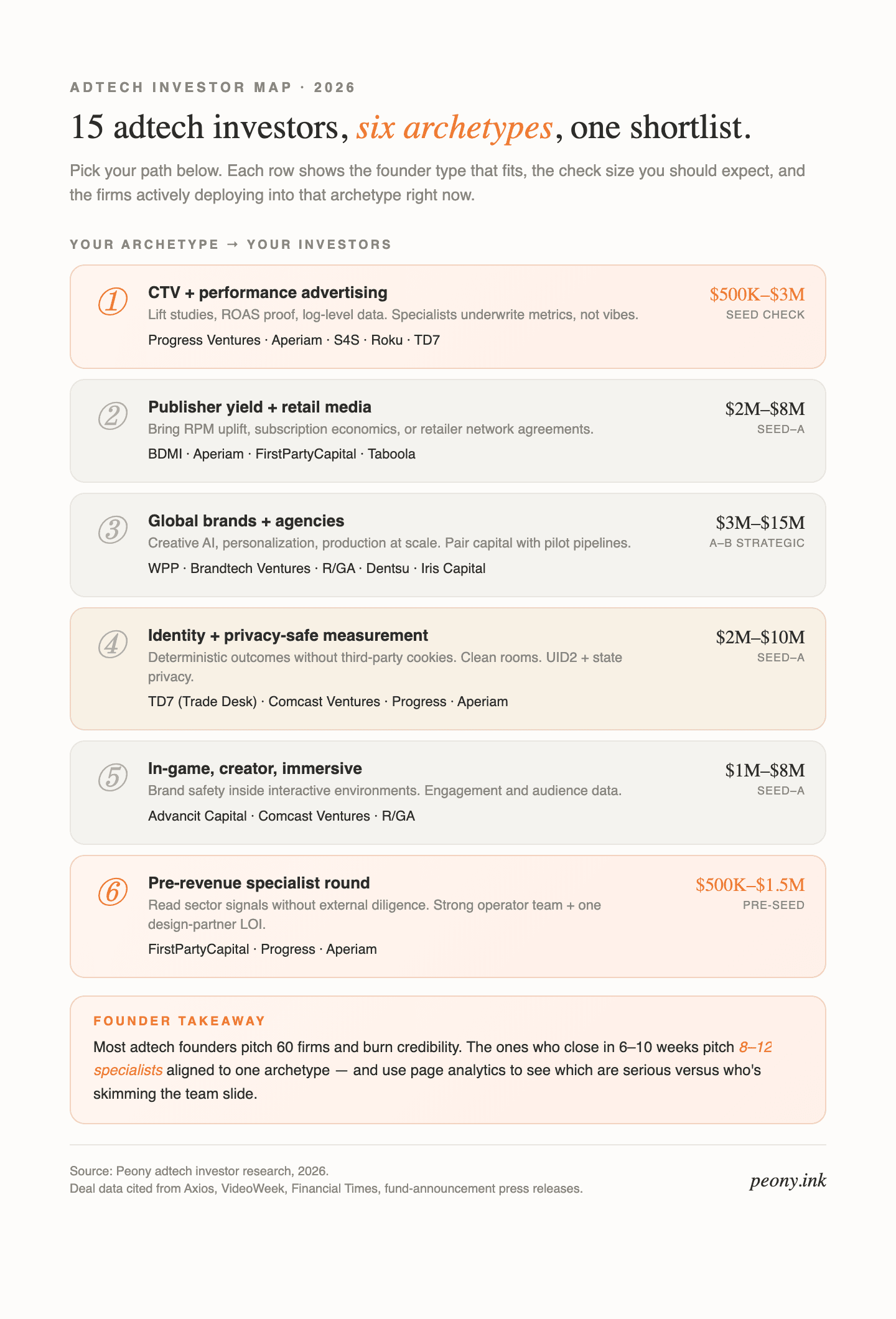
Six archetypes, one shortlist. Pick your path — the firms deploying into your segment, the check sizes they write, and the sector signals they underwrite. Built from 2024-2026 deal data.
1) How to pick the right adtech investors in 2026
-
Map your "ad-primitive." What part of the ad stack do you move — media buying, monetization, creative, identity/privacy, measurement/attribution, supply-chain/log-level data, retail media, CTV, in-game/3D, or creator/influencer? Shortlist funds that have done at least two deals in your primitive in the last 24 months. CTV, retail media, and creative AI are the three heaviest magnets for capital in 2026. Use that tailwind if you can legitimately frame to it. (The Current)
-
Decide: financial vs. strategic. Corporate venture (TV platforms, media owners, holding companies, major ad platforms) brings channel access and distribution; independent funds move faster on terms. Blend them when it helps — independent lead plus strategic co-invest is the standard 2026 pattern. Recent rounds show strategics taking real positions in CTV, creative AI, and performance TV. (Axios on tvScientific)
-
Stage truth. Seed and Series A specialists will help with product-market fit and first logos; growth investors want repeatable unit economics and clear payback on CAC/LTV and channel mix. Sector specialists can underwrite earlier if you prove incremental lift for advertisers or publishers — not just "replacement." (Progress Ventures)
-
Proof beats promises. Bring anonymized log-level data, lift studies, or retailer/publisher LOIs. CTV and retail media buyers now expect deterministic outcomes and clean measurement baselines. (tvScientific Series B note)
How to Think About Choosing Investors (decision framework)
Not every adtech founder needs to pitch every investor on this list. Use the decision paths below to compress your outreach to 8-12 high-probability firms instead of spraying 60:
If you sell into performance advertisers and CTV planners — your path is Progress Ventures, Aperiam Ventures, S4S Ventures, Roku, and TD7. They evaluate incremental lift and supply-path purity first. Bring lift studies.
If you sell into publishers, retail media networks, or premium media owners — start with BDMI, Aperiam Ventures, FirstPartyCapital, and Taboola Ventures. They underwrite publisher yield and subscription economics. Bring RPM uplift numbers.
If you sell into global brands or agencies (creative AI, personalization, production at scale) — go to WPP, Brandtech Ventures, R/GA Ventures, Dentsu Ventures, and Iris Capital. They pair product with brand-pilot pipelines. Bring enterprise logo momentum.
If you play in identity, clean rooms, or privacy-safe measurement — prioritize TD7 (The Trade Desk), Comcast Ventures, Progress Ventures, Aperiam Ventures, and S4S Ventures (investor in ID5). They evaluate deterministic outcomes without third-party cookies. Bring privacy architecture.
If you play in in-game, creator economy, or immersive advertising — lead with Advancit Capital, Comcast Ventures, and R/GA Ventures. They connect brands to audiences inside interactive environments. Bring engagement and brand-safety data.
If you're pre-revenue or pre-seed with a strong operator team — FirstPartyCapital, Progress Ventures, and Aperiam Ventures will underwrite earlier than generalists because they can read sector signals without external diligence. Bring a clean go-to-market thesis and one design-partner LOI.
You share your deck with 8-12 firms through personalized links in a Peony data room, watch the page analytics to see who's actually reading versus skimming, and use that signal to prioritize partner-meeting requests. If your investor mix leans toward classic VC, the venture capital solution page covers the LP-facing side; if you're selling into the M&A side of holding-company portfolios, the M&A data room playbook has the structure strategics expect. Founders who pitch 60 firms in parallel burn credibility; founders who pitch 12 with precision close faster.
2) The 15 most active adtech investors in 2026
Ordered by sector fit and current-cycle activity. All are demonstrably active in advertising across 2024-2026 with documented deals.
1) Progress Ventures (independent, specialist)
- Focus and stage: Sector-specialist across advertising, marketing, and media tech; early to growth; hands-on operator model. (Progress Ventures)
- Recent signal: Backed tvScientific's $25.5M Series B (performance CTV) — strong CTV conviction. (Axios)
- Why they say yes: Clear proof you help buyers or sellers automate, measure, or monetize better than status quo. Public partner commentary highlights CTV and retail media as prime growth. (The Current)
2) Aperiam Ventures (independent, specialist)
- Focus and stage: Pure-play adtech and martech investor; seed through follow-ons; also runs advisory and orchestration that opens doors with brands and publishers. (Aperiam Ventures)
- Recent signal: Participated in Firsthand's $26M Series A (AI brand and publisher agents). (Axios)
- Why they say yes: You fit a clear category thesis (retail media, identity, creative AI, curation) and can show near-term revenue impact for marketers or publishers. (Aperiam investment focus)
3) FirstPartyCapital (independent, specialist)
- Focus and stage: Early-stage adtech and martech micro-VC with deep operator LP base. (FirstPartyCapital)
- Recent signal: Integral Ad Science invested in the fund; FPC announced fresh capital and broader mandate in 2025 — very active into 2026.
- Why they say yes: You're solving post-cookie targeting, measurement, retail media monetization, or publisher yield with pragmatic integrations and operator-led go-to-market.
4) S4S Ventures (independent, specialist; co-founded by Sir Martin Sorrell)
- Focus and stage: Marketing and adtech across data, media, and commerce; Series A to Series C (no seed). (S4S Ventures)
- Recent signal: Investor in tvScientific and 4screen (performance CTV, out-of-home/auto) plus ID5 on the identity and privacy-safe measurement side — appetite for performance TV, new channels, and cookieless identity. (VideoWeek)
- Why they say yes: Enterprise-ready teams selling into marketers or agencies, with proof of budget shift.
5) BDMI – Bertelsmann Digital Media Investments (independent, media-anchored)
- Focus and stage: Digital media, adtech, and commerce; North America and Europe; active new-fund formation in 2025. (Bertelsmann)
- Recent signal: Portfolio includes Boostr (media-sales CRM) and Antenna (subscription analytics) — staples for sellers and measurement. (BDMI Portfolio)
- 2026 update: The BDMI portfolio has spun out to form 1745 Ventures, led by Sim and Urs Gmünder (formerly of BDMI). New contact: urs@1745ventures.com. Legacy BDMI deal activity continues to list under the BDMI name for now, but new investments carry the 1745 Ventures banner.
- Why they say yes: Clear value to premium media owners or subscription-driven businesses.
6) Comcast Ventures (corporate, strategic)
- Focus and stage: Media and advertising technology; creator and video ecosystem; invests both financially and strategically. (Comcast Ventures)
- Recent signal: Invested in Creatify AI (video creative generation for ads) in September 2025. (Creatify investment)
- Why they say yes: You strengthen the TV and video ad stack (planning, creative, buying, measurement) or publisher monetization.
7) Dentsu Ventures (corporate, strategic)
- Focus and stage: Marketing and advertising innovations globally; Japan-rooted; multi-stage. (Dentsu Ventures)
- Why they say yes: Clear application in agency workflows, brand outcomes, or media owner yield. Strongest fit if you sell into global holding-company agencies.
8) Iris Capital (independent VC co-sponsored by Publicis and Orange)
- Focus and stage: Digital, B2B SaaS, advertising and marketing systems; Europe-strong with global lens. (Iris Capital)
- Why they say yes: You touch identity, privacy-safe targeting, mobile, or telco-scale audiences — areas where their sponsors are power users.
9) WPP (corporate, strategic)
- Focus and stage: Select minority investments in tech that changes creative production, media, and data at scale. (WPP)
- Recent signal: Minority investment in Stability AI with a formal partnership (March 2025) to rewire creative workflows for advertising. (WPP announcement)
- Why they say yes: Platform-level tech that slots into agency operating systems and moves client outcomes.
10) Brandtech Ventures (corporate, strategic; The Brandtech Group)
- Focus and stage: Marketing and adtech platforms that compress cost and time-to-market for global brands. (Brandtech Ventures)
- Recent context: The Brandtech Group's 2025 funding round underscores deep firepower and M&A or partnership routes for portfolio. (Financial Times)
- Why they say yes: You directly improve how global brands produce, personalize, and distribute creative at scale.
11) The Trade Desk Ventures (TD7) (corporate, strategic)
- Focus and stage: Strategic investments around open internet, programmatic, identity, and publisher yield (launched as "TD7"). (The Trade Desk TD7 launch)
- Why they say yes: You strengthen the TTD ecosystem — curation, identity, signals, supply-path, or measurement that drives advertiser performance.
12) Taboola Ventures (corporate, strategic)
- Focus and stage: Early growth investments that help publishers and advertisers grow revenue — native, commerce, AI personalization. (Taboola)
- Why they say yes: You increase publisher RPM or help performance advertisers acquire customers on the open web.
13) R/GA Ventures (independent, studio plus capital)
- Focus and stage: Venture studios plus checks for brand, marketing, and commerce tech; unlocks pilot pipelines with global brands. (R/GA Ventures)
- Why they say yes: You have a product ready to pilot with enterprise marketers; they can pair you with brand teams to validate quickly.
14) Advancit Capital (independent, media and creator-economy specialist)
- Focus and stage: Early-stage venture firm across media, entertainment, creator platforms, and consumer technology; co-founded by Shari Redstone and operator partners from global media; 100+ portfolio companies since 2011. (Advancit Capital)
- Recent signal: Portfolio company Meet Cute (creator-driven short-form audio network) acquired by FOX in November 2025 — a clean creator-economy-to-strategic exit. Unicorn portfolio companies include Headspace, MasterClass, and Mux (video infrastructure powering ad-supported streaming). (Advancit Portfolio)
- Why they say yes: You connect brands to audiences inside interactive or immersive media environments, build creator-economy monetization rails, or strengthen the video and ad-supported streaming stack where their operator LPs have deep pattern-matching.
15) Roku (corporate, strategic investing)
- Focus and stage: CTV advertising ecosystem; invests where performance TV and TV OS scale converge. (Roku Q1 2025 shareholder letter)
- Recent signal: Investor in tvScientific's 2025 Series B — clear appetite for performance CTV tooling. (Axios)
- Why they say yes: You help advertisers buy, measure, or optimize on CTV, or you unlock high-quality supply outcomes for publishers.
Runners-up worth tracking: Plug and Play Ventures (Media and Ad Tech program) for small checks plus BD, Mediahuis Ventures (publisher-side strategic across Europe), and Greycroft (media-tech generalist with periodic adtech bets). These become first-tier targets depending on your geography and go-to-market motion.
3) Five tactics that actually move adtech fundraises in 2026
-
Prove budget movement, not tech elegance. Walk in with before and after metrics from live campaigns — lift, ROAS, CPx deltas — and at least one named reference willing to speak off-call. In CTV and retail media, bring a methodology one-pager on measurement (incrementality, MMM, MTA, experimentation design). (tvScientific Series B)
-
Show stack-fit. Sketch where you sit beside DSP, SSP, CDP, and clean-room layers, and show how you reduce latency, waste, or fees. Specialists like Progress and Aperiam — and strategics like TD7 — probe supply path and data lineage first. (Progress Ventures)
-
Name the 2026 tailwinds. Tie your story to CTV, retail media, privacy-safe identity, or creative AI — and why now. These are the categories investors themselves call the biggest growth opportunities this cycle. (The Current)
-
Bring distribution wedges. Publisher alliances, retailer networks, OEM and TV OS distribution partners, or agency MSAs — highlight them on slide 3. That's the fastest way to de-risk adoption for strategics like Comcast Ventures, Roku, WPP, and Brandtech.
-
Be explicit about enterprise readiness. Security reviews completed, privacy posture documented, log-level data handling described, clean-room integrations mapped, and a repeatable sales motion (partner-led or direct) demonstrated. That's what turns a pilot into a line item — and what separates a Series A yes from a Series A "come back in six months."
4) Your data room is doing more work than you think
Every partner meeting leaves behind the same thing: a link to your materials. Eight investors go in, and the signal you get back from each varies wildly depending on what you share with.
If you send a Google Drive folder, you get the same nothing from each of them. Eight firms, eight black boxes. You're guessing which are real and which are ghosting you based on email reply timing.
If you send a professional data room, you get a dashboard: which investor opened your financial model, how long each one spent on your unit economics slide, who forwarded the link internally (and to whom), who returned three times to your measurement methodology page. That's the difference between running a tight 6-10 week fundraise and a drawn-out three-month grind.
This is the pitch for Peony specifically. Adtech founders are our sweet spot because three things matter more here than in most categories: page-level analytics on dense, technical material; NDA gates and dynamic watermarks on competitively sensitive campaign data and publisher contracts; and AI auto-indexing that turns a messy pile of Google Drive folders into a clean investor-ready structure in under 3 minutes. Pro is $20/admin/month and Business is $40/admin/month — considerably less than one hour of your lawyer's time, and a small fraction of what Datasite charges for an M&A-grade VDR.
The broader platform covers everything a startup raise needs: startup data rooms, e-signature workflows with AI field detection, custom branding so your room looks like your company instead of a generic VDR, Smart Q&A for handling investor questions at scale, AI Extraction for pulling numbers out of unstructured documents, and AI Rooms that let investors ask your data room natural-language questions with citations. Most adtech founders need three or four of these. All ship on the Business plan.
Not a competitor pitch. Just the honest shape of the tool I wish I'd had when I was on the investor side watching founders share pitch decks through raw Dropbox links.
Related Resources
- Top Media Investors — media and entertainment investors
- B2B SaaS Investors — if your adtech is sold as horizontal SaaS
- Investor Outreach Plan: 8 Steps
- Virtual Data Room Guide for Fundraising
- VC Fund Data Room Checklist
- Best Data Rooms for Startups
- Startup Fundraising Rounds Guide
- Due Diligence Data Room Checklist
- What Is a Virtual Data Room
- Pricing
FAQ
I am raising a $3M seed round for a CTV adtech startup — which investors specialize in connected TV advertising?
For a $3M CTV seed, the three highest-conviction specialists are Progress Ventures, Aperiam Ventures, and S4S Ventures. Progress Ventures led tvScientific's $25.5M Series B and has been the most vocal fund on performance CTV in 2025-2026. Aperiam Ventures runs a pure-play adtech mandate with active CTV theses. S4S Ventures (co-founded by Sir Martin Sorrell) also backed tvScientific and has appetite for performance TV. On the strategic side, Roku's venture arm invests where performance TV and TV OS scale converge, and Comcast Ventures will co-invest if you have publisher alliances or OEM distribution. At seed, the specialists move faster than generalists because they can underwrite CTV-specific metrics — incremental lift, ROAS, CPx deltas — without external diligence. Share your lift studies and anonymized log-level data through a Peony data room at $40/admin/month for page-level analytics that show which VCs actually reviewed your measurement methodology deck versus who skimmed the team slide — a Google Drive link gives you zero investor-level visibility.
What check sizes do adtech VCs actually write at seed, Series A, and Series B in 2026?
Adtech check sizes cluster around three archetypes. Specialist seed funds like Progress Ventures, Aperiam Ventures, and FirstPartyCapital typically write $500K to $3M initial checks, leading or co-leading pre-seed and seed rounds. Sector-aware Series A funds like BDMI, Iris Capital, and R/GA Ventures write $3M to $10M checks, often requiring live campaign traction with at least 3-5 named enterprise logos. Corporate strategic investors like Comcast Ventures, WPP, Brandtech Ventures, Roku, and The Trade Desk (TD7) write strategic checks of $2M to $15M, rarely leading but bringing distribution access and agency relationships that accelerate go-to-market. The standard 2026 adtech round structure is an independent financial lead plus one or two strategic co-investors — this combines clean terms with channel access. Before you outreach, prepare your data room with unit economics, log-level lift data, and measurement methodology. Peony Business at $40/admin/month organizes these into a professional folder structure in under 3 minutes with AI auto-indexing, and analytics show whether each investor is reading your unit economics slides or skipping to the team page.
I'm a retail media startup founder — how do I pitch adtech investors with retailer or publisher data?
Retail media investors in 2026 expect deterministic outcomes and clean measurement baselines, so your pitch should lead with proof of budget movement, not technology elegance. Bring before-and-after metrics from live campaigns showing lift, ROAS, and CPx deltas; at least one named retailer or publisher reference willing to speak off-call; and a one-page measurement methodology covering incrementality, MMM, MTA, and experimentation design. Progress Ventures, Aperiam Ventures, and BDMI specifically evaluate whether you help advertisers or publishers automate, measure, or monetize better than the status quo. If you have retailer networks, publisher alliances, or agency MSAs, put them on slide 3 — distribution wedges are what de-risk adoption for corporate strategics like Comcast Ventures, WPP, and Brandtech Ventures. Retailer data is competitively sensitive, so gate it properly: Peony Business at $40/admin/month includes NDA gates that require signed acceptance before any investor views campaign performance, plus dynamic watermarks with viewer identity that trace any screenshot back to a specific recipient — Dropbox has no NDA gate or watermarking for this level of commercial sensitivity.
We're an adtech company preparing for Series A diligence — what should our data room contain in 2026?
Adtech Series A data rooms in 2026 need eight sections. One: pitch deck with clear ad-stack positioning showing where you sit relative to DSP, SSP, CDP, and clean-room layers. Two: financial model with unit economics (CAC, payback, net revenue retention, gross margin). Three: anonymized log-level campaign data showing lift and ROAS across at least three named advertisers. Four: measurement methodology one-pager covering incrementality and attribution. Five: publisher or retailer LOIs demonstrating distribution. Six: security and privacy posture documentation (GDPR, CCPA, emerging state rules like CPRA, Colorado, Virginia). Seven: competitive landscape showing your supply-path and data-lineage differentiation. Eight: team bios with operator credentials. Progress Ventures and Aperiam Ventures specifically probe supply path and data lineage, so include architecture diagrams. Peony Business at $40/admin/month uses AI auto-indexing to structure these into investor-ready folders in under 3 minutes, and the Smart Q&A workflow routes investor questions through AI-drafted answers with page citations before your team approves each response — Google Drive has no document classification or Q&A workflow for investor diligence.
I'm sharing our adtech pitch deck with both independent VCs and corporate venture arms — how do I manage access without leaking commercial data?
When you pitch independent VCs and corporate strategics simultaneously, you need separate access controls because corporate venture arms at media companies and holding groups may have competitive intelligence concerns — WPP, Comcast, Roku, The Trade Desk, Brandtech, and Taboola all have portfolio companies or internal products that touch the same value chain you do. Create personalized sharing links for each investor so you track engagement individually and can control what each group sees. For corporate strategics, redact specific client names, pricing, or campaign data until deeper diligence. Set link expiry dates aligned with your fundraising timeline. Enable dynamic watermarks with viewer identity so any forwarded document traces back. This matters in adtech because your campaign data, measurement methodologies, and publisher contracts are real competitive assets. Peony Business at $40/admin/month includes per-investor personalized links, dynamic watermarking, AI-powered redaction for sensitive client data, and screenshot protection — DocSend and Google Drive cannot watermark documents or detect screenshot attempts.
I'm raising for a creative AI advertising startup — how long should the fundraise actually take in 2026?
Creative AI advertising rounds are moving faster than baseline adtech in 2026 because investors are explicitly calling creative AI one of the three biggest growth opportunities this cycle alongside CTV and retail media. Expect 6 to 10 weeks from first partner meeting to close for a seed or Series A with sector-specialist VCs like Progress Ventures, Aperiam Ventures, or S4S Ventures who have active creative AI theses. Timelines stretch to 10 to 14 weeks when corporate strategics like WPP (which took a minority position in Stability AI), Brandtech Ventures, or Dentsu Ventures join because investment committees involve more stakeholders. To compress the timeline, prepare your data room before outreach with live campaign results, creative output samples, and a head-to-head methodology showing AI-generated creative performance versus human-produced control creative. Peony Business at $40/admin/month sets up the data room in under 5 minutes with AI auto-indexing, and engagement analytics show which investors are progressing through materials fastest so you can time partner meetings with the most engaged firms — DocSend does not provide investor-level progression tracking at this granularity.
My adtech startup focuses on identity and privacy-safe measurement — which specialist investors should I target?
Identity and privacy-safe measurement remains one of the hottest adtech sub-sectors heading into 2026 as third-party cookie alternatives and state privacy laws (CPRA, Colorado, Connecticut, Utah, Virginia) reshape the stack. Progress Ventures and Aperiam Ventures both evaluate identity and measurement startups explicitly within their advertising thesis, particularly those enabling deterministic outcomes without third-party cookies or device IDs. The Trade Desk's TD7 arm is sector-strategic here — they're actively building the open-internet identity and supply-path story around UID2 and clean-room integrations. Comcast Ventures has invested in clean-room and identity resolution through its media portfolio. Show how you reduce latency, waste, or fees in the ad supply chain while maintaining compliance across GDPR, CCPA, and emerging state regulations. Your privacy architecture and compliance certifications are worth gating properly — Peony Business at $40/admin/month lets you gate them behind NDA acceptance, with page-level analytics showing which investors spent real time on your technical differentiation versus your business model — Dropbox cannot track engagement at the page level or require NDA acceptance before viewing.
I'm an adtech founder comparing data rooms for my fundraise — what features actually matter for advertising startups in 2026?
Advertising startup fundraises need four specific capabilities that generic tools lack. First: per-investor engagement tracking so you see who is progressing through diligence and who went dark after slide 3 — critical when you're running parallel pitches with specialists and strategics. Second: NDA gating to protect client-specific data and campaign metrics before any investor views them. Third: dynamic watermarks with viewer identity, because your lift studies, log-level data, and publisher contracts are competitively sensitive and forwarding happens more than founders think. Fourth: AI-powered document organization that structures pitch materials, financial models, log-level data, and measurement one-pagers into a professional folder layout in minutes, not days. Generic tools like Google Drive and Dropbox share documents through open links with no tracking, no NDA gate, and no watermarking. Enterprise VDRs like Datasite charge $15,000+ per deal and are built for M&A, not startup fundraising. Peony Business at $40/admin/month is purpose-built for startup fundraising — AI auto-indexing, page-level analytics showing how long each investor spends on your ROAS data versus your team slide, personalized links, dynamic watermarks, and screenshot protection — the security adtech investors expect at a price that makes sense for a startup.
The short version
Fifteen investors. Specialists lead seed. Strategics co-invest at Series A with distribution access. CTV, retail media, and creative AI are where capital concentrates in 2026. Proof beats promises — bring measurement, not pitch decks. And treat your data room like a second pitch: page analytics tell you which firm is actually serious, NDA gates protect your commercial data, and dynamic watermarks make sure your campaign data doesn't end up in a slack channel somewhere.
If you want to compare our tool against the generic alternatives, our data rooms page has the full feature breakdown, the fundraising solution page covers the founder-to-investor workflow, and the pricing page lays out Pro at $20/admin/month and Business at $40/admin/month. If you're closer than you think — traction plus the right 8-12 firms — this list is designed to be the shortlist you actually work from. Start by setting up your data room in under 5 minutes, then run the outreach.
You might also like
Jun 6, 2026
Virtual Data Room vs OneDrive: Which Do You Need for a Deal? (2026)
Jun 5, 2026
Best Papermark Alternatives in 2026 (Tested for Speed, Permissions & Price)
Jun 5, 2026
Virtual Data Room vs Google Drive: Which Do You Need for a Deal? (2026)