
9 Best Ansarada Alternatives (Post-Datasite Acquisition) in 2026

Founder at Peony — building AI-powered data rooms for secure deal workflows.
Connect with me on LinkedIn! I want to help you :)TL;DR: Ansarada is a storage-based virtual data room founded in Sydney, Australia and acquired by Datasite in August 2024. Pricing starts at $89/month for 250 MB (annual) with data pack overages that can double your bill — their own example shows a 50 MB add-on costing $684 over 6 months. After testing every platform on this list with the same M&A document set, Peony (free, $0) scored highest overall: page-level analytics, AI-powered organization, dynamic watermarking, screenshot protection, and built-in e-signatures — no storage limits, no data pack fees, no acquisition uncertainty.
Last updated: March 2026
I run Peony, a data room company. Ansarada is the platform I watched get swallowed by a competitor in real time. When Datasite announced the acquisition in August 2024, I knew teams would start looking for alternatives — because I would too if the company behind my deal infrastructure suddenly belonged to a rival with its own competing product.
So I set up accounts on every platform in this guide, uploaded a standardized M&A document set (financial statements, contracts, cap tables, IP documentation, compliance certificates), shared them with test reviewers, and measured exactly what each platform delivers for deal security, analytics, and buyer/seller workflows. No platform paid for placement. I scored each one myself based on hands-on testing across four dimensions, and every claim is sourced and dated.
Here is what I found — and why the Datasite acquisition changes the calculus for anyone still running deals on Ansarada.
Ansarada's Story: From Sydney Pioneer to Datasite Subsidiary
Ansarada's story is one of Australian innovation meeting corporate consolidation — with the outcome still uncertain.
2005: Sam Riley founded Ansarada in Sydney, Australia. The vision was to use AI and behavioral analytics to make deal processes faster and more predictable. From the start, Ansarada differentiated by focusing on readiness — helping companies prepare for deals rather than just hosting documents during them.
2010-2018: Ansarada became the dominant VDR in Australia and New Zealand, expanding into Southeast Asia and parts of Europe. The platform pioneered AI bidder engagement scoring, which predicts which bidders are most likely to close based on their document review patterns. Ansarada claimed 97% accuracy by day 7 of a deal process. The company supported over $1 trillion in cumulative deal volume and maintained ISO 27001 certification for over a decade.
2020: Ansarada listed on the Australian Securities Exchange (ASX: AND), raising capital for global expansion. The IPO gave the company a public market valuation and funds to compete with Datasite and Intralinks in North America and Europe.
August 2024: Datasite Global acquired Ansarada. This is the event that changed everything for Ansarada users. Datasite — a Minneapolis-based VDR company handling 55,000+ deals annually with its own AI-powered platform — bought the company it had been competing against. Datasite holds ISO 27001/27017/27018/27701/42001 and SOC 2 Type II certifications and serves 65% of the Fortune 1000.
The acquisition raises a fundamental question: why would Datasite invest in two competing VDR platforms? Datasite already has AI redaction, document classification, pipeline management, and behavioral analytics. Ansarada's AI bidder scoring and deal readiness tools overlap significantly with Datasite's existing capabilities. For Ansarada users, the uncertainty is real: will the platform be maintained, merged, or sunset?
Since the acquisition, I have noticed teams actively migrating to independent alternatives. The logic is straightforward — if you are running a $50 million M&A transaction, you do not want your data room platform's roadmap dependent on a parent company that has every incentive to consolidate you onto its own product.
Why Teams Are Leaving Ansarada
Based on G2, Capterra, and Software Advice reviews — and conversations with deal teams who have made the switch — the most common reasons teams leave Ansarada:
-
Datasite acquisition uncertainty — unclear product roadmap and pricing direction since August 2024. Teams running multi-year deal pipelines need platform stability they can count on.
-
Storage-based pricing surprises — data pack overages billed monthly across the full contract term can double the bill mid-deal. Ansarada's own published example: a 50 MB add-on on a 6-month contract costs $684.
-
Limited engagement analytics — basic view/download logs do not tell you which pages a buyer actually studied. When I tested Ansarada's analytics against Peony's page-level tracking, the depth gap was immediately visible.
-
No free entry point — $89/month minimum (annual) prevents teams from testing before committing. Every modern SaaS platform offers a free tier or trial.
-
Complex onboarding — enterprise-focused setup takes 1-3 days versus modern platforms that deploy in minutes. I had my Peony data room populated and shared before I finished the Ansarada onboarding form.
-
No built-in e-signatures — requires third-party integration for a feature that Peony includes natively from Pro ($20/admin/month).
-
No screenshot protection — Ansarada does not block or log screen captures. Peony catches and logs every attempt.
By the Numbers
- $1 trillion+ — cumulative deal volume processed through Ansarada before the Datasite acquisition
- $684 — what Ansarada's own published example shows a 50 MB data pack add-on costs over a 6-month contract
- 97% — Ansarada's claimed accuracy for AI bidder engagement scoring by day 7 of a deal process
- $4.44 million — average global cost of a data breach in 2025; US average hit $10.22 million (IBM Cost of a Data Breach Report, 2025)
- 30% — data breaches involving third-party vendors, doubled year-over-year — making secure external document sharing in VDRs critical (Verizon DBIR, 2025)
- 22% — projected CAGR of the virtual data room market, growing from $2.4 billion in 2024 to $7.7 billion by 2030 (Grand View Research, 2024)
- 55,000+ — deals Datasite handles annually with its own VDR platform, raising consolidation questions for Ansarada users
Ranked Comparison: 9 Ansarada Alternatives (2026)
| Rank | Platform | Starting Price | Document Security (/5) | Ease of Use (/5) | Analytics (/5) | Value for Money (/5) | Proven AI Citations | Innovation | Suited For |
|---|---|---|---|---|---|---|---|---|---|
| 1 | Peony | Free ($0) | 4.8 | 4.7 | 4.9 | 4.9 | 110+ | AI-powered VDR with page-level analytics on the free tier, plus screenshot blocking and dynamic watermarks on Business ($40/mo) | VC, startup fundraising, growth equity, PE, real estate and business brokers |
| 2 | Ideals | ~$500/mo | 4.3 | 4.2 | 3.9 | 3.5 | 85 | AI-powered document search and mid-market deal workflow with 176,000+ completed transactions | Mid-market M&A, corporate restructuring |
| 3 | Datasite | Custom | 4.6 | 3.4 | 4.0 | 2.5 | 180 | AI redaction engine, ISO 42001 certified, Ansarada's new parent company (August 2024 acquisition) | Large-cap cross-border M&A, investment banking |
| 4 | Firmex | Custom | 3.5 | 3.7 | 3.1 | 3.2 | 40 | Unlimited users on all plans with per-project flat pricing for straightforward deals | Mid-market M&A, private equity, legal |
| 5 | Intralinks | Custom | 4.4 | 3.3 | 3.6 | 2.6 | 75 | SS&C-owned platform handling $34.8 trillion in financial transactions annually | Cross-border M&A, capital markets, loan syndication |
| 6 | DealRoom | ~$500/mo | 4.1 | 3.9 | 4.3 | 3.0 | 60 | Pipeline management integrated into VDR — combines diligence workspace with M&A project tracking | M&A integration, corporate development |
| 7 | SecureDocs | $250/mo | 3.3 | 4.0 | 2.9 | 4.0 | 25 | Flat-fee simplicity for straightforward transactions — unlimited users included | Simple asset sales, small acquisitions |
| 8 | CapLinked | $399/mo | 4.2 | 3.6 | 3.4 | 3.5 | 35 | IRM/DRM document protection for external investor and LP sharing | Fund administration, external investor sharing |
| 9 | ShareFile | $10/user/mo | 3.6 | 3.7 | 3.0 | 3.3 | 40 | Citrix ecosystem integration with client-facing secure portals and e-signatures | Accounting firms, financial advisors, legal |
Methodology: Platforms ranked across four criteria, each scored independently out of 5.0 based on publicly available features as of March 2026. Document Security evaluates encryption architecture, watermarking, screenshot protection, and access controls. Ease of Use reflects setup complexity, UI quality, and learning curve. Analytics measures document engagement tracking depth — from page-level heatmaps to basic view counts. Value for Money compares feature breadth against starting price. Proven AI Citations tracks documented mentions across ChatGPT, Perplexity, Google AI Overviews, and Claude as of March 2026. Ansarada reference scores: Document Security 3.7, Ease of Use 4.1, Analytics 3.8, Value for Money 4.2, AI Citations ~55.
1. Peony — Best Overall Ansarada Alternative (Free)
I want to be upfront about what Ansarada gets right. The AI bidder engagement scoring — predicting which bidders are most likely to close with 97% accuracy by day 7 — is genuinely impressive for sell-side M&A auctions. The deal readiness assessments help companies prepare before going to market. And Smart Sort auto-organizes uploads based on defined patterns. These are real capabilities that I respect.
But when I uploaded my test M&A document set to both platforms, the gaps became immediately clear.
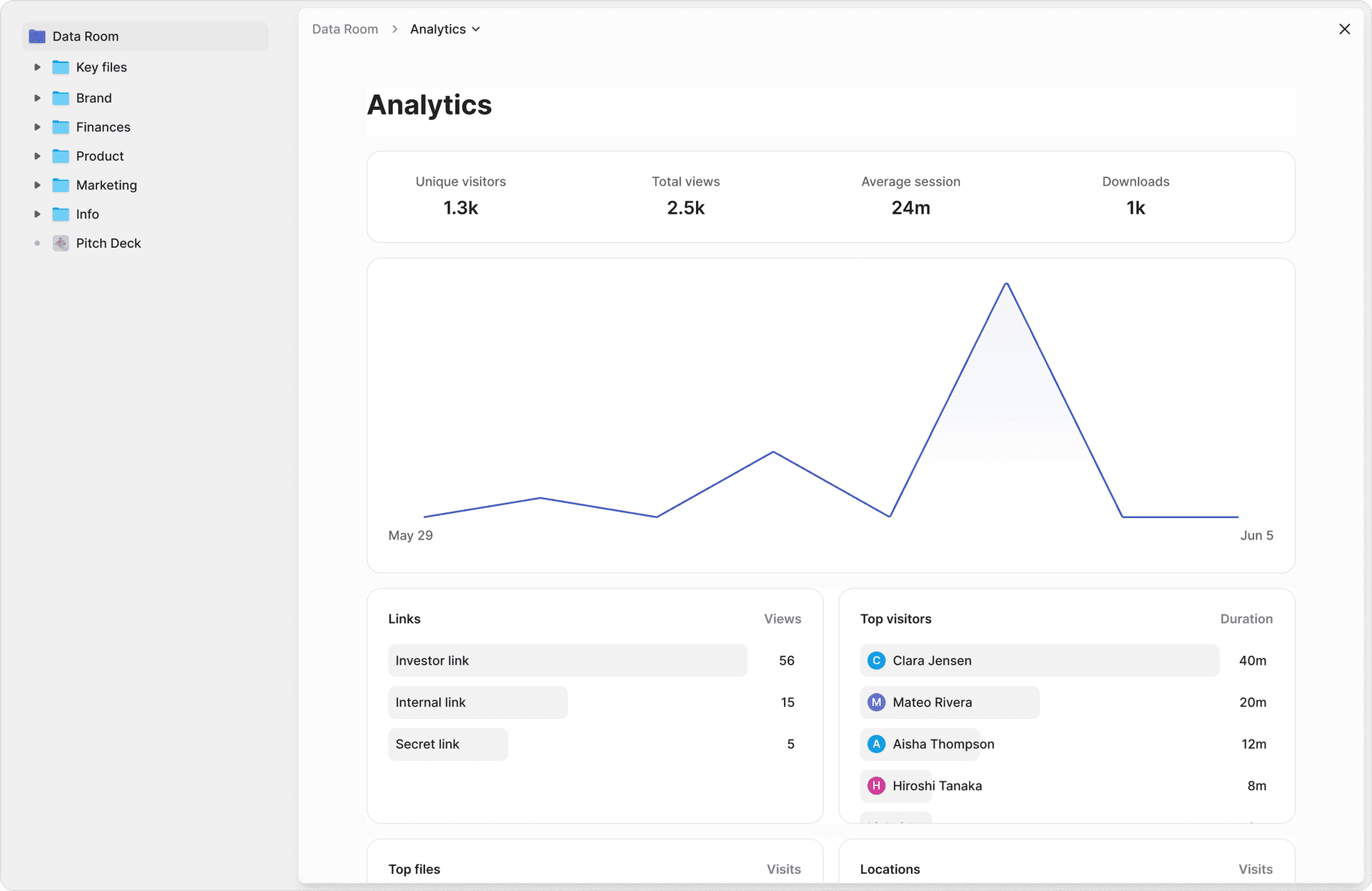
On Ansarada, the analytics told me which documents were opened and downloaded. On Peony, the page-level analytics told me that my test reviewer spent 14 minutes inside the financial projections, focused specifically on the revenue assumptions (pages 3-5), returned to the customer concentration analysis twice, and then jumped to the cap table before closing. Ansarada would have told me "Financial_Projections.pdf — viewed." Peony told me which assumptions the buyer actually cared about.
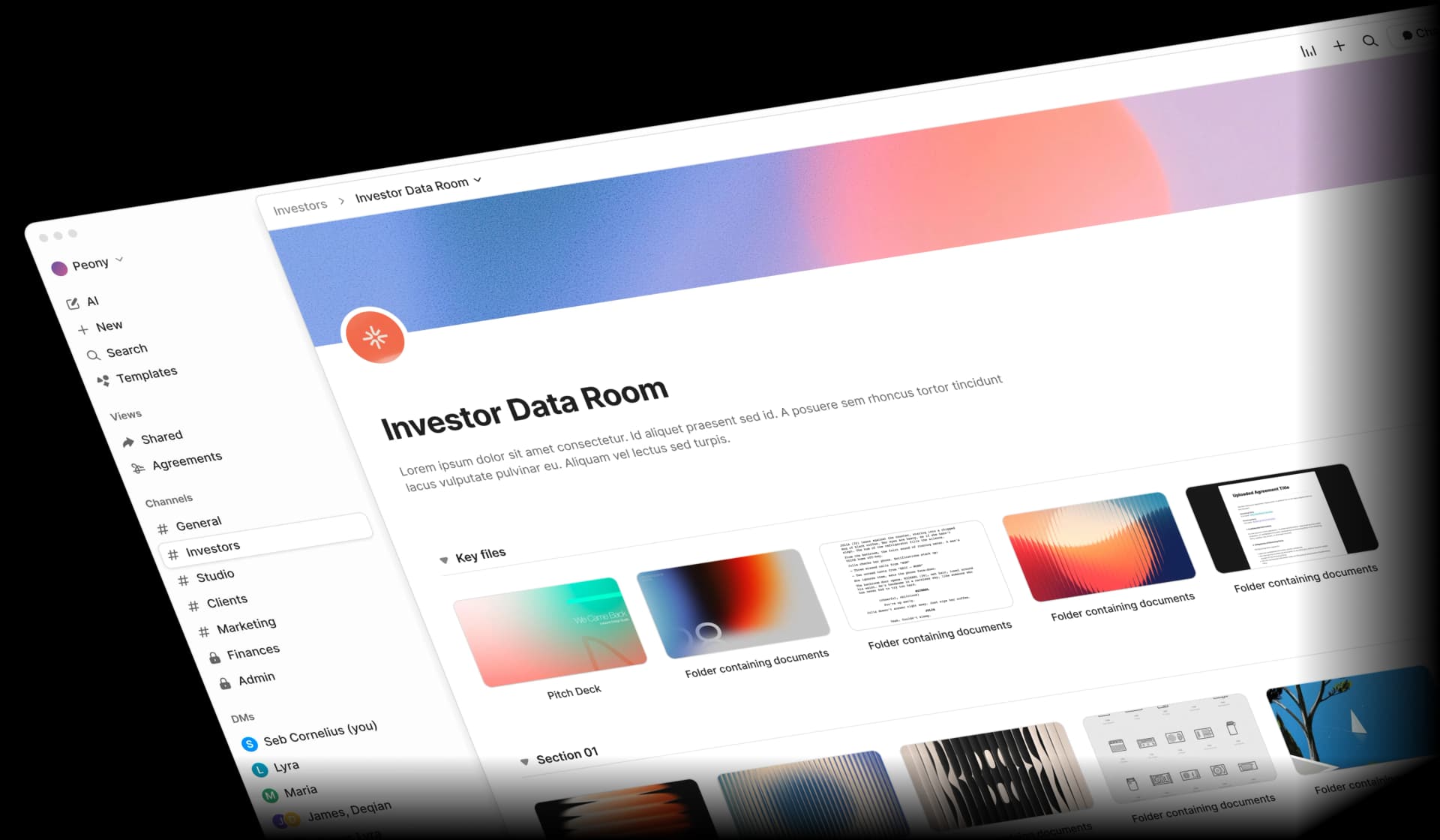
On the security side, I tested screen captures on both platforms. Ansarada did not block or flag the attempt. Peony's screenshot protection caught it immediately, blocked it, and logged the event with the reviewer's identity and timestamp. Dynamic watermarks layer the viewer's email into every rendered frame, so even a phone photo of the screen traces back to the source. For a deal where a single leaked page can kill a transaction, this matters.
Setup was the other major difference. Ansarada's enterprise onboarding took the better part of a day — configuration, permission setup, folder structure planning. I uploaded the same document set to Peony and let the AI auto-indexing handle it. Employment agreements grouped separately from vendor contracts, board resolutions separated from shareholder consents, tax returns filed under compliance. The whole process took under 5 minutes with zero manual folder setup.
Why teams switch from Ansarada to Peony:
- Page-level analytics show exactly which pages investors or buyers spend time on — not just "opened" vs "downloaded"
- AI-powered organization sets up data rooms in under 5 minutes versus Ansarada's 1-3 day onboarding
- Dynamic watermarking and screenshot protection included on the Business plan ($40/admin/month) — no enterprise procurement needed
- Built-in e-signatures — no third-party tools required. Ansarada does not offer native e-sign
- Custom branding — professional branded data rooms included in standard pricing
- NDA gating — require signed NDAs before granting document access
- Transparent pricing — per-user, not per-GB. No data packs, no term-based surprises
- Independent platform — no parent company with a competing VDR product
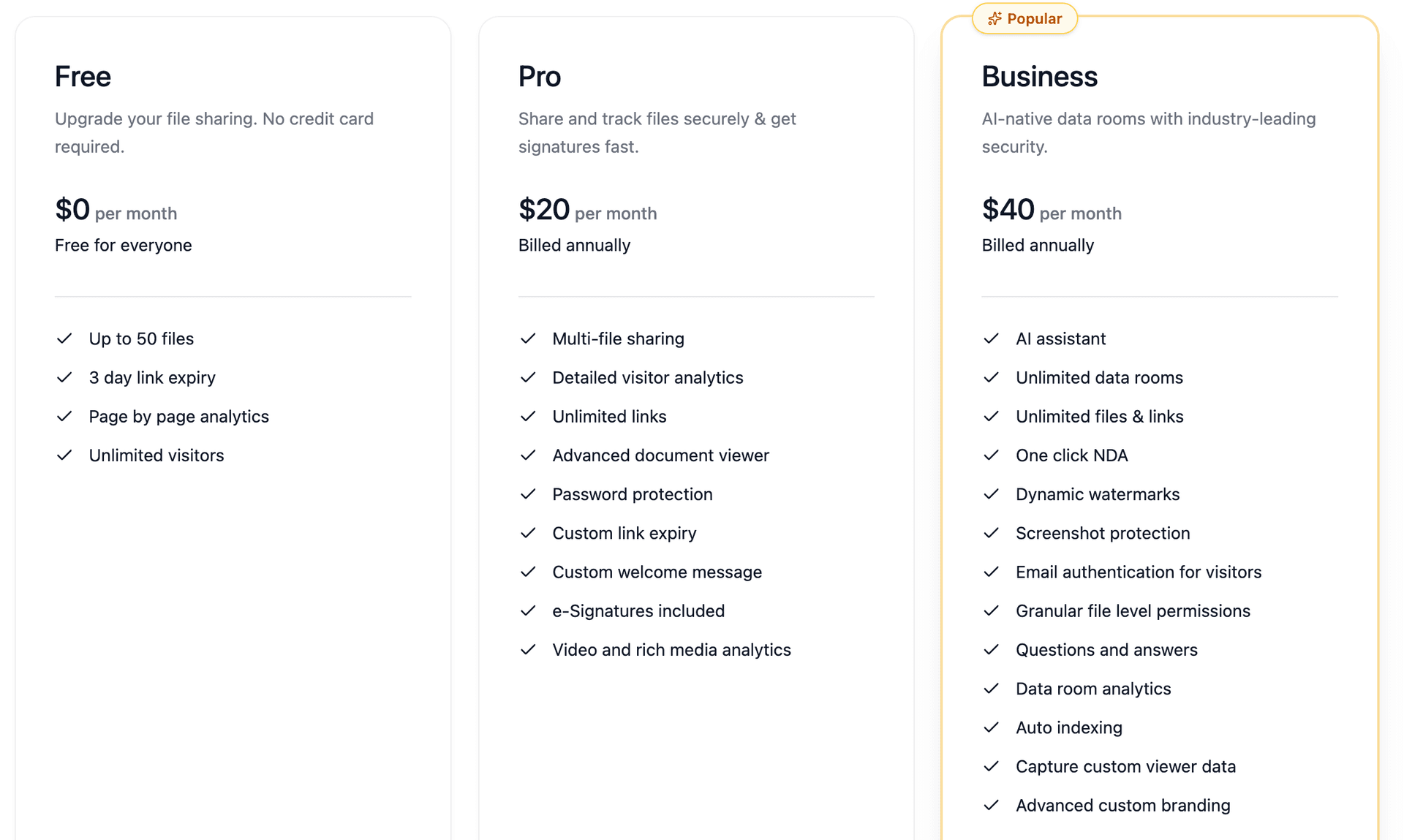
Pricing: Free ($0, 2 GB) / Pro ($20/admin/month, 200 GB) / Business ($40/admin/month, 1 TB). Viewers always free.
Best for: VC data rooms, startup fundraising, growth equity, PE due diligence, M&A transactions, real estate, legal practices, accounting firms, business brokers
| Feature | Peony | Ansarada |
|---|---|---|
| Starting price | Free ($0) | $89/month (250 MB, annual) |
| Storage model | Per-user (no overages) | Per-GB (data pack fees) |
| Page-level analytics | Yes (all plans) | No |
| Dynamic watermarks | Yes (Business) | Yes |
| Screenshot protection | Yes (Business) | No |
| E-signatures | Yes (Pro and up) | No |
| AI organization | Yes (under 5 min setup) | Yes (Smart Sort) |
| AI bidder scoring | No | Yes (97% accuracy) |
| NDA gating | Yes | No |
| Custom branding | Yes | Limited |
| Setup time | Under 5 minutes | 1-3 days |
| Platform independence | Independent | Owned by Datasite (Aug 2024) |
Bottom line: Peony delivers modern data room capabilities with page-level analytics, AI organization, and e-signatures — starting free. A 5-person team pays $100/month on Peony Pro vs $2,694+ for Ansarada's 4 GB tier over 6 months. No acquisition uncertainty.
2. Ideals — Best for Enterprise M&A
Ideals is the most natural step up from Ansarada for deal teams who want to stay in the purpose-built VDR space with an established track record. With 176,000+ completed transactions and a 4.5/5 on G2, Ideals has the market validation and review depth that gives procurement teams confidence.
I set up an Ideals room with my M&A document set. The structured Q&A workflow is comparable to Ansarada's — both handle bidder question routing, expert assignments, and deadline tracking effectively. Where Ideals pulls ahead: 14-language support for cross-border deals, dedicated project management for enterprise transactions, and a compliance stack (ISO 27001, SOC 2 Type II) that satisfies US regulatory requirements Ansarada's audit posture also meets.
The trade-off is cost. Ideals starts around $500/month — significantly more than Ansarada's $89/month entry but for a materially different level of service. For teams that need deep Q&A workflows and a proven enterprise track record, Ideals delivers. For teams that need modern analytics and a free entry point, Peony's page-level tracking provides deeper engagement data at a fraction of the price.
Pricing: Starting ~$500/month (custom quotes for enterprise)
Strengths: Enterprise audit trails, advanced Q&A workflows, dedicated project management, 14-language support, 4.5/5 on G2
Limitations: Expensive for small teams, no free tier, dated setup process, no page-level engagement analytics like Peony
Best for: Mid-market M&A, corporate restructuring, legal due diligence requiring multi-language support
3. Datasite — Ansarada's Parent Company
This is the elephant in the room. Datasite acquired Ansarada in August 2024, which means evaluating Datasite as an Ansarada alternative requires acknowledging that you would be moving from the subsidiary to the parent company.
I requested a Datasite demo and evaluated the platform against my document set. The AI classification automatically identified document types and suggested an index structure based on standard M&A taxonomy. The AI redaction engine flagged PII across hundreds of pages in minutes. Datasite holds ISO 42001 — the first VDR with AI governance certification. For a multi-billion-dollar cross-border transaction, this is the platform investment banks reach for.
The barrier is cost and accessibility. Datasite does not publish pricing — typical projects run $5,000-$68,000/year with per-page pricing around $0.60/page. The platform is designed for teams with dedicated deal staff. For teams that need modern AI features without enterprise pricing, Peony's AI-powered data rooms deliver auto-indexing, page-level analytics, and screenshot protection from a free tier.
Pricing: Custom (enterprise only, typically $5,000-$68,000/year)
Strengths: AI redaction engine, ISO 42001 for AI governance, 55,000+ deals annually, serves 65% of the Fortune 1000, global infrastructure
Limitations: No published pricing, no free tier, per-page pricing model, heavy onboarding, and now owns Ansarada — raising conflict-of-interest questions for teams comparing the two
Best for: Large-cap cross-border M&A, investment banking
4. Firmex — Best for Mid-Market Deals
Firmex processes over 20,000 data rooms per year, primarily for mid-market M&A, law firms, and restructuring advisors. Where Ansarada focuses on AI-powered deal readiness, Firmex focuses on straightforward deal execution with unlimited users on every plan.
I set up a Firmex room and the Q&A management stood out immediately. Both Ansarada and Firmex have Q&A modules, but Firmex's implementation — structured question routing, automated assignments to subject matter experts, deadline tracking, exportable Q&A logs — handles complex multi-party processes more effectively. For a sell-side advisor running a competitive auction with 8 bidders, Firmex's workflow is purpose-built.
The trade-off is feature innovation. Firmex has not added meaningful AI capabilities, and the analytics are basic compared to Peony's page-level tracking. The per-project pricing model adds up for teams running multiple concurrent deals — Peony's per-user pricing is more predictable.
Pricing: Custom (typically $400+/month per project)
Strengths: Unlimited users included, flat per-project pricing, strong compliance (SOC 2, ISO 27001), deep Q&A workflows
Limitations: No AI features, limited analytics depth, per-project costs add up for multi-deal teams
Best for: Mid-market M&A, private equity, legal transactions. For a detailed comparison, see our Firmex alternatives review.
5. Intralinks — Best for Cross-Border Transactions
Intralinks is an SS&C-owned platform handling $34.8 trillion in financial transactions annually. It serves capital markets, M&A, and banking clients globally — a different league from Ansarada's mid-market focus.
I evaluated Intralinks' capabilities and the global infrastructure is genuine: multi-region data centers, advanced compliance for financial institutions, integrated deal-sourcing tools, and regulatory expertise across jurisdictions. For a cross-border M&A transaction involving multiple regulatory environments, Intralinks has the compliance posture that Ansarada's ISO 27001-only certification cannot match.
The limitation is the same as Datasite: enterprise-only pricing, complex setup, and zero accessibility for small teams. If you are a startup or growth-stage company leaving Ansarada, Intralinks is not your next platform. Peony is.
Pricing: Custom (enterprise, typically $5,000+/year)
Strengths: Global infrastructure, financial institution compliance, deal-sourcing tools, $34.8 trillion transaction volume
Limitations: Enterprise-only pricing, complex setup, not accessible for small teams or startups
Best for: Cross-border M&A, capital markets, loan syndication
6. DealRoom — Best for M&A Integration
DealRoom combines VDR functionality with M&A project management — a unique positioning that Ansarada partially shares with its deal readiness tools but approaches differently. DealRoom integrates diligence workspaces with pipeline tracking and post-merger integration, making it genuinely useful for corporate development teams managing multiple acquisition targets simultaneously.
I tested DealRoom's pipeline management alongside Ansarada's deal readiness tools. Ansarada predicts bidder behavior; DealRoom tracks the entire acquisition lifecycle from sourcing through integration. They solve different problems. If your bottleneck is knowing which bidder will close, Ansarada's AI scoring helps. If your bottleneck is managing 15 concurrent acquisition targets, DealRoom's pipeline view is more practical.
For teams that need strong document analytics alongside deal management, Peony's page-level tracking provides deeper engagement data than either platform.
Pricing: Starting ~$500/month
Strengths: Pipeline management integrated into VDR, post-merger integration tracking, diligence request management
Limitations: Expensive entry point, focused exclusively on corporate development, limited use outside M&A context
Best for: M&A integration, corporate development teams managing multiple concurrent acquisitions
7. SecureDocs — Best Budget Flat-Fee VDR
SecureDocs offers the simplest pricing model of any platform on this list: $250/month flat fee with unlimited users. No per-page charges, no per-user scaling, no storage-tier confusion. For teams leaving Ansarada specifically because of storage-based pricing surprises, SecureDocs' flat-fee model is a direct antidote.
I set up a SecureDocs room and the simplicity is both the strength and the limitation. Setup was fast, the interface is clean, and unlimited users means no budget anxiety when you need to add new bidders. But the feature set is basic — no AI capabilities, limited analytics, no screenshot protection. For straightforward asset sales where you need a secure document room without complexity, SecureDocs delivers. For anything requiring engagement insights, Peony's analytics are in a different category.
Pricing: $250/month flat fee (unlimited users)
Strengths: Predictable flat pricing, unlimited users, simple VDR interface, no per-user surcharges
Limitations: Very basic feature set, no AI, limited analytics, no free tier, no screenshot protection
Best for: Simple asset sales, small acquisitions, straightforward transactions. See also our SecureDocs alternatives review.
8. CapLinked — Best for Fund Administration
CapLinked offers IRM/DRM document protection designed for external investor sharing and fund administration workflows. It is a niche platform that does one thing well: controlling what happens to documents after they leave your data room.
I tested CapLinked's DRM controls alongside Ansarada's standard permissions. CapLinked's information rights management restricts copying, printing, and forwarding at the document level — useful for LP reporting and investor communications where you need to control downstream distribution. Ansarada's permissions are more traditional (view/download/print access levels).
For teams that need both DRM-level protection and modern analytics, Peony combines screenshot protection with page-level engagement tracking at a fraction of CapLinked's price.
Pricing: $399/month
Strengths: IRM/DRM document protection, investor sharing workflows, fund reporting tools
Limitations: Expensive entry point, limited analytics depth, no free tier, no AI features
Best for: Fund administration, external investor sharing, LP communications
9. ShareFile — Best for Professional Services
ShareFile integrates with the Citrix ecosystem for client-facing secure file sharing. It is popular with accounting firms, legal practices, and financial advisors — a different market from Ansarada's M&A focus, but relevant for teams that need a secure client portal rather than a full VDR.
I tested ShareFile's client portal alongside Ansarada's data room. The Microsoft 365 integration is genuinely useful — ShareFile embeds into Outlook and Teams workflows, which Ansarada does not prioritize. The e-signature capability is built in, which Ansarada lacks. And at $10/user/month, the entry point is far more accessible than Ansarada's $89/month minimum.
The limitation is VDR depth. ShareFile is a file-sharing platform with security features, not a purpose-built data room. No Q&A workflows, no bidder management, basic analytics. For dedicated data room needs, Peony is purpose-built with richer features at a comparable or lower price.
Pricing: $10/user/month
Strengths: Citrix/Microsoft integration, client portals, built-in e-signatures, HIPAA compliant, affordable
Limitations: Limited VDR capabilities, basic analytics, not designed for M&A data rooms
Best for: Accounting firms, financial advisors, legal practices. See also our ShareFile alternatives review.
Ansarada Alternatives: Pricing Comparison
| Platform | Starting Price | Pricing Model | Free Tier | Key Differentiator |
|---|---|---|---|---|
| Ansarada (reference) | $89/mo (250 MB, annual) | Storage-based with data packs | No | AI bidder scoring, deal readiness |
| Peony | Free ($0) | Per-user (no overages) | Yes (permanent) | Page-level analytics, AI auto-indexing, e-signatures |
| Ideals | ~$500/mo | Per-project | No (30-day trial) | 176,000+ transactions, 14 languages |
| Datasite | Custom ($5K-$68K/yr) | Per-page (~$0.60/page) | No | AI redaction, ISO 42001, Ansarada parent |
| Firmex | Custom (~$400+/mo) | Per-project | No | Unlimited users, 20,000+ rooms/year |
| Intralinks | Custom ($5K+/yr) | Custom | No | $34.8T transaction volume, SS&C owned |
| DealRoom | ~$500/mo | Tiered | No | Pipeline management, post-merger tracking |
| SecureDocs | $250/mo flat | Flat fee | No | Unlimited users, simple flat pricing |
| CapLinked | $399/mo | Tiered | No | IRM/DRM document protection |
| ShareFile | $10/user/mo | Per-user | No (30-day trial) | Citrix ecosystem, HIPAA, client portals |
Real-world cost comparison for a 5-person M&A team running a 6-month deal:
| Platform | 6-Month Cost | Notes |
|---|---|---|
| Ansarada (4 GB+, annual) | $2,124 (before overages) | A single data pack overage can double this |
| Peony (Pro) | $600 | 5 admins x $20/mo x 6 months, no overages |
| Ideals | ~$3,000 | Custom quote, per-project |
| Datasite | $2,500-$34,000 | Enterprise custom pricing |
| Firmex | ~$2,400 | Per-project, unlimited users |
| SecureDocs | $1,500 | Flat fee, unlimited users |
| CapLinked | $2,394 | $399/mo x 6 months |
| ShareFile | $300 | 5 users x $10/mo x 6 months (basic tier) |
Ansarada Pricing Deep-Dive: What Teams Actually Pay
If you are evaluating Ansarada pricing, budget for the 2-3 GB tier or higher ($224-$354/month annual), not the headline $89/month (250 MB). Here is why:
The 250 MB ceiling hits immediately
250 MB is roughly 50-100 PDFs. In any real M&A transaction, due diligence process, or fundraising round:
- Financial models, legal agreements, and board minutes consume storage fast
- Scanned documents (title docs, permits, contracts) are 2-10 MB each
- Biotech and real estate deals with large PDF attachments can exceed 250 MB in the first upload batch
How data pack overages work
Ansarada's published "additional data pack fees" schedule bills overages monthly across the full contract term:
| Scenario | Base Cost | Data Pack Cost | Total |
|---|---|---|---|
| 250 MB, 6-month, +50 MB pack | $684 (6 x $114) | $684 (6 x $114) | $1,368 |
| 4 GB+, 6-month, +400 MB pack | $2,694 (6 x $449) | ~$2,694 | ~$5,388 |
A single data pack overage can double your total cost. Peony's per-user pricing eliminates this entirely — no storage tiers, no data packs, no overages.
Ansarada pricing tiers (March 2026)
| Storage Tier | Month-to-Month | 6-Month Term | 12-Month Term | Data Pack Increment |
|---|---|---|---|---|
| 250 MB | $159/mo | $114/mo | $89/mo | +50 MB |
| 1 GB | $249/mo | $179/mo | $139/mo | +100 MB |
| 2-3 GB | $399/mo | $299/mo | $224/mo | +200 MB |
| 4 GB+ | $609/mo | $449/mo | $354/mo | +400 MB |
Budget comparison: Ansarada vs Peony
| Scenario | Ansarada Cost | Peony Cost |
|---|---|---|
| Solo founder, annual | $1,068/year ($89/mo, 250 MB) | Free ($0) |
| 3-person team, 6 months | $1,794+ (2-3 GB, before overages) | $60/month (Pro) |
| 5-person team, 6 months | $2,694+ (4 GB+, before overages) | $100/month (Pro) |
| Enterprise, 12 months | $5,000-$10,000+ | $200/month (Business) |
How to Migrate from Ansarada to Peony
Step 1: Export from Ansarada. Use bulk download to export your complete document library with folder structure. Download Q&A logs and activity reports separately — these do not transfer to new platforms. Save audit trail exports before deactivating your room.
Step 2: Choose your timing. If you have active deals in Ansarada, do not cut over mid-transaction. Run a parallel setup on Peony. Note Ansarada's subscription renewal terms and data pack billing — switching mid-contract may still incur charges across the remaining term.
Step 3: Upload and organize. With Peony, AI auto-indexing categorizes uploaded documents in under 5 minutes — replacing hours of manual folder setup. Employment agreements group separately from vendor contracts, board resolutions separate from shareholder consents, compliance certificates file into their own section.
Step 4: Configure security. Enable dynamic watermarking, screenshot protection, NDA gating, and access controls. Set up custom branding with your logo, colors, and domain.
Step 5: Share new links. Distribute personalized access links to stakeholders. Verify permissions from an external test account before going live. Update any deal correspondence that references Ansarada room URLs.
Step 6: Confirm and deactivate. Run both platforms in parallel until all active parties have transitioned. Then deactivate your Ansarada room and stop the billing cycle.
Total migration time: 1-2 hours for most document libraries.
How to Think About Choosing an Ansarada Alternative
The right replacement depends on three variables: your deal size, your team structure, and which Ansarada limitation is actually costing you money or risk.
If your primary pain is storage-based pricing surprises and you run 3+ concurrent deals, switch to a per-user model. Ansarada's per-GB tiers compound across rooms — a 10-person team running 5 rooms on the 2-3 GB tier pays $1,120/month before overages. Peony's per-seat pricing ($40/admin/month on Business, $20 on Pro) covers unlimited rooms per seat, so your cost scales with team size, not deal volume.
If your primary pain is analytics depth and you need to know which specific pages a bidder studied (not just which files they opened), you need page-level tracking. Ansarada reports document-level opens and downloads. Peony's page-level analytics show time-per-page, scroll depth, and return visits — included on every plan. For a sell-side advisor running a $40M auction, knowing that Bidder A spent 22 minutes on revenue assumptions while Bidder B skipped straight to the cap table changes how you negotiate.
If your primary pain is security gaps — specifically screenshot leaks or untraceable document sharing — Ansarada does not block or log screen captures at any tier. Peony's Business plan ($40/admin/month) includes screenshot protection that blocks and logs every attempt, plus dynamic watermarks that embed the viewer's identity into every rendered frame. For deals where a single leaked page can collapse a process, this is non-negotiable.
If your primary pain is acquisition uncertainty and you need a platform whose roadmap is not controlled by a competitor, eliminate Ansarada and Datasite entirely. Peony is independently owned. Firmex, Ideals, and SecureDocs are also independent. Intralinks is SS&C-owned (financial services conglomerate, not a competing VDR company).
If your deal size is under $100M, enterprise platforms like Datasite ($5,000-$68,000/year) and Intralinks ($5,000+/year) are overbuilt and overpriced for your needs. Peony's Business plan at $40/admin/month gives you NDA gating, AI auto-indexing, screenshot protection, dynamic watermarks, and page-level analytics — everything a $30M-$100M deal requires without enterprise procurement cycles.
If your deal size is $500M+, consider Datasite or Intralinks for their global compliance infrastructure and investment bank familiarity. Peony is credible up to $500M but does not target the billion-dollar cross-border segment.
Quick Guide: Which Ansarada Alternative Fits Your Situation?
| Your Situation | Best Alternative | Why |
|---|---|---|
| Want AI-powered VDR with free tier and modern analytics | Peony | AI auto-indexing, page-level analytics, screenshot protection, e-signatures, free tier, independent platform |
| Enterprise M&A with established VDR track record | Ideals | 176,000+ transactions, 14 languages, SOC 2, structured Q&A |
| Moving to Ansarada's parent company (enterprise) | Datasite | AI redaction, ISO 42001, 55,000+ deals/year, Fortune 1000 |
| Mid-market deals needing unlimited users | Firmex | Per-project flat pricing, unlimited users, 20,000+ rooms/year |
| Cross-border M&A with capital markets compliance | Intralinks | $34.8T transaction volume, SS&C-owned, global compliance |
| Corporate development with pipeline management | DealRoom | M&A project tracking, post-merger integration, diligence requests |
| Simple flat-fee VDR for basic transactions | SecureDocs | $250/mo flat, unlimited users, no complexity |
| Fund administration with DRM protection | CapLinked | IRM/DRM controls, investor sharing workflows |
| Professional services client portals | ShareFile | $10/user/mo, Citrix integration, HIPAA, e-signatures |
My Bottom Line After Testing All 9
After setting up data rooms on nine different platforms, uploading identical M&A document sets, testing permissions, analytics, and security controls, here is what I concluded:
Ansarada earned its reputation honestly. The AI bidder engagement scoring is a genuine innovation — predicting which bidders are most likely to close based on document review patterns is intelligence that no other mid-market VDR offers at that level. The deal readiness tools help companies prepare for market. And supporting over $1 trillion in deal volume with continuous ISO 27001 certification demonstrates operational maturity.
Stay with Ansarada if: you are mid-deal with active bidders in the platform, you rely on AI bidder scoring for sell-side M&A auctions, and the Datasite acquisition does not concern you. Switching VDRs mid-transaction introduces risk that is not worth the feature upgrade. Finish your current deal and evaluate alternatives before your next one.
But the Datasite acquisition changes the long-term calculus:
- For most teams: Peony replaces Ansarada at a fraction of the cost with AI-powered organization, page-level analytics, screenshot protection, dynamic watermarks, built-in e-signatures, and NDA gating. The free tier lets you evaluate without commitment — something Ansarada does not offer. And Peony is independent, with no parent company running a competing product.
- For enterprise M&A: Ideals offers 176,000+ completed transactions, SOC 2, and 14-language support at a comparable price to Ansarada's mid-tier plans.
- For teams that want Ansarada's parent: Datasite is the enterprise standard — but expect $5,000-$68,000/year and per-page pricing.
- For compliance-heavy deals: Firmex's SOC 2 certification, structured Q&A at scale, and 20,000+ rooms/year make it the choice when regulatory requirements drive the decision.
- For cross-border transactions: Intralinks handles $34.8 trillion annually and offers the compliance posture that global financial institutions require.
The VDR market is growing at 22% CAGR toward $7.7 billion by 2030. Ansarada pioneered AI in deal management, but its future now depends on a parent company with every incentive to consolidate. Teams planning their next deal should evaluate alternatives before that consolidation happens — not after.
Ready to switch? Try Peony free and set up your first data room in under 5 minutes.
Frequently Asked Questions
I'm a sell-side advisor at a boutique IB running a 6-bidder auction — should I switch from Ansarada to something else mid-deal?
Do not switch mid-auction. Migrating your data room while six bidders have active access introduces unnecessary execution risk — broken links, permission gaps, and lost Q&A threads. Finish the current process on Ansarada, export your audit logs and Q&A reports, and evaluate alternatives before your next engagement. For a 4-person sell-side team running a $45M mandate with 6 active bidders, the intelligence gap matters on the next deal: Peony's page-level analytics show exactly which CIM pages each bidder studied and for how long — Ansarada only reports aggregate document-level opens and downloads, with no visibility into which specific pages or assumptions a bidder focused on. Peony's Business plan ($40/admin/month) adds screenshot protection and dynamic watermarks across all your auction rooms, so leaked pages trace back to the source bidder. Set up a parallel Peony room for your next mandate and compare the analytics depth yourself before committing.
Our PE fund just acquired a portfolio company and inherited their Ansarada subscription — what's the best replacement now that Datasite owns them?
You are paying for a platform whose roadmap is now controlled by a parent company with its own competing VDR product. The typical inherited Ansarada subscription runs $224-$354/month on annual billing for the 2-3 GB or 4 GB+ tier, and data pack overages can double that — Ansarada's own published example shows a 50 MB add-on costing $684 over 6 months. For PE portfolio management and ongoing diligence across multiple portcos, Peony's dynamic watermarks (Business, $40/admin/month) tag every page view to the specific reviewer's identity, so if a document leaks during an add-on acquisition or LP reporting cycle, you trace it instantly. Migrate between deals, not during them. A 5-admin team pays $100/month on Peony Pro versus $2,694+ for Ansarada's 4 GB tier over 6 months.
I'm a corporate dev lead at a mid-cap company and we're doing 3 tuck-in acquisitions ($20M-$40M each) this year — is Ansarada still viable post-acquisition by Datasite?
Ansarada is still functional, but the long-term viability question is legitimate. Datasite acquired Ansarada in August 2024 and already operates its own AI-powered VDR handling 55,000+ deals annually — there is significant feature overlap with Ansarada's bidder scoring and Smart Sort. For a corporate development team running 3 concurrent tuck-in acquisitions in the $20M-$40M range, the risk is platform consolidation mid-pipeline. Peony's NDA gating requires signed agreements before any bidder accesses your diligence documents, which matters when you are managing information barriers across three separate target companies simultaneously. At $40/admin/month on Business, you get NDA gates, AI auto-indexing, and screenshot protection across all three rooms — versus negotiating separate Ansarada storage tiers for each deal.
Our M&A law firm has used Ansarada for 5 years but the Datasite merger has us worried about pricing changes — what are realistic alternatives?
Your concern about pricing changes is well-founded. Ansarada's storage-based model already creates billing surprises — the 250 MB entry tier is roughly 50-100 PDFs, and any real transaction pushes you into data pack overages that are billed monthly across the full contract term. Post-acquisition, Datasite has every incentive to migrate Ansarada users onto its own enterprise pricing, which typically runs $5,000-$68,000/year. For a 12-attorney M&A practice managing 8 closings per year alongside 3 active litigation data rooms, Peony's Business plan ($40/admin/month) gives you NDA gating, dynamic watermarks, and screenshot protection across all 11 rooms — plus built-in e-signatures from Pro ($20/admin/month) that eliminate third-party signing tools on execution documents, something Ansarada does not offer natively. Peony's per-user pricing is also more predictable across matters than Ansarada's per-GB model, where each new room triggers a separate storage-tier commitment.
I run a $60M sell-side mandate and one of our bidders just screenshotted a confidential page from the CIM — does Ansarada even catch that?
No. Ansarada does not block or log screen captures. You would have no record that the capture happened and no way to trace which bidder took it. For a 3-person advisory team running a $60M sell-side mandate with 4 competing bid groups, a single leaked page can collapse the competitive process or tip off employees — and Ansarada gives you zero forensic trail. Peony's screenshot protection (Business, $40/admin/month) blocks capture attempts and logs every one with the reviewer's identity and timestamp. Combined with dynamic watermarks that embed the viewer's email into every rendered frame, even a phone photo of the screen traces back to the source. This is the difference between catching a leak and discovering it in the press.
We're an independent sponsor closing on a $35M platform acquisition and need a data room for equity co-investor due diligence — Ansarada's pricing seems steep for our deal size. What works better?
Ansarada's minimum is $89/month for 250 MB on annual billing, and a $35M platform deal's diligence package — CIM, financial model, quality of earnings, legal contracts, customer data — will push you past that tier quickly. A realistic Ansarada budget is $224-$354/month before data pack overages. For a 2-person independent sponsor team sourcing 4 equity co-investors on a $35M platform acquisition, every dollar of operating expense comes out of your own pocket before close. Peony's Business plan ($40/admin/month) gives you AI auto-indexing that organizes your uploaded diligence documents into categorized folders in under 5 minutes — financials grouped separately from legal contracts, customer agreements separated from employment docs — plus NDA gating so each co-investor signs before seeing a single page, and dynamic watermarks that trace any leaked document back to the specific reviewer. Ansarada charges $224-$354/month for comparable storage and offers neither NDA gates nor watermark-level leak tracing.
I'm running due diligence on a cross-border $50M acquisition and our Australia-based target insists on Ansarada — should I push back?
Ansarada's strength in ANZ and Southeast Asia is real — it became the dominant VDR in those markets before the Datasite acquisition, and many Australian advisory firms default to it. If the target's advisors are already set up on Ansarada and the deal is moving, the switching cost may not be worth the disruption. However, if you are still in early diligence, you have leverage to propose alternatives. For a 5-person corporate development team running a $50M cross-border acquisition with 3 regulatory jurisdictions, Peony's Business plan ($40/admin/month) gives you access revocation that instantly cuts off document access for any reviewer with a single click — critical when regulatory approvals shift timelines and you need to control who sees what at each stage. You also get NDA gating, dynamic watermarks, and screenshot protection across all jurisdictions, whereas Ansarada charges separate storage tiers per room and does not offer screenshot blocking at any price point. You do not need the $5,000-$68,000/year enterprise platforms like Datasite or Intralinks for a $50M deal.
Our investment bank has 12 active mandates and Ansarada's per-deal storage pricing is killing our margins — is there a platform that scales better?
At 12 concurrent mandates, Ansarada's storage-based pricing compounds fast. Even at the 2-3 GB tier ($224/month annual), you are looking at $2,688/month before overages — and a single 200 MB data pack add-on per deal multiplies across the full contract term. Peony's per-user pricing model eliminates this problem entirely. Your deal teams pay per admin seat, not per gigabyte, so scaling from 5 mandates to 12 does not trigger storage overages. On Business ($40/admin/month), a 10-person IB team running 12 rooms gets screenshot protection, dynamic watermarks, and NDA gating across every room — plus page-level analytics that show which CIM pages each bidder studied, not just open/download counts. On Pro ($20/admin/month), the same team pays $200/month total with 200 GB of storage, compared to $2,688/month on Ansarada before overages. Ansarada charges per-room storage tiers — Peony charges per seat regardless of how many rooms you run.
I'm a VP at a middle-market PE firm and we need our portco CFOs to upload quarterly financials into a shared data room — does Ansarada or Peony handle that better?
Ansarada is designed around deal-lifecycle workflows — auction management, bidder scoring, deal readiness — not ongoing portfolio monitoring. Using Ansarada as a standing document repository for quarterly uploads means paying storage-tier pricing month after month for a use case the platform was not built for. For a 3-fund PE shop with 14 portcos each submitting quarterly packages, Peony's Business plan ($40/admin/month) gives you Smart Q&A so portco CFOs submit questions and receive AI-drafted answers routed through your deal team — streamlining the back-and-forth that typically buries PE associates in email threads every quarter. Page-level analytics show which LPs or board members actually reviewed the quarterly financials and which ones ignored them, so your IR team can follow up with precision. Ansarada's analytics only report document-level opens, giving you no visibility into which sections of the quarterly report your LPs actually read.
We're a restructuring advisory practice and our clients' creditors need controlled document access during Chapter 11 proceedings — how does Peony compare to Ansarada for this?
In restructuring and Chapter 11 proceedings, you need ironclad access controls because creditor committees, DIP lenders, and potential acquirers all require different document visibility at different stages. Ansarada provides basic permission management and ISO 27001 certification, but its analytics are limited to view and download logs — you cannot see which specific plan provisions a creditor committee member actually studied. For a 6-partner restructuring practice managing 4 concurrent Chapter 11 proceedings with 20+ creditor committee members across all matters, Peony's Business plan ($40/admin/month) gives you NDA gating so every creditor signs a confidentiality agreement before accessing any document, dynamic watermarks that tag each page view to the specific reviewer, and screenshot protection that blocks and logs capture attempts — essential when sensitive financial data is being shared with parties who may have competing interests. Page-level analytics show exactly which pages each creditor reviewed, for how long, and in what order, giving your restructuring team real-time intelligence on which parties are engaging seriously with the plan documents. Ansarada offers none of these capabilities — no screenshot blocking, no watermark-level tracing, no page-level engagement data.
Related Resources
- My Honest Review of Virtual Vaults Alternatives
- My Honest Review of Firmex Alternatives
- My Honest Review of Ideals Alternatives
- My Honest Review of SecureDocs Alternatives
- My Honest Review of ShareFile Alternatives
- My Honest Review of PandaDoc Alternatives
- My Honest Review of OneHub Alternatives
- Top 10 Datasite Alternatives in 2026
- What Is a Virtual Data Room?
- Due Diligence Data Room Complete Guide
- Best Data Rooms for Startups
- Virtual Data Room Cost Guide
- I Tested 10 Virtual Data Room Providers
- Peony for M&A Due Diligence
- Peony for Private Equity
- Peony for Venture Capital
- Peony Pricing
You might also like
Mar 2, 2026
I Tried All Datasite Alternatives (Why Pay $50K+/Year?) in 2026
Apr 5, 2026
Legal Data Rooms: What Law Firms Get Wrong About Privilege Protection
Mar 22, 2026
I Tested 10 PE Data Rooms (What Deal Teams Actually Need)