
Top 15 Health Tech VCs That Actually Led Rounds in 2026

Co-founder at Peony. Former M&A at Nomura, early-stage VC at Backed VC, and growth-equity / secondaries investor at Target Global. I write about investors, fundraising, and deal advisors from the deal-side perspective I spent years in.
TL;DR: U.S. digital health startups raised $14.2 billion in 2025, up 35% year-over-year (Rock Health). CB Insights tracked $22.3 billion globally with 14 new AI-driven unicorns (HIT Consultant). AI-enabled companies captured 54% of total funding, commanding a 19% premium on average deal size. Below are the 15 investors actively deploying capital into health tech in 2026.
Last updated: April 2026
We run Peony, a virtual data room platform, and I see health tech fundraising from the inside. Every week, founders share clinical data, regulatory roadmaps, and pilot results through our data rooms with the investors on this list. That vantage point reveals something most "top investor" lists miss: who actually opens the documents, who moves fast after reviewing diligence materials, and who ghosts after the first meeting.
Health tech in 2026 is a tale of two markets. The top companies are raising massive rounds — Oura's $900 million Series E was the largest digital health round ever tracked — while the median startup is competing for fewer, more selective checks. The investors below are the ones I have seen consistently engage with founders, lead rounds, and add strategic value beyond capital. Some are payer-backed strategics with distribution advantages. Others are pure VCs with deep healthcare operating networks. I have organized them by type so you can match the right investor to your buyer, stage, and regulatory profile.
Quick reference table
| Investor | Type | Stage | Health Tech Focus | Activity (1-5) |
|---|---|---|---|---|
| Optum Ventures | Strategic (UHG) | Series A-C | Payer tech, analytics, care delivery | 5 |
| a16z Bio + Health | Pure VC | Seed-Series A | AI health, care delivery, infrastructure | 5 |
| General Catalyst | Pure VC | Seed-Growth | Health assurance, system transformation | 5 |
| CVS Health Ventures | Strategic (CVS) | Multi-stage | Consumer health, care delivery, tech | 4 |
| GV (Google Ventures) | Corporate VC | Seed-Growth | AI health, femtech, precision medicine | 5 |
| Kaiser Permanente Ventures | Strategic (KP) | Multi-stage | Provider innovation, care delivery | 4 |
| Blue Venture Fund | Strategic (BCBS) | Early-Growth | Payer platforms, value-based care | 4 |
| Flare Capital Partners | Pure VC | Seed-Series B | Health IT, payer/provider infrastructure | 4 |
| Define Ventures | Pure VC | Pre-seed-Series A | Consumer digital health, infrastructure | 4 |
| 7wireVentures | Pure VC | Seed-Series B | Connected health consumer | 4 |
| Echo Health Ventures | Strategic (BCBS alliance) | Early-Growth | System transformation, value-based care | 3 |
| Town Hall Ventures | Pure VC | Seed-Growth | Medicare/Medicaid, underserved populations | 4 |
| Rock Health Capital | Pure VC | Pre-seed-Series A | Seed-stage digital health | 3 |
| Health Velocity Capital | Pure VC | Early-Growth | Healthcare software, RCM, value-based | 4 |
| Transformation Capital | Pure VC | Series B-D | Growth-stage health IT, scaling | 4 |
How to pick the right health tech investor
Before diving into the list, map your buyer to your investor. This single decision determines whether your strategic investor accelerates distribution or creates conflicts.
- Selling to payers? Prioritize Optum Ventures, Blue Venture Fund, or Echo Health Ventures. These funds have parent-organization distribution that can shortcut 12-18 months of enterprise sales cycles.
- Selling to health systems? Kaiser Permanente Ventures, UPMC Enterprises, and Allumia Ventures (Providence) offer pilot pathways inside major systems. But provider-backed funds may limit competitive positioning with rival systems.
- Building AI infrastructure? a16z Bio + Health, General Catalyst, and GV are writing the largest checks for AI-enabled health tech and bring deep technical networks without payer/provider conflicts.
- Targeting consumers? Define Ventures and 7wireVentures specialize in consumer-driven digital health. GV leads in femtech specifically.
Organize your materials in a secure data room to demonstrate professionalism and make it easy for investors to review your pitch deck and regulatory documentation.
The 15 investors actively funding health tech
1. Optum Ventures
Website: optumventures.com
Type: Strategic VC (UnitedHealth Group)
Stage and check: Series A through growth; typically co-leads or leads with significant follow-on capacity
Focus: Software, data analytics, and tech-enabled care delivery with payer distribution leverage. Portfolio spans care delivery, clinical analytics, and healthcare infrastructure.
Optum Ventures is the venture arm of UnitedHealth Group's Optum division and one of the most active strategic health tech investors. In 2025, they made 3 new investments including Chamber Cardio and Indigo, with 3 more already completed in early 2026. Their portfolio includes 5 unicorns, with Ambience reaching unicorn status in 2025 after Optum first invested. The team of 35 includes 10 Partners and 12 Principals across the U.S. and UK.
What they look for: Products that scale across payer, employer, and provider channels with clear cost and outcomes impact. Distribution fit with UnitedHealth Group's ecosystem is a significant advantage.
Notable portfolio: Brightline, Garner Health, Calibrate, Galileo, Ambience, DispatchHealth.
How to approach: Lead with payer ROI data — Optum evaluates everything through the lens of their 150+ million covered lives. Show how your solution reduces total cost of care within 12 months. Organize regulatory documentation and pilot data in a data room for investors to accelerate their diligence process.
2. a16z Bio + Health
Website: a16z.com/bio-health
Type: Pure VC (Andreessen Horowitz)
Stage and check: Seed through Series A primarily; checks range from $1 million to $50 million
Focus: AI-driven healthcare, care delivery transformation, clinical infrastructure, and bio/pharma platforms.
a16z Bio + Health is the healthcare arm of one of the world's largest VC firms ($45 billion under management). Led by Julie Yoo, Vijay Pande, Vineeta Agarwala, and Jorge Conde, the team takes provocative positions on AI in healthcare. In January 2025, they launched a $500 million Biotech Ecosystem Venture Fund in partnership with Eli Lilly. Recent investments include Aradigm ($20 million Series A, December 2025), Truemed ($34 million Series A, December 2025), and Hippocratic AI.
What they look for: Companies taking non-consensus approaches to healthcare delivery, payment, or discovery. Strong technical teams building platforms, not point solutions. The Lilly partnership signals deep interest in companies bridging tech and pharma.
Notable portfolio: Hippocratic AI, Turquoise Health, Devoted Health, Aradigm, Truemed.
How to approach: a16z values thought leadership. Publish your thesis before you pitch. Julie Yoo has written extensively about what she looks for — read her pieces and reference specific frameworks. Their Health Builders program also sources early-stage deals. Use Peony's analytics to track which a16z partners engage with your materials.
3. General Catalyst
Website: generalcatalyst.com
Type: Pure VC (multi-stage)
Stage and check: Seed through growth; $1 million to $200+ million across stages
Focus: Health Assurance thesis — systemic transformation of how care is delivered, paid for, and experienced. Infrastructure, clinically embedded AI, and models that align with how care is actually delivered.
General Catalyst is redefining what a health tech investor looks like. Their $670 million Health Assurance Fund II and $8 billion in total new capital make them one of the most heavily resourced health tech investors globally. They completed 25 U.S. digital health deals in 2024 alone, making them the second most active investor in the sector. Their Health Assurance Ecosystem includes partnerships with 23 global healthcare systems.
What they look for: Interoperable infrastructure, clinically embedded AI, and companies with system-wide relevance. They favor models that reduce total cost of care across the continuum, not just single-point solutions.
Notable portfolio: Commure, HarmonyCares, Maven Clinic, Transcarent, Hippocratic AI.
How to approach: General Catalyst thinks in terms of health system transformation. Frame your pitch around how your solution fits into a health system's operating model, not just a department's workflow. Their health system partnerships mean they can facilitate pilot introductions. Share your materials through a secure data room with page-level analytics.
4. CVS Health Ventures
Website: cvshealthventures.com
Type: Strategic VC (CVS Health)
Stage and check: Multi-stage; partners closely to accelerate distribution and reimbursement pathways
Focus: Transforming care delivery, whole-person care, consumer-centric health, and disruptive tech enablement aligned with CVS Health's enterprise strategy.
CVS Health Ventures emerged as the leading core investor in U.S. digital health according to Galen Growth's 2025 rankings, ahead of Insight Partners, GV, and General Catalyst. Their strategic alignment with CVS Health — which operates 9,000+ retail locations, Aetna insurance, and Caremark PBM — creates unmatched distribution for portfolio companies across retail, payer, and PBM channels.
What they look for: Strategic alignment with CVS Health's enterprise capabilities and clear member impact. Products that can leverage retail pharmacy, Aetna's plan infrastructure, or Caremark's PBM network to reach patients faster.
Notable portfolio: Portfolio companies gain access to CVS's retail, payer, and PBM infrastructure for pilot and distribution.
How to approach: Map your product to a specific CVS channel — retail pharmacy, Aetna plan, or Caremark PBM. Show how your solution drives measurable outcomes for their members. Their diligence process is thorough, so prepare comprehensive clinical validation and regulatory documentation.
5. GV (Google Ventures)
Website: gv.com
Type: Corporate VC (Alphabet)
Stage and check: Seed through growth; part of $8+ billion under management
Focus: AI-driven healthcare, precision medicine, computational biology, femtech, and healthcare finance infrastructure.
GV has deployed $1.3 billion into healthcare and life science companies since 2020 and ranks among the top 5 most active digital health investors globally. They rank first in femtech and second in TechBio (behind Insight Partners). Their most recent health tech investment was a $27 million Series A in Translucent (AI for healthcare finance) in March 2026, just months after the company's seed round. They have also partnered with 20 AI healthcare companies including insitro and Isomorphic Labs.
What they look for: Technical depth and differentiated AI/ML capabilities. Companies leveraging computation to solve healthcare problems that traditional approaches cannot. GV brings Google's technical resources and network without operational conflicts.
Notable portfolio: Translucent, insitro, Isomorphic Labs, and 20+ AI healthcare companies.
How to approach: GV values technical founders with deep domain expertise. Lead with your technology moat — proprietary data, novel architecture, or validation results that demonstrate technical superiority. Use Peony's screenshot protection to share proprietary AI benchmarks securely.
6. Kaiser Permanente Ventures
Website: kpventures.com
Type: Strategic VC (Kaiser Permanente)
Stage and check: Multi-stage with strategic pilot pathways inside Kaiser's integrated system
Focus: Innovations that improve care delivery, operations, and patient outcomes across Kaiser's integrated payer-provider model.
Kaiser Permanente Ventures is one of the longest-tenured provider-backed health tech funds in the U.S. Their unique advantage is Kaiser's integrated model — they are both the payer and the provider, which means portfolio companies can pilot across the full care continuum within a single organization. This eliminates the typical friction of selling separately to plans and systems.
What they look for: Solutions with measurable value to health systems and patients across quality, access, and cost. Products that work within integrated care models have a natural advantage.
Notable portfolio: Companies operating across Kaiser's footprint with access to one of the largest integrated health systems in America.
How to approach: Kaiser evaluates through the lens of their integrated model. Show how your product improves outcomes across both the insurance and delivery sides. Pilot data from any integrated delivery network strengthens your case. Share your regulatory documentation through a secure data room with dynamic watermarks for confidential clinical data.
7. Blue Venture Fund (Sandbox Industries)
Website: blueventurefund.com
Type: Strategic VC (35+ Blue Cross Blue Shield plans)
Stage and check: Early through growth; leverages BCBS distribution to scale nationally
Focus: Payer-relevant platforms including care enablement, navigation, and value-based care infrastructure.
Blue Venture Fund, managed by Sandbox Industries, invests on behalf of 35+ Blue Cross Blue Shield plans. This gives portfolio companies potential distribution access to the largest health insurance network in the U.S. — over 115 million members across BCBS plans. Portfolio companies that perform well with one plan can rapidly expand across the Blue system.
What they look for: Payer ROI, scalable claims and clinical data integration, and solutions that improve member outcomes while reducing total cost of care.
Notable portfolio: HealthEdge, Lumeris, Somatus.
How to approach: Frame your pitch around claims-level ROI. Show how your solution integrates with existing payer infrastructure and can scale across multiple BCBS plans. The multi-plan distribution is the key value proposition — demonstrate that your product works across different plan configurations.
8. Flare Capital Partners
Website: flarecapital.com
Type: Pure VC (dedicated healthcare)
Stage and check: Series A through C; $5 million to $30 million initial investments
Focus: Healthcare IT, digital health infrastructure, and solutions that reduce cost, improve outcomes, and scale across the care continuum.
Flare Capital Partners is one of the largest dedicated healthcare technology VCs with a deep operating network across payers and providers. Their most recent investment was BridgeHealthAI (March 2026), a healthcare technology systems company, signaling continued conviction in AI-enabled infrastructure. They frequently lead at Seed through Series B and bring hands-on operational support.
What they look for: Platforms that reduce cost, improve outcomes, and scale across the care continuum. They value technical differentiation and clear paths to enterprise adoption.
Notable portfolio: Bright Health, HealthVerity, Aetion, BridgeHealthAI.
How to approach: Flare Capital values evidence-based approaches. Come with clear outcome data and a distribution strategy mapped to specific payer or provider segments. Their operating network can facilitate introductions. Track engagement with Peony's page-level analytics to identify which partners are reviewing your materials.
9. Define Ventures
Website: definevc.com
Type: Pure VC (dedicated digital health)
Stage and check: Pre-seed through Series A; $1 million to $20 million. Closed $460 million across two funds in 2023
Focus: Consumer-driven digital health, infrastructure, navigation, and fintech-adjacent health platforms.
Define Ventures is one of the largest funds focused exclusively on early-stage digital health. Their portfolio includes several category leaders, and the $460 million fund close gives them significant capital to lead early rounds and provide follow-on support. They specialize in hands-on company building and go-to-market support.
What they look for: Products that empower consumers, build essential infrastructure, or create new care navigation pathways. They have strong conviction in the intersection of healthcare and fintech.
Notable portfolio: Hims and Hers, Unite Us, Cohere Health, FOLX Health.
How to approach: Define Ventures invests early and gets deeply involved in company building. Come with a clear consumer insight or infrastructure thesis. Show early traction data and a realistic path to unit economics. They value founders who can articulate both the clinical and business case.
10. 7wireVentures
Website: 7wireventures.com
Type: Pure VC (dedicated digital health)
Stage and check: Seed through Series B; $2 million to $15 million initial investments; 42 portfolio companies
Focus: "Informed, Connected Health Consumer" thesis — products that empower consumers to be better stewards of their health.
7wireVentures has deep roots in consumer health tech — they were early investors in Livongo (now part of Teladoc) and continue to back companies that put the consumer at the center of care decisions. Their 2026 Predictions report highlights continued focus on consumer empowerment and digital health transformation. With 42 portfolio companies, they offer a strong peer network.
What they look for: Products that create measurable outcomes and value by empowering consumers. They evaluate through the lens of consumer engagement, behavior change, and health outcome improvement.
Notable portfolio: Transcarent (unicorn), HomeThrive, and consumer-first digital health platforms.
How to approach: Frame your pitch around consumer behavior change and measurable outcomes. Show engagement metrics, retention data, and evidence that your product drives real health improvements. Use a Peony data room to organize consumer analytics and engagement data for their review.
11. Echo Health Ventures
Website: echohealthventures.com
Type: Strategic VC (Cambia Health Solutions, Blue Cross NC, USAble, BCBS Tennessee)
Stage and check: Early through growth; accelerates national scaling through plan partner relationships
Focus: System-level health transformation with measurable outcomes and cost reduction. Invests through the Echo Innovation Alliance.
Echo Health Ventures brings together multiple Blue plan partners into a single investment platform, offering portfolio companies access to diverse regional payer networks. With 52 portfolio companies, 4 unicorns, 2 IPOs, and 23 acquisitions, they have a strong track record. Over 75% of their portfolio companies have executed commercial agreements with Alliance members, with 125+ agreements since 2017.
What they look for: System-level transformation with measurable outcomes and cost reduction. Products that can demonstrate value across multiple regional payer environments.
Notable portfolio: Aledade, Cityblock Health, Phreesia (IPO), Amwell (IPO).
How to approach: Show how your product works across different regional plan environments. Echo's Alliance structure means a single investment can open doors to multiple Blue plans simultaneously. Demonstrate interoperability and adaptability across different payer configurations.
12. Town Hall Ventures
Website: townhallventures.com
Type: Pure VC (mission-driven)
Stage and check: Seed through growth; $3 million to $30 million initial checks
Focus: Medicare, Medicaid, and underserved populations. Value-based care enablement and primary care innovation.
Town Hall Ventures, led by former HHS Acting Administrator Andy Slavitt and Meera Mani, focuses specifically on tech-enabled healthcare innovation for underserved populations. Their thesis targets the largest and fastest-growing segments of U.S. healthcare — Medicare and Medicaid — where policy tailwinds drive adoption of value-based models.
What they look for: Impact combined with unit economics in lower-income and complex populations. Payer and provider partnerships that demonstrate scalable distribution. Regulatory expertise in government programs.
Notable portfolio: Companies serving Medicare, Medicaid, and dual-eligible populations with value-based models.
How to approach: Lead with your impact thesis and back it with financial sustainability data. Town Hall evaluates both mission alignment and commercial viability. Show how your model works within government program constraints and reimbursement structures. Organize your impact metrics and financial projections in a startup data room.
13. Rock Health Capital
Website: rockhealthcapital.com
Type: Pure VC (seed-first digital health)
Stage and check: Pre-seed through Series A; low-single-digit-million initial checks, frequently leading early rounds
Focus: U.S.-focused digital health across all subsectors. Part of the broader Rock Health platform that includes research and community.
Rock Health Capital operates within the Rock Health ecosystem, which publishes the most widely cited digital health funding data in the industry. Their annual and quarterly market reports (showing $14.2 billion in 2025 funding) are required reading for any health tech founder. This research arm creates a unique deal-sourcing advantage — they see market trends before most investors and back founders aligned with emerging categories.
What they look for: Evidence-based paths to scale. Founders who can leverage Rock Health's published market data to strengthen their fundraising narrative. Early-stage companies with clear unit economics and realistic regulatory strategies.
Notable portfolio: Early-stage digital health companies across care delivery, infrastructure, and consumer health.
How to approach: Reference Rock Health's market data in your pitch — it shows you have done your homework and understand the ecosystem they track daily. Rock Health values data-driven founders. Prepare a clean data room with cohort analysis and early outcome data.
14. Health Velocity Capital
Website: healthvelocitycapital.com
Type: Pure VC (dedicated healthcare)
Stage and check: Early growth through later stages; invested in 47 companies total
Focus: Healthcare software and services exclusively. Labor enablement, revenue cycle management, value-based infrastructure. Based in Nashville and San Francisco.
Health Velocity Capital invests exclusively in healthcare technology, with a portfolio spanning software and services that improve access to quality care. They made 4 investments in 2025, with Third Way Health ($15 million Series A) being their most recent first-time investment in February 2026. Their Nashville presence gives them proximity to the largest concentration of healthcare companies in the U.S.
What they look for: Clear enterprise buyer, scalable distribution, and measurable cost or outcomes lift. They emphasize reach across organizations that insure approximately 175 million Americans.
Notable portfolio: Artera, Sureco, Greater Good Health, Third Way Health.
How to approach: Health Velocity values operational rigor and clear enterprise sales motions. Come with named customers, pipeline data, and a distribution strategy that maps to their network of payer and provider contacts. Their Nashville network is particularly valuable for health system relationships.
15. Transformation Capital
Website: transformcap.com
Type: Pure VC (growth-stage healthcare)
Stage and check: Series B through D; selective about repeatable go-to-market and capital efficiency
Focus: Growth-stage healthcare IT and services. Rigorous operator mindset with scaling expertise. Led by former Sequoia investor Mike Dixon.
Transformation Capital occupies a distinct niche: they invest in health tech companies that are past early product-market fit and need capital and operational support to scale. The 2025 exit rebound — 5 digital health IPOs and a 33% surge in M&A activity — plays directly to their wheelhouse, as their portfolio companies are positioned for these exit opportunities.
What they look for: Companies past early PMF with strong revenue quality, payer or provider proof points, and repeatable go-to-market motions. They are selective and prioritize capital efficiency.
Notable portfolio: DexCare ($50 million Series B) and growth-stage health IT platforms.
How to approach: Transformation Capital is for companies ready to scale, not experiment. Show trailing revenue, net retention, and a clear path to profitability or strategic exit. Their operator mindset means they want to see that you have already solved the hard product problems and need capital to scale distribution.
Five tips for pitching health tech investors
-
Lead with buyer math. Put one slide up front showing payer or system ROI within 12 months — avoided admissions, faster coding, margin lift, or reduced readmissions. Back it with pilot data or a signed LOI. Health tech investors in 2026 are rewarding earlier stages but want rigorous commercial signal, not just product-market-fit vibes.
-
Show your regulatory and data pathway. If you touch clinical decision support or diagnostics, spell out your 510(k), De Novo, or SaMD plan and your data access plus de-identification strategy. It saves weeks of diligence churn. AI health companies especially need to articulate their FDA approach clearly.
-
Design a distribution wedge that fits your investor. Payer-backed investors love TPA and PBM hooks, risk-share models, and claims-first proofs. Provider-backed groups favor workflow integration, throughput impact, and staffing solutions. Map this to the specific firms above.
-
Name two concrete customer paths. Something like "Plan A leads to employer carve-out" and "System B leads to service line pilot" beats a generic TAM slide every time. Tie each path to a partner in the investor's network.
-
Demonstrate HIPAA-grade security posture. Health tech investors evaluate your security infrastructure as part of diligence. Use Peony to organize your startup data room with NDA gates, screenshot protection, and dynamic watermarks that protect PHI and PII throughout the fundraising process.
How Peony helps health tech startups raise capital
Peony provides secure data rooms purpose-built for health tech fundraising. Here is what matters for health tech founders specifically:
- AI redaction for PHI/PII: Before sharing clinical data with investors, Peony's AI identifies protected health information, financial data, and sensitive terms, then suggests redactions. This is critical for health tech startups sharing pilot data that contains patient information.
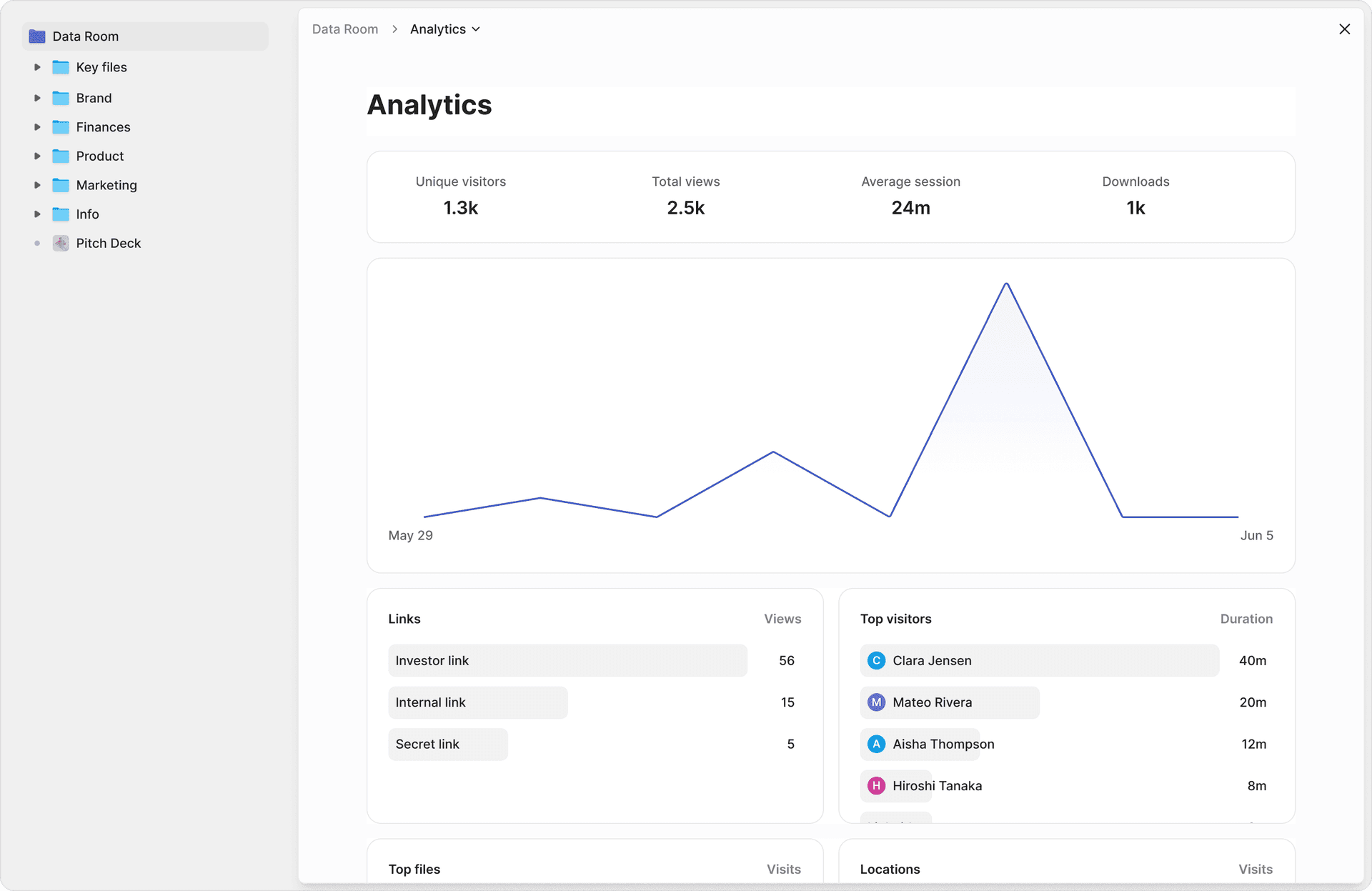
- Page-level analytics: See exactly which sections of your regulatory roadmap, clinical validation studies, and financial projections each investor spent time reviewing. Time your follow-ups based on engagement data.
- Multi-level access gating: NDA gates, password protection, email verification, and 2FA let you share different materials with strategic investors, financial VCs, and clinical advisors simultaneously without cross-contamination.
- AI auto-indexing: Upload your regulatory filings, pilot reports, and clinical data — Peony categorizes everything automatically in under 3 minutes.
- Screenshot protection: Block and log screenshot attempts on confidential clinical data and proprietary AI benchmarks. Dynamic watermarks with viewer identity ensure accountability.
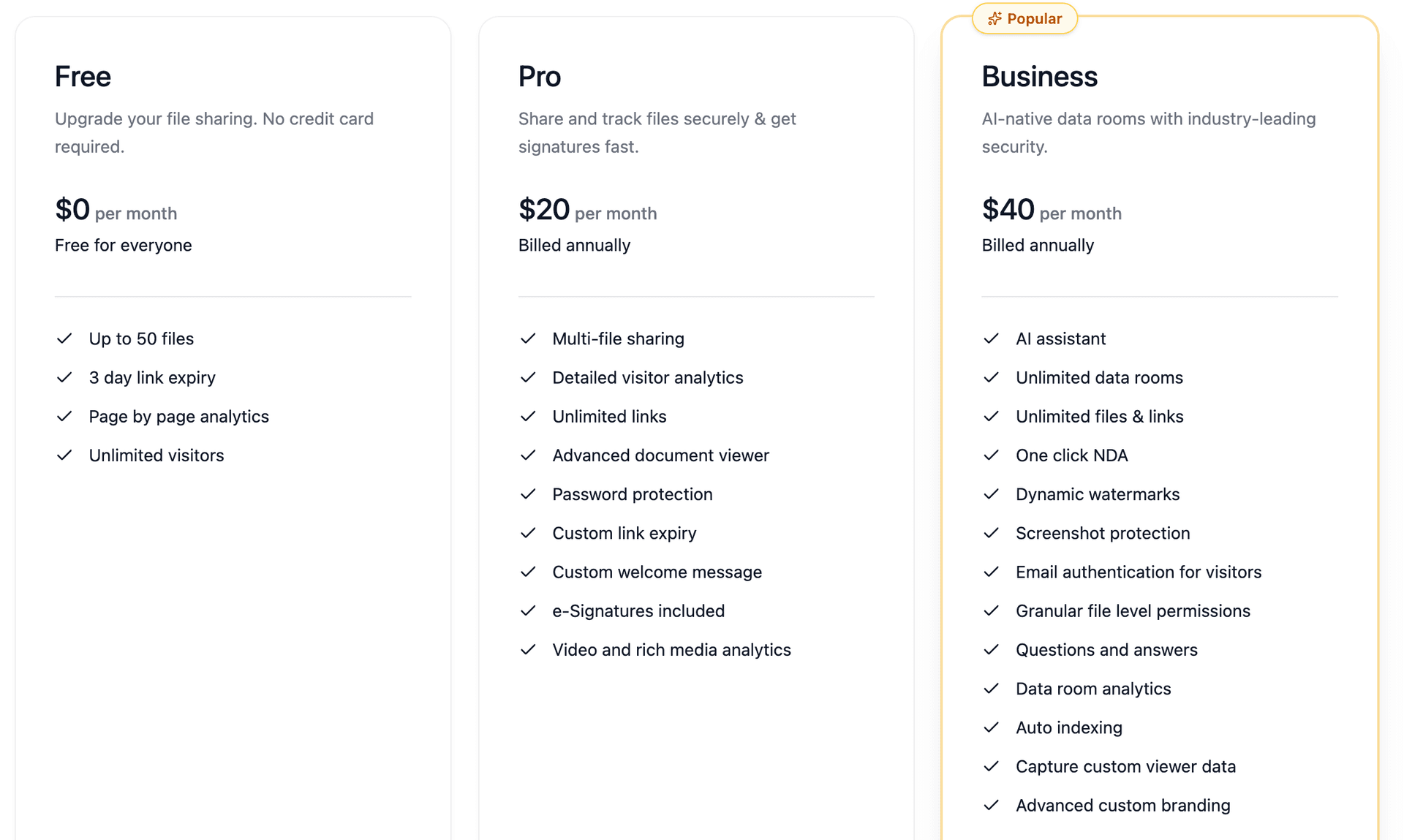
- Set up in under 5 minutes. Peony's Pro plan starts at $20 per admin per month, and the Business plan at $40 per admin per month includes advanced features like AI redaction and e-signatures. No per-page fees. No setup costs.

Frequently asked questions
How much venture capital went into digital health in 2025?
U.S. digital health startups raised 14.2 billion dollars in 2025, a 35% increase over 2024's 10.5 billion dollars and the highest total since 2022 according to Rock Health. CB Insights tracked an even broader 22.3 billion dollars globally. The market produced 26 mega deals and 15 new unicorns, nearly triple the previous year. Peony helps health tech founders track which investors actually engage with their materials through page-level analytics that show time spent on each document.
What do health tech investors look for in a startup pitch?
Health tech investors want payer or provider ROI demonstrated within 12 months, a clear FDA or regulatory pathway if you touch clinical decision support, and at least one pilot with a named system or plan. Strategic investors like Optum Ventures and CVS Health Ventures also evaluate distribution fit with their parent organization. Set up a Peony data room in under 5 minutes with NDA gates and email verification to demonstrate enterprise-grade security posture before your first investor meeting.
Should I raise from a strategic health tech investor or a pure VC?
Strategic investors like Optum Ventures, CVS Health Ventures, and Kaiser Permanente Ventures offer payer or provider distribution that pure VCs cannot match, but they may limit future acquirer optionality. Pure VCs like a16z Bio and Health, General Catalyst, and Define Ventures offer more flexibility and larger follow-on capacity. Many founders take both: a strategic co-investor for distribution and a financial lead for governance. Peony's multi-level access gating with NDA gates, password protection, and 2FA lets you share different materials with strategic and financial investors simultaneously.
What is the typical check size for health tech venture capital?
Check sizes vary widely by stage and investor type. Seed and Series A checks from dedicated health tech funds like Rock Health Capital, Define Ventures, and Flare Capital typically range from 1 million to 10 million dollars. Growth checks from firms like General Catalyst and Transformation Capital can exceed 50 million dollars. The average digital health deal size reached 29.3 million dollars in 2025, up from 20.7 million in 2024. Peony's Pro plan at 20 dollars per admin per month gives early-stage health tech founders the same data room capabilities that growth-stage companies get from legacy providers.
How should I organize my data room for health tech investors?
Health tech investors expect a data room with your pitch deck, financial model, cap table, regulatory roadmap including FDA pathway if applicable, pilot data with payer or provider ROI metrics, HIPAA compliance documentation, and clinical validation studies. Organize these into clearly labeled folders. Peony's AI auto-indexing categorizes health tech documents automatically in under 3 minutes, and AI redaction identifies PHI and PII before you share sensitive clinical data with investors.
Which health tech subsectors are attracting the most funding?
AI-enabled health tech companies captured 54% of total digital health funding in 2025, commanding a 19% premium on average deal size. Clinical and non-clinical workflow automation jointly captured 39% of total funding. The largest rounds went to AI clinical documentation companies like Abridge and Ambience, AI drug discovery platforms, and value-based care infrastructure. Peony's AI document extraction lets health tech founders pull specific data points from clinical studies and regulatory filings when preparing investor materials.
How do I pitch health tech investors if I am a first-time founder?
First-time health tech founders should lead with buyer math showing payer or provider ROI within 12 months, name at least two concrete customer paths tied to the investor's network, and demonstrate regulatory literacy even if you are pre-FDA. Strategic investors value domain expertise over startup experience, so highlight clinical advisory boards and pilot partnerships. Peony's screenshot protection and dynamic watermarks with viewer identity help first-time founders share confidential clinical data and IP with investors while maintaining full control over document access.
What happened to health tech IPOs and exits in 2025?
Five digital health companies broke a three-year public exit drought in 2025: Hinge Health, Omada Health, HeartFlow, Carlsmed, and Profusa. M&A activity surged 33% with 210 deals in 2025, up from 158 in 2024, ending a three-year decline. The exit window reopening is encouraging investors to deploy more aggressively into growth-stage health tech. Peony's built-in e-signatures with AI-powered field detection streamline the closing process for health tech acquisitions, eliminating the need for separate signing tools.
Related resources
You might also like
May 27, 2026
10 Fundraising Data Room Mistakes Sophisticated Bidders See in 2026
May 20, 2026
Q1 2026 Startup Fundraising Benchmarks: $3M Median Seed, $20M Series A, 23% Dilution — and Why the 18-Month Rule Just Died
May 15, 2026
Top 12 Chip Investors in 2026: Cerebras $5.55B IPO and +68% Day-1 Open the Cycle