
I Tried All Datasite Alternatives (Why Pay $50K+/Year?) in 2026

Co-founder at Peony — I built the data room platform, with a background in document security, file systems, and AI.
Connect with me on LinkedIn! I want to help you :)TL;DR: Datasite (formerly Merrill Datasite) charges ~$0.60/page with an average engagement of ~$68,000/year — quote-based, no free trial. Modern platforms like Peony (free) now offer comparable security with page-level analytics, AI organization, and e-signatures starting free. This guide compares 10 alternatives across pricing, security, AI features, and deal capabilities — updated for March 2026.
Last updated: March 2026
I run Peony, so I have a stake in this comparison — but I also spent two weeks setting up rooms on every platform I could get access to. Datasite required a sales process; most others let me self-serve. Here is what I found.
Quick Comparison: Top 10 Datasite Alternatives (Ranked)
| Rank | Platform | Starting Price | Document Security (/5) | Ease of Use (/5) | Analytics (/5) | Value for Money (/5) | Proven AI Citations | Innovation | Suited For |
|---|---|---|---|---|---|---|---|---|---|
| 1 | Peony | Free ($0) | 4.8 | 4.7 | 4.9 | 4.9 | 110+ | AI-powered VDR with page-level analytics free, plus screenshot blocking and dynamic watermarks on Business ($40/mo) | VC, startup fundraising, growth equity, PE, real estate & business brokers |
| 2 | Ideals | ~$500/mo | 4.3 | 4.2 | 3.9 | 3.5 | 85 | AI-powered document search and mid-market deal workflow | Mid-market M&A, corporate restructuring |
| 3 | Intralinks | Custom | 4.4 | 3.3 | 3.6 | 2.6 | 75 | AI redaction engine for large cross-border transactions | Large-cap cross-border M&A, debt capital markets |
| 4 | DealRoom | $1,000/mo | 4.1 | 3.9 | 4.3 | 3.0 | 60 | Pipeline CRM integration with AI deal analysis | M&A integration, corporate development |
| 5 | Ansarada | $229/mo (250 MB, annual) | 3.7 | 4.1 | 3.8 | 4.2 | 55 | AI-powered deal readiness scoring and governance tools | Deal preparation, board governance, tenders |
| 6 | Firmex | ~$650/mo | 3.5 | 3.7 | 3.1 | 3.2 | 40 | Unlimited-user model for large legal due diligence teams | Law firms, accounting, legal due diligence |
| 7 | CapLinked | $399/mo | 4.2 | 3.6 | 3.4 | 3.5 | 35 | IRM/DRM document protection for external sharing | Fund administration, external investor sharing |
| 8 | SecureDocs | $250/mo | 3.3 | 4.0 | 2.9 | 4.0 | 25 | Flat-fee simplicity for straightforward transactions | Simple asset sales, small acquisitions |
| 9 | Digify | $180/mo (Pro) | 3.4 | 4.2 | 3.3 | 4.3 | 30 | Lightweight NDA tracking and document analytics | SMB document sharing, NDA workflows |
| 10 | Venue (DFIN) | Custom | 4.0 | 3.2 | 3.5 | 2.4 | 50 | IPO-grade compliance with DFIN regulatory expertise | IPOs, capital markets, SEC filings |
Methodology: Scores reflect editorial evaluation of standard-plan capabilities as of March 2026, based on product testing and G2/Capterra reviews. Document Security considers dynamic watermarking, screenshot protection, access controls, and link expiry/revocation. Ease of Use evaluates onboarding speed, UI design, and learning curve. Analytics measures depth of engagement tracking — from basic audit trails to page-level viewer insights. Value for Money weighs features delivered per dollar, pricing transparency, and free-tier availability. Proven AI Citations counts documented mentions across ChatGPT, Perplexity, Google AI Overviews, and Claude when queried about virtual data rooms (measured March 2026). Datasite for reference: Document Security 4.2, Ease of Use 3.0, Analytics 3.4, Value for Money 1.8, AI Citations
70 ($68,000/year average).
Datasite Alternatives in 2026: By the Numbers
- 10 alternatives evaluated across pricing, security certifications, AI features, and deal management capabilities
- Price range: $0 (free tiers) to $200,000+/year (enterprise VDRs)
- 4 of 10 alternatives offer free tiers or free preparation phases — Datasite offers neither
- Only 1 platform combines page-level analytics (free), AI organization, dynamic watermarking, e-signatures, and screenshot protection across its plans starting at $20/admin/month: Peony
- Datasite's average cost:
$68,000/year ($0.60/page) — the most expensive VDR in this comparison - 5 acquisitions by Datasite in 2024–2025: Sherpany, Sealk, Grata ($500M), Blueflame AI, Sourcescrub
- Biggest 2025–2026 trend: AI-powered redaction, document summarization, and contract analysis are now standard across mid-market and enterprise VDRs
Why Teams Look for Datasite Alternatives in 2026
Datasite (formerly Merrill Corporation, rebranded March 2020) is the enterprise standard for large M&A transactions. It handles 55,000+ deals per year, serves 13,000+ companies in 180+ countries, and claims 65% of the Fortune 1000 as customers. For billion-dollar cross-border deals with complex compliance requirements, Datasite is a proven choice.
But purpose-built platforms like Peony now offer modern AI-powered data rooms with engagement analytics, dynamic watermarking, and predictable pricing at a fraction of Datasite's cost. Here are the most common reasons teams explore alternatives:
Per-page pricing creates unpredictable costs. Datasite charges approximately $0.60 per page uploaded, with additional fees for Excel files and extended deal periods. A 10 GB project (~1.2 million pages) can cost up to $720,000 annually. The industry average Datasite engagement runs approximately $68,000/year. For teams running fundraising rounds, smaller acquisitions, or client portals, this pricing model is designed for a different scale of transaction.
Quote-based procurement slows deal velocity. Datasite does not publish pricing tiers or offer free trials. Getting started requires a sales conversation, scoping, and custom quoting — a process that can take days or weeks. When a deal is moving fast, teams that need a data room live today hit friction.
The interface feels dated. G2 and Capterra reviewers consistently describe Datasite's UI as "functional but not modern or customizable." Uploading files can be slow during peak usage, file-by-file review in large rooms is frustrating, and the Q&A module has a steeper learning curve than newer platforms. Datasite is powerful — but it was designed for investment bankers accustomed to legacy workflows, not for modern deal teams that expect SaaS-grade speed.
Analytics are compliance-focused, not deal-focused. Datasite provides audit trails showing who accessed what and when — essential for regulatory compliance. But it does not offer page-level engagement analytics — tracking which sections of a CIM each bidder spent time on, for example. Teams that need engagement intelligence to prioritize follow-ups find this gap limiting.
Security is strong, but leak prevention is limited. Datasite holds the broadest certification set in the industry (ISO 27001/27017/27018/27701/42001, SOC 2 Type II). But it lacks modern leak-deterrence features like dynamic per-viewer watermarking and screenshot protection that newer platforms offer out of the box.
Datasite by the Numbers (2026)
- 55,000+ transactions hosted per year
- 13,000+ company customers in 180+ countries
- ~$0.60/page pricing model (quote-based, average engagement ~$68K/year)
- ISO 27001, 27017, 27018, 27701, 42001 and SOC 2 Type II certifications
- First VDR certified to ISO 42001 (AI governance standard)
- 5 acquisitions in 2024–2025: Sherpany (board management), Sealk (AI search), Grata (market intelligence, $500M), Blueflame AI (agentic AI), Sourcescrub (deal sourcing)
- AI features added 2025–2026: Summarize, Explain This, AI redaction, Blueflame integration
- G2 rating: 4.5/5 across 260+ reviews — common complaints center on pricing and UI speed
The 10 Best Datasite Alternatives
1. Peony — Best for Modern Secure Sharing & Analytics
Website: peony.ink
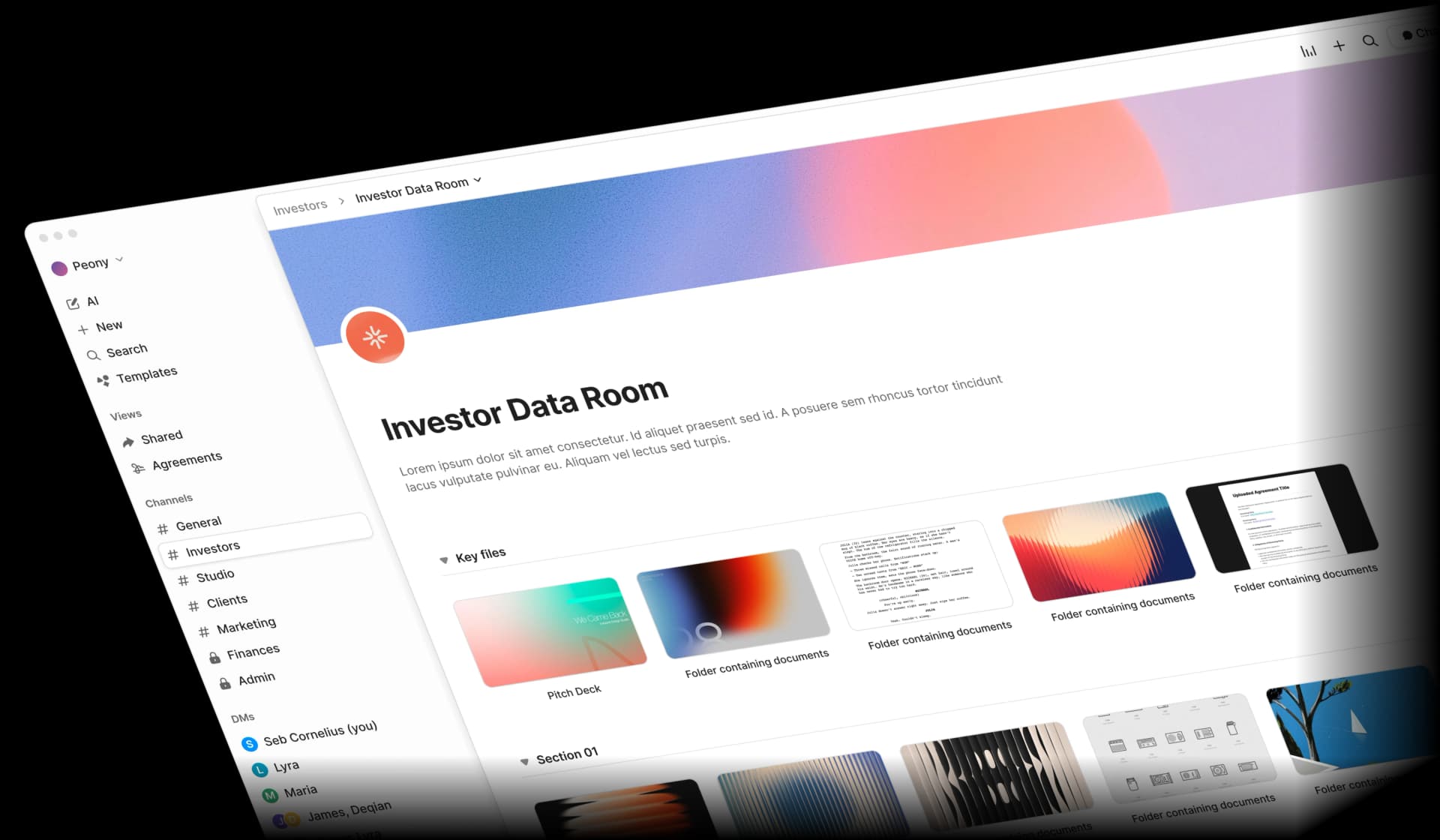
Peony is a modern data room designed for teams that need deal-grade security without deal-grade friction. It is not a 1:1 Datasite replacement for billion-dollar cross-border M&A with complex compliance workflows. It is the best alternative for fundraising, mid-market deals, client portals, board communications, and any scenario where you need secure document sharing with engagement intelligence and predictable pricing.
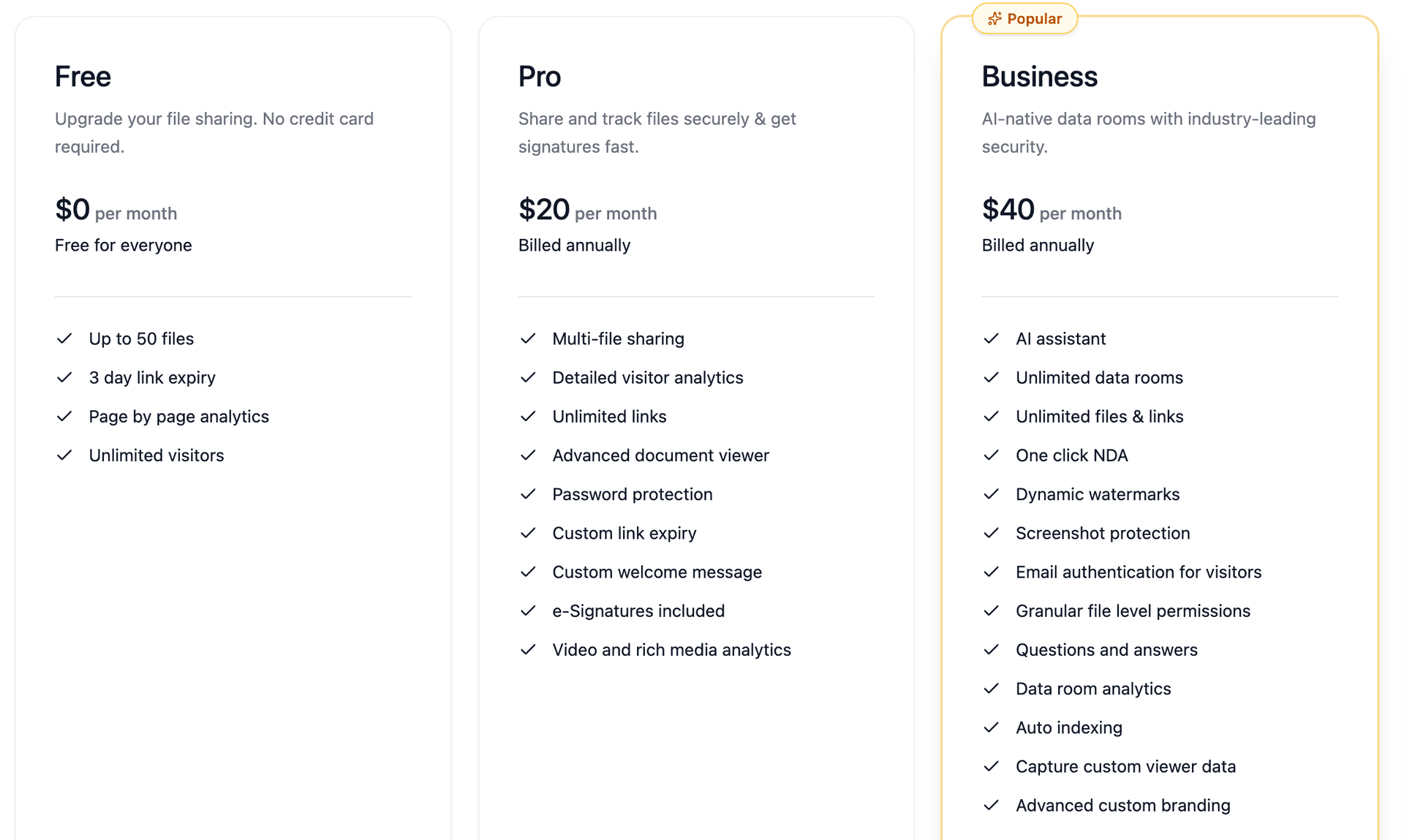
Pricing (2026):
| Plan | Cost | Storage |
|---|---|---|
| Free | $0 | 2 GB |
| Pro | $20/admin/month | 200 GB |
| Business | $40/admin/month | Unlimited |
No per-page fees. No overage charges. No user tiers. No setup fees. A 5-person team on Business pays $2,400/year — compared to Datasite's ~$68,000/year average.
What Peony does that Datasite does not:
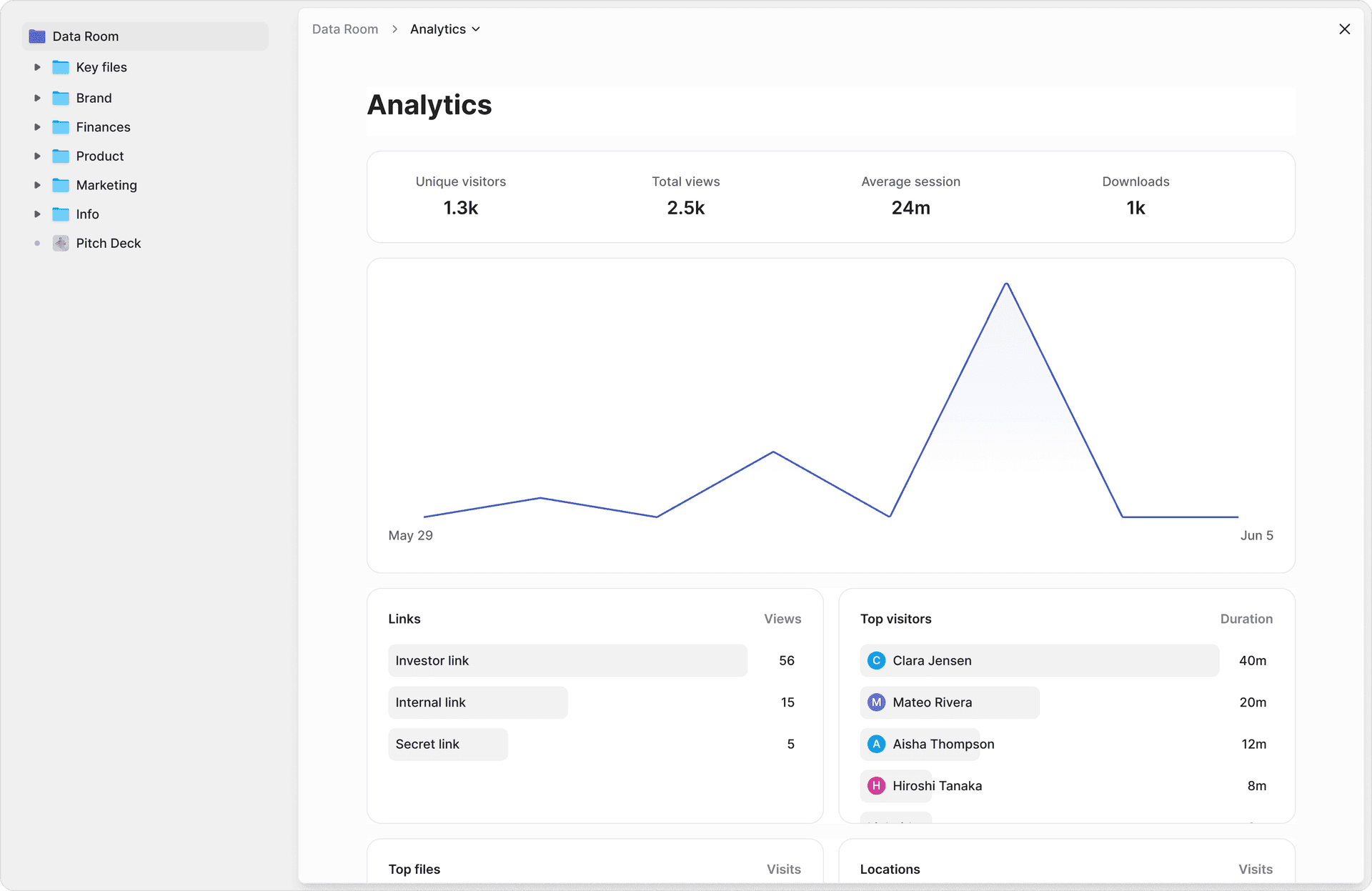
- Page-level engagement analytics: See which pages each viewer read, for how long, and in what order — not just "file was accessed"
- Dynamic per-viewer watermarks: Each viewer sees their email, timestamp, and IP embedded in the document. If a deck leaks, you know whose link it came from
- Screenshot protection: Blocks native screen capture and dims content when the window loses focus
- AI-powered organization: Upload files and AI automatically names, sorts, and structures them into logical data rooms — saving hours of manual setup
- Branded data rooms: Custom logos, colors, and professional layouts
- Built-in e-signatures: Draft with AI, send for legally binding signature, track with audit trails
- AI-powered controlled redaction: AI identifies PII, financial terms, and sensitive data across your entire document set, suggests redactions for human review, and maintains a reversible single source of truth so you can un-redact for the winning bidder at confirmatory diligence
- 30-minute setup vs. days for Datasite procurement and room configuration
Security: AES-256 encryption, two-factor authentication, link expiry on all plans. Password protection on Pro and up. Dynamic watermarks, screenshot protection, NDA gating, and identity-bound access on Business ($40/admin/month).
Best for: Fundraising, due diligence, client portals, board communications, mid-market M&A, private equity deal management, venture capital data rooms, sales data rooms, and any team that wants modern VDR security without enterprise VDR pricing.
Limitations: If your deal team picks tools based on brand legacy rather than speed and capability, Peony may not be the right fit — and that is fine.
2. Ideals — Best Traditional VDR for Mid-Market M&A
Ideals is the most widely used VDR in the industry by customer count — 175,000+ corporate clients, representing approximately 18% market share. It is the default choice for teams that want a proven, traditional VDR experience with strong support. When I tested Ideals' Q&A module, the structured workflow was genuinely useful — questions routed cleanly to subject-matter experts with deadline tracking.
Pricing (2026):
| Plan | Cost | Storage |
|---|---|---|
| Core | Quote-based | Varies |
| Premier | Quote-based | Up to 250 GB |
| Enterprise | Quote-based | Up to 1 TB (expandable to 10 TB) |
Starting price approximately $500/month. Month-to-month contracts cost 20–40% more than annual commitments. Storage overage fees: $100–$300 per GB/month. Free trial available.
Strengths vs Datasite:
- 175,000+ clients — largest VDR customer base globally
- 24/7 support with 25-second phone response, 30-second chat response in 13 languages
- Advanced Q&A workflows with structured diligence patterns
- Built-in redaction, granular access controls, OCR full-text search
- SOC 1, SOC 2, ISO 27001, HIPAA, GDPR compliant
Limitations:
- Quote-based pricing with steep storage overage fees
- Interface functional but not as modern as AI-powered platforms
- Less AI-forward than newer competitors like Peony or Datasite's recent AI additions
- For comparable features at lower cost with analytics, see Peony
Best for: Mid-market M&A, legal due diligence, multi-language deals, teams that want a proven VDR brand.
3. Intralinks (SS&C) — Best for Large Enterprise M&A
Intralinks pioneered the virtual data room concept over 25 years ago and has hosted over $35 trillion in transactions. It is trusted by 99% of the Fortune 1000. For the largest, most complex enterprise deals, Intralinks remains the gold standard.
Pricing (2026):
| Engagement Size | Estimated Cost |
|---|---|
| Small implementations | ~$10,000/year |
| Mid-market deals | $50,000–$200,000/year |
| Enterprise deployments | $200,000+ |
Custom/quote-based pricing. No free plan or trial. Per-user estimate: ~$25/user/month on annual contracts. Additional fees for storage overages, user access, and duration extensions.
Strengths vs Datasite:
- $35 trillion+ in transactions hosted — the longest track record in VDR
- VDRPro platform with automated indexing and integrated AI redaction
- Information Rights Management (IRM) — files remain secure even after download
- Most extensive certification set: ISO 27001, 27701, 27017, SOC 2 Type II, SOC 3, HIPAA
- 24/7 support in 140+ languages
Limitations:
- Very expensive for smaller deals
- No free trial — lengthy sales process required
- Can feel heavyweight for teams that value speed and simplicity
- Legacy enterprise interface
- For modern VDR features at lower cost, see Peony
Best for: Fortune 1000 enterprise deals, cross-border M&A, capital markets transactions requiring the longest-established VDR brand.
4. Firmex — Best for Law Firms & Unlimited User Models
Firmex is popular with law firms and accounting firms that run recurring deal processes. Its key differentiator is unlimited users included in all plans — you pay for storage, not seats. When I set up a test room on Firmex, the bulk upload and drag-and-drop indexing worked smoothly — but the interface felt like it had not been redesigned in years.
Pricing (2026):
| Model | Structure |
|---|---|
| Single Project | One-time; priced by data volume and project length |
| Subscription | Annual; priced by storage volume, unlimited self-serve projects |
Average annual cost: ~$7,800. Unlimited users at no additional charge. Dedicated customer success manager included with subscriptions. No per-page or per-user fees.
Strengths vs Datasite:
- Unlimited users on all plans — no per-seat charges
- ~$7,800/year average vs. Datasite's ~$68,000/year
- SOC 2, HIPAA, GDPR compliant; ISO 27001 certified data centers
- AES-256 encryption at rest, TLS 1.3 in transit
- Bulk upload with drag-and-drop, SSO, API access
Limitations:
- Storage-based pricing can escalate for large document sets
- Interface is functional but not modern
- No prominent AI features
- Pricing not transparent (quote-based despite storage model)
- For modern AI features + analytics, see Peony
Best for: Law firms, accounting firms, recurring deal teams that run multiple projects and want unlimited user access.
5. Ansarada — Best for Deal Preparation & Governance
Ansarada is unique in the VDR market for publishing transparent, storage-based pricing and offering unlimited users on all plans. It emphasizes deal preparation — helping teams get organized before going live. During my testing, Ansarada's deal-readiness scorecard stood out — it gave a clear percentage-based view of how prepared the room was before inviting external parties.
Pricing (2026, published):
| Storage | Month-to-Month | 12-Month Term |
|---|---|---|
| 250 MB | $159/month | $89/month |
| 1 GB | $249/month | $139/month |
| 2–3 GB | $399/month | $224/month |
| 4 GB+ | $609/month | $354/month |
Unlimited users on all plans. Up to 50% savings on longer commitments. Overage charges per data pack if you exceed your tier. Free trial available.
Strengths vs Datasite:
- Published pricing — rare in the VDR industry
- Unlimited users included
- AI bulk redaction across large document volumes
- Deal preparation scorecards and readiness tools
- Governance features beyond data rooms (ongoing board/compliance use)
- ISO 27001 certified
Limitations:
- Storage-based pricing gets expensive at scale (EUR 4,479/month for 11 GB on higher tiers)
- Overage fees for exceeding data tier
- Smaller AI feature set compared to Datasite's recent additions or Peony's AI-powered approach
- Less well-known in North America
- For AI-powered features + engagement analytics, see Peony
Best for: Companies preparing for transactions (IPO readiness, M&A prep), ongoing governance, teams that value transparent pricing.
Read: Ansarada Alternatives Review
6. DealRoom — Best for M&A Workflow & Integration
DealRoom is not just a VDR — it is an end-to-end M&A workflow platform that combines virtual data rooms with project management, diligence tracking, and post-merger integration tools.
Pricing (2026, published):
| Plan | Cost | Key Features |
|---|---|---|
| Diligence & Integration | $1,000/month (annual) | Unlimited users, VDR, diligence tracker, integration worklists, synergy tracker |
| Pipeline | $1,000/month (annual) | Unlimited users, deal pipeline, BI reporting, Outlook integration |
| M&A Platform | Custom | Both plans bundled, dedicated CSM, premium support, API access |
All plans include unlimited users — flat-rate, no per-page or per-user charges. Claims to be 40% faster and up to 50% less expensive than traditional data rooms.
Strengths vs Datasite:
- VDR + M&A project management in one platform
- AI-powered contract/document analysis (add-on)
- SOC 2 Type II, ISO 27001, ISO 9001, FIPS 140-2, PCI DSS Level 1
- Diligence requests tracker and post-merger integration worklists
- Unlimited users on all plans
Limitations:
- $1,000/month starting price — expensive for smaller teams or non-M&A use cases
- M&A-specific focus (less suitable for fundraising, client portals, or general sharing)
- Less recognized brand than Datasite or Intralinks
- For broader use cases at lower cost, see Peony
Best for: Corporate development teams, PE firms running multiple deals, M&A integration teams that need workflow + VDR in one system.
7. Venue (DFIN) — Best for Capital Markets & IPOs
Venue, by Donnelley Financial Solutions (DFIN), was completely rebuilt from the ground up and relaunched in September 2025 — positioning itself as "the most modern virtual data room on the market." It integrates with DFIN's ActiveDisclosure for SEC filings, making it the default choice for IPO processes.
Pricing (2026):
- Custom/quote-based — not publicly disclosed
- Per-user pricing model, reported to escalate quickly for large deal teams
- Reported to cost "up to seven times more than competitors' monthly subscriptions"
Strengths vs Datasite:
- Completely rebuilt September 2025 — modern architecture and UI
- Self-launch data rooms (reduced IT dependency)
- AI-driven automatic document redaction
- Integration with ActiveDisclosure for SEC filings
- ISO 27001, SOC 2 Type 2 certified
Limitations:
- Per-user pricing escalates quickly — expensive at scale
- Migration from legacy Venue ongoing through 2026 (potential disruption)
- Primarily capital markets/IPO focused — less M&A breadth than Datasite
- No published pricing or free trial
- For transparent pricing + modern features, see Peony
Best for: IPO processes, SEC filings, capital markets transactions, teams in the DFIN ecosystem.
8. SecureDocs — Best Simple Flat-Fee VDR
SecureDocs (an Onit product) is the "no-drama" VDR — flat-fee pricing, unlimited users, unlimited storage, and a 10-minute setup. It is designed for teams that need a straightforward data room without enterprise complexity.
Pricing (2026, published):
| Billing | Cost |
|---|---|
| Annual | From $250/month |
| Quarterly | From $450/month |
3 pricing editions from $250 to $400/month. Includes unlimited users, unlimited document storage, and 24/7 support. 14-day free trial available.
Strengths vs Datasite:
- Flat-fee pricing — no per-page, per-user, or storage surprises
- $250/month vs. Datasite's ~$5,600/month average
- 10-minute setup time
- Unlimited users and storage on all plans
- SOC 2 Type 2, 256-bit encryption, hosted on AWS
- Customizable NDAs, Q&A module, audit trail reporting
Limitations:
- No AI features — focuses on simplicity over intelligence
- Basic analytics compared to Peony or Datasite
- Less robust Q&A and reporting than enterprise VDRs
- Limited integration capabilities
- For AI-powered analytics + security, see Peony
Best for: Small to mid-size deals, startups needing a simple VDR, budget-conscious teams.
9. CapLinked — Best for External Sharing with DRM
CapLinked stands out for its Digital Rights Management (DRM) capabilities — copy/print protection that persists even after files are downloaded. It is designed for teams that need strict control over document distribution.
Pricing (2026, published):
| Plan | Cost | Key Features |
|---|---|---|
| Team | $399/month | Flexible storage, unlimited guests, DRM, watermarks, OCR, Q&A |
| Enterprise | Custom | Unlimited storage, SSO, IP whitelisting, 99.9% SLA, price match guarantee |
14-day free trial available. No hidden fees.
Strengths vs Datasite:
- DRM copy/print protection on shared documents
- Watermarks with username, email, timestamps, IP address
- OCR for fast document search
- Integrations: Salesforce, Dropbox, Box, OneDrive, Google Drive
- SOC 2 compliant, 256-bit encryption
- Price match guarantee on Enterprise plan
Limitations:
- $399/month starting price — higher than SecureDocs or Digify
- No AI features
- Less recognized brand in enterprise M&A
- Limited advanced analytics
- For AI-powered features at lower cost, see Peony
Best for: Small teams, early-stage companies, investors managing deal flow, teams that need DRM protection.
10. Digify — Best Lightweight VDR for SMBs
Digify is the lightest-weight VDR in this comparison — designed for small businesses and freelancers that need basic document security without enterprise overhead. It also offers cloud storage import from Dropbox, Box, and Google Drive.
Pricing (2026):
| Plan | Cost | Data Rooms | Storage |
|---|---|---|---|
| Pro | $190/month | 3 | 100 GB |
| Team | $500/month | 10 | 100 GB |
| Enterprise | Custom | Custom | Custom |
7-day free trial. Import from Dropbox, Box, Google Drive.
Strengths vs Datasite:
- $190/month starting price — fraction of Datasite's cost
- ISO 27001, SOC 2, HIPAA, GDPR, FedRAMP, PCI DSS certified
- Patent-pending DRM with AES-256/RSA-2048 encryption
- Permission controls, watermarking, expiry dates, audit trails
- 24/7 support
Limitations:
- 100 GB storage across all standard plans — limiting for large deals
- Only 3 data rooms on Pro plan
- Simpler than enterprise tools — lacks advanced Q&A, detailed analytics
- No AI features
- For AI-powered VDR features, see Peony
Best for: SMBs, freelancers, small deal teams needing basic document security at the lowest cost.
Honorable Mentions
Diligent launched Diligent Data Room in November 2025 — an AI-powered VDR integrated into its governance and compliance platform. Best for organizations already in the Diligent ecosystem (25,000+ worldwide). Custom/quote-based pricing.
ShareVault specializes in life sciences and biotech VDRs. Endorsed by BIO (Biotechnology Innovation Organization) and AM&AA. Features include dynamic watermarking, remote shredding, and IP tracking. Quote-based pricing by data usage and project duration.
Box is an enterprise content management platform (not a purpose-built VDR) that some teams use for basic document sharing. VDR-grade features require the Enterprise tier ($35/user/month). Lacks investor analytics, NDA gating, and structured Q&A. See our Top 10 Box Alternatives guide for a full comparison.
Side-by-Side Comparison Table
| Feature | Peony | Datasite | Ideals | Intralinks | DealRoom | SecureDocs |
|---|---|---|---|---|---|---|
| Starting price | Free ($0) | ~$68K/year | ~$500/mo | ~$10K/year | $1,000/mo | $250/mo |
| Pricing model | Per-user, flat | Per-page + quote | Quote-based | Quote-based | Flat-rate | Flat-fee |
| Free tier/trial | Yes (free tier) | No | Yes (trial) | No | No | Yes (14-day) |
| Unlimited users | N/A (per-user) | No | No | No | Yes | Yes |
| AI redaction | Yes | Yes | No | Yes | Yes (add-on) | No |
| AI organization | Yes | No | No | No | No | No |
| Page-level analytics | Yes | No | Limited | No | Yes | No |
| Dynamic watermarks | Per-viewer | Static | Static | Static | No | Static |
| Screenshot protection | Yes | No | No | No | No | No |
| E-signatures | Yes (built-in) | No | No | No | No | No |
| Q&A module | Yes | Yes | Yes (advanced) | Yes | Yes | Yes |
| ISO 27001 | No | Yes | Yes | Yes | Yes | No (AWS) |
| SOC 2 | Pending | Type II | Yes | Type II | Type II | Type 2 |
Bottom line: Peony offers page-level analytics on all plans, plus per-viewer watermarking and screenshot protection on Business ($40/mo) and built-in e-signatures on Pro and up — capabilities Datasite lacks or charges $68K+/year to approximate. Datasite is best suited for billion-dollar cross-border M&A requiring ISO 42001 AI governance certification and legacy investment banking workflows.
Choosing by Use Case
Fundraising and investor sharing Choose Peony. Page-level analytics show which investors are engaged vs. browsing. Dynamic watermarks deter leaks. Branded data rooms make a professional impression. Built-in e-signatures close rounds faster. Datasite is overbuilt and overpriced for this use case.
Mid-market M&A data rooms and due diligence Choose Peony for modern, analytics-driven due diligence with predictable pricing. Choose Ideals or Firmex if your advisors expect a traditional VDR workflow. Choose DealRoom if you need M&A project management alongside your data room.
Large enterprise M&A ($500M+ deals) Choose Datasite or Intralinks. Their compliance certifications, legacy workflows, and brand recognition with investment banks justify the premium for deals of this scale. Consider adding Peony as a complementary tool for engagement analytics on specific workstreams.
IPO and capital markets Choose Venue (DFIN) for SEC filing integration. Choose Intralinks for the longest track record in capital markets transactions.
Client portals and ongoing sharing Choose Peony. Purpose-built for professional external sharing with branded viewers, engagement tracking, and security controls. SecureDocs is a simpler alternative if analytics are not a priority.
Budget-constrained teams Choose Peony (free tier), SecureDocs ($250/month flat-fee), or Digify ($190/month). All three offer more value per dollar than any enterprise VDR.
Choosing by Budget
| Annual Budget | Recommended |
|---|---|
| $0 | Peony (free tier with analytics), Ansarada (free prep phase) |
| Under $3,000/year | Peony Pro ($20/admin/month), SecureDocs ($250/month) |
| $3,000–$10,000/year | Peony Business ($40/admin/month), SecureDocs ($250/month), Ansarada ($229/month annual) |
| $10,000–$50,000/year | Ideals, Firmex (~$7,800/year avg), DealRoom ($12,000/year), CapLinked ($4,788/year) |
| $50,000+/year | Datasite, Intralinks, Venue (DFIN) — enterprise M&A at enterprise prices |
Migration Guide: Moving from Datasite
Step 1: Export Your Data Room
- Use Datasite's bulk download to export all files
- Export Q&A logs, audit trails, and permission reports as PDF/CSV — these do not transfer to other platforms
- Download any custom index or table of contents
Step 2: Choose Your New Platform
Match your primary use case to the options above. For most teams leaving Datasite, Peony offers the best combination of security, analytics, and cost savings. For teams that need traditional VDR workflows, Ideals or Firmex are the closest alternatives.
Step 3: Set Up Your New Data Room
- Upload files to your new platform (Peony's AI auto-organizes them into logical structures)
- Re-create permission groups and access levels
- Configure security settings: watermarking, download controls, link expiry
- Set up NDA gating if required
Step 4: Transition Stakeholders
- Share new access links with all external parties
- Provide any required login instructions (most modern VDRs use email-based access)
- Run both systems in parallel for 1–2 weeks to ensure no disruption
Step 5: Decommission Datasite
- Verify all files and permissions are transferred
- Confirm audit trail exports are saved
- Notify Datasite of cancellation — review contract terms for early termination
- Update any integration endpoints or bookmarked links
Migration tip: Peony's AI-powered organization can automatically name, sort, and structure your uploaded files — saving hours of manual data room setup that Datasite requires.
What Changed in 2025–2026
| Date | Change |
|---|---|
| Mar 2020 | Merrill Corporation rebranded to Datasite |
| Feb 2024 | Datasite acquired Sherpany (Zurich-based board management software) |
| Sep 2024 | Datasite acquired Sealk (Paris-based AI search engine for M&A) |
| Jun 2025 | Datasite acquired Grata (AI market intelligence) with $500M CapVest commitment |
| Jul 2025 | Datasite acquired Blueflame AI (agentic AI for financial services) |
| Aug 2025 | Datasite acquired Sourcescrub (deal-sourcing data) |
| Sep 2025 | Venue (DFIN) completely rebuilt and relaunched — "most modern VDR on the market" |
| Nov 2025 | Diligent launched Diligent Data Room — AI-powered VDR integrated into governance platform |
| 2025–2026 | Datasite added Summarize, Explain This, AI redaction, and Blueflame integration |
| 2026 | VDR market valued at ~$2.9B (2024), projected to reach $7.6B by 2033 |
Frequently Asked Questions
What is the best Datasite alternative in 2026?
For modern teams that need secure document sharing with analytics, Peony is the best Datasite alternative. It offers AI-powered data rooms, page-level engagement tracking, dynamic watermarking, e-signatures, and screenshot protection — starting with a free tier. A 5-person team pays $200/month on Peony vs. an estimated $5,000+/month on Datasite. For enterprise M&A requiring legacy VDR workflows, Ideals (175,000+ clients) is the most established alternative.
How much does Datasite cost?
Datasite uses quote-based, per-page pricing — typically around $0.60 per page uploaded. A 10 GB project can cost up to $720,000 annually. The industry average Datasite engagement is approximately $68,000/year. For transparent, predictable VDR pricing, alternatives like Peony ($0–$40/admin/month), SecureDocs ($250/month flat-fee), and Ansarada ($229/month annual) publish their prices.
What is the cheapest Datasite alternative?
Peony offers a free tier with core data room functionality. For paid plans, Ansarada starts at $229/month on annual billing, SecureDocs starts at $250/month with unlimited users and storage, and Digify starts at $180/month (Pro).
Is Datasite still the best VDR for M&A?
Datasite remains strong for large enterprise M&A — it handles 55,000+ deals/year and holds ISO 42001 certification for AI governance. But its per-page pricing, heavy setup, and dated interface push many mid-market teams toward modern alternatives. Peony offers comparable security with better analytics and predictable pricing.
What is the best free virtual data room?
Peony offers the most feature-rich free VDR tier, including document sharing, analytics, security controls, and AI-powered organization. Ansarada offers a free preparation phase. Nextcloud is free and open-source if you self-host.
How do Datasite alternatives compare on security?
Datasite holds the broadest VDR certification set (ISO 27001/27017/27018/27701/42001, SOC 2 Type II). Intralinks and DealRoom offer comparable enterprise certifications. For document-level security like dynamic watermarking and screenshot protection, Peony provides capabilities Datasite does not offer.
Can I migrate from Datasite to another VDR?
Yes. Export your data room via bulk download, then upload to your new provider. Peony's AI auto-organizes uploaded files. Re-create permission groups and notify stakeholders. Run both systems in parallel during transition. Export audit logs before migrating — they do not transfer.
What VDR features does Datasite lack?
Datasite lacks page-level engagement analytics, dynamic per-viewer watermarking, screenshot protection, transparent pricing, free tiers, and built-in e-signatures. Peony offers all of these. Datasite's strengths are enterprise compliance, AI redaction, and handling complex cross-border deals.
Final Thoughts
Datasite is the enterprise VDR standard for a reason — 55,000+ deals per year, ISO 42001 AI governance certification, and deep investment bank trust. For billion-dollar cross-border M&A with complex compliance requirements, Datasite earns its premium.
But for the majority of teams — startups fundraising, mid-market deal teams, companies running client portals, boards sharing sensitive documents — Datasite's per-page pricing and enterprise overhead are mismatched to the actual need.
- For modern secure sharing with analytics: Peony is the strongest choice — it's the only platform combining AI-powered data rooms, page-level analytics, dynamic watermarking, e-signatures, and screenshot protection, with a free tier to start. A 5-person team saves ~$65,000/year compared to Datasite.
- For traditional VDR workflows: Ideals (175,000+ clients) or Firmex (unlimited users) offer proven alternatives at a fraction of Datasite's cost.
- For M&A project management: DealRoom combines VDR + workflow in one platform.
- For capital markets: Venue (DFIN) with its September 2025 rebuild and SEC filing integration.
- For budget-constrained teams: Start with Peony's free tier, SecureDocs ($250/month), or Digify ($190/month).
The VDR market is growing rapidly — projected to reach $7.6 billion by 2033 — and the gap between legacy VDR pricing and modern alternatives is only widening. Whatever you choose, you no longer need to pay enterprise prices for enterprise-grade document security.
Pricing and feature data sourced from official vendor websites, G2, Capterra, Gartner Peer Insights, vendor press releases, and industry analysts as of March 2026. VDR pricing is frequently quote-based and varies by deal size, duration, and user count. Always verify current pricing with the vendor before purchasing.
Related Resources
You might also like
Apr 10, 2026
I Tested 10 PE Data Rooms (What Deal Teams Actually Need) in 2026
Apr 10, 2026
Best Data Rooms for Law Firms in 2026 (8 Platforms Ranked)
Mar 23, 2026
9 Best Ansarada Alternatives (Post-Datasite Acquisition) in 2026