
How to Send Your Pitch Deck to Investors (Most Get This Wrong) in 2026

Co-founder at Peony. Former VC at Backed VC and growth-equity investor at Target Global — I write about investors, fundraising, and deal advisors from the deal-side perspective I spent years in.
Set up my next data room with SeanLast updated: March 2026
We run Peony, a data room and secure document sharing platform used by startups raising pre-seed through Series C rounds. Over the past two years, I have watched hundreds of founders send pitch decks to investors — and the ones who treat deck delivery as an afterthought consistently underperform in fundraising.
Here is the mistake I see most often: a founder spends weeks polishing a 15-slide deck, gets a warm intro to a top-tier fund, and then emails it as Pitch_Deck_v7_FINAL.pdf with a four-paragraph body and no tracking. Three weeks later, they have no idea if the partner even opened it, no signal to prioritize follow-ups, and no way to update the financials they just revised.
The pitch deck itself matters. But how you send it — the packaging, the tracking, the security — is part of the signal investors read. A founder who sends a clean, trackable link with version control and analytics looks like someone who runs a tight operation. A founder who sends a random PDF attachment looks like they wing it.
TL;DR: The best way to send a pitch deck to investors is a trackable link with per-viewer analytics, not an email attachment. Peony gives you per-page analytics and instant access revocation on the free tier, with dynamic watermarks and screenshot protection on Business ($40/admin/month) — all behind one URL with version control. Investors spend 2-3 minutes on an average deck, and you are competing with hundreds of decks per fund per month. You need signal, not hope.
Quick guide — pick the method that matches your situation:
- Best overall for fundraising → Secure data room link (Peony) — Method 1
- Need analytics but minimal setup? → Link-based sharing platform — Method 2
- Investor specifically requested a PDF? → Direct email attachment — Method 3
- Already use Google Workspace? → Google Drive restricted link — Method 4
- Enterprise cloud user? → Cloud storage link (Dropbox, OneDrive, Box) — Method 5
- In-person meeting or pitch event? → QR code + link combo — Method 6
6 methods to send your pitch deck to investors
Method 1: Secure data room link (Peony)
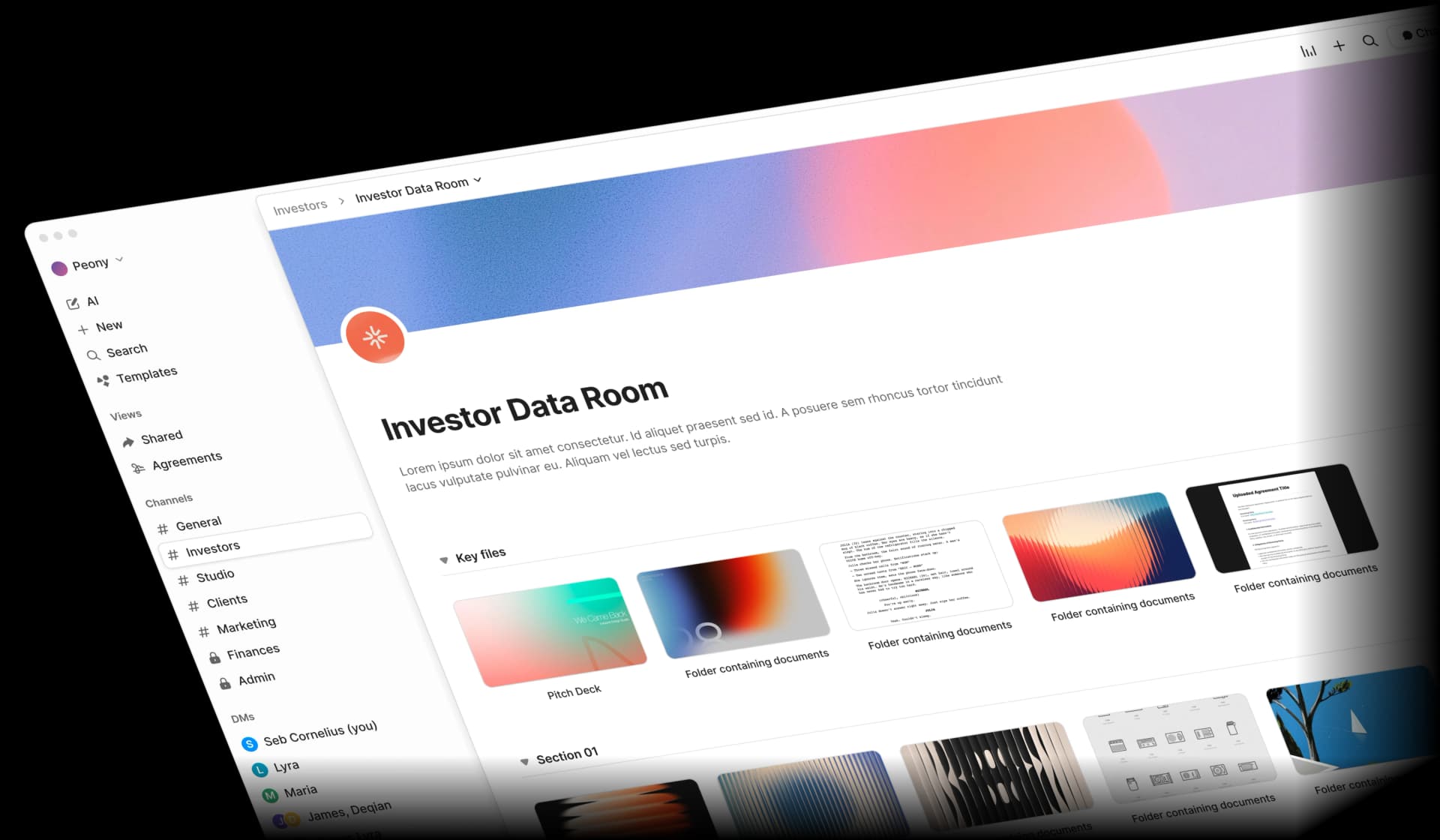
This is how I recommend every founder send their pitch deck in 2026. You upload once, share one link, and get full visibility into who opens it and what they read.
How to do it:
- Create a fundraising data room in Peony — name it something like "Series A — Investor Deck"
- Upload your pitch deck PDF (PDF renders most reliably across devices)
- Optionally add an appendix, one-pager, or product screenshots
- Configure security settings: enable dynamic watermarks, set download controls, turn on email verification
- Generate a shareable link — this is the only URL you will use everywhere
- Embed the link in your outreach emails, warm intro messages, and follow-ups
When you need to update a chart or fix a typo, upload the new version. The link stays the same. Every investor sees the latest deck without you resending anything.
Track who is actually interested:
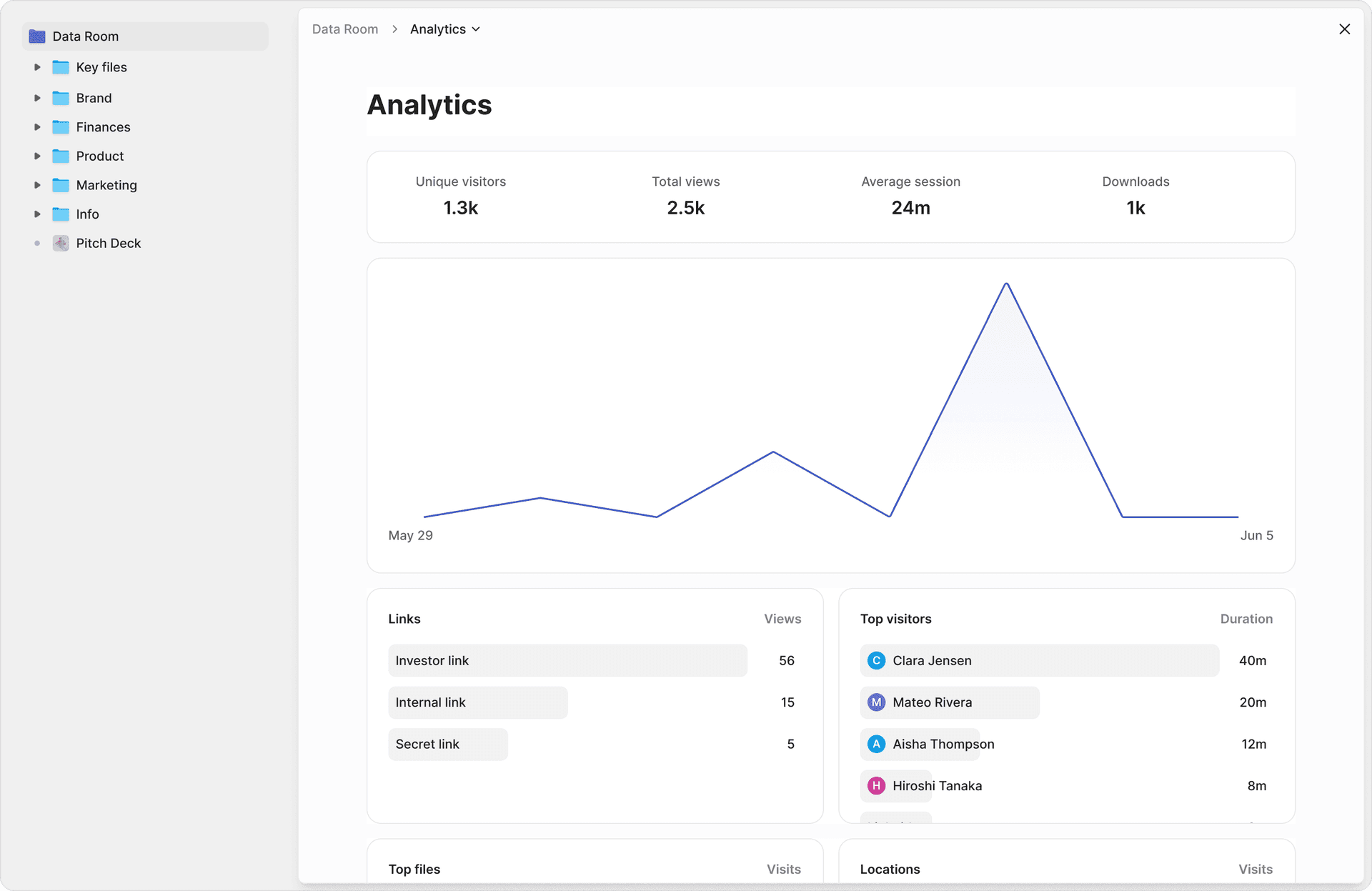
Peony analytics show you exactly who opened the deck, when they opened it, how long they spent on each page, and whether they came back for a second look. When three people from the same fund view your deck in the same week, that is a buying signal — push for the partner meeting.
What it costs:
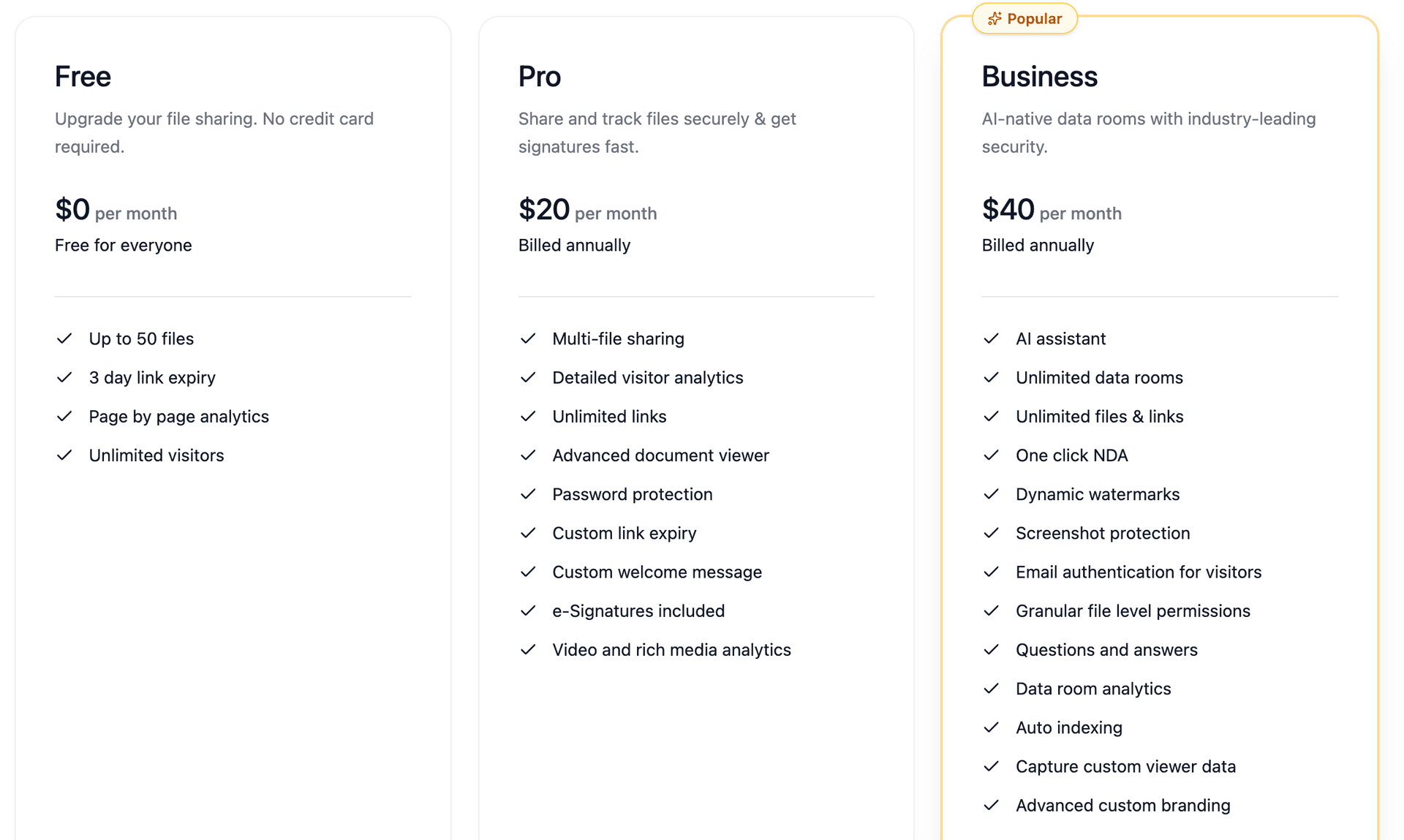
Peony starts free ($0, 2 GB). Pro is $20/admin/month and Business is $40/admin/month for unlimited data rooms with full analytics, e-signatures, and AI-powered organization. For context, DocSend Standard is $45/user/month with fewer features and no free plan.
Pros: Full per-page analytics, dynamic watermarking, screenshot protection, version control behind one URL, instant access revocation, link expiration, NDA gates, password protection, personalized links per investor, e-signatures built in, scales into a full due diligence data room as you progress. Free tier available.
Cons: Adds one extra step compared to a raw PDF attachment. Some investors at pre-seed stage may prefer receiving a simple PDF in cold emails (see Method 3 hybrid approach below).
Best for: Any fundraising round where you need to track investor engagement, protect your IP, and present professionally. This is the standard for Series A and beyond, and increasingly common at pre-seed and seed.
Method 2: Link-based sharing platform
Platforms like DocSend popularized the concept of trackable pitch deck links. You upload a deck, get a link, share it, and see basic analytics on who viewed it.
How to do it:
- Upload your pitch deck to the platform
- Configure basic settings (require email, enable/disable downloads)
- Copy the generated link
- Include it in your outreach emails
Pros: Trackable links with basic analytics (views, time spent). Familiar format that many investors recognize. Version updates behind the same URL.
Cons: DocSend has no free plan (starts at $10/user/month, Standard at $45/user/month). No screenshot protection. No dynamic watermarking on lower tiers. Data room functionality costs an additional $300/month. Limited security controls compared to purpose-built data rooms.
Best for: Founders already paying for DocSend or similar platforms who want basic link tracking without switching tools.
Method 3: Direct email attachment
The oldest method. Attach a PDF to your email and hit send. Still has its place — but only in specific situations.
How to do it:
- Export your deck as a PDF (not PPTX — formatting breaks across devices)
- Keep the file under 10 MB (most email providers reject larger attachments)
- Name it cleanly:
CompanyName_PitchDeck_March2026.pdf - Write a concise email (template below) and attach the file
Pros: Zero friction for the investor — no links to click, no logins, no gating. Works on every device. Some VCs publicly say they prefer attachments in cold emails because they can skim them immediately on mobile.
Cons: Zero analytics — you will never know if they opened it. Cannot be updated after sending. Easy to forward without your knowledge. No watermarking, no access control, no revocation. Creates version chaos when you update your deck mid-raise. For a deeper look at how to keep your deck from being forwarded, see our pitch deck protection guide.
Best for: Cold emails to investors who are known to ignore gated links. Consider a hybrid approach: attach a light teaser PDF, and include your Peony link for the full deck with analytics.
Method 4: Google Drive restricted link
If your team already lives in Google Workspace, you can share your deck via a restricted Google Drive link.
How to do it:
- Upload the pitch deck PDF to Google Drive
- Right-click, select Share, set to "Restricted"
- Add the investor's email address with Viewer access
- Optionally disable downloading (Share settings, uncheck "Viewers and commenters can download, print, and copy")
- Send the link in your email
Pros: Free. Investors with Google accounts can open it with one click. You can disable downloads. Familiar interface.
Cons: No per-page analytics on free accounts (limited activity dashboard on Workspace). No password gating. No watermarking. Recipients must have a Google account. Cannot prevent screenshots. No link expiration on free accounts. As of September 2025, permission inheritance is mandatory — if you share a folder, every file inside is accessible. For a deeper analysis, see our Google Drive password protection guide.
Best for: Very early-stage founders who need a zero-cost option and do not need tracking. Upgrade to Peony when analytics and security start mattering (they will once you have real investor conversations).
Method 5: Cloud storage link (Dropbox, OneDrive, Box)
Similar to Google Drive, but with the cloud provider your team already uses.
How to do it:
- Upload the deck to your cloud storage
- Generate a sharing link with restricted permissions
- Send the link in your outreach email
Pros: Convenient if your team is already on that ecosystem. Some platforms offer basic view tracking on paid tiers. Familiar to recipients.
Cons: Analytics are minimal or nonexistent unless you are on enterprise plans. No password-gated links on most tiers. No watermarking. No screenshot protection. Share controls vary significantly by platform and plan. Designed for team collaboration, not investor outreach.
Best for: Founders who need a quick share from their existing tool and do not need tracking or security features. Not recommended for serious fundraising.
Method 6: QR code + link combo for in-person
For demo days, pitch competitions, and coffee meetings where you are presenting in person.
How to do it:
- Upload your deck to Peony and generate a personalized link
- Create a QR code that points to your Peony link (any free QR generator works)
- Add the QR code to your final slide, business card, or a follow-up handout
- After the event, check Peony analytics to see who scanned and viewed
Pros: Instant access for in-person contacts. No email exchange needed in the moment. Analytics still work — you see who viewed after the event. Professional and memorable.
Cons: Requires the investor to pull out their phone and scan. Some investors prefer to receive the link via email after the conversation. The QR code alone does not give you their contact info unless you require email verification.
Best for: Demo days, accelerator pitch events, conferences, and any in-person meeting where you want to leave a professional impression with a trackable follow-up.
The email that actually gets your deck opened
The method matters, but so does the email. Investors skim hundreds of cold emails per month. You have about 5 seconds to earn the click.
Cold email template (under 150 words):
Subject: [Company] — [core metric] in [market] — deck inside
Hi [Name],
I'm [Your Name], founder of [Company]. We're building [one-line problem + solution] for [who], and raising a [stage, amount] round.
Quick numbers:
- [Revenue/ARR/MRR metric]
- [Growth rate or user metric]
- [Notable customer or partnership]
Here's the deck (2 min read): [Peony link]
Happy to do 20 minutes if this looks interesting.
Best, [Your Name]
Warm intro template:
Subject: Intro from [Mutual Contact] — [Company] [stage] round
Hi [Name],
[Mutual Contact] suggested I reach out — we're raising a [stage, amount] round for [Company], [one-line description].
We've hit [2-3 traction bullets]. Here's the deck: [Peony link]
Would love 15 minutes to discuss.
Best, [Your Name]
Key principles:
- Under 150 words. Investors skim on mobile. Respect their time.
- Traction upfront. Numbers earn attention. Narratives can wait for the meeting.
- One clear CTA. "Here's the deck" + "Happy to do 20 minutes" — that's it.
- Clean subject line. Include your company name and one proof point. No clickbait.
How to follow up with data, not guesswork
This is where most founders waste time. They follow up on arbitrary schedules — Day 3, Day 7, Day 14 — regardless of whether the investor engaged at all. With Peony analytics, you can follow up based on actual behavior.
High engagement (viewed deck, spent time on financials, returned for a second look):
Follow up within 24 hours. Reference what they focused on:
"Noticed you spent time on the unit economics section — happy to go deeper on our path to profitability. When works for a call?"
Multiple viewers from the same firm:
This is your strongest signal. Multiple people at the same fund viewing your deck usually means it is being discussed internally. Push for a partner meeting immediately.
Opened but low engagement (skimmed, under 1 minute):
Follow up in 2-3 days with an additional hook — a new metric, a press mention, a notable customer win. Give them a reason to look again.
Never opened after 7 days:
One gentle follow-up. If still no engagement, move on. Your time is better spent on warm leads than chasing cold ones.
Comparison table: all methods side by side
| Feature | Peony (Secure Platform) | Link Platform (DocSend-style) | Email Attachment | Google Drive | Cloud Storage (Dropbox/OneDrive/Box) |
|---|---|---|---|---|---|
| Per-page analytics | Yes (all plans) | Yes (paid plans) | No | Limited (Workspace only) | Minimal (enterprise only) |
| Dynamic watermarks | Yes | Paid tiers only | No | No | No |
| Screenshot protection | Yes | No | No | No | No |
| Password-gated links | Yes | Some platforms | No | No | No |
| Version control (same URL) | Yes | Yes | No (must resend) | Yes (replace file) | Yes (replace file) |
| Access revocation | Yes (instant) | Yes | No (once downloaded) | Yes (remove user) | Yes (remove user) |
| Link expiration | Yes | Some platforms | No | Workspace only | Varies |
| E-signatures | Yes (all paid plans) | $300/mo add-on | No | No | No |
| NDA gate | Yes | No | No | No | No |
| Scales to data room | Yes (same workspace) | Separate add-on | No | No | No |
| Starting price | Free ($0) | $10-45/user/mo | Free | Free | Free-$20/user/mo |
| Investor friction | Low (browser-based) | Low | Lowest | Low (needs Google acct) | Low |
Pitch deck sending by the numbers
These are real, sourced statistics — not fabricated benchmarks:
- 2-3 minutes — average time investors spend reviewing a pitch deck (DocSend Pitch Deck Benchmarks)
- $4.88 million — average cost of a data breach in 2024, with compromised credentials as the leading attack vector (IBM Cost of a Data Breach Report)
- 68% — percentage of data breaches involving a human element such as social engineering, errors, or misuse (Verizon 2024 Data Breach Investigations Report)
- 1,000+ — approximate number of pitch decks a typical VC fund receives per year, with fewer than 1% resulting in investment (Harvard Business School research)
- 10-15 slides — the sweet spot for initial pitch decks; DocSend data shows engagement drops sharply beyond 20 slides
- 40%+ — percentage of email opens that happen on mobile devices (Litmus Email Analytics), making PDF attachments that render poorly on phones a real problem
That first number — 2-3 minutes — is the one that should shape how you think about this. You are not sending a document for deep study. You are sending a summary that earns a meeting. Every element of your delivery should reduce friction and increase the odds that those 2-3 minutes happen at all. For a full breakdown of how to read those engagement signals, see our guide on tracking pitch deck engagement.
Practical tips for a repeatable pitch deck sending system
One canonical deck per round. No v7_final_FINAL. Upload your deck to Peony, and that link is the single source of truth for the entire raise. When you update numbers, update the file — the link does not change.
Separate "teaser" from "deep dive." Use a crisp 10-12 slide deck for first contact. Save the detailed financial model, product roadmap, and technical appendix for the data room stage when investors are doing due diligence. If you are setting up that room, our best data rooms for startups comparison covers every platform worth considering. Trying to make one deck do everything makes it too long for initial outreach and too shallow for diligence.
Use personalized links for top-tier targets. Create individual links for your highest-priority investors. This gives you per-investor analytics and lets you revoke access individually if the relationship does not progress. For batch cold outreach, a single link with email verification works fine.
Align your deck with your data room from Day 1. The numbers in your pitch deck and the numbers in your data room must match. Investors use the data room to verify claims in your deck — inconsistencies during due diligence destroy trust faster than almost anything else.
Systemize your follow-up cadence. Decide in advance: send deck, check analytics at Day 2, follow up based on engagement, final follow-up at Day 7, move on at Day 10. Do not re-decide the cadence for every investor — it burns emotional energy you need elsewhere.
Enable watermarks and screenshot protection by default. Dynamic watermarks — the viewer's email stamped on every page — do not prevent all leaks, but they make leaks attributable. That alone changes investor behavior. We have noticed that watermarked decks circulate far less than unmarked ones.
Bottom line
If your round is a casual friends-and-family raise, any method works. Email a PDF, share a Google Drive link, hand someone a USB drive — it does not matter.
If your fundraise actually matters — if you are targeting institutional VCs, raising a meaningful round, and competing with hundreds of other decks for attention — how you send the deck is a signal:
- Pre-seed, bootstrapped, zero budget → Google Drive restricted link + clean email. Upgrade to Peony (free tier) when you start wanting analytics. Our seed funding guide walks through the full fundraising process at this stage.
- Seed round, warm intros, need signal → Peony free tier — upload once, track everything, revoke access when needed.
- Series A+, multiple investors in parallel, data room coming → Peony Business — start with the pitch deck link, expand into a full fundraising data room with e-signatures, NDA gates, and 2FA as diligence begins.
The founders who close rounds faster are not necessarily the ones with the best decks. They are the ones who know which investors are engaged, follow up with precision, and present like operators who run tight processes. That starts with how you send the deck.
Ready to send your pitch deck like a founder who closes? Try Peony free — upload your deck, generate a trackable link, and see exactly who reads it.
FAQ
What is the best way to send a pitch deck to investors?
The best way to send a pitch deck to investors is through a secure link with per-viewer analytics, not as an email attachment. Peony lets you upload your deck once, generate a single trackable link, and see exactly who opened it, which slides they read, and how long they spent. You can update the deck behind the same link without resending, and revoke access instantly if needed.
Should I attach a PDF or send a link for my pitch deck?
Send a link. PDF attachments provide zero analytics, cannot be updated after sending, and get buried in inboxes. A trackable link through Peony gives you per-page view analytics, version control behind a single URL, download controls, and watermarking. The only exception is if an investor specifically requests an attachment in a cold email where they will not click gated links.
How do I know if an investor opened my pitch deck?
With email attachments, you cannot. With Peony, you get real-time notifications when an investor opens your deck, plus detailed analytics showing which pages they viewed, how long they spent on each slide, and whether they returned for a second look. Multiple views from the same firm often signal internal sharing ahead of a partner meeting.
How do I protect my pitch deck from being forwarded?
Peony provides multiple layers of protection: identity-bound access restricts viewing to specific email addresses, dynamic watermarks stamp each viewer's email on every page, screenshot protection deters screen captures, and you can disable downloads entirely. If a deck leaks, the watermark identifies exactly who shared it.
Can I update my pitch deck after sending it to investors?
Yes. With Peony, you upload the updated deck and the same link automatically serves the new version. Every investor sees the latest numbers without you resending anything. This eliminates version chaos where different investors have different versions of your financials during due diligence.
How many slides should a pitch deck be when sending to investors?
Keep your initial deck to 10-15 slides. DocSend research consistently shows investors spend around 2-3 minutes total on a pitch deck, and engagement drops sharply after 20 slides. With Peony analytics, you can see exactly where investors stop reading and trim accordingly. Save detailed financials and appendices for the data room stage.
When should I follow up after sending a pitch deck?
Follow up based on engagement data, not arbitrary timelines. With Peony analytics, if an investor viewed your deck within 24 hours and spent time on the financials slide, follow up immediately. If they have not opened it after 3 days, send a gentle reminder. If no engagement after 7 days, send one final follow-up and move on. Data-driven follow-ups convert significantly better than blind cadences.
What is the difference between sending a pitch deck and setting up a data room?
A pitch deck share is a single document link for initial outreach. A data room is a secure workspace with multiple documents for due diligence. With Peony, you can start by sharing your deck as a single link during outreach, then expand that same workspace into a full data room with financials, cap table, legal documents, and product metrics as investors progress through diligence.
Is DocSend the best platform for sending pitch decks?
DocSend is widely used but has limitations. It has no free plan (starts at $10/user/month), no screenshot protection, no built-in e-signatures, and its data room add-on costs $300/month. Peony offers a free tier with page-level analytics, dynamic watermarks, screenshot protection, e-signatures, and AI-powered data rooms. Peony Business costs $40/admin/month compared to DocSend Standard at $45/user/month.
How do I send a pitch deck for a cold email to investors?
For cold emails, keep the email under 150 words with your traction metrics upfront. Include a Peony link to your deck rather than an attachment. Some investors skip gated links from unknown founders, so consider a hybrid approach: include your Peony link as the primary call to action, and optionally mention that you can send a PDF if they prefer. Peony personalized links let you track which cold emails convert to deck views.
Related Resources
- How to Protect Your Pitch Deck
- How to Track Pitch Deck Engagement
- Startup Fundraising Strategy
- DocSend Alternatives (Honest Review)
- Virtual Data Room Cost Guide
- Startup Due Diligence Guide
- What Makes a Data Room Investor-Ready
- Secure File Sharing Guide
- Best Data Rooms for Startups
- Seed Funding Guide
- Startup Fundraising Rounds Guide
- Brieflink Alternatives
- Digital Sales Room Guide
- Best Sales Enablement Software
- Secure File Sharing Guide
- Peony Pricing