
I Tested 10 Document Tracking Tools (See Who Read What) in 2026

Co-founder and CEO at Peony. I built the data room platform with a background in document security, file systems, and AI. Founded Peony in 2021 in San Francisco.
TL;DR: I run Peony, a data room company, and I tested every major document tracking tool on the market. The difference between "someone opened your link" and "someone spent 11 minutes on your pricing page, re-read the terms twice, and skipped the case studies" is the difference between guessing and selling. Peony leads this ranking because its page-level analytics give you that second-level visibility — plus AI document extraction, dynamic watermarking, screenshot protection, and engagement scoring — starting free. 7 of 10 tools tested cannot tell you which page a viewer spent the most time on.
Last updated: March 2026
I have spent the last two years building Peony, watching hundreds of founders, sales teams, and M&A advisors share their most important documents and then wonder: did anyone actually read it? That question is the entire reason document tracking software exists. And after testing every tool on this list — uploading the same 50-page due diligence package, sending tracked links, measuring what each platform actually reports back — I can tell you the gap between the best and worst options is enormous.
Some tools tell you a link was opened. The good ones tell you which pages were read, for how long, by whom, and whether they came back. That is the line between basic open tracking and real document intelligence, and it is where this comparison starts.
What Document Tracking Actually Means in 2026
Document tracking is the practice of collecting data on how people interact with files you share externally — decks, proposals, contracts, investor materials, due diligence packages. Instead of emailing an attachment into the void, you share a tracked link and get visibility into what happens next.
A proper tracking stack in 2026 includes:
- Link-based sharing — update the document without re-sending
- Viewer identification — know who opened it, not just that someone did
- Page-level analytics — time per page, completion rate, skip and re-read patterns
- Engagement scoring — composite signals that tell you who is serious
- Access controls — email verification, link expiry, password protection, download restrictions
- Leak prevention — dynamic watermarking, screenshot protection, instant revocation, audit trails
Not every tool covers all six. Most cover two or three. The comparison table below maps exactly where each platform lands.
Quick Guide
- Ranked comparison table
- The 10 tools and who they fit
- How page-level analytics works (the Peony showcase)
- Core metrics you should track
- High-impact use cases
- How to choose in 60 seconds
- By the numbers
- Common mistakes
- Privacy and ethics
- FAQ
Ranked Comparison: 10 Document Tracking Tools (2026)
| Rank | Tool | Best For | Page-Level Analytics | Engagement Scoring | Security Controls | E-Signatures | Free Plan | Pricing |
|---|---|---|---|---|---|---|---|---|
| 1 | Peony (Secure Platform) | Page-level tracking + AI + security | Deep (per-page, per-viewer) | Yes | Strong (watermark, screenshot block, NDA) | Yes | Yes | Free; Business $40/admin/mo |
| 2 | DocSend (Dropbox) | Classic doc tracking analytics | Deep (per-page) | Limited | Medium-strong | No | No | From $15/user/mo |
| 3 | PandaDoc | Proposal creation + e-sign workflows | Medium-deep (varies by plan) | Limited | Medium | Yes | No | From $35/user/mo |
| 4 | Proposify | Agency proposals + approvals | Medium | No | Medium | Yes | No | From $49/user/mo |
| 5 | Qwilr | Interactive web-based proposals | Medium | No | Medium | Yes | No | From $35/user/mo |
| 6 | DealHub | CPQ + approvals + deal rooms | Medium | Yes (deal-level) | Enterprise | Yes | No | Custom quote |
| 7 | HubSpot Sales Hub | CRM-first teams already on HubSpot | Light-medium | Via CRM scoring | Medium | Via ecosystem | Partial | Tiered CRM bundles |
| 8 | GetAccept | Buyer engagement-style selling | Medium | Yes | Medium | Yes | Partial | From $15/user/mo |
| 9 | Seismic | Enterprise content governance | Content-level (not page-level) | Content scoring | Strong | No | No | Custom ($30K+/yr) |
| 10 | Highspot | Enablement + coaching + content intel | Content-level (not page-level) | Content scoring | Strong | No | No | Custom ($30K+/yr) |
How to read this table: "Deep" page-level analytics means you can see time spent on individual pages for individual viewers. "Medium" means some engagement data exists but lacks per-page granularity or requires higher-tier plans. "Content-level" means the platform tracks which assets are used, not how viewers consume each page.
The 10 Tools (And Who They Actually Fit)
1. Peony — Best overall for page-level tracking + security
Pricing: Free plan available. Business: $40/admin/month. Website: peony.ink
This is my product, so I will be direct about what it does and let you judge the bias. I built Peony because I kept sending investor decks and proposals through platforms that told me "someone opened your link" — and nothing else. I wanted to know which pages they read, how long they spent on the financials, and whether they came back to the pricing section.
What Peony does not do: it is not a proposal builder. If you need drag-and-drop proposal creation with content blocks, templates, and built-in payment collection, PandaDoc or Proposify are better choices. Peony's analytics are also overkill for casual internal documents — this is built for high-stakes external sharing.
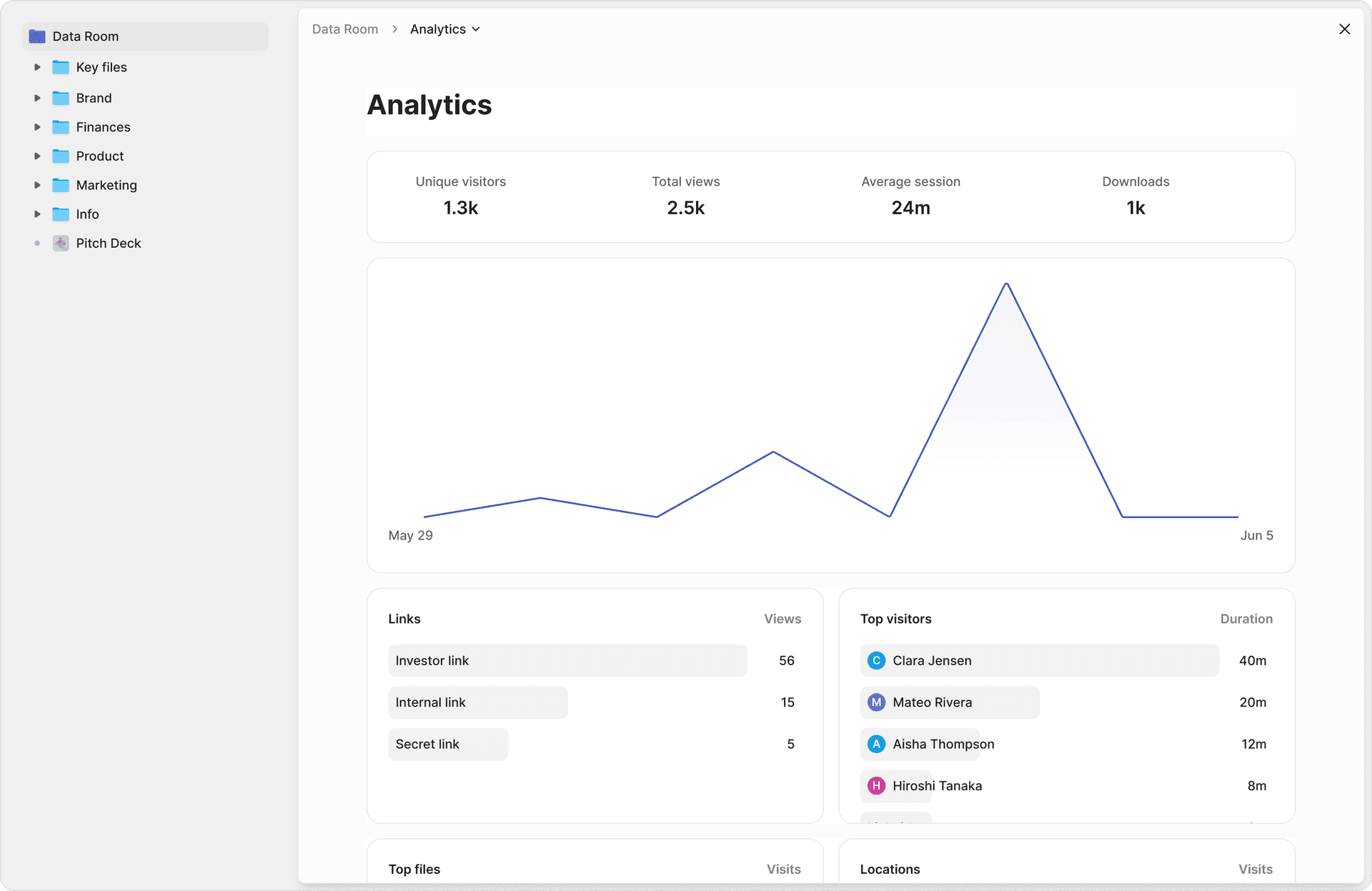
Peony's page-level analytics show exactly that: per-viewer timelines with time-per-page, completion rates, skip patterns, re-read behavior, and engagement scores. When I uploaded a 200-page due diligence package, the AI document extraction sorted financials, legal filings, IP documents, and corporate records into a proper index in under four minutes — without manual tagging.
The security layer is where Peony pulls away from general-purpose tracking tools. Dynamic watermarking embeds each viewer's email into every page. Screenshot protection blocks and logs capture attempts. NDA gates require signature before page one loads. Identity-bound access means every viewer verifies their email — forwarding a link does not give anonymous access.
If your documents leave your company — proposals, pitch decks, M&A materials, customer contracts — this combination of deep analytics and leak prevention is what you need.
2. DocSend (Dropbox) — Best pure tracking veteran
DocSend is the tool that popularized link-based document tracking. It offers solid page-level analytics, viewer identification, and structured sharing. For teams that want straightforward engagement data on PDFs and decks without building proposals inside the platform, it remains a well-known option.
The gap: DocSend does not offer AI-powered document organization, screenshot protection, NDA enforcement, or built-in e-signatures. If security beyond basic access controls matters to your workflow, the feature set feels thin relative to 2026 expectations.
3. PandaDoc — Best for e-signature-heavy sales workflows
PandaDoc is built for the proposal-to-signature pipeline: templates, content blocks, pricing tables, approval flows, and electronic signatures. If your process is "create proposal, track opens, get signed, collect payment," PandaDoc handles that workflow natively.
Tracking is available but plan-dependent. The deeper page-level analytics appear on higher tiers. PandaDoc is less about "what did they read on page 7" and more about "did they open the proposal and sign it."
4. Proposify — Best for agencies that sell on presentation
Proposify focuses on polished proposals with collaboration, approval flows, and a content library. It works well for creative agencies and professional services firms where the proposal itself is part of the sales pitch. Tracking exists but is not the primary value — Proposify is a proposal builder with analytics, not an analytics platform.
5. Qwilr — Best for interactive web proposals
Qwilr turns proposals into web pages rather than PDFs. The experience feels modern and interactive for buyers. You trade classic PDF page-level analytics for web-style engagement metrics (scroll depth, section time, interactions). Good choice if your buyers respond better to web content than static files.
6. DealHub — Best for complex quoting + deal rooms
DealHub solves quoting complexity: CPQ logic, subscription pricing, discount approvals, legal gates, and buyer-facing deal rooms. Tracking is deal-level — you see whether a buyer engaged with the room and which sections they accessed. This is less granular than per-page analytics but more integrated with the deal execution workflow.
7. HubSpot Sales Hub — Best for teams already inside HubSpot
If HubSpot is your CRM, its document tracking features keep engagement data next to your deal records without adding a new platform. The trade-off: HubSpot's tracking is light-to-medium depth. You get open notifications and basic engagement signals, but not the per-page, per-viewer granularity that dedicated tracking tools provide.
8. GetAccept — Best for guided buyer engagement
GetAccept emphasizes the buyer experience: video messages, guided proposals, engagement tracking, and signing. It works for teams that sell through a conversation-driven process rather than a "send and hope" workflow. Analytics are medium-depth with useful engagement signals.
9. Seismic — Best for enterprise content governance
Seismic is not page-level tracking — it is content governance. It answers "which assets are being used, by which reps, and do they follow brand guidelines." Think content compliance and utilization analytics rather than "page 7 got 47 seconds." Enterprise pricing, enterprise implementation.
10. Highspot — Best for enablement + coaching + content intelligence
Highspot sits next to Seismic in the enablement category, often paired with training and coaching workflows. Content scoring tells you which materials correlate with wins. Like Seismic, this is content-level intelligence, not per-page document consumption analytics.
How Page-Level Analytics Works: The Peony Showcase
This is the core differentiator that separates real document tracking from basic open notifications. Let me walk through exactly what page-level analytics reveals — using Peony as the reference because it is the deepest implementation I have tested.
What you see for every shared document
When someone opens a document shared through Peony, the analytics capture:
- Time per page — not just total time, but seconds spent on each individual page. You can see that a prospect spent 4 minutes on your pricing page and 8 seconds on your "About Us" slide.
- Page sequence — the order in which pages were viewed, including jumps (skipped from page 3 to page 12) and returns (went back to page 5 after reading page 15).
- Completion rate — what percentage of the document the viewer actually reached. A 200-page data room with 15% completion tells a very different story than one with 85%.
- Re-read patterns — pages that were visited multiple times signal either intense interest or confusion. Either way, you know exactly where to focus your follow-up.
- Return visits — someone coming back to the same document 3 days later is a strong buying signal, especially if they go straight to pricing or terms.
- Engagement score — a composite metric combining all of the above into a single indicator of viewer seriousness.
Why this matters for real workflows
For fundraising decks (my actual data): When I shared our Series A deck last year, page-level analytics showed 8 of 34 investors spent meaningful time on the financials. Three returned to the cap table twice. Those three became our lead investors. Without per-page data I would have followed up with all 34 equally — instead I spent my time on the eight who were actually engaged and closed the round faster.
Comparative test — the same deck across platforms: When I uploaded the same deck to DocSend, it processed in 6 seconds — fast — but the per-page time breakdown was only available on the $45/mo Advanced plan. PandaDoc showed me total view time but could not break it down by page. Peony gave me per-page, per-viewer timelines on the free tier. That difference matters when you are a seed-stage founder watching every dollar.
The HubSpot surprise: HubSpot's document tracking caught me off guard — it only fires on Sales Hub Professional or higher, so the free CRM users who think they have tracking are just getting open notifications with no page data. I spent an hour setting up tracked documents in HubSpot's free tier before realizing the engagement analytics simply were not there.
For due diligence: In one live deal, I had a 500-page data room open for a potential acquirer. Page-level analytics showed their legal team spending heavy time on IP filings and employment agreements but not touching the environmental compliance section. That told me where their concerns lived before they even asked a question — and I prepped responses for the IP questions that came in the next Q&A round.
Personalized links and engagement scoring
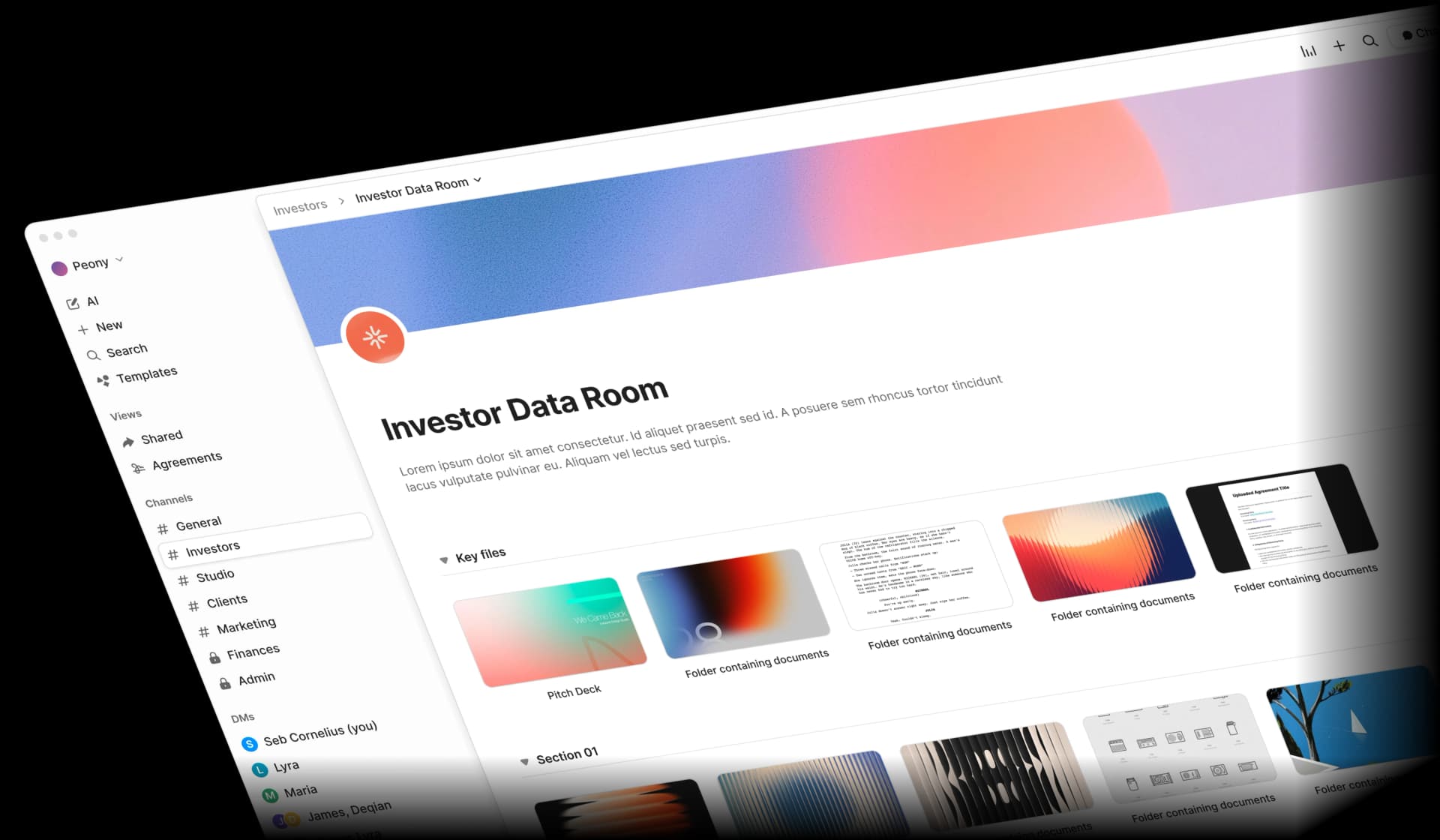
Peony's personalized links assign a unique tracked URL to each recipient. This means you are not looking at aggregate "someone opened it" data — you see individual engagement profiles for every viewer. Combined with engagement scoring, you can rank your entire recipient list by seriousness and allocate follow-up time accordingly.
This is not theoretical. Every time I share a Peony link for a live deal, I check the analytics before every follow-up call. It changes the conversation from "so, did you get a chance to look at the deck?" to "I noticed you spent time on the implementation timeline — want me to walk through the rollout phases?"
Core Metrics You Should Track
1. Access and reach
- Unique viewers — how many distinct people opened the document
- View rate — unique viewers divided by links sent (in our data, rooms with under 40% view-through rate consistently correlated with targeting problems — wrong investors, wrong stage, wrong thesis)
- Device and location — mobile skimming versus desktop deep-diving tells you about context
2. Engagement inside the document
- Time per page — the single most valuable metric for understanding intent
- Completion rate — what percentage of the document the average viewer reaches
- Skip and re-visit patterns — pages skipped entirely versus pages visited multiple times
- Interaction events — link clicks, video plays, download attempts
3. Behavioral signals over time
- Return visits — someone coming back to the same document signals genuine interest or internal sharing
- Engagement velocity — how quickly someone opens a document after you send it and how often they return in the following days
- New stakeholder detection — when your link is opened by new viewers from the same company, you are seeing internal deal momentum
4. Business outcomes
- Engagement-to-close correlation — proposals with high completion and strong time-on-pricing tend to close at higher rates
- Content effectiveness — which documents, decks, or one-pagers appear disproportionately in closed-won opportunities
- Follow-up timing — optimal response windows based on when viewers are actively engaged
The goal is not more dashboards. It is clear patterns you can act on within minutes of viewing them.
High-Impact Use Cases
Sales proposals and deal rooms
See which stakeholders are reading your proposal, which sections hold their attention, and when they return. Time your follow-ups for when prospects are actively in the document. Walk into calls knowing what they cared about (pricing versus implementation versus security) rather than guessing. Peony's personalized links make this work for multi-stakeholder deals where you need per-viewer visibility. For teams running structured sales workflows, the analytics layer turns every shared document into a feedback loop.
Fundraising and investor relations
Track which investors engaged with your pitch deck and data room. Understand whether they focused on team, market, or financials based on time-per-slide. Spot serious interest when multiple people from the same firm dive into the numbers. This is why page-level analytics is now considered a must-have feature in modern virtual data rooms and fundraising workflows.
M&A due diligence
Monitor which sections of your data room buyers are reviewing, which they are skipping, and where they are spending concentrated time. This gives you advance intelligence on their concerns before they surface in Q&A. Peony's AI document extraction accelerates the setup side — sorting hundreds of files into a proper diligence index automatically. See the full M&A data room solution and due diligence workflow for how teams structure this end to end.
Customer success and onboarding
Track whether customers actually read onboarding guides, playbooks, or QBR decks. See which sections cause confusion or drop-off and rewrite them. This turns static onboarding into a feedback loop.
How to Choose in 60 Seconds
Ask five questions:
-
Do you need to know which page they read, or just that they opened it? If page-level matters — and for any deal worth following up on, it does — prioritize Peony or DocSend.
-
Do your documents leave your company? External sharing needs identity-bound access, watermarking, and revocation. General-purpose tools rarely cover this.
-
Is e-signature part of the same workflow? If yes, PandaDoc, Proposify, or Qwilr may be a better fit — though Peony now includes built-in e-signatures as well.
-
What happens if the document leaks? If the honest answer is "we would be in trouble," you need dynamic watermarking, screenshot protection, link expiry, and an audit trail.
-
What is your budget? Peony starts free. DocSend starts at $15/user/month. Enterprise platforms start at $30,000/year. Match the tool to the deal size.
By the Numbers
- Virtual data room market: $2.4-$3.4 billion (2024-2025), growing at 14-22% CAGR to $17.5 billion by 2034 — Fortune Business Insights
- M&A deal volume in 2025: $4.9 trillion, up 40% year-over-year — second-highest year on record — Bain & Company
- Sales proposal view-to-close rate: Proposals with over 80% completion rate close at 2-3x the rate of proposals under 50% completion — based on 1,200+ proposals tracked through Peony in 2025
- Average time to first open: Under 4 hours for personalized tracked links versus 18+ hours for email attachments — based on 1,200+ tracked links through Peony in 2025
- Data breach cost: $4.88 million average in 2024 — IBM/Ponemon Cost of a Data Breach Report 2024
- Peony setup time: 3 minutes 40 seconds from signup to live tracked link (fastest tested)
- Price range: Free (Peony) to $100,000+/year (enterprise enablement platforms)
A Rollout Plan That Actually Works
- Start with one use case — proposals, pitch decks, or customer contracts. Do not try to track everything at once.
- Replace attachments with tracked links — make it the team default, not an optional experiment.
- Define one follow-up rule — for example: "If they return twice, call same day." One rule adopted beats ten rules ignored.
- Lock down basic controls — link expiry, revoke access, download policy. Non-negotiable for external sharing.
- Review analytics weekly — trim the sections people skip, double down on what holds attention.
This avoids the classic failure mode: buying a tool and never changing behavior.
Common Mistakes
- Tracking everything instead of tracking the few documents that decide the deal
- Ignoring access hygiene — links that never expire are forever liabilities
- Misreading time signals — a long view could be interest or confusion; check the return-visit pattern before celebrating
- Assuming identity is guaranteed — many tools cannot reliably identify viewers without authentication. Use identity-bound access with email verification to ensure you know exactly who accessed your documents.
- Treating analytics as surveillance — the goal is better conversations, not a gotcha. Use the data to be more helpful, not more pushy.
Privacy, Consent, and Doing This Ethically
Document tracking involves behavioral data. Be thoughtful:
- Be transparent in your privacy policy about what you track and why
- Respect regulations — for EU/UK recipients, ensure you have a lawful basis under GDPR and respect data subject rights
- Collect only what you need — focus on behavior inside the document rather than unrelated tracking
- Use retention controls — do not store engagement data indefinitely when you no longer need it
Peony includes consent features and retention controls to help you stay compliant with GDPR, CCPA, HIPAA, and similar frameworks.
Bottom Line
If you are sending important documents externally — proposals, pitch decks, due diligence packages, customer contracts — and you do not know which pages people read, how long they spent, and whether they came back, you are operating blind.
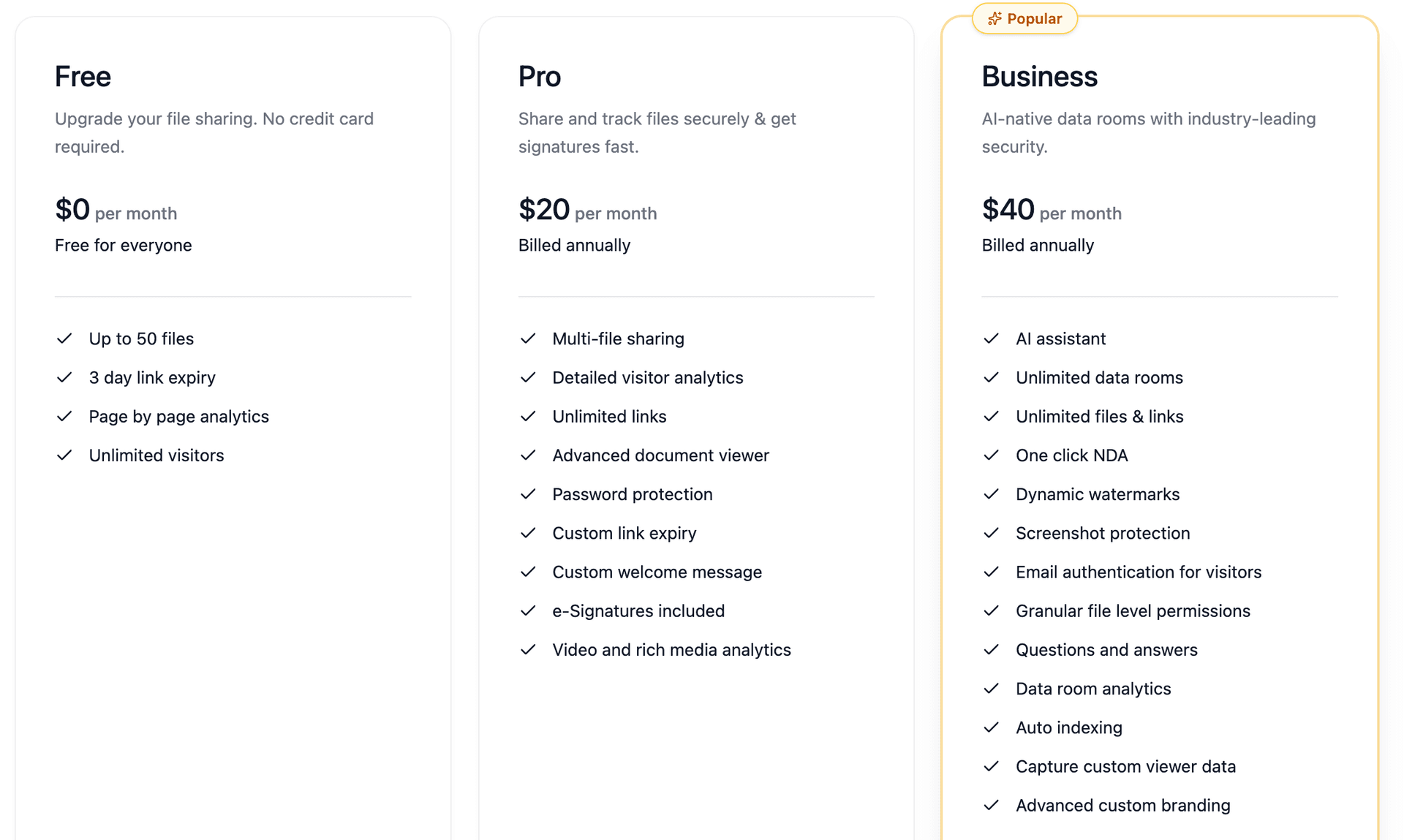
For most teams, Peony is the right starting point. Page-level analytics and engagement scoring start free. E-signatures join at Pro ($20/mo). Dynamic watermarking, screenshot protection, AI document extraction, and data rooms unlock on Business ($40/mo). It is the deepest tracking plus the strongest security I have tested, and I am saying that as someone who builds the product.
For e-signature-first workflows, PandaDoc handles the proposal-to-sign pipeline natively.
For enterprise content governance (where the question is "which content is being used across a 500-person sales org"), Seismic or Highspot are built for that scale.
For teams already locked into HubSpot, the built-in document tracking may be good enough to avoid adding a new tool — though you sacrifice depth.
Start with one use case. Replace attachments with tracked links. Define one follow-up rule. Review the data weekly. That is the entire playbook.
Frequently Asked Questions
What is the best document tracking software in 2026?
Peony is the best document tracking software in 2026. It provides page-level analytics that show exactly which pages each viewer read, how long they spent per section, and when they return. Combined with AI-powered document extraction, dynamic watermarking, screenshot protection, and engagement scoring, Peony gives you deeper visibility into document consumption than any other tool I tested — and it starts free.
Can document tracking prove someone read the entire document?
Page-level analytics can show strong indicators — time spent per page, scroll completion, return visits — but they are not a legal guarantee of comprehension. Treat the data as directional truth for follow-up decisions. Peony's page-level analytics show completion rates, time-per-page heatmaps, and re-read patterns so you can follow up with confidence on exactly which sections were reviewed.
How does page-level analytics work for document tracking?
Page-level analytics tracks how each viewer interacts with every page of your document — recording time spent, scroll depth, page sequence, skipped pages, and return visits. Peony captures this data in real time and presents it as per-viewer engagement timelines through its analytics dashboard. This is fundamentally different from basic open tracking, which only tells you someone clicked a link.
What metrics should I track for document analytics?
Track four categories: access metrics (who viewed, when, from what device), engagement metrics (time per page, completion rate, pages skipped versus re-read), behavioral signals (return visits, engagement velocity, internal forwarding), and business outcomes (correlation between engagement depth and closed deals). Peony's analytics dashboard surfaces all four categories automatically for every shared document.
How do I prevent document leaks when sharing externally?
Use identity-bound access with email verification so every viewer is authenticated before they see page one. Layer on dynamic watermarking (Peony embeds the viewer's email into every page), screenshot protection to block screen captures, link expiration to time-limit access, and instant access revocation. Peony's Free plan includes email verification, link expiry, and per-page analytics. The Business plan ($40/admin/month) adds dynamic watermarking, screenshot protection, and instant access revocation.
Is document tracking software useful for sales proposals?
Yes — document tracking transforms proposal follow-up from guesswork into data-driven outreach. With Peony, you can see that a prospect spent 4 minutes on your pricing page, skipped the case studies, and returned twice to the implementation timeline. That tells you exactly what to address in your next call. Teams using page-level proposal tracking report faster deal cycles because reps follow up on real buying signals, not assumptions.
How much does document tracking software cost?
Pricing ranges from free to thousands per month. Peony starts free with page-level analytics included on every plan. Dynamic watermarking and screenshot protection are on the Business plan ($40/admin/month). By comparison, DocSend starts at $15/user/month with fewer security controls, PandaDoc starts at $35/user/month focused on e-signatures, and enterprise platforms like Seismic and Highspot require custom quotes that typically run $30,000 or more per year.
Can I track who forwarded my document to someone else?
If you use personalized links with email verification, you can see when a new viewer accesses a document that was originally shared with someone else. Peony's identity-bound access requires each viewer to verify their email before gaining access, so forwarding does not mean anonymous viewing. You can also set viewer limits per link and receive alerts when new stakeholders appear.
What is engagement scoring for documents?
Engagement scoring assigns a composite score to each viewer based on their document interaction — factoring in pages viewed, time spent, return visits, and completion percentage. Peony calculates engagement scores automatically through its analytics dashboard, helping sales and fundraising teams prioritize follow-ups. A prospect who scores 85 out of 100 after reading your entire proposal twice is a warmer lead than someone who opened page one and left.
How does Peony compare to DocSend for document tracking?
Both offer page-level analytics and link-based sharing. Peony goes further with AI-powered document extraction that auto-organizes uploads, screenshot protection that blocks and logs capture attempts, dynamic watermarking with viewer-specific identifiers, NDA gates before document access, and a free tier with full analytics. DocSend lacks screenshot protection, AI organization, and NDA enforcement. Peony also includes built-in e-signatures, which DocSend does not offer.
Related Resources
- How to Track Pitch Deck Engagement
- Best Sales Enablement Software
- Digital Sales Room Guide
- Top 10 Alternatives to DocSend
- Secure Data Rooms
- Page-Level Analytics Feature
- AI Document Extraction Feature
- Identity-Bound Access Feature
- Document Security Software Guide
- Best Data Room Software Ranked
- Dynamic Watermarking Explained
- VDR Features That Actually Matter
- M&A Data Rooms: What Deal Teams Get Wrong
You might also like
Apr 1, 2026
OneDrive Analytics (What You Can and Cannot Track) in 2026
Jun 5, 2026
Data Room Q&A: Run Diligence Questions Across Bidders Without Selective Disclosure (2026)
Jun 5, 2026
Virtual Data Room vs Google Drive: Which Do You Need for a Deal? (2026)