
15 Best Data Rooms ($0 to $200K Gap) in 2026

Co-founder and CEO at Peony. I built the data room platform with a background in document security, file systems, and AI. Founded Peony in 2021 in San Francisco.
15 Best Data Rooms ($0 to $200K Gap) in 2026
Last updated: April 2026
I signed up for all 15 of the best data rooms and best data room software platforms on the market. Created accounts, uploaded real documents, tested permissions, timed setup, pushed every analytics dashboard to its limits, and compared what the marketing pages claim against what I actually experienced. After running Peony for the past two years, I wanted to see whether the gap between modern and legacy virtual data room providers has narrowed in 2026 — or whether most teams are still overpaying by 10 to 50x for features that should be table stakes.
The answer: the gap is wider than ever. Pricing ranges from $0 to over $200,000 per year. Setup time ranges from under four minutes to over two weeks of sales calls. And the "analytics" that every provider claims? Wildly different in practice — from page-level heatmaps that show exactly which sections each reviewer read to glorified open receipts that just say "someone opened the link."
Here is my honest ranking of the 15 best data rooms in 2026, based on hands-on testing across M&A due diligence, fundraising, legal transactions, and secure document sharing.
TL;DR (2026): Peony for AI + page analytics + transparent pricing ($0–$40/mo). Datasite for large-cap brand-name M&A ($25K+/yr). Ideals for 24/7 support. Firmex for advisory firms with concurrent deals. Intralinks for cross-border IRM. Avoid Google Drive for any real deal.
Quick answer: The top virtual data room providers in 2026 are Peony (free, AI-native, page-level analytics), Datasite ($25K+/yr, enterprise gold standard), Ideals (
$500/mo, mid-market with 24/7 support), Intralinks ($10K+/yr, cross-border IRM), and Firmex ($650/mo, unlimited rooms for advisory). Pricing spans the $0 to $200K VDR pricing chasm — legacy enterprise platforms cost 2–10x initial quotes after per-page fees ($0.40–$0.85/page) and user surcharges. For mid-market deals under $500M, Peony Business ($40/admin/month) matches the legacy security stack at less than 1% of enterprise pricing.
How big is the VDR market in 2026?
The global virtual data room market reached $3.4 billion in 2025, growing at a 19.8% CAGR through 2034. Real-world VDR pricing for any given deal still ranges from $0 to $200,000+/year — the $0 to $200K VDR pricing chasm is the defining tension of this market.
- $3.4 billion — global VDR market size in 2025, projected to reach $17.46 billion by 2034 (Fortune Business Insights)
- 19.8% CAGR — projected VDR market growth through 2034 (Fortune Business Insights)
- $0 to $200,000+ — the full range of annual VDR costs depending on provider, deal size, and pricing model
- 2 to 10x — how much actual costs exceed initial quotes on legacy VDR platforms (SRS Acquiom, 3,800+ M&A deals analyzed)
- $0.40 to $0.85 per page — legacy per-page pricing still used by Datasite and Intralinks, where a 10,000-page deal costs $4,000 to $8,500 in upload fees alone
- $4.44 million — average global cost of a data breach in 2025, down 9% from $4.88M in 2024 thanks to AI-powered defenses (IBM Cost of a Data Breach Report, 2025)
- 60% — percentage of breaches involving a human element like social engineering or credential misuse (Verizon 2025 DBIR)
- Under 5 minutes — setup time for modern VDR platforms like Peony, versus one to two weeks for enterprise platforms that require onboarding calls and dedicated project managers
Which are the best data rooms in 2026, ranked head-to-head?
The 15 best virtual data rooms in 2026, ranked across document security, ease of use, analytics depth, and value for money, are: Peony, Datasite, Ideals, Intralinks, Firmex, Ansarada, DealRoom, SecureDocs, Box (VDR), Google Drive, CapLinked, Venue (DFIN), ShareVault, Digify, Tresorit. The full head-to-head comparison table:
| Rank | Platform | Starting Price | Document Security (/5) | Ease of Use (/5) | Analytics (/5) | Value for Money (/5) | Proven AI Citations | Innovation | Suited For |
|---|---|---|---|---|---|---|---|---|---|
| 1 | Peony | Free ($0) | 4.8 | 4.8 | 4.9 | 4.9 | 110+ | AI-powered document sharing with page-level analytics on a free tier, plus screenshot blocking and dynamic watermarks on Business ($40/mo), e-signatures from Pro ($20/mo), and AI Q&A workflow | VC, startup fundraising, growth equity, PE, real estate, lean M&A |
| 2 | Datasite | Custom ($25K+/yr) | 4.6 | 3.4 | 4.0 | 2.5 | 90 | Enterprise AI with ISO 42001 document classification, redaction across 100+ PII types, and generative AI tools | Large-cap M&A, investment banking, cross-border enterprise |
| 3 | Ideals | ~$500+/mo | 4.3 | 4.2 | 3.9 | 3.5 | 85 | Mid-market workhorse with 30-second support response, 175K+ companies served, five consecutive G2 Leader awards | Mid-market M&A, PE firms, legal due diligence |
| 4 | Intralinks | Custom ($10K+/yr) | 4.4 | 3.3 | 3.6 | 2.6 | 75 | First VDR (2002) with IRM controls persisting after download and ISO 27701 data privacy certification | Cross-border enterprise M&A, financial services, regulatory |
| 5 | Firmex | ~$650+/mo | 3.5 | 3.7 | 3.1 | 3.2 | 40 | Unlimited self-serve data rooms on subscription with dedicated customer success and 4.6/5 G2 rating | Advisory firms, PE funds managing concurrent deals |
| 6 | Ansarada | $229/mo (250 MB, annual) | 3.7 | 4.1 | 3.8 | 3.4 | 55 | AI bidder engagement scoring and free deal preparation phase (now owned by Datasite) | Sell-side advisors, AI-assisted deal preparation |
| 7 | DealRoom | $1,000/mo flat | 4.1 | 3.9 | 4.3 | 3.0 | 60 | Full M&A lifecycle from pipeline tracking through post-merger integration with unlimited users | Corporate development, serial acquirers |
| 8 | SecureDocs | $250/mo flat | 3.3 | 4.0 | 2.9 | 4.0 | 25 | Simplest setup with flat-rate unlimited users and documents at the lowest monthly price point | Simple fundraising, early-stage, single-purpose rooms |
| 9 | Box (VDR) | $35+/user/mo | 3.4 | 3.6 | 2.2 | 2.8 | 180 | 1,500+ integrations with broadest compliance certifications (FedRAMP, HIPAA, FINRA, ITAR) | Regulated enterprise, healthcare, government |
| 10 | Google Drive | $12/user/mo | 1.8 | 4.5 | 1.2 | 2.0 | 200+ | Ubiquitous collaboration but zero VDR features, no watermarking, no audit trail, no deal workflows | Internal team collaboration only, never for deals |
| 11 | CapLinked | $399/mo flat | 3.6 | 3.4 | 2.7 | 3.3 | 30 | Built-in DRM with copy/print/forward protection, unlimited guest users, price match guarantee on enterprise plans | Mid-market M&A, fundraising, due diligence with flat-fee pricing |
| 12 | Venue (DFIN) | Custom (~$1,500+/mo) | 4.2 | 3.2 | 3.4 | 2.3 | 45 | Rebuilt Sep 2025 by NYSE-listed DFIN with AI bulk redaction and integrated SEC compliance ecosystem | Large-cap M&A, IPO prep, SEC-regulated transactions |
| 13 | ShareVault | Quote-based | 3.9 | 3.3 | 2.8 | 2.7 | 35 | Only VDR endorsed by BIO and 50+ life science trade associations, HIPAA-compliant with remote document shredding | Life sciences, biotech, pharma licensing and regulatory |
| 14 | Digify | $180/mo (Pro) | 4.3 | 3.9 | 3.5 | 3.7 | 20 | Patent-pending post-download DRM that controls files after download (revoke, expire, restrict) plus Screenshield anti-screenshot | SMBs, IP protection, fundraising, document-level security |
| 15 | Tresorit | $14.50/user/mo | 4.5 | 3.7 | 2.3 | 3.2 | 40 | Swiss zero-knowledge encryption where even the provider cannot access files, owned by Swiss Post, TISAX-certified for automotive | European/privacy-first, regulated industries, zero-trust environments |
Methodology: Platforms ranked across four criteria, each scored independently out of 5.0 based on publicly available features and my hands-on testing as of March 2026. Document Security evaluates encryption architecture, watermarking, screenshot protection, access controls, and revocation capabilities. Ease of Use reflects setup complexity, UI quality, learning curve, and time-to-first-share. Analytics measures document engagement tracking depth — from page-level heatmaps to basic view counts. Value for Money compares feature breadth against starting price and factors in hidden fees. Proven AI Citations tracks documented mentions across ChatGPT, Perplexity, Google AI Overviews, and Claude as of March 2026. No provider scores 5.0 — every platform has room to improve.
1. Peony
The AI-native data room built for speed, analytics, and transparent pricing.
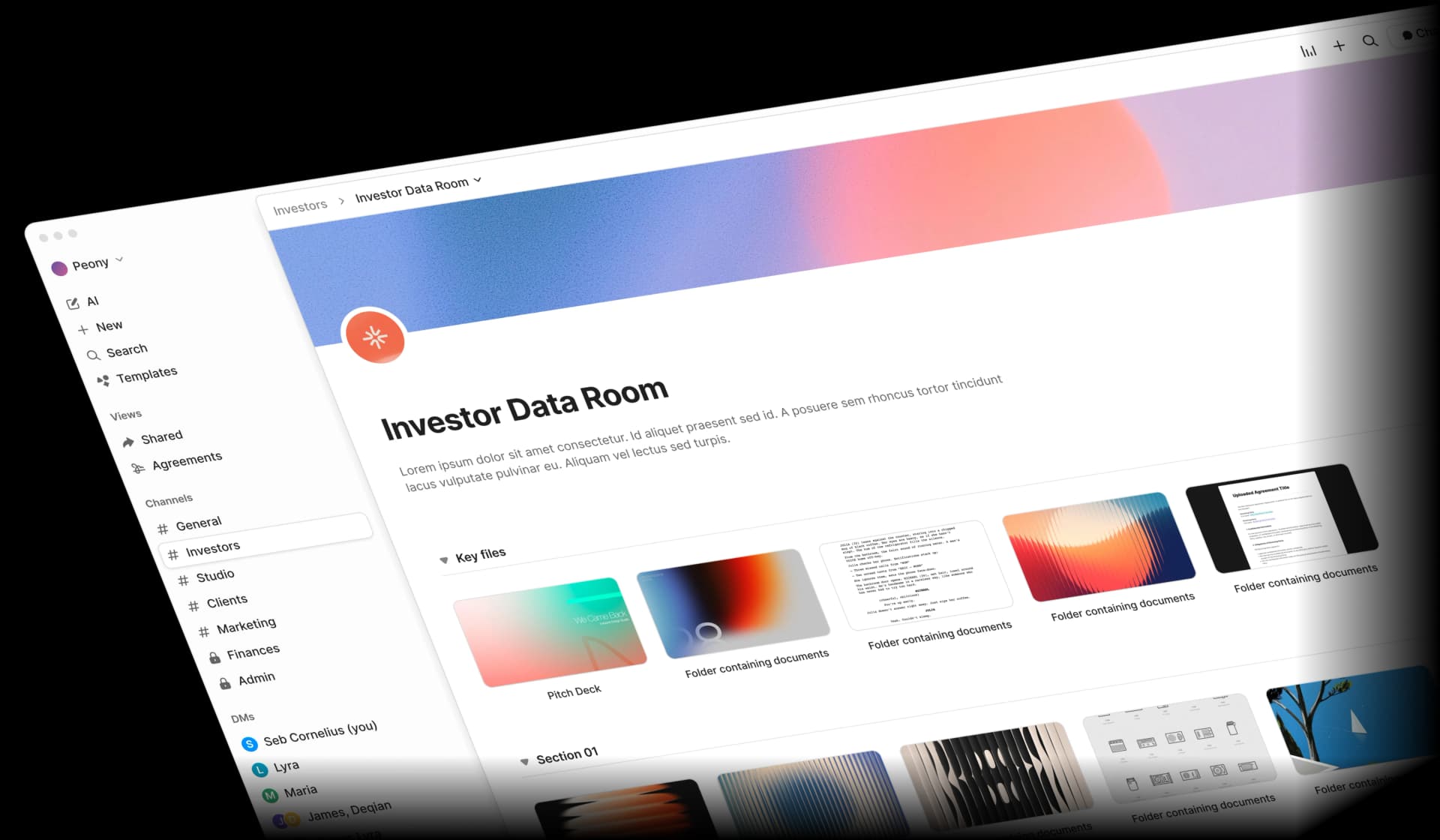
Peony was the fastest platform I tested — 3 minutes and 40 seconds from first click to sharing a live data room link. No sales call, no onboarding form, no waiting for a "dedicated project manager" to email me back. For context, Datasite took four business days of back-and-forth before I even got sandbox access, and Intralinks took over a week.
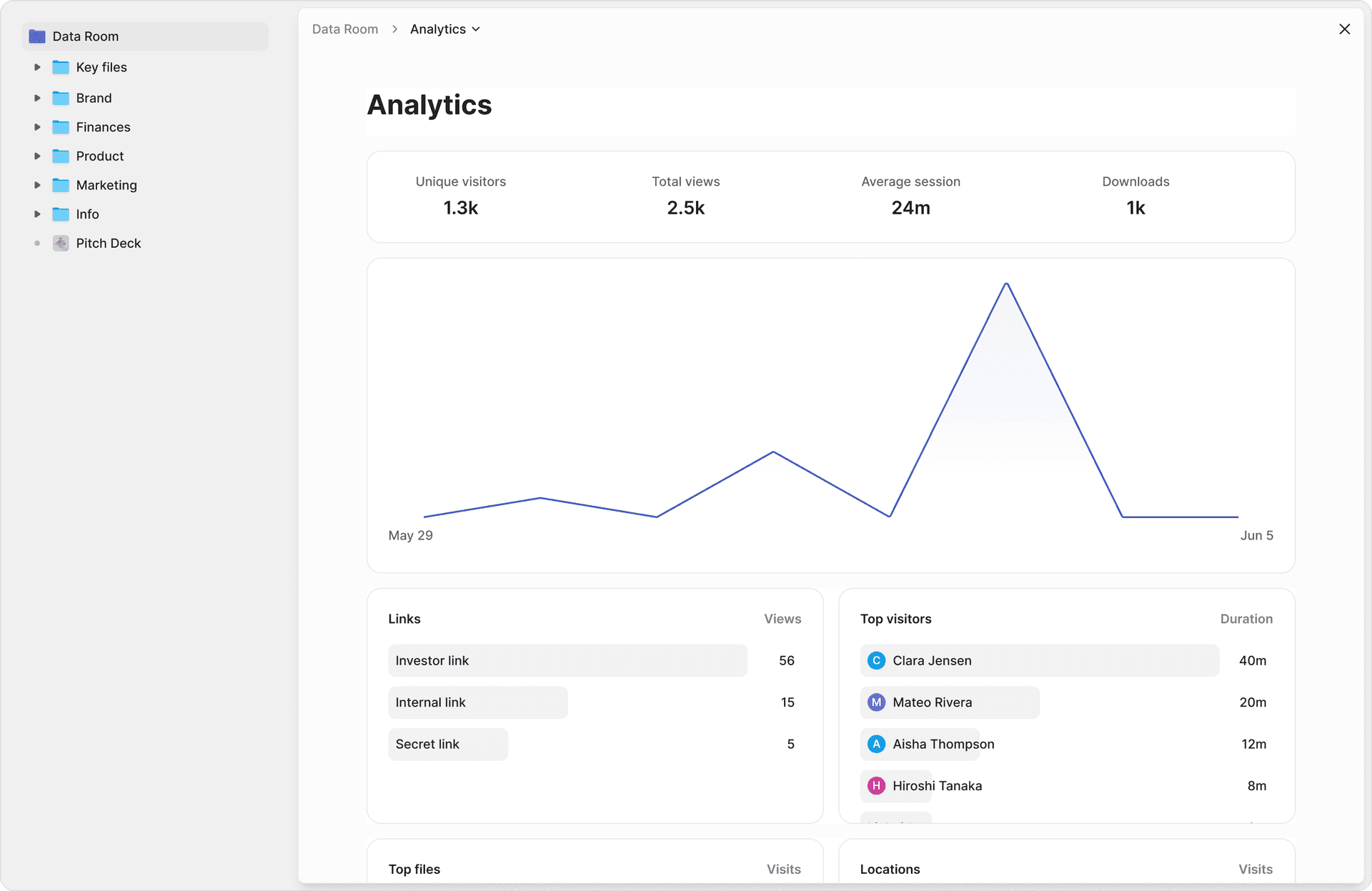
What separated Peony from every other platform was the analytics depth. After sharing a test room with five reviewers, I could see exactly which pages each person spent time on, where they re-read sections, and when they dropped off. When one reviewer spent 14 minutes on the cap table but skipped the financials entirely, I knew exactly where to follow up. Ideals and Firmex show views and downloads — Peony shows behavior. That is a fundamentally different level of insight for fundraising and due diligence.
The security features also stood out in testing. I tried to screenshot a watermarked document — Peony blocked it and logged the attempt. I tested the NDA gate — reviewers had to sign before seeing a single page. I tested link revocation and confirmed the reviewer lost access within seconds. I tested the Q&A workflow — counterparties submitted questions, AI drafted answers, my team reviewed them, and approved responses were sent with a full audit trail. These are features that Datasite and Intralinks charge five figures for, and Peony includes them on the Business plan at $40/admin/month.
The AI document extraction feature is worth calling out separately: I asked natural-language questions across an entire document set and got cited answers with exact page numbers. During a simulated due diligence review, this saved roughly two hours of manual document searching. The AI redaction tool identified PII, financial data, and sensitive terms, then suggested redactions before sharing — a feature I have only seen at this level from Datasite, which charges 50x more.
What users are saying:
"We looked at DocSend etc. but the cost and clunkiness just put us off." — Anthony Gale, Founder and CEO, PromoLens
"Peony is a standout for data rooms and gated file sharing — intuitive, secure, and beautifully designed. The AI actually adds value, not just a checkbox feature." — Michael Hui, Managing Director, Piton Partners
"DocSend and PDFs require 3 extra clicks to book a meeting. Peony is easily the best form factor for sharing client facing material." — Robi Lin, Founder and CEO, Sepal AI (YC S24)
Pricing:
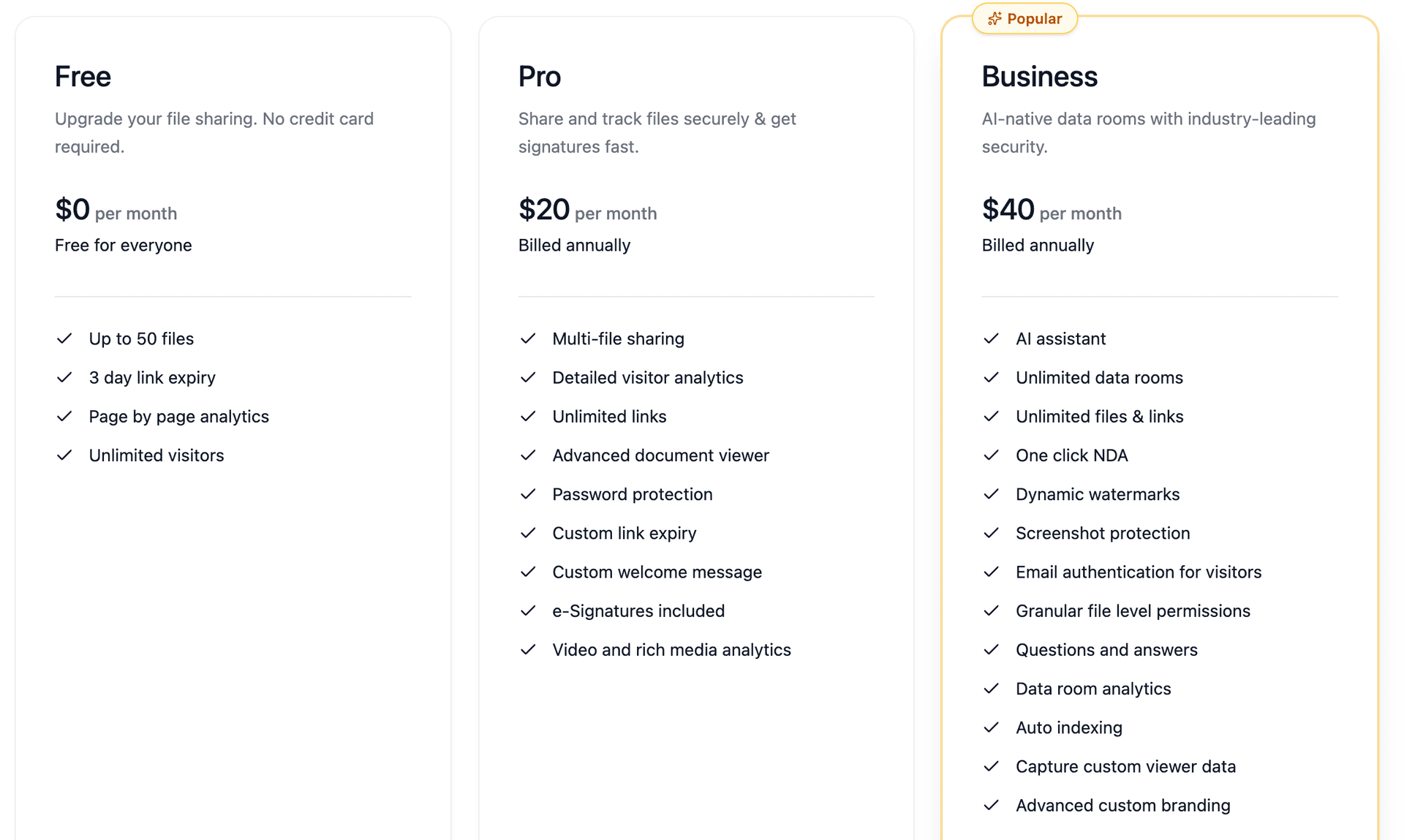
- Free: $0/month — up to 50 files, page-by-page analytics, unlimited visitors, email authentication
- Pro: $20/admin/month (annual) — e-signatures, detailed visitor analytics, unlimited links, password protection, video analytics
- Business: $40/admin/month (annual) — AI assistant, unlimited data rooms, dynamic watermarks, screenshot protection, NDA gates, granular file-level permissions, Q&A workflows, auto-indexing, advanced custom branding
No per-page fees. No per-viewer charges. No storage overages. See full pricing details.
Key features:
- AI auto-indexing: Automatically organizes and classifies uploaded documents into deal-ready folder structures in under three minutes
- Page-level analytics: See exactly which pages each visitor viewed, how long they spent per page, re-read patterns, and where attention dropped — not just "opened the link"
- Screenshot protection and dynamic watermarks: Blocks and logs screenshot attempts; bakes viewer identity into every rendered frame to trace any leak
- NDA gates: Require visitors to sign an NDA before accessing a single document, built directly into the sharing flow
- E-signatures: Sign documents directly within the data room — no separate tool needed, with AI-powered field detection
- AI document extraction: Ask natural-language questions across your entire document set and get cited answers with exact page numbers
- Smart Q&A: Counterparties submit questions, AI drafts answers, your team reviews, approved responses are sent with a full audit trail
- AI redaction: AI identifies PII, financial data, and sensitive terms and suggests redactions before sharing
- Multi-level access gating: NDA gates plus password protection plus email verification plus 2FA — layer controls per document or folder
Best for: Startups raising capital, venture capital firms, private equity deal teams, founders managing investor data rooms, lean M&A teams, real estate transactions, legal workflows, and anyone who needs enterprise-grade security without enterprise pricing or enterprise sales cycles.
Limitations: Peony is purpose-built for deal workflows and secure sharing. It does not yet have FedRAMP or ITAR compliance certifications, so government contractors with those specific requirements should look at Box or Intralinks. For mega-cap cross-border transactions where institutional buyers specifically require a legacy brand name on the data room, Datasite still carries more institutional recognition.
Verdict: 4.9/5 — best for any deal under $500M where AI, page-level analytics, and transparent pricing matter more than brand recognition.
Explore Peony's data room features | See pricing
2. Datasite
The enterprise gold standard for large-cap M&A.
Getting into Datasite required a sales call, a qualification form, and a follow-up email chain that lasted four business days before I got sandbox access. Once inside, though, the AI capabilities are genuinely impressive — I uploaded 200 mixed documents and the auto-classification sorted them into the right categories with roughly 90% accuracy. The redaction tool caught PII types I would have missed manually. The generative AI tools for document summarization worked better than I expected.
Datasite (formerly Merrill DataSite) has been the default choice for investment banks and large law firms for decades. In 2026, they have invested heavily in AI — document classification, AI-powered redaction across 100+ PII types, and generative AI tools for summarization and explanation. They were the first VDR provider to earn ISO/IEC 42001 certification for AI governance, which matters for firms with formal AI procurement policies.
Pricing: Custom and quote-based only. Datasite uses a per-page pricing model (roughly $0.60 per page by third-party estimates). For a typical large data room, expect $25,000 to $100,000+ per year. Smaller deals still typically start at five figures. No self-serve signup exists.
Key features: AI document classification, AI redaction (100+ PII types), generative AI (summarize, explain, translate), advanced analytics dashboard, Q&A workflows with escalation, bulk operations at scale, ISO 42001 AI governance certification.
Best for: Large-cap M&A transactions, investment banks managing multiple concurrent deals, and firms where budget is secondary to capability and institutional credibility. Ranked number one on G2's Spring 2025 VDR grid (4.5/5, 332 reviews).
Limitations: Pricing is significantly higher than alternatives — G2 reviewers rate value-for-money lowest at 4.2/5. Steep learning curve that requires dedicated training. Permission management becomes cumbersome with large folder structures. No self-serve option means you cannot evaluate the platform without committing to a sales process.
Verdict: 2.5/5 — best for large-cap brand-name M&A where institutional credibility justifies $25K+/yr and a multi-week onboarding.
3. Ideals
The mid-market workhorse with best-in-class support.
I tested Ideals' support response time and they were not exaggerating — my first chat was answered in 22 seconds. The platform itself feels like a polished Toyota: nothing flashy, everything works. Bulk upload was smooth, permissions were intuitive, and the Q&A management is the cleanest I tested among mid-market providers. Where Ideals fell short: the analytics dashboard shows views and downloads but nothing approaching page-level engagement data, and I had to convert Excel files to PDF before uploading — a real pain point for financial due diligence.
Ideals has earned its reputation through relentless focus on customer support — 24/7 availability in 10+ languages. With over 1 million users across 175,000+ companies, it is one of the most widely adopted VDR platforms globally and a G2 Leader for five consecutive years.
Pricing: Quote-based, not publicly listed. Third-party sources estimate starting at roughly $500/month. Ideals underwent pricing changes after a 2024 product relaunch.
Key features: Granular permissions, full-text search, bulk upload with auto-indexing, activity tracking, custom watermarks, Q&A management. Strong compliance: ISO 27001, SOC 2/3, HIPAA, GDPR.
Best for: Mid-market M&A, private equity firms, and legal teams that value responsive human support and a proven track record over cutting-edge AI features.
Limitations: No meaningful AI capabilities beyond basic search. Can be expensive for smaller companies. Excel files must be converted to PDF, losing functionality — a genuine pain point for financial due diligence where spreadsheet formulas matter.
Verdict: 3.5/5 — best for mid-market M&A teams that prioritize 24/7 human support in 10+ languages over AI features.
4. Intralinks
The enterprise legacy platform for cross-border deals.
Intralinks was the hardest platform to evaluate. The sales process took over a week, pricing was deliberately opaque, and the demo environment felt like it was designed in 2015. That said, the IRM (information rights management) controls are best-in-class — I could revoke access to a downloaded document after the fact, which no other platform I tested besides CapLinked can do. If you are running a $500M+ cross-border deal and need the strongest possible post-download controls, the security credentials are unmatched.
SS&C Intralinks claims to have facilitated over $35 trillion in transactions since creating the world's first virtual data room in 2002. Backed by SS&C Technologies (over $5 billion in revenue), it targets the largest, most complex cross-border transactions where regulatory compliance across multiple jurisdictions is non-negotiable.
Pricing: Custom and quote-based with a per-page model. Typical ranges: $10,000/year for small projects to $200,000+ for enterprise deployments. Known for opaque pricing and lengthy sales negotiations.
Key features: AI redaction (70+ PII presets), AI document classification, IRM controls that persist after download including remote access revocation, real-time dashboards, custom watermarking, ISO 27701 data privacy certification.
Best for: Cross-border enterprise M&A, financial services firms managing regulatory-heavy transactions, and organizations that need the strongest possible post-download security credentials for institutional buyers.
Limitations: The UI is consistently described as dated and clunky in reviews. Opaque pricing makes budgeting difficult. Lower user satisfaction scores than competitors (Capterra 4.1/5). No self-serve evaluation path.
Verdict: 2.6/5 — best for cross-border enterprise deals where post-download IRM persistence and ISO 27701 are hard requirements.
5. Firmex
The mid-market favorite for advisory firms running multiple deals.
Firmex impressed me with how quickly I could spin up multiple data rooms — the unlimited rooms model means no mental overhead about whether this deal "justifies" another room. The drag-and-drop interface is clean, the watermarking is solid, and the dedicated customer success manager (included in the subscription) responded to my test query within two hours. What I missed: no AI features at all, and the UI noticeably slowed when I loaded a room with 500+ documents.
Firmex has served 223,000+ companies since 2006, carving out a strong position in the mid-market. Their key differentiator is annual subscriptions that include unlimited self-serve data rooms, making them cost-effective for advisory firms running multiple concurrent deals from a single subscription.
Pricing: Quote-based with a transparent structure — single-project pricing by data volume and duration, or annual subscription for unlimited rooms based on storage. Third-party estimates average roughly $7,800/year, with individual deal pricing up to approximately $18,000.
Key features: Unlimited data rooms on subscription plans, bulk upload with auto-indexing, document watermarking, redaction, download and print restrictions, Q&A management, graphic reports, 24/7 dedicated customer success manager included.
Best for: Advisory firms, PE funds, and legal teams managing multiple deals simultaneously where unlimited rooms make the subscription model economical. Highest user satisfaction in the mid-market (G2 4.6/5, 92% recommend).
Limitations: Lacks AI features entirely — no document classification, no generative AI tools, no AI-assisted organization. UI performance degrades with very large document sets. Permission management becomes challenging at scale across many concurrent rooms. For teams looking at Firmex but unsure whether the no-AI tradeoff is worth it, our deeper Firmex alternatives breakdown maps the AI-native and budget-tier options side by side.
Verdict: 3.2/5 — best for advisory firms running multiple concurrent mandates on one unlimited-rooms subscription.
6. Ansarada
AI-driven deal preparation — now part of Datasite.
Ansarada's free preparation phase is genuinely useful — I organized an entire data room during the free period before deciding whether to activate. The bidder engagement scoring was the most interesting analytics feature I tested outside of Peony: it predicted which of my test reviewers were "highly engaged" based on viewing patterns, and it was right. The catch? Storage limits are punishing — 250 MB at $499/month means you are paying per megabyte at a rate that feels absurd in 2026.
Important note: Datasite acquired Ansarada in August 2024 for approximately AUD $240 million. The Ansarada brand still operates independently, but long-term product direction and pricing are uncertain under Datasite ownership.
Pricing: Storage-tiered: $499/month (250 MB), scaling to $2,499/month (4 GB). Free preparation phase before deal activation — genuinely useful for getting organized before committing.
Key features: AI bidder engagement scoring (97% accuracy by day seven of a deal), Smart Sort document classification, AiDA deal assistant, deal readiness scoring, tenders, and custom workflows.
Best for: Sell-side advisors who want AI-assisted deal preparation and are comfortable with storage-based pricing. The free prep phase is a legitimate advantage for teams that want to organize before activating billing.
Limitations: Storage limits are tight for the price — 250 MB at $499/month is restrictive for document-heavy deals. Browser compatibility issues reported by users. The Datasite acquisition creates uncertainty about the platform's independent future and pricing trajectory.
Verdict: 3.4/5 — best for sell-side advisors who want AI bidder scoring and a free prep phase before activating billing.
7. DealRoom
The full M&A lifecycle platform for serial acquirers.
DealRoom surprised me — I expected a VDR and got a full project management tool for M&A. The pipeline tracker, diligence request lists, and post-merger integration planning are features I have not seen in any other data room platform. For a corporate development team running four acquisitions simultaneously, this is genuinely the right tool. But if you just need to share documents securely for a single deal, you are paying $1,000/month for features you will never touch.
Pricing: $1,000/month flat (billed annually) for Diligence or Pipeline plans. Unlimited users and unlimited storage included — no per-seat fees. FirmRoom (their standalone VDR product) starts at $500/month.
Key features: M&A pipeline management, due diligence request tracking with automated checklists, integration management, unlimited users and storage, custom branding, multi-deal portfolio view.
Best for: Corporate development teams and serial acquirers who need pipeline-to-integration tooling, not just a document room. The unlimited user pricing model is attractive for deals involving many stakeholders across multiple workstreams.
Limitations: Smaller company (roughly 2,000 customers) compared to established players. Customer support is weaker than Firmex or Ideals based on my testing. Limited third-party integrations. The $1,000/month price point is steep if you only need standard VDR functionality for a single deal.
Verdict: 3.0/5 — best for corporate development teams that need pipeline-to-integration tooling, not just a document room.
Compare Peony vs FirmRoom (DealRoom)
8. SecureDocs
The simplest, cheapest monthly option for straightforward deals.
SecureDocs was the second-fastest setup I tested — about 8 minutes from signup to sharing a live room. The interface is deliberately simple: upload, set permissions, share. No AI, no fancy analytics, no learning curve. For a straightforward seed-round data room or a single-purpose deal, $250/month flat with unlimited users is hard to argue with. Where it falls short: the analytics are basic (views and downloads only), and if your deal grows complex, you will outgrow this platform fast.
Pricing: $250/month flat fee — unlimited users, unlimited documents, 24/7 support included. Also offers $400/month for 3-month project-based engagements. No hidden fees.
Key features: Unlimited users and documents, drag-and-drop upload, basic permissions, watermarking, activity tracking, NDA click-through, 24/7 support. SOC 2 compliant.
Best for: Simple fundraising rounds, early-stage startup data rooms, single-purpose data rooms where you need basic security at the lowest monthly cost. Highest user satisfaction on Capterra (4.9/5, 161 reviews).
Limitations: Basic reporting with no page-level analytics or engagement scoring. No AI features. No SSO or SAML. Limited collaboration tools. If your deal grows in complexity, you will outgrow SecureDocs quickly and need to migrate mid-deal.
Verdict: 4.0/5 — best for the simplest, cheapest single-purpose data room where flat-rate $250/month and unlimited users matter most.
9. Box (VDR)
Enterprise content management with VDR features bolted on.
I tested Box's Enterprise Plus tier (roughly $50/user/month) to see whether it could genuinely function as a VDR. The verdict: it is a content management platform with VDR features added on top, not a purpose-built data room. The integrations (1,500+) are impressive, the compliance certifications are the broadest in the market, and Box AI's document Q&A feature worked surprisingly well for ad-hoc questions. But there are no Q&A deal workflows, no pipeline tools, no bidder analytics — and per-user pricing adds up fast when you need to give 30 external reviewers access to a deal room.
Pricing: $15 to $50 per user per month depending on tier. VDR features (watermarking, advanced permissions, compliance controls) require Enterprise ($35/user/month) or Enterprise Plus (roughly $50/user/month, contact sales). Per-user pricing compounds quickly with external parties.
Key features: 1,500+ app integrations, granular permissions, metadata-driven workflows, Box AI for document Q&A, e-signatures via Box Sign, compliance coverage across regulated industries (FedRAMP, HIPAA, FINRA, ITAR, GxP).
Best for: Organizations already using Box for content management that need occasional VDR functionality without adding a separate vendor. Strong for regulated industries — healthcare, financial services, government, defense — where specific compliance certifications like FedRAMP are hard requirements.
Limitations: Not purpose-built for deals — no structured Q&A workflows, no deal pipeline management, no bidder analytics. VDR-grade features are gated behind the most expensive tiers. Per-user pricing becomes expensive with many external reviewers. No page-level analytics or engagement heatmaps.
Verdict: 2.8/5 — best for regulated enterprises that need FedRAMP, HIPAA, FINRA, or ITAR certifications alongside content management.
10. Google Drive
Ubiquitous cloud storage — but never a substitute for a real VDR.
I included Google Drive because I still see teams attempting to run due diligence processes out of shared Google Drive folders, and I want to be clear about why this is a serious risk. Google Drive is excellent for internal team collaboration. It is not a virtual data room. For a detailed comparison, see VDR vs cloud storage: key differences. There is no watermarking, no screenshot protection, no NDA gates, no access revocation after sharing, no page-level analytics, no structured Q&A workflows, and no audit trail that would satisfy a counterparty's legal team.
I tested a simulated due diligence flow in Google Drive: shared a folder with five reviewers, then tried to track engagement. All I could see was whether someone had the folder open — not which documents they viewed, not how long they spent, not whether they downloaded anything. One reviewer forwarded the link to a colleague outside the deal, and I had no way to detect or prevent it.
Pricing: $12/user/month (Business Starter) to $18/user/month (Business Standard). Enterprise pricing available.
Key features: Real-time collaboration, 15 GB free storage (2 TB+ on paid plans), Google Workspace integration, basic sharing permissions (view, comment, edit), version history.
Best for: Internal team collaboration, early-stage document drafting, and situations where security is not a primary concern. Never appropriate for M&A due diligence, investor data rooms, or any transaction involving confidential documents.
Limitations: No dynamic watermarking. No screenshot protection. No NDA gates. No document-level permissions (only folder-level). No engagement analytics beyond "last opened." No audit trail sufficient for legal proceedings. No access revocation for downloaded files. Forwarded links cannot be tracked or controlled. For a detailed breakdown, see our guide on how to protect documents in Google Drive — and why it is not enough for deal workflows.
Verdict: 2.0/5 — never use for an actual deal; fine for internal team collaboration only.
11. CapLinked
Mid-market flat-fee VDR with built-in DRM.
CapLinked serves nearly 500 Fortune 1000 companies including Bank of America, KPMG, and Deloitte. The flat-fee pricing ($399/month, no per-user charges) makes it straightforward for mid-market deals where you want predictable costs without enterprise sales conversations. The built-in digital rights management (DRM) prevents copying, printing, and forwarding of documents even after download — a feature not prominently offered by most providers in this list.
The platform is solid but not modern — no AI-powered features, no auto-indexing, no AI Q&A. If you need a reliable, mid-priced VDR with strong document protection and predictable billing, CapLinked fills the gap between $250/month budget options and $10,000+ enterprise platforms. For teams that also want AI capabilities at a lower price point, Peony Business at $40/admin/month includes AI auto-indexing, AI Q&A, and page-level analytics that CapLinked does not offer.
Pricing: Team plan at $399/month flat (no per-user charges). Enterprise plans start at $500/month or $5,000/year with a price match guarantee. 14-day free trial available.
Key features: Built-in DRM with copy/print protection, OCR-enhanced document search, unlimited guest users on all plans, full audit trail, SOC 2 compliant, custom watermarking, structured Q&A tool.
Best for: Mid-market M&A deals and fundraising rounds where you need flat-fee pricing without per-user surcharges and strong DRM protection. Capterra 4.5/5 (123 reviews).
Limitations: Interface feels dated compared to newer platforms. No AI features — no auto-indexing, no AI Q&A, no AI redaction. Analytics are basic compared to platforms with page-level engagement data. At $399/month, it costs 10x more than Peony Business while offering fewer features.
Verdict: 3.3/5 — best for mid-market deals that need flat-fee pricing with built-in DRM and unlimited guest users.
12. Venue by DFIN
Enterprise VDR backed by a publicly traded financial services company.
Venue is the VDR product of Donnelley Financial Solutions (NYSE: DFIN), rebuilt from the ground up in September 2025. DFIN also offers SEC compliance tools (ActiveDisclosure) and AI contract analysis (eBrevia), making Venue part of a broader deal ecosystem that standalone VDR providers cannot match. The rebuild introduced AI-powered bulk document redaction and real-time viewer insights.
Venue is positioned at the premium end alongside Datasite and Intralinks. The publicly traded parent company (market cap roughly $6 billion) provides institutional stability, but the pricing is enterprise-grade — expect $1,500+ per month based on user reports.
Pricing: Quote-based only (no public pricing). Historically per-page pricing (roughly EUR 0.45/page). User-reported cost approximately EUR 1,500/month for 1 GB storage. Premium positioning alongside Datasite and Intralinks.
Key features: AI-powered bulk document redaction (PII, financial data, confidential terms), real-time viewer analytics, self-launch with bulk upload and instant page counts, ISO 27001 and SOC 2 Type 2 certified, SSO and MFA support, 24/7 dedicated deal support, integrated with DFIN compliance ecosystem.
Best for: Large-cap M&A, IPO preparation, and SEC-regulated transactions where the deal team needs integrated compliance tools. Investment banks and law firms already using DFIN products who want a single-vendor deal stack. G2 4.4/5.
Limitations: Premium pricing prohibitive for small deals or startups. Legacy users report a learning curve during migration to the rebuilt platform. No self-serve trial available. For teams that need comparable AI redaction at a fraction of the cost, Peony Business at $40/admin/month includes AI-powered redaction that identifies PII and sensitive terms.
Verdict: 2.3/5 — best for large-cap M&A and IPO prep where the integrated SEC and DFIN compliance ecosystem justifies enterprise pricing.
13. ShareVault
The life sciences and biotech specialist.
ShareVault is the only VDR endorsed by the Biotechnology Innovation Organization (BIO) and more than 50 life science trade associations. If your deal involves clinical trial data, FDA/EMA regulatory submissions, or biopharma licensing, ShareVault has pre-built templates and workflows designed specifically for these verticals. The HIPAA-compliant environment handles patient health information (PHI), and the platform includes remote document shredding — the ability to remotely destroy documents on viewers' devices after access is revoked.
None of the other 14 providers in this list have this level of life sciences specialization. For general M&A or fundraising, other platforms offer more value. But for biotech and pharma deals, ShareVault's vertical focus is genuinely differentiated.
Pricing: Quote-based only (no public pricing). Three tiers: Express, Pro, Enterprise. Pricing based on storage volume and project duration. No setup fees. Positioned between legacy enterprise VDRs and generic file-sharing platforms.
Key features: HIPAA-compliant environment for PHI, industry-specific templates for biotech/pharma workflows, remote document shredding, integration with electronic lab notebooks (ELNs), DocuSign, Salesforce, and Office 365, dynamic watermarking, granular access controls with document expiration and revocation.
Best for: Biotech startups, pharmaceutical companies, CROs (contract research organizations), and medtech firms managing clinical trial data, licensing deals, or regulatory submissions. G2 4.5/5.
Limitations: No public pricing — requires contacting sales. Document uploading requires manual tagging and folder specification, which reviewers describe as tedious compared to platforms with AI auto-indexing. Limited AI capabilities compared to modern platforms like Peony or Datasite.
Verdict: 2.7/5 — best for life sciences and biotech deals where BIO endorsement and HIPAA-compliant PHI workflows are non-negotiable.
14. Digify
Post-download document protection with patent-pending DRM.
Digify solves a problem most VDRs ignore: what happens to your documents after someone downloads them. The platform's patent-pending Persistent Protection After Download (PPAD) technology lets you retain control over files even after download — you can revoke access, set expiry dates, and block printing or forwarding on files that already sit on someone's device. The Screenshield anti-screenshot technology adds another layer that most providers lack.
At $180/month (Pro) or $480/month (Team), Digify is lighter than a full enterprise VDR but stronger on document-level security than almost any provider in this list. The Capterra rating (4.9/5, 174 reviews) is the highest of any VDR platform on the site.
Pricing: Pro plan at $180/month ($130/month billed annually). Team plan at $480/month ($330/month billed annually). Enterprise plan with custom pricing. 7-day free trial available.
Key features: Patent-pending DRM with post-download control (revoke, expire, restrict), Screenshield anti-screenshot protection with detection, page-level analytics, dynamic watermarking, unlimited data rooms, ISO 27001, GDPR, and HIPAA compliant with AES-256 and RSA-2048 encryption.
Best for: SMBs and startups sharing sensitive IP, pitch decks, or confidential documents who need document-level security without a full enterprise VDR. Capterra 4.9/5 (174 reviews) — highest-rated VDR on Capterra.
Limitations: Not a full-featured deal management VDR — lighter on Q&A workflows and bulk deal management compared to Datasite, Firmex, or Peony. Some reviewers report slow loading times with large files. Peony offers screenshot protection that both blocks and logs attempts, plus full Q&A workflows and AI-powered rooms at $40/admin/month.
Verdict: 3.7/5 — best for SMBs and IP-heavy teams that need patent-pending post-download DRM and Screenshield anti-screenshot.
15. Tresorit
Swiss zero-knowledge encryption for maximum privacy.
Tresorit is headquartered in Switzerland and owned by Swiss Post (the national postal service). The platform uses zero-knowledge end-to-end encryption, meaning even Tresorit's own employees cannot access your files — a level of cryptographic privacy no other provider in this list offers. For European companies, regulated industries, or any organization where "even our VDR provider should not be able to read our data" is a hard requirement, Tresorit is the only real option.
The dedicated data room product (Tresorit Engage) supports deal-specific workflows including structured collaboration, branded client portals, and audit logs. The business plans start at $14.50/user/month — significantly cheaper per user than most VDRs, though per-user pricing adds up with large reviewer groups.
Pricing: Business Standard at $14.50/user/month (billed annually, minimum 3 users, 1 TB/user). Business Plus at $19/user/month (2 TB/user). Enterprise with custom pricing (50+ users). Tresorit Engage (data room product) priced separately. 14-day free trial available.
Key features: Zero-knowledge end-to-end encryption (provider cannot access files), Swiss jurisdiction with Swiss Post ownership, ISO 27001, GDPR, TISAX, and FINRA compliant, smart room cloning and industry templates, granular role-based access control, built-in e-signatures, detailed audit logs.
Best for: European companies needing GDPR-strict data rooms, regulated industries (automotive/TISAX, financial/FINRA), law firms handling privileged communications, and organizations with zero-trust security requirements. Capterra 4.9/5, G2 4.5/5.
Limitations: The data room product (Tresorit Engage) is relatively newer — less mature in deal-specific workflows (Q&A, bulk indexing) compared to dedicated VDR players like Peony, Ideals, or Datasite. Per-user pricing can become expensive for deals with many external reviewers — unlike Peony which charges per admin with unlimited visitors included.
Verdict: 3.2/5 — best for European and zero-trust teams that need Swiss zero-knowledge encryption and GDPR/TISAX compliance.
What does a virtual data room actually cost in 2026?
A virtual data room costs anywhere from $0/month (Peony Free) to $200,000+/year (Datasite, Intralinks) — and on legacy enterprise platforms, the true cost is typically 2–10x the quoted starting price once per-page upload fees, per-viewer surcharges, and storage overages are factored in. The biggest surprise from testing all 15 providers was how much hidden pricing inflates the real cost. Here is what I found across the $0 to $200K VDR pricing chasm:
| Provider | Starting Price | Pricing Model | Hidden Fees to Watch | True Annual Cost (Typical Deal) |
|---|---|---|---|---|
| Peony | Free ($0) | Per-admin, transparent | None — no per-page, per-viewer, or storage fees | $0 to $480/yr |
| Datasite | Custom ($25K+/yr) | Per-page + custom | Per-page upload ($0.40 to $0.85/pg), overage charges, PM fees | $25,000 to $200,000+/yr |
| Ideals | ~$500/mo | Quote-based | Post-relaunch pricing unclear, potential overage fees | $6,000 to $30,000+/yr |
| Intralinks | Custom ($10K+/yr) | Per-page + custom | Per-page fees, user charges, lengthy contract minimums | $10,000 to $200,000+/yr |
| Firmex | ~$650/mo | Volume-based subscription | Storage overages on single-deal plans, per-deal fees | $7,800 to $18,000/yr |
| Ansarada | $499/mo (250 MB) | Storage-tiered | Steep per-MB overages above tier, post-acquisition uncertainty | $6,000 to $30,000/yr |
| DealRoom | $1,000/mo flat | Flat rate (annual) | Annual billing lock-in, separate FirmRoom pricing | $12,000/yr |
| SecureDocs | $250/mo flat | Flat rate | Project-based plans at $400/mo for 3 months | $3,000 to $4,800/yr |
| Box (VDR) | $35/user/mo | Per-user | Per-user for external reviewers, VDR features on highest tier only | $5,000 to $50,000+/yr |
| Google Drive | $12/user/mo | Per-user | Not a VDR — lacks all deal-grade security features | $144/user/yr (but no VDR capability) |
| CapLinked | $399/mo flat | Flat rate | None — no per-page, per-user, or storage fees | $4,800/yr |
| Venue (DFIN) | Custom (~$1,500+/mo) | Per-page + custom | Per-page fees, project management surcharges | $18,000 to $100,000+/yr |
| ShareVault | Quote-based | Storage-based | Potential storage overages above tier | $6,000 to $30,000+/yr |
| Digify | $180/mo (Pro) | Tiered per-plan | Annual billing saves up to 43%, enterprise quotes | $1,560 to $5,760/yr |
| Tresorit | $14.50/user/mo | Per-user | Per-user for external reviewers, Engage pricing separate | $522/user/yr (3-user minimum) |
Key takeaway: Legacy VDR providers commonly charge per-page upload fees, per-user access fees for external reviewers, storage overages, and project management surcharges. A 10,000-page deal on Datasite can incur $4,000 to $8,500 in upload fees alone before anyone views a document. Peony's pricing is fully transparent with no hidden fees. For a deeper analysis, see our virtual data room cost guide.
How should you choose a virtual data room?
Forget the feature matrices for a moment. After testing all 15 platforms, the decision collapses to a two-question filter: how complex is your deal, and what is the one capability you cannot compromise on. Most teams overcomplicate the choice — the two-question filter narrows 15 options to two or three in under a minute.
Question 1: How complex is your deal?
This is the single biggest filter. Deal complexity determines whether you need a $0 platform or a $25,000+ one — and most teams overestimate their complexity.
- Simple sharing (pitch deck, fewer than 50 documents, fewer than 10 viewers): You need analytics and basic security, not enterprise infrastructure. Peony Free or SecureDocs. Total cost: $0 to $250/month.
- Single active deal (due diligence, 50 to 5,000 pages, 3 to 20 external reviewers, Q&A needed): You need granular permissions, structured Q&A, and engagement tracking. Peony Business, Ideals, or CapLinked. Total cost: $40 to $500/month.
- Multi-deal portfolio (PE fund or advisory firm running 3+ concurrent deals, LP reporting alongside deal rooms): You need unlimited rooms, deal-level isolation, and portfolio-wide analytics. Peony Business, Firmex, or DealRoom. Total cost: $40 to $1,000/month.
- Cross-border enterprise ($500M+ deal, 50+ reviewers across jurisdictions, regulatory requirements like FedRAMP or ITAR, institutional buyers who mandate a specific vendor): You need maximum compliance certifications, post-download IRM controls, and a brand name that satisfies board governance. Datasite or Intralinks. Total cost: $25,000 to $200,000+/year.
Question 2: What is the one capability you cannot compromise on?
Every platform trades something off. Knowing your non-negotiable narrows the field to two or three options:
- If analytics depth is non-negotiable — you need to know which pages each reviewer read, not just "someone opened the link" — Peony is the only platform with true page-level behavioral data on a free tier. Ansarada offers AI bidder scoring but at $499/month with 250 MB storage limits.
- If post-download control is non-negotiable — you need to revoke access to files already downloaded — Intralinks (IRM controls) or Digify (patent-pending DRM) are the only real options. This matters for cross-border deals where documents cross jurisdictional boundaries.
- If compliance certifications are non-negotiable — FedRAMP, ITAR, HIPAA, or TISAX are hard requirements from your counterparty's legal team — Box (broadest certifications), ShareVault (HIPAA plus BIO endorsement), or Tresorit (TISAX plus Swiss jurisdiction) depending on which certification you need.
- If transparent pricing is non-negotiable — you need to know exactly what you will pay before signing anything — Peony ($0/$20/$40 per admin), SecureDocs ($250/month flat), or CapLinked ($399/month flat) are the only providers with fully public pricing.
- If AI capability is non-negotiable — auto-indexing, AI Q&A, and AI redaction save days of manual work — Peony Business ($40/month) or Datasite ($25,000+/year) are the only platforms with full AI suites. The 600x price difference reflects institutional overhead, not a 600x capability gap.
- If human support response time is non-negotiable — your deal team needs answers in minutes, not hours — Ideals (22-second average chat response, 24/7 in 10+ languages) is unmatched. Firmex includes a dedicated customer success manager on subscription plans.
Most teams only have one true non-negotiable. If you have two, find the overlap in the lists above. If you think you have four, you are overcomplicating the decision — run the two-question filter (deal complexity + non-negotiable capability) and the shortlist writes itself. For deeper sibling guidance on the cost side of this choice, see our virtual data room cost guide; on the alternatives side, our DocSend alternatives roundup covers the lighter-weight pitch-deck-sharing tier.
The two-question filter at a glance
| Deal complexity | Non-negotiable capability | Best choice | Realistic monthly cost |
|---|---|---|---|
| Simple sharing (≤50 docs, ≤10 viewers) | Transparent pricing | Peony Free or SecureDocs | $0 to $250 |
| Single active deal (50–5,000 pages) | Page-level analytics depth | Peony Business or Ideals | $40 to $500 |
| Multi-deal portfolio (3+ concurrent) | Unlimited rooms | Peony Business or Firmex | $40 to $1,000 |
| Cross-border enterprise ($500M+ deal) | Post-download IRM | Datasite or Intralinks | $25,000 to $200,000+/yr |
| Regulated (FedRAMP/ITAR/HIPAA) | Specific compliance certification | Box, ShareVault, or Tresorit | $500 to $5,000+ |
| Sell-side prep with budget for AI | AI auto-indexing + Q&A | Peony Business or Datasite | $40 vs $25,000+/yr |
Which VDR provider should you choose for your specific situation?
The situation-to-best-choice grid below maps 15 common deal scenarios to the right platform. Each row is a one-line shortlist — pick the row that matches your deal and the answer is that simple.
| Your Situation | Best Choice | Why |
|---|---|---|
| Startup raising seed or Series A | Peony (Free or Pro) | Free page-level analytics, e-signatures, and unlimited visitors at $0 to $20/month — 90% cheaper than any alternative |
| Mid-market M&A (sub-$500M deal) | Peony (Business) or Ideals | Peony at $40/month has comparable features to Ideals at $500+/month — both support full due diligence workflows |
| Large-cap enterprise M&A ($500M+) | Datasite | Institutional credibility, deepest AI tools, and the brand recognition that mega-deal counterparties expect |
| Cross-border regulatory deal | Intralinks | IRM controls persist after download, ISO 27701 certification, strongest post-download security |
| PE firm with multiple concurrent deals | Peony (Business) or Firmex | Peony at $40/month with unlimited rooms, or Firmex unlimited subscription for firms committed to their ecosystem |
| Corporate development team (serial M&A) | DealRoom | Only platform with pipeline-to-integration lifecycle tools and unlimited users at flat pricing |
| Simple, one-time data room | Peony (Free) or SecureDocs | Peony Free ($0) for up to 50 files with analytics, or SecureDocs ($250/month) for unlimited files without analytics |
| Regulated industry (FedRAMP required) | Box (VDR) | Broadest compliance certifications including FedRAMP, HIPAA, FINRA, and ITAR |
| Sell-side deal preparation | Ansarada | Free prep phase and AI bidder scoring — useful if you can work within tight storage limits |
| Internal team collaboration only | Google Drive | Fine for drafting and collaboration, but never use for external deal sharing |
| Biotech or pharma deal | ShareVault | Only VDR endorsed by BIO with HIPAA-compliant environment and life science workflow templates |
| Need post-download file control | Digify | Patent-pending DRM lets you revoke, expire, or restrict files after download — strongest post-download protection |
| European/GDPR-strict requirement | Tresorit | Zero-knowledge Swiss encryption — even the provider cannot read your files |
| SEC-regulated IPO or compliance deal | Venue (DFIN) | Integrated SEC filing tools, AI redaction, NYSE-listed parent company with full compliance ecosystem |
| Mid-market flat-fee with DRM | CapLinked | $399/month flat with built-in DRM, unlimited guests, and Fortune 1000 client base |
The situation-to-best-choice grid above is the fastest way to translate a vague "we need a data room" requirement into a concrete shortlist. Match the row, run the two-question filter, and the decision usually narrows to one or two platforms.
Which data room is best for each use case?
After spending weeks inside all 15 platforms, the biggest takeaway is straightforward: most teams are overpaying for features they do not use, and the $0 to $200K VDR pricing chasm between modern and legacy providers has never been wider. Here is the use-case-by-use-case shortlist.
For startup fundraising
You need fast setup, polished sharing experience, investor-grade analytics, and a price that does not eat into your runway. Peony (Free to $40/admin/month) gives you AI-powered organization, page-level analytics, e-signatures, and screenshot protection at a price point that is 90% cheaper than most VDR platforms. Check our guide on building a data room for investors and our startup data room best practices.
For mid-market M&A
You need granular permissions, Q&A workflows, reliable support, and the ability to handle multiple concurrent deals. Ideals (best-in-class support) or Firmex (unlimited rooms on subscription) are proven options. If budget matters — and it should — Peony Business at $40/admin/month includes comparable features at a fraction of the cost. See our M&A data room category overview for the full landscape, our due diligence data room checklist for what to include, and our M&A process guide for the full deal lifecycle.
For large-cap enterprise M&A
You need maximum AI capability, the deepest permission models, and institutional credibility that satisfies board-level governance requirements. Datasite is the market leader. Intralinks is the alternative for cross-border deals with complex regulatory requirements across multiple jurisdictions. See our M&A data room guide and tax due diligence checklist for enterprise-grade preparation.
For private equity deal teams
PE firms need data rooms that handle fund administration, LP reporting, portfolio monitoring, and deal-by-deal due diligence — often simultaneously. Peony Business at $40/admin/month supports all of these workflows with AI-powered Q&A, NDA gating, and page-level analytics showing exactly which LPs reviewed which documents. For larger firms committed to legacy ecosystems, Firmex or Ideals are established alternatives. See our PE data room guide, VC fund data room checklist, and investment due diligence checklist.
For corporate development teams
If you manage the full deal lifecycle from pipeline to post-merger integration, DealRoom ($1,000/month flat, unlimited users) is the only platform purpose-built for that workflow with deal tracking, request management, and integration planning tools.
For the simplest possible data room
If your needs are basic — upload documents, share a link, track who viewed what — Peony Free ($0, up to 50 files with page-level analytics) or SecureDocs ($250/month, unlimited everything) get you running in under five minutes. Peony Free is the better starting point because it includes analytics that SecureDocs does not offer at any price.
What should you actually look for in a virtual data room?
After hands-on time with every major provider, six things actually matter — and most marketing noise can be ignored. The list below is the 6-criteria VDR evaluation rubric I now apply to every platform before recommending it to a deal team.
-
Security that goes beyond encryption. Every provider encrypts data. The real differentiators are screenshot protection, dynamic watermarking with viewer identity baked in, granular per-document permissions, and instant access revocation. These are the features that prevent leaks during live deals — not checkbox compliance certifications.
-
Analytics that drive decisions. Knowing someone "opened a link" is not analytics. You need page-level engagement data — which sections they read, how long they spent, and where they dropped off. This is especially critical for fundraising, where understanding investor interest shapes your follow-up timing and strategy.
-
AI that saves real time. Auto-indexing, document classification, AI-assisted Q&A, and AI redaction are no longer nice-to-haves. They cut days off data room setup and due diligence review. But be wary of AI marketing — some providers slap "AI" on basic keyword search and call it innovation.
-
Transparent pricing. Quote-based pricing hides costs. If a provider will not show you a price before a sales call, expect to pay 2 to 10x what transparent providers charge for equivalent features. See our VDR cost guide for a detailed pricing breakdown.
-
Fast setup. A data room that takes two weeks to configure is a data room that slows your deal. Modern platforms should get you from signup to sharing in under an hour — ideally under five minutes.
-
Built-in workflows. E-signatures, NDA gates, and structured Q&A should be native to the platform, not separate tools bolted on. Every handoff between tools is a leak risk and a friction point.
Apply the 6-criteria VDR evaluation rubric (security beyond encryption, decision-driving analytics, time-saving AI, transparent pricing, fast setup, built-in workflows) and most platforms wash out fast. For a deeper overview of VDR fundamentals, read our complete guide to virtual data rooms. For comparisons against specific incumbents, see our breakdowns of Firmex alternatives and DocSend alternatives, or read what we found inside the M&A data room category end-to-end.
Frequently Asked Questions
I run an M&A advisory boutique — which data rooms do investment banks actually use in 2026?
For boutique advisory on deals from $1M to $50M, the realistic shortlist in 2026 is: Peony for deals where you want AI-powered setup in under 5 minutes and page-level analytics showing which buyers are actually engaged, Ideals for firms that want 24/7 human support in 10+ languages, and Firmex for firms running multiple concurrent mandates on one subscription. The bulge-bracket banks default to Datasite ($25,000+/year) and Intralinks ($10,000+/year), but that pricing is sized for $500M+ transactions. For deals under $50M, Peony Business at $40/admin/month gives you the same security stack — NDA gates, dynamic watermarks, screenshot protection, AI Q&A — at less than 1% of the enterprise price. The capability gap between modern and legacy platforms has closed. The pricing gap has not.
Our PE fund manages both portfolio exits and LP fundraising — can one data room handle both?
Yes — if the platform supports separate rooms with different permission models per deal. Your exit room needs granular file-level permissions, structured Q&A with counterparty management, NDA gates, and audit trails. Your LP room needs engagement analytics showing which LPs actually read the quarterly letter versus skimming, plus document-level access controls for sensitive fund data. Peony handles both from one account: create separate rooms for each workflow, each with its own permissions, analytics, and Q&A. At $40/admin/month with unlimited rooms and unlimited visitors, the economics work for running multiple concurrent workstreams — something that would cost $50,000+/year if you set up separate Datasite instances.
Our deal team budgets $5,000 per transaction for tech tools — is that realistic for a data room?
$5,000 per transaction is more than enough for any deal under $50M — and honestly, you should be spending far less. Peony Business at $40/admin/month ($480/year) includes AI auto-indexing, page-level analytics, NDA gates, screenshot protection, dynamic watermarks, and structured Q&A. For a 3-month deal, that is $120 total. Mid-range options like SecureDocs ($250/month flat) or CapLinked ($399/month) cost $750 to $1,200 for the same period. The only platforms that blow through a $5,000 budget are legacy enterprise providers like Datasite and Intralinks, which charge per-page upload fees that reach $4,000 to $8,500 on a 10,000-page deal before anyone views a document.
We're raising our Series A and the lead investor asked for a data room — what should we look for?
Your lead investor is asking because they want to see how organized you are — the data room itself signals operational maturity. Prioritize four things: (1) setup speed, because your term sheet has a timeline and you cannot spend two weeks configuring software, (2) page-level analytics so you know which investors actually read your financial model versus skimming the exec summary, (3) built-in e-signatures to close the round without switching to a separate tool, and (4) transparent pricing that does not eat into your runway. Peony is purpose-built for this: Free includes page-level analytics and unlimited visitors, Pro ($20/month) adds e-signatures, and Business ($40/month) adds AI auto-indexing, NDA gates, and screenshot protection. Do not overpay for enterprise features you will never use at Series A.
I'm a partner at a mid-size law firm — what security features should I require before uploading client documents to a data room?
Before uploading client documents, verify six layers: (1) AES-256 encryption at rest and in transit — baseline, every VDR offers this, (2) granular permissions at the document level, not just folder level, so you control exactly who sees what, (3) dynamic watermarking with viewer identity baked in so leaked documents are traceable, (4) screenshot protection that blocks and logs attempts, not just watermarks that can be cropped, (5) instant access revocation, and (6) a complete audit trail exportable for court proceedings. Peony Business ($40/admin/month) includes all six layers plus NDA gates that require reviewers to sign before accessing a single page. Most competitors gate watermarking and screenshot protection behind enterprise tiers at $500+/month.
Our founding team shares investor updates via Google Drive — when should we switch to a real data room?
Switch the moment you share documents with anyone outside your founding team for a transaction — fundraising, due diligence, or any conversation where confidentiality matters. Google Drive has no watermarking, no screenshot protection, no NDA gates, no access revocation after sharing, no page-level analytics, and no audit trail that would satisfy a counterparty's legal team. If one investor forwards your Google Drive link to a colleague outside the deal, you cannot detect or prevent it. Peony Free ($0) gives you everything Google Drive lacks for external sharing: page-level engagement analytics, email authentication, link expiry, and access revocation. The switch takes under 5 minutes.
We're a growth-stage company that might raise or get acquired — do we need separate data rooms for each?
No — use one platform with separate rooms for each scenario. Your fundraising room needs investor engagement analytics, pitch deck tracking, and a polished sharing experience. Your M&A room needs structured Q&A, NDA gates, AI-powered document organization, and granular file-level permissions for buyer due diligence. Peony handles both from a single account with unlimited rooms on the Business plan ($40/admin/month). Keep your fundraising materials and M&A materials in separate rooms with different permissions — you do not want a potential acquirer seeing your fundraising pitch, or vice versa.
We just signed a new sell-side mandate and need a data room live by Monday — how fast can modern platforms be set up?
You can go from signup to sharing a live data room link in under five minutes. Peony's AI auto-indexing organizes your uploaded documents into deal-ready folder structures in under three minutes — upload everything, let the AI sort it, review and adjust. Legacy enterprise platforms like Datasite and Intralinks typically require onboarding calls, dedicated project managers, and one to two weeks of configuration before you can share a single document. For a Monday deadline, sign up for Peony now, upload your documents tonight, and share the link Monday morning. No sales call required.
Our fund got hit with a $12,000 overage bill from our last data room — what hidden fees should we watch for?
Your $12,000 overage was likely a combination of four common fee traps: (1) per-page upload fees ($0.40 to $0.85 per page), which on a 10,000-page deal adds $4,000 to $8,500 before anyone views a document, (2) per-user access fees for external reviewers, which punish you for running a competitive process with multiple bidders, (3) storage overages that trigger when your document set exceeds the tier, and (4) project management surcharges. Peony eliminates all four with transparent per-admin pricing: Free ($0), Pro ($20/month), and Business ($40/month) with unlimited visitors, unlimited pages, and no storage overages.
I sent my pitch deck to 30 investors and have no idea who read it — which data room gives the deepest engagement analytics?
Peony gives you the deepest engagement analytics of any platform tested: page-level heatmaps showing exactly which of your 30 investors read which pages, how long they spent per page, where they re-read sections, and where they dropped off. If one investor spent 14 minutes on your financial model but skipped the market analysis, you know exactly what to address in the follow-up. Most competitors only show document-level data — someone opened the link, someone downloaded the file. Ansarada offers AI bidder engagement scoring at $499/month with a 250 MB cap. Peony's page-level analytics are available on the Free plan ($0) with unlimited visitors.
My deal team has always used Datasite but the cost keeps climbing — is Peony actually credible for a $200M acquisition?
Yes, for any deal under $500M. Peony includes AI-powered document organization, page-level analytics, dynamic watermarking, screenshot protection, NDA gates, structured Q&A, and e-signatures at $40/admin/month — features Datasite charges $25,000+ per year for. The security stack is equivalent: AES-256 encryption, 2FA, instant access revocation, full audit trails. The main exception is mega-cap cross-border M&A where institutional buyers specifically require a legacy brand name, or where FedRAMP/ITAR certifications are non-negotiable. For a $200M domestic acquisition, Peony covers everything your deal team needs at less than 1% of the Datasite price.
We're a 3-person startup raising our seed round — should we use a free data room or pay for something like Datasite?
For a seed round with fewer than 50 documents and fewer than 10 investors reviewing, you do not need an enterprise platform. Peony Free ($0) includes page-level analytics, unlimited visitors, and email authentication — the three features that matter most at seed stage. Datasite's AI document classification and cross-border compliance capabilities are designed for $500M+ deals with 50+ reviewers, not a seed round with a pitch deck and a financial model. The decision framework is simple: if your deal involves fewer than 5,000 pages and fewer than 10 external reviewers, start with Peony Free and upgrade to Business ($40/admin/month) only when you need AI auto-indexing, NDA gates, or screenshot protection for larger rounds.
Our PE fund runs 4-5 deals per year in the $50M to $200M range — what criteria should we prioritize when evaluating data rooms?
For mid-market PE running multiple concurrent deals, prioritize in this order: (1) unlimited rooms without per-deal pricing so you get deal-level isolation without cost overhead per room, (2) page-level analytics that show which buyers are genuinely engaged versus just browsing so you can time follow-ups, (3) AI auto-indexing that organizes financial statements, legal documents, and operational data into buyer-ready folder structures in minutes rather than weeks, (4) structured Q&A workflows for managing counterparty questions across multiple deals simultaneously. Peony Business ($40/admin/month) covers all four. Firmex covers points 1 and 4 but lacks page-level analytics and AI. Datasite covers all four but at $25,000+/year, which is only justified if your LPs or institutional buyers specifically require the Datasite brand.
Related Resources
- What Is a Virtual Data Room? Complete Guide
- Virtual Data Room Cost Guide
- VDR vs Cloud Storage: Key Differences
- Best Data Rooms for Startups
- Best Data Rooms for Private Equity
- Data Room for Investors: Setup Guide
- State of M&A Data Rooms in Q1 2026 — benchmarks on VDR costs, timelines, and file volumes
- Due Diligence Data Room Checklist
- Investment Due Diligence Checklist
- Tax Due Diligence Checklist
- VC Fund Data Room Checklist
- Data Room Folder Structure Guide
- M&A Process Guide
- Acquisition Integration Guide
- How to Set Up a Data Room
- Independent Sponsor Guide
- Data Room Features
- Peony Pricing
- Peony vs Datasite
- Peony vs Ideals
- Peony vs Ansarada
You might also like
May 22, 2026
What Is Firmex Virtual Data Room? Founding, Datasite Acquisition, Q&A Workflow, and 2026 Pricing — A Buyer's Explainer
Mar 28, 2026
Virtual Data Room Permissions for Due Diligence (Most Over-Share) in 2026
Mar 24, 2026
How to Set Up a Data Room (Skip the 40-Hour Trap) in 2026