
The hedge fund data room for DDQs, ODD and investor reporting
Send each allocator your DDQ, PPM and track record behind an NDA, see which pages their operational due diligence team read, and keep strategy files, side letters and LP reports walled off by vehicle: guard your alpha, and share your DD without losing control.
The data room purpose-built for hedge fund managers, IR teams, and allocators: distribute DDQs, offering memoranda, and investor letters without risking strategy leaks. Set up in under 5 minutes; the median on Peony from sign-up to first uploaded document is 4 min 19 s.
No credit card · 7-day Data Room trial that never auto-charges · allocators view free, no account
24/7 dedicated support for enterprise deals
Last updated October 2026
8,000+ customers in 60+ countries · $44.7B in client assets
Peony staff can't open your documents, your documents aren't used to train AI, and Peony has had no data breach since launch.
What is a hedge fund data room, and how does Peony run one?
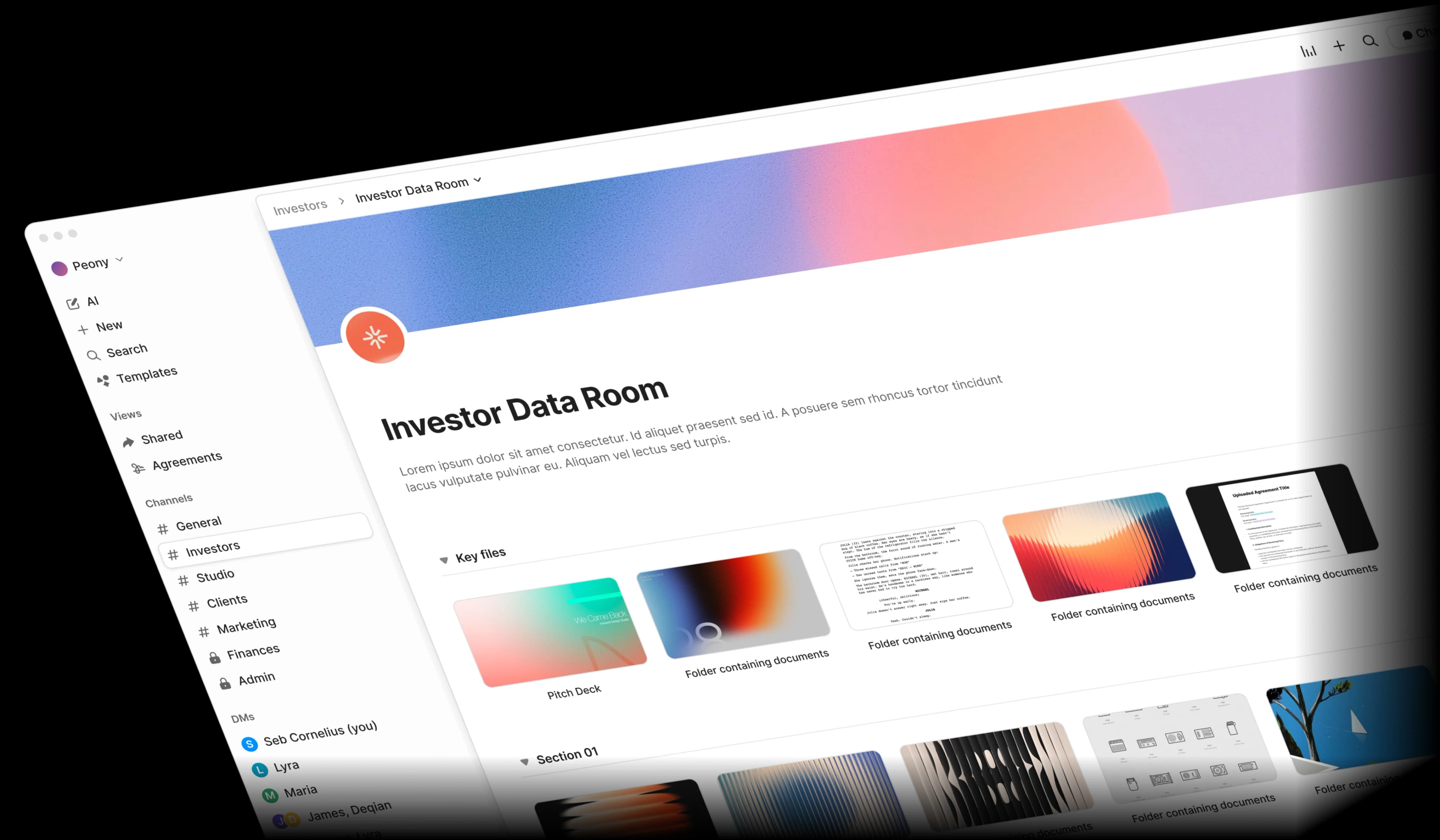
Peony is a virtual data room that hedge fund managers and IR teams use to share DDQs and offering documents with allocators, see which pages each allocator reads, and keep strategy files behind an NDA.
A hedge fund data room is a secure online space where a manager shares its offering and due diligence documents with allocators, consultants and investors, with verified access, page-level read tracking and revocation. It typically holds the offering memorandum, the DDQ, Form ADV, the track record, audited financials, investor letters, side letters and K-1s.
On Peony, an allocator process runs on Data Room, the most popular plan: $52 per admin per month billed yearly ($75 monthly), with unlimited rooms and storage, and allocators, consultants and LPs view free with no account.
- Share your DD with each allocator: the DDQ, PPM, track record and Form ADV in one room, with a group, NDA and watermark per allocator, and the current version always at the same link.
- See who read what: page-level analytics show which pages each allocator and consultant opened, for how long and when they came back, and the per-allocator audit trail keeps the record for your CCO.
- Wall off strategies and vehicles: strategy memos behind screenshot protection and a signed NDA, and each LP's letters, side letter and K-1s in a folder only that LP can open.
Peony at a glance
- Built for
- Hedge fund managers from emerging managers raising first institutional capital to multi-strategy platforms, and their IR, capital-raising, COO and CCO teams: allocator and consultant due diligence, operational due diligence, offering documents, side letters and investor reporting.
- Typical plan
- Data Room, $52 per admin per month billed yearly ($75 monthly): unlimited rooms, documents and storage, a signed NDA with audit record, dynamic watermarks with each viewer's email and IP, a group with its own folder permissions for each allocator or vehicle, access questions, Visitor Q&A, Screenshield, a custom domain and the per-allocator audit trail.
- Pricing
- Business $30, Data Room $52 and Deal Team $64 (minimum 4 admins) per admin per month billed yearly ($44, $75 and $89 monthly); Enterprise is custom. Free ($0) covers 50 documents and 500 MB as tracked single-file links; data rooms start on Business.
- Allocators
- Allocators are unlimited and free on every plan and don't need a Peony account. You pay per admin, not per viewer.
- Rooms and storage
- Unlimited data rooms, documents and storage on Data Room and above, and no per-file size cap on any plan. Business includes 3 data rooms per admin, 1,000 documents per admin and 100 GB of storage, with no per-file size cap.
- DDQ and ODD
- Keep the completed AIMA or ILPA DDQ as the master copy and update it in place with Upload new version. Index documents numbers every folder and file (1, 1.1, 1.2...) so both sides can say "open 2.3" (Data Room plan). Visitor Q&A keeps each allocator's follow-up questions in its own question team (Data Room).
- Vehicles and side letters
- One room with a group per vehicle or investor, so each LP opens only its own letters, side letter and K-1s (Data Room). Send side letters and subscription documents for e-signature, unlimited from Business.
- Strategy protection
- Downloads off and desktop screenshot protection (Business); Screenshield on mobile, dynamic watermarks and a signed NDA before page one (Data Room); redaction that permanently removes fee terms from a PDF before release (Deal Team).
- AI on fund documents
- AI document Q&A answers across PPMs, side letters and DDQs with page citations, for your team and for any allocator group you switch it on for (Business and up; 5x usage on Data Room). AI features switch on after you upgrade.
- Strategy separation
- Put each strategy's admins in their own team, restricted to that team's rooms in team settings, with the COO in every team.
- Activity records
- Page-level views on every plan; CSV export of views, sessions and downloads (Business); a per-allocator audit trail (Data Room). Logs are kept 1 year on Business, 2 years on Data Room and with no time limit on Deal Team and Enterprise.
- Live HTML
- Peony renders .html files live with JavaScript running, so a Claude or ChatGPT artifact (a model, dashboard or calculator) stays interactive for the viewer, behind your NDA gate, permissions and analytics. The dynamic watermark applies to documents, so pair a live dashboard with screenshot protection and an NDA gate.
- Works alongside
- Your administrator's investor portal, your CRM and your books-and-records archive stay the systems of record; Peony is the controlled sharing layer for the documents that leave them.
- Versus legacy VDRs
- Legacy data rooms like Ideals and Datasite charge five or six figures annually; on Peony, two admins on Data Room pay $1,248 a year, and allocators are free. See the virtual data room cost guide.
- Hosting
- AWS US (us-east-1); EU-region hosting on Enterprise.
- Security
- AES-256 at rest, TLS 1.2+ in transit. Peony staff can't open your documents, your documents aren't used to train AI, and Peony has had no data breach since launch. Peony's incident-response policy commits to telling affected customers within 72 hours of confirming an incident that affects customer data. SOC 2 Type II-ready and ISO 27001-ready, with both audits underway. Compliance and certifications
- Setup
- Median 4 min 19 s from sign-up to first uploaded document (State of M&A Data Rooms, Q3 2026 edition).
- Trial
- 7-day Data Room trial you start yourself: no credit card, and it never auto-charges. Rooms, files, links, analytics and NDA settings carry over when you upgrade. AI features switch on after you upgrade.
- Support
- 24/7 support, handled directly by the Peony team across Europe, US and Asia hours, with no outsourced tier. Everyone you speak to on Peony support has M&A experience at elite boutiques or bulge-bracket banks, VC experience, or has raised $1M+ themselves.
- Customers
- 8,000+ customers in 60+ countries, with $44.7B in client assets.
Which hedge fund teams use a data room, and for what?
Emerging managers, multi-strategy platforms, IR teams, COOs and CCOs use a Peony data room to send allocators the DDQ and offering documents, run operational due diligence, and keep each investor's reporting to its own vehicle.
Emerging managers raising first institutional capital
The PPM, DDQ and track record as tracked links on Free or Business, then one allocator room on Data Room ($52/admin/mo billed yearly) when consultants and seeders start diligence. See the emerging manager data room guide.
Multi-strategy platforms and multi-vehicle managers
A room per strategy or vehicle, or one room with a group per vehicle; each strategy's IR admins in their own team, restricted to that team's rooms in team settings.
IR and capital-raising teams
A link or group per allocator, an email each time one opens the deck or DDQ, page-level reading data, and a CSV export (Business) to match views to your CRM by email.
COOs and CCOs
The operational due diligence room: compliance manual, policies, Form ADV and service-provider files released in stages, with a per-allocator audit trail of who opened what (Data Room).
Crypto and digital-asset funds
Performance, custody and operational metrics shown to allow-listed allocators only, with downloads off, screenshot protection and an expiry date, so nothing sits on a public page.
Seeders, funds of funds and allocators
Collect DDQ responses and ODD files from the managers you review: give each manager an Upload folder in your room, with no account needed (Data Room). Family offices: see Peony for family offices.
Built for how hedge funds actually operate: Peony gives you institutional-grade document security, AI-powered fund intelligence, and SEC-ready audit trails — at a fraction of legacy data room pricing.
How do hedge funds manage secure document sharing with allocators and investors?
Hedge funds share confidential documents through links or data rooms that verify each recipient, can be revoked, record what was read and tie every copy to its viewer; Peony does all four.
An email attachment can't be recalled, and a password travels with the file. For a DDQ, strategy memo or tear sheet, send a Peony link with email verification and downloads off; for a full allocator process, run one room with a group per allocator, each behind a signed NDA and its own watermark.
| Method | Only named people open it | Can be revoked after sending | Shows which pages were read | Controls downloads and screenshots | Ties each copy to its viewer |
|---|---|---|---|---|---|
| Email attachment | No: anyone the email reaches can open it | No | No | No: the attachment is the copy | No |
| Password-protected PDF | No: anyone with the password can open it | No | No | Depends on the PDF settings | No |
| Shared-drive link | Depends on the sharing settings | Yes, if you remove access | Depends on the tool | Depends on the tool | Depends on the tool |
| Administrator's investor portal | Yes, for investors with a portal login | Depends on the vendor | Depends on the vendor | Depends on the vendor | Depends on the vendor |
| Peony tracked link | Yes: an emailed one-time code and an allow list (Business) | Yes: switch it off (Business) or set an expiry (every plan) | Yes: every page, time per page and return visits (every plan) | Downloads off and desktop screenshot protection (Business) | Dynamic watermark with the viewer's email and IP (Data Room) |
| Peony allocator room | Yes: only the allocator's listed emails get in | Yes: switch the allocator's group off, or set one folder to No access (Data Room) | Yes, plus a per-allocator audit trail (Data Room) | View or Download per folder, plus Screenshield on mobile (Data Room) | Dynamic watermark on every page and a signed NDA (Data Room) |
Why is hedge fund document sharing a liability?
Strategy memos forwarded to competitors. DDQs floating in email chains. Side letters scattered across shared drives. Every unsecured document is alpha walking out the door.
Strategy doc leaks
Investment theses, position reports, and trade models shared via email or Dropbox are one forward away from eroding your edge.
Regulatory scrutiny
SEC and FCA examiners expect complete audit trails for document access. Generic file-sharing tools cannot prove who reviewed your Form ADV or PPM.
Multi-vehicle LP reporting
Distributing quarterly letters, K-1s, and capital account statements across flagship, long-short, and co-invest vehicles manually is error-prone and slow.
Investor onboarding friction
New LPs and allocators need access to offering docs, track records, and operational DDQs — without seeing proprietary research meant for existing investors.
The longer playbook for fund documents is in our data room for investors guide.
How should a hedge fund share its DDQ with allocators?
Keep one master copy of your completed DDQ in a Peony room, give each allocator its own group behind an NDA, and update the DDQ in place so every allocator always opens the current version.
Allocators usually send one of two published templates or their own variant. AIMA's Illustrative Questionnaire for the Due Diligence of Investment Managers is modular; its 2025 edition, presented on March 12, 2025, keeps the modular approach AIMA adopted in 2017, adds a Private Markets strategy module, and refines questions on performance presentations, outsourcing, technology risks, counterparty, leverage and liquidity risks, anti-money laundering and expense disclosures. ILPA DDQ 2.0, the Institutional Limited Partners Association's questionnaire, was released November 1, 2021, to "standardize the key areas of inquiry posed by investors during their diligence of managers."
Keep one master DDQ
Upload the completed DDQ (PDF, Word or Excel) with its supporting documents. When you revise it, Upload new version replaces it in place: same position, same link, and every earlier version one click away in the version menu.
Give each allocator its own group
One group per allocator or consultant, with email verification and an allow list (Business), a signed NDA before page one and folder permissions (Data Room), so each sees only the folders you release.
Watermark and lock it down
Dynamic watermarks print each viewer's email and IP on every page (Data Room); turn downloads off and screenshot protection on (Business). Redaction permanently removes fee terms from a PDF before release (Deal Team).
Answer follow-ups in the room
Visitor Q&A keeps each allocator's questions in its own question team (Data Room), and an answer to a process-wide question can go to every team at once without revealing who asked. Deal Team adds expert and approver routing before anything is published.
Draft faster from your own documents
AI document Q&A finds the source page behind each DDQ answer across your PPM, policies and letters, with page citations, so your IR team drafts responses from what the documents actually say (Business and up).
What each template covers, section by section, is in our due diligence questionnaire guide.
What do allocators' operational due diligence teams ask a hedge fund for?
Operational due diligence teams ask for regulatory filings, offering terms, policies, service-provider details, controls and investor reporting; on Peony, a manager releases them from one ODD room, folder by folder.
Structure the room the way the questionnaire is structured, so the analyst can match each answer to its evidence. AI room generation proposes a folder structure from a one-line description of the deal before you upload (Data Room plan). Index documents numbers every folder and file (1, 1.1, 1.2...) so both sides can say "open 2.3" (Data Room plan). Turn on Hide new content by default and files you add stay hidden until you release them group by group, so the operations folders open after the first meeting, not before.
Firm and regulatory
Form ADV Parts 1 and 2A, Part 2B supplements, compliance manual, code of ethics, regulatory registrations and exam correspondence
Fund and offering
Offering memorandum (PPM), fund constitutional documents, subscription documents, side letters and MFN summaries, the completed AIMA or ILPA DDQ
Performance and reporting
Track record with its calculation support, monthly and quarterly investor letters, performance attribution, audited financial statements
Service providers
Administrator, prime broker, custodian, auditor and legal counsel, with the administrator's controls report and service agreements
Operations and risk
Valuation policy, trade allocation and personal trading policies, cash controls, business continuity plan, cybersecurity and vendor oversight policies
Investors and tax
K-1s or other investor tax statements, capital account statements, transparency and risk reports, by investor and vehicle
Form ADV Parts 1 and 2A are public on the SEC's adviser database (IAPD), so analysts often read them before the room opens; the room puts the filed versions next to what isn't public. How ODD teams test each area is in our guides to LP operational due diligence and operational due diligence.
How do you keep strategy documents and tear sheets away from competitors?
Send strategy documents and tear sheets on Peony links that only allow-listed allocators can open, with downloads off, screenshots blocked and every page watermarked with the viewer's identity. A leaked copy then traces back to one person.
Screenshot protection, watermarks, and NDA gates
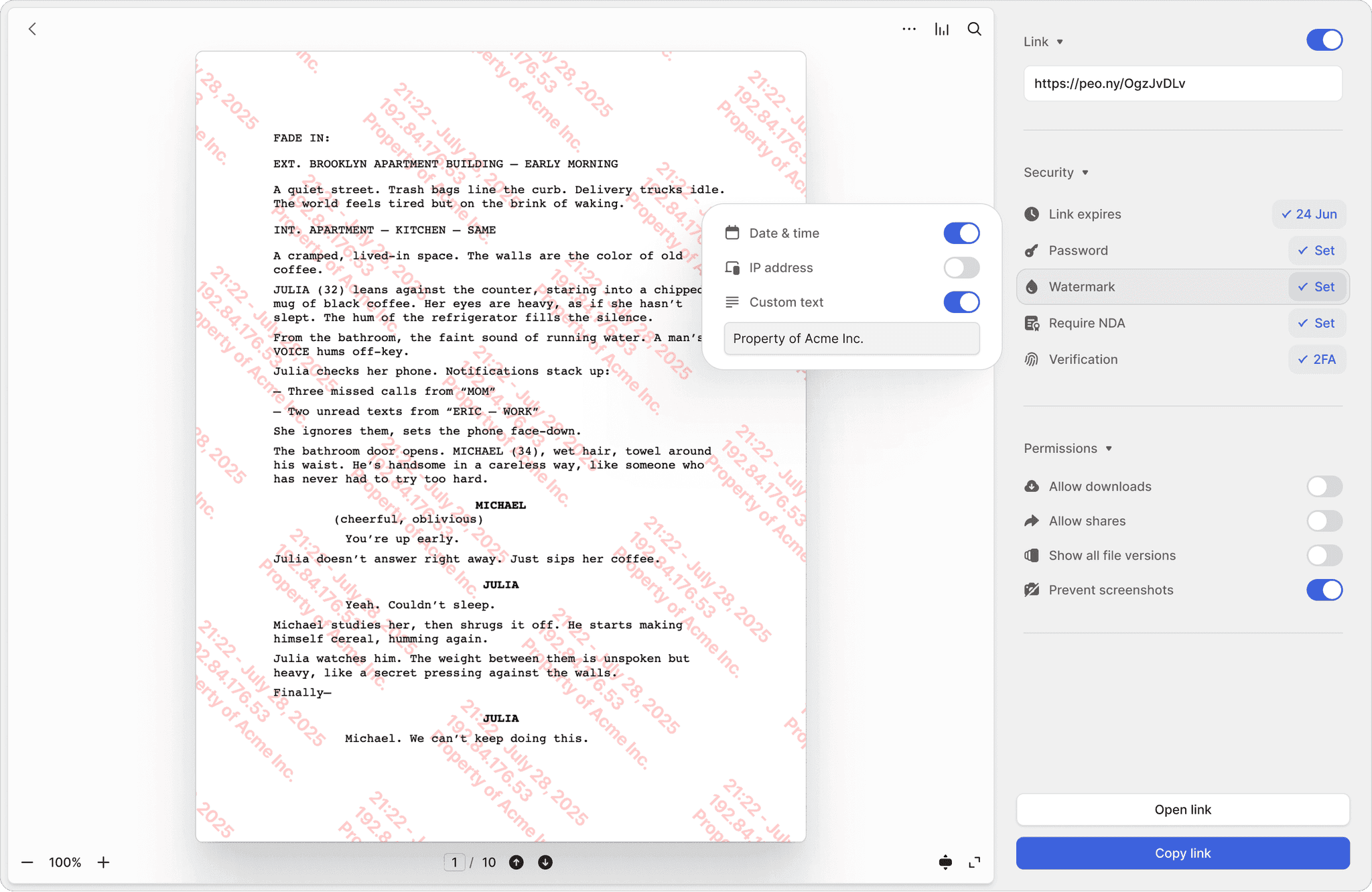
Your investment theses and quantitative models are your edge. Peony blocks screenshots on strategy documents, stamps every page with dynamic watermarks tied to the viewer, and requires NDA signatures before prospective LPs can access a single page.
Screenshot protection
Block screen captures of investment theses, trade models, and position reports. Keep proprietary research from being shared with competitors or replicators. Desktop on Business; Screenshield extends it to iPhone, iPad and Android on Data Room.
Dynamic watermarks
Every page of your strategy deck or offering memorandum is stamped with the viewer's identity and timestamp. If a document surfaces outside your fund, you know exactly who leaked it. On Data Room and above.
NDA-gated access
Require prospective LPs, allocators, and consultants to sign an NDA before viewing any fund documents. Integrated e-signatures mean zero friction and a complete compliance record. Acknowledgment NDA on Business; signed NDA with a PDF and audit log on Data Room.
Which data rooms give a hedge fund audit trails for SEC exams and allocator ODD?
Peony logs every page view, download and NDA signature with timestamp and IP address, the access record SEC exams and allocator ODD ask about, and keeps a per-allocator audit trail on Data Room.
Page-level tracking for every DDQ and offering doc
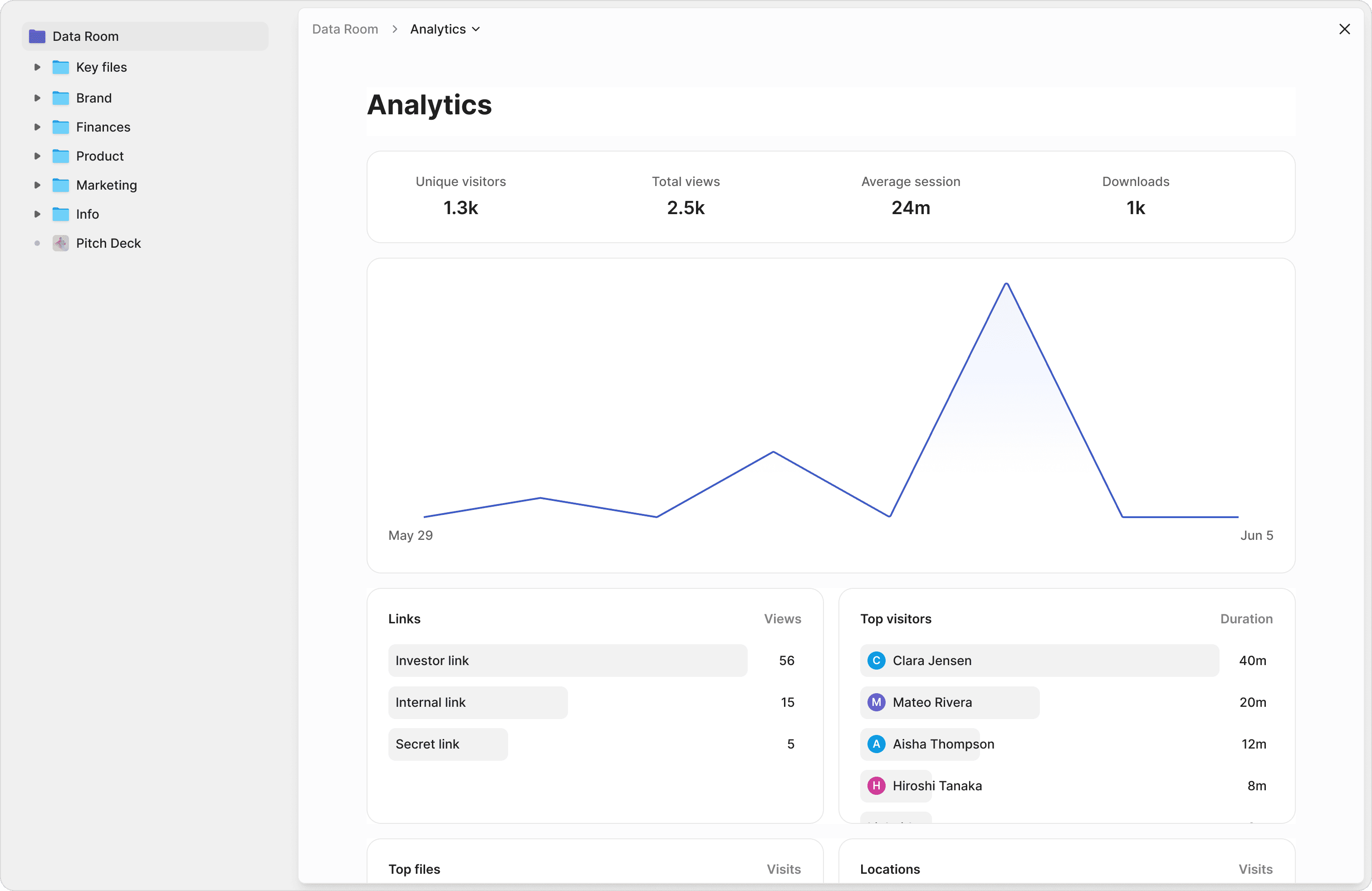
When the SEC or FCA comes knocking, you need proof of who reviewed what. Peony logs every page view, download, and signature with timestamps — so your CCO can export a compliance-ready report in seconds, not days.
Page-by-page tracking
See exactly which pages of your DDQ, PPM, or investor letter each allocator reviewed and for how long. Know who skimmed and who did deep diligence.
Compliance-ready logs
Exportable audit trails with timestamps, IP addresses, and device details. Hand your CCO a clean report for SEC exams, FCA reviews, or investor operational due diligence.
2FA identity verification
Verify that the person accessing your fund documents is who they claim to be. Two-factor authentication ensures only authorized LPs and allocators can view sensitive materials.
"Peony is by far the simplest and most intuitive way to populate and share data rooms with investors and partners. All the key analytics and features integrated into a sleek interface!"
Mark Petrov
Head of Financials, Loop
Michael Hui
Managing Director, Piton Partners
Peony is a standout for data rooms and gated file sharing — it gave us the control and visibility needed to close the deal with a great viewer experience.
How do hedge fund IR teams use AI on their fund documents?
Hedge fund IR teams use Peony's AI document Q&A to answer questions across PPMs, side letters, DDQs and filings with page-cited sources, and can switch it on so allocators ask the room directly.
Chat with your fund docs and regulatory filings
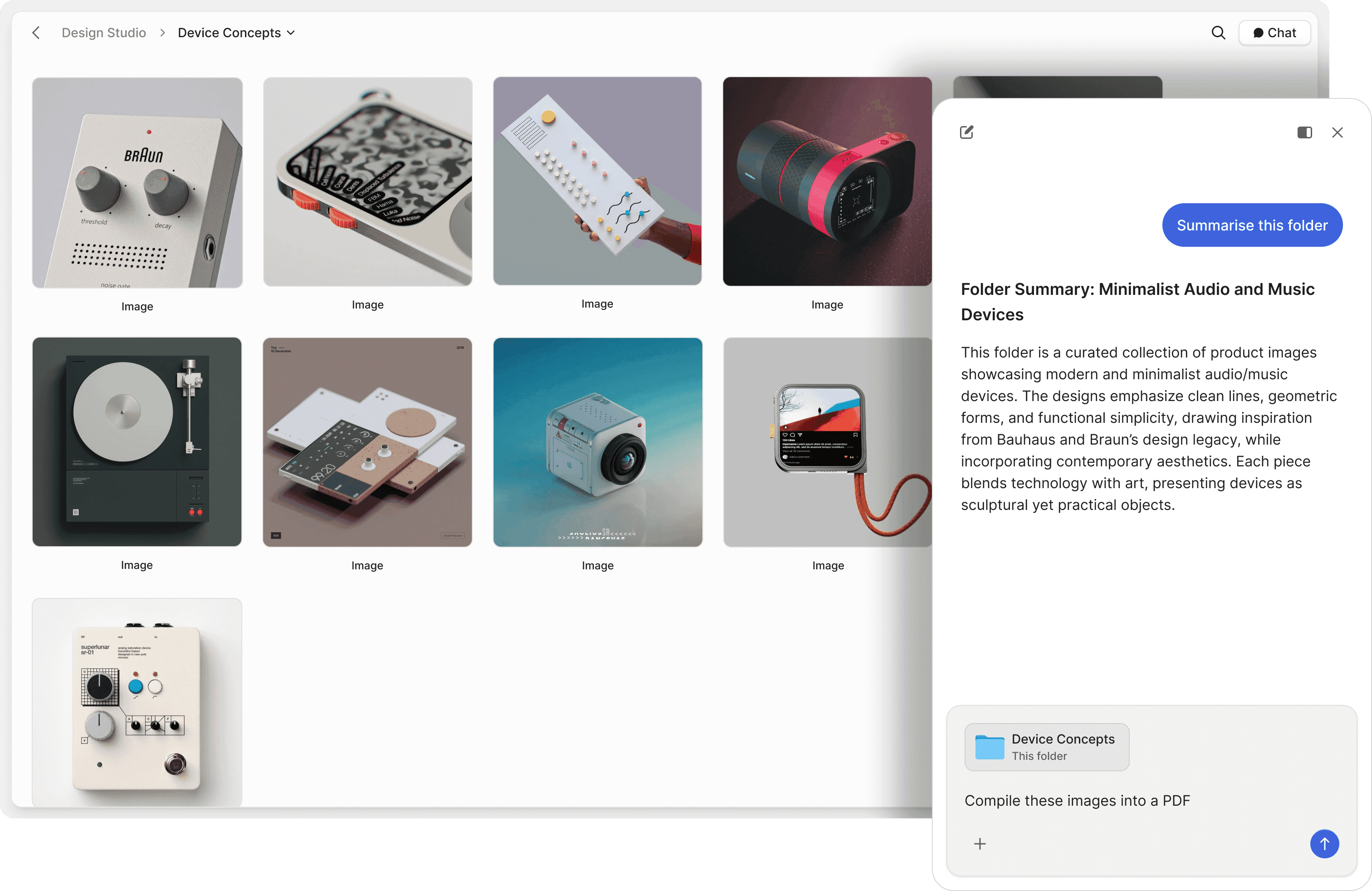
Stop hunting through folders of PPMs, side letters, and Form ADVs. Ask questions across your entire document library and get instant, sourced answers — whether your IR team needs a data point for an allocator call or your CCO is prepping for an exam.
Chat across fund documents
Ask questions across offering memoranda, investor letters, side letters, and compliance filings. AI retrieves answers with exact source references from your data room.
Natural language search
Search your data room in plain English. Find specific fee terms in side letters, performance attribution data, or regulatory references without remembering file names.
Investor Q&A on autopilot
Let AI field allocator questions about fund terms, track record, and operational infrastructure 24/7. Track what prospective LPs ask to sharpen your pitch and DDQ responses.
AI document Q&A is on Business and above, with 5x usage on Data Room; you switch it on per allocator group, and each allocator's questions appear in their audit trail (Data Room). Your documents aren't used to train AI. AI features, such as AI document Q&A and AI room generation, switch on once you're on a paid plan. See AI document Q&A; the human Q&A workflow is in Smart Q&A.
How do you keep side letters, K-1s and investor letters separate by vehicle and investor?
Run one Peony room with a group per vehicle or investor and set folder permissions per group, so each LP opens only its own side letter, statements and K-1s while shared letters reach everyone.
Granular folder and file permissions are on Data Room ($52/admin/mo billed yearly): flagship, long-short and co-invest materials sit in one room with no duplicate rooms. A file set to No access is absent from that group's view, and a group's switch turns its link off in one click when an investor redeems.
Side letters
Send side letters and subscription documents for e-signature (unlimited from Business): each signer gets a secure link, and the signed PDF and audit log go to both sides. File each executed side letter in its investor's folder, and use AI document Q&A to find MFN or fee terms across them with page citations.
Monthly and quarterly letters
Upload new version replaces a file in place: it keeps its position in the room and its link, and every earlier version stays one click away in the version menu. On Deal Team, investors with email access get a daily summary when new files are added.
K-1s and capital statements
A folder per investor at View or Download, visible to that investor's group only. Hide new content by default keeps a new year's K-1s hidden until you release them group by group.
Investor portal or data room: which should a hedge fund use for which documents?
A hedge fund should use both: its administrator's investor portal for statements and NAV reporting to existing investors, and Peony for what goes to prospects and allocators or needs read tracking and revocation.
A prospective allocator, a consultant's research team or an ODD analyst usually has no portal login. Peony reaches them with a link and an emailed code, on your own domain on Data Room, and the record of what they read stays with your IR team.
Keep in the administrator's portal
- Capital account statements and NAV reporting
- Contract notes and transaction confirmations
- Documents for investors who already log in there
Send through Peony
- The DDQ, PPM and track record for prospective allocators
- The operational due diligence room
- Strategy memos and tear sheets you need to watermark
- Side letters and subscription documents for e-signature
- Interactive dashboards built in Claude or ChatGPT
For portal options side by side, see our investor portal software guide; for the IR workflow beyond hedge funds, see Peony for investor relations.
How does Peony fit a hedge fund's compliance document management?
Peony is the controlled-sharing layer of a hedge fund's compliance document stack: offering documents, DDQs and investor reports leave through verified, logged links, and your books-and-records archive stays the record.
- Rule 204-2 under the Investment Advisers Act sets the books and records an SEC-registered adviser keeps, including written communications relating to its advice and the records behind any performance it presents; paragraph (e)(1) requires keeping them for at least five years from the end of the fiscal year of the last entry, the first two in an appropriate office of the adviser. Peony's CSV export of views, sessions and downloads (Business) lets you file who received and read each document.
- Hedge funds commonly sell interests privately under Rule 506 of Regulation D. A Rule 506(b) offering is subject to Rule 502(c)'s limits on general solicitation; Rule 506(c) allows it but requires every purchaser to be accredited and reasonable steps to verify that. A gated room keeps offering materials off public pages, and access questions make each investor answer questions you set before entry (Data Room); confirming eligibility stays with your compliance process. For issuer-side offerings, see Peony for private placements.
- The SEC adopted amendments to Regulation S-P on May 16, 2024, covering SEC-registered investment advisers: larger entities, which for advisers means $1.5 billion or more in AUM, had to comply by December 3, 2025, and smaller entities by June 3, 2026. The rule requires written policies for overseeing service providers through due diligence and monitoring, reasonably designed so each provider notifies the firm as soon as possible, and no later than 72 hours after becoming aware, of a breach that gives unauthorized access to a customer information system the provider maintains.
What can your CCO show about Peony in a vendor or ODD review?
If fund documents sit in Peony, Peony is one of the service providers your program oversees, and allocators' ODD teams may ask about it too. These are the controls you can show; your CCO and counsel decide how they fit your written policies.
Know who received the PPM and DDQ
Email verification with a one-time code and an allow list (Business); the NDA acknowledgment records each viewer's email, name, timestamp and IP (Business), and the signed NDA emails a signed PDF and audit log to both sides (Data Room).
Keep each investor to its own vehicle
One group per investor or vehicle with its own folder permissions; a file at No access is absent from that group's view (Data Room).
Keep a record of access
Page-level view logs on every plan, a CSV export of views, sessions and downloads (Business) you can file to your archive, and a per-allocator audit trail (Data Room). Logs are kept 1 year on Business, 2 years on Data Room and with no time limit on Deal Team and Enterprise.
Take access back
Link expiry on every plan; switch a link or group off from Business, and access stops on the viewer's next load.
Protect the data itself
AES-256 at rest, TLS 1.2+ in transit. Peony staff can't open, move or edit the documents in your room. Your documents aren't used to train AI: Peony's LLM providers work under data-handling agreements that prohibit training on customer content.
Oversee the vendor
Peony completes your security questionnaire or vendor-risk form and provides a standard DPA with SCCs, on request on Deal Team and Enterprise. Peony's incident-response policy commits to telling affected customers within 72 hours of confirming an incident that affects customer data. SOC 2 Type II-ready and ISO 27001-ready, with both audits underway. Peony has had no data breach since launch.
How do you set up a hedge fund data room in Peony?
Setting up a hedge fund data room in Peony takes five steps: pick the plan, build the room around your DDQ, lock it down, invite each allocator, then track activity and keep documents current.
The median time on Peony from account creation to first uploaded document is 4 min 19 s (State of M&A Data Rooms, Q3 2026 edition).
Pick the plan
Data Room ($52/admin/mo billed yearly) for an allocator process: unlimited rooms, signed NDAs, watermarks and a group per allocator. Business ($30) for an emerging manager sending a tracked link per document.
Build the room around your DDQ
Describe the fund in one line and AI room generation drafts the folders; mirror your DDQ's sections so each answer sits next to its evidence. Index documents numbers every file. Duplicate a data room copies its files and folders into a fresh room; groups, links and analytics start clean.
Lock it down
Email verification and an allow list, downloads off and screenshot protection (Business); a signed NDA, dynamic watermarks and folder permissions per group (Data Room); redaction of fee terms on PDFs (Deal Team).
Invite each allocator
List each allocator's emails in its own group, and Peony emails them an invitation; everyone not listed is blocked. Allocators open the room in the browser with an emailed one-time code and no account.
Track and maintain
Page-level analytics and an email each time an allocator opens a document; Upload new version keeps the DDQ and monthly letter current at the same link; expiry and group switches when a process ends. Logs are kept 2 years on Data Room.
What does a hedge fund data room cost on Peony?
On Peony, a hedge fund's allocator rooms run on Data Room at $52 per admin per month billed yearly ($75 monthly), with unlimited rooms; allocators, consultants and LPs view free.
Institutional security without institutional pricing
Legacy data rooms charge five or six figures a year. Peony starts free and scales with your fund: you pay per admin, not per allocator, so two admins on Data Room pay $1,248 a year however many allocators open the room. The per-provider math is in our virtual data room cost guide.
Business
$30/admin/mo
AI Q&A, NDA gate, screenshot protection
For growing funds and IR teams
Data Room · Most popular
$52/admin/mo
Unlimited rooms & storage, watermarks
For multi-strategy platforms and allocator processes
Deal Team
$64/admin/mo
Minimum 4 admins
Redaction, Advanced Q&A routing, OAuth SSO, standard DPA on request
Try Data Room
7 days free
No credit card, never auto-charges
Build the DDQ room and invite one allocator to test it
Prices per admin per month, billed yearly ($44, $75 and $89 monthly); Enterprise is custom. Allocators are free and unlimited on every plan. Business includes 3 data rooms per admin, 1,000 documents per admin and 100 GB of storage, with no per-file size cap. Free ($0) covers 50 documents and 500 MB as tracked single-file links; data rooms start on Business. Free suits an emerging manager sending the PPM and DDQ to early allocators.
Frequently asked questions
What is Peony, and is it a good fit for hedge fund managers and IR teams?
Yes. Peony is a virtual data room that hedge fund managers and IR teams use to share DDQs and offering documents with allocators, see which pages each allocator reads and keep strategy files behind an NDA. Data Room, the most popular plan, is $52 per admin per month billed yearly ($75 monthly), with unlimited rooms and storage; inviting allocators is free and unlimited.
Can I try Peony before I pay?
Yes. Peony's Data Room plan has a 7-day free trial you start yourself, with no credit card, and it never converts to paid on its own. Rooms, files, links, analytics and NDA settings carry over when you upgrade. AI features, such as AI document Q&A and AI room generation, switch on once you're on a paid plan.
Which data room should a hedge fund manager choose?
Choose a data room that verifies each allocator, requires an NDA, watermarks every page, tracks page-level reading and keeps each vehicle's files apart; Peony Data Room does all five for $52 per admin per month. That price is billed yearly ($75 monthly), with unlimited rooms and storage, and allocators, consultants and ODD analysts open the room free with no account, so a long allocator list adds nothing to the bill. Upload new version keeps the DDQ current at the same link, and support runs 24/7, handled by the Peony team, for the moment an allocator is locked out mid-review. Legacy VDRs price by the page, by storage or by the project; the provider-by-provider math is in our virtual data room cost guide.
What documents do hedge fund managers include in a data room for institutional allocator due diligence?
A hedge fund data room for allocator due diligence holds the offering memorandum (PPM), the DDQ, investor letters, side letters, Form ADV, audited financials, K-1 schedules and track record data, released in stages. Institutional allocators expect them in the folder structure they're used to: on Peony's Data Room plan ($52 per admin per month billed yearly), AI room generation proposes that structure from a one-line description, Index documents numbers every file so an ODD analyst can ask for "3.2", and AI-powered search (AI document Q&A, which you switch on per allocator group) lets allocators locate specific clauses or performance figures instantly, with page citations. Operational due diligence teams also ask for the compliance manual, valuation and trade-allocation policies, and service-provider details; see what ODD teams ask a hedge fund for.
How do I share DDQs securely with allocators?
Share your DDQ in a Peony room or link that verifies each allocator's email, gates access behind an NDA, blocks screenshots and watermarks every page with the viewer's identity. Personalized links, email verification, NDA gating and screenshot protection are on the Business plan ($30/admin/month billed yearly); dynamic watermarks tied to each viewer, a signed NDA with audit record and per-allocator folder permissions are on the Data Room plan ($52/admin/month). Peony's Advanced Redaction (Deal Team plan, $64/admin/month, minimum 4 admins) lets you permanently black out sensitive fee structures or proprietary terms before sharing documents with prospective allocators. When you update the DDQ, Upload new version keeps it at the same link. Unlike legacy VDRs like Ideals and Datasite, which charge by storage or by the page, Peony delivers institutional-grade security at a fraction of the cost.
Can I track which pages of my offering memo investors reviewed?
Yes. Peony's page-level analytics, on every plan, show which pages of your offering memo each allocator viewed, the time spent per page and their return visits. This helps your IR team prioritize follow-ups with engaged prospects and identify which sections of your PPM or DDQ generate the most interest. Business ($30/admin/month billed yearly) adds download activity, drop-off reports and a CSV export of views, sessions and downloads you can match to your CRM by email; Data Room ($52) adds a per-allocator audit trail with a timestamped, file-by-file timeline.
How does Peony protect hedge fund strategy documents from leaks?
Peony blocks screenshots on strategy memos and investment theses, stamps every page with dynamic watermarks tied to the viewer's identity, and requires NDA signatures before access. If a document leaks, you know exactly who shared it. Screenshot protection, download prevention and the NDA gate start on the Business plan ($30/admin/month billed yearly); dynamic watermarks, the signed NDA and Screenshield mobile protection are on the Data Room plan ($52/admin/month) — unlike Firmex or Digify, which charge far more for similar protection.
Is Peony compliant with SEC and FCA audit requirements?
Peony gives your CCO the access records SEC exams, FCA reviews and allocator ODD ask about: every page view, download and signature logged with timestamp, IP address and device details. It runs on infrastructure secured with AES-256 encryption at rest, TLS 1.3 in transit, SOC 2 Type II and ISO 27001 readiness (both audits underway), and GDPR, CCPA, and HIPAA compliance. Your CCO can export a compliance-ready audit report in seconds for SEC exams, FCA reviews, or investor operational due diligence — no manual log compilation required. The CSV export of views, sessions and downloads is on Business and above, and the per-allocator audit trail is on Data Room. How those records fit your books-and-records policies under Rule 204-2 or the FCA's rules is for your CCO and counsel to decide, and your archive stays the record.
How much does a hedge fund data room cost for an emerging manager raising a first fund?
Emerging managers can start on Peony's free plan ($0), sharing the PPM and DDQ as tracked links, and run a full allocator room on Data Room at $52 per admin per month. Free ($0) covers 50 documents and 500 MB as tracked single-file links; data rooms start on Business. As the LP pipeline grows, the Business plan ($30/admin/month billed yearly, $44 monthly) adds personalized allocator links, unlimited e-signatures, AI document Q&A, screenshot protection and 3 data rooms per admin, while the Data Room plan ($52/admin/month, $75 monthly) adds unlimited data rooms, unlimited storage, dynamic watermarks, Advanced NDA, and 5x AI Q&A usage for multi-vehicle structures. Peony has no per-viewer, per-page, or per-link limits, so costs stay predictable whether you are sharing with 5 LPs or 50: two admins on Data Room pay $1,248 a year. Legacy data rooms like Ideals and Datasite charge five or six figures annually — prohibitive for a first fund; the per-provider math is in our virtual data room cost guide. 7-day Data Room trial you start yourself: no credit card, and it never auto-charges.
Can I use AI to answer allocator questions about my fund?
Yes. Peony's AI document Q&A answers questions across your PPMs, side letters, DDQs and investor letters with page-cited sources, for your IR team and for allocators in groups you allow. Switch it on for an allocator's group and they get instant, sourced answers 24/7 across every document in the room; it's on Business and above, with 5x usage on Data Room. Peony's Deal Team plan ($64/admin/month, minimum 4 admins) also adds a structured Advanced Q&A module where allocators submit questions, your IR team routes and assigns them, reviews and approves answers, and only then are responses published; on Data Room, Visitor Q&A keeps each allocator's questions in its own question team. Your IR team can also use AI document chat internally to find data points for allocator calls, or the source page behind a DDQ answer, without hunting through folders.
What support does Peony provide hedge fund managers during allocator due diligence?
Peony provides 24/7 support handled directly by the Peony team, and everyone you speak to has M&A experience at elite boutiques or bulge-bracket banks, VC experience, or has raised $1M+ themselves. That matters because when a pension fund's operational due diligence team cannot access your DDQ or offering memo during their review window, you risk losing the allocation entirely. Managers on enterprise deals get 24/7 dedicated support by booking a demo with our deal infrastructure team, and Deal Team adds priority support and a dedicated account manager. Every plan includes in-app chat, documentation, and email support.
How do I manage LP reporting across multiple fund vehicles?
Run one Peony data room with a group per investor or vehicle, so each LP sees only the quarterly letters, K-1s and capital account statements for their own vehicle. Peony supports personalized links per LP, and granular folder permissions (Data Room, $52/admin/month billed yearly) let you separate flagship, long-short, and co-invest materials within a single data room — no duplicate rooms needed. Upload new version replaces a monthly letter in place at the same link, and on Deal Team investors with email access get a daily summary when new files are added.
What is the AIMA DDQ, and how is it different from the ILPA DDQ?
The AIMA DDQ is AIMA's Illustrative Questionnaire for the Due Diligence of Investment Managers, a modular template for diligence on hedge funds and other managers, with a 2025 edition AIMA presented on March 12, 2025. That edition keeps the modular approach AIMA adopted in 2017, adds a Private Markets strategy module, and refines questions on performance presentations, outsourcing, technology risks, counterparty, leverage and liquidity risks, anti-money laundering and expense disclosures. ILPA DDQ 2.0, the Institutional Limited Partners Association's questionnaire for private-markets fund managers, was released November 1, 2021, to "standardize the key areas of inquiry posed by investors during their diligence of managers." Whichever one an allocator sends, keep your completed response as the master copy in a Peony room and update it with Upload new version, so every allocator opens the current version at the same link. See our due diligence questionnaire guide.
Do allocators need a Peony account to open our documents?
No. Allocators, consultants and their ODD teams open your Peony room or link in the browser with no account, and they're unlimited and free on every plan; you pay per admin. With email verification on (Business and up), each allocator types a one-time code sent to their inbox, and an allow list means only the addresses or domains you list get in, so a forwarded link opens for nobody else. Streamlined access, on by default, lets a verified allocator skip the code for 7 days on the same browser.
Can investors sign side letters and subscription documents online in Peony?
Yes. Send a side letter or subscription document for e-signature from Peony: each signer gets a secure link, and the signed PDF and its audit log go to both sides. E-signatures are 3 a month on Free and unlimited from Business ($30/admin/month billed yearly), and they're designed to meet the US ESIGN Act and EU eIDAS requirements for standard e-signatures. Keep each executed side letter in its investor's folder, open to that investor only (Data Room), and use AI document Q&A to find MFN or fee terms across side letters with page citations.
How can an emerging or crypto fund manager show performance to allocators without public disclosure?
Share performance and operational metrics on a Peony link that only allow-listed allocator emails can open, with downloads off, screenshot protection and an expiry date, so nothing sits on a public page. On Data Room ($52/admin/month billed yearly), add a signed NDA and dynamic watermarks with each viewer's email and IP, and see page by page what each allocator read. A Rule 506(b) offering under Regulation D is subject to Rule 502(c)'s limits on general solicitation, while Rule 506(c) allows it but requires every purchaser to be accredited and reasonable steps to verify that; your counsel decides which applies, and a gated room keeps the materials off public pages either way. Peony renders .html files live with JavaScript running, so a Claude or ChatGPT artifact (a model, dashboard or calculator) stays interactive for the viewer, behind your NDA gate, permissions and analytics.
Where do these figures come from?
- AIMA, Presenting the 2025 edition of the Illustrative Questionnaire for the Due Diligence of Investment Managers (March 12, 2025)
- ILPA, Due Diligence Questionnaire (DDQ 2.0, November 1, 2021)
- 17 CFR 230.506 (Rule 506(b) and 506(c) of Regulation D), Cornell LII
- 17 CFR 275.204-2 (adviser books and records: (a)(7), (a)(16) and the (e)(1) retention period), Cornell LII
- SEC press release 2024-58 (May 16, 2024): Regulation S-P amendments adopted
- Federal Register, Regulation S-P final rule, 89 FR 47688 (June 3, 2024): compliance dates and the $1.5 billion AUM threshold
- 17 CFR 248.30 (eCFR): service-provider oversight and the 72-hour provider notice
Sources checked October 17, 2026.
Protect your edge. Streamline LP access
Join hedge fund teams already using Peony to distribute DDQs, manage side letters, and run investor onboarding — securely and affordably.
- Allocators, consultants and LPs never need a seat or an account.
- Unlimited rooms on Data Room: a room per vehicle or allocator costs nothing extra.
- Live in minutes (median 4 min 19 s to first upload); the 7-day trial never auto-charges.
- Peony staff can't open your documents, your documents aren't used to train AI, and Peony has had no data breach since launch.
No credit card · 7-day Data Room trial that never auto-charges · allocators view free, no account
24/7 dedicated support for enterprise deals
Last updated: October 2026