
Redact sensitive documents in minutes, not days
AI redaction scans every page for PII, customer names, financial figures, and sensitive terms — then suggests redactions for your team to review. Approve in bulk, share stage-gated versions with counterparties, and maintain a complete audit trail. What used to take an analyst 2–3 days now takes 2–3 hours.
Available on request. We tune the detection categories to your data types before enabling AI redaction on your account — talk to our team to get set up.
How AI redaction works at a glance
- What it detects: Emails, phone numbers, SSNs, names, addresses, financial figures, and custom data categories tuned to your business.
- Permanent removal: Redacted regions are flattened into the PDF before sharing — viewers see only the redacted version, no way to peel back the black box.
- Access model: Available on request — typically enabled within hours after our team tunes detection categories for your specific data.
Updated May 2026
Why does manual redaction break at scale?
Manual redaction means a paralegal scrolling through 500-page PDFs hunting for SSNs, addresses, and contract counterparties one box at a time. It takes days, costs $200+/hour, and a single missed instance can blow a deal.
A sell-side M&A advisor shares a 200-page CIM with 8 bidders. Customer names, revenue-by-client breakdowns, employee compensation, and supplier terms all need redacting before Phase 1 bidders see the document.
The analyst doing this manually in Adobe Acrobat is working through page 140 at 11pm. They miss a customer name on page 73. They miss a compensation figure in an exhibit footnote. The deal team doesn't find out until a bidder mentions it — and by then, the information is out.
AI doesn't fatigue. It catches what people miss.
How does Peony's AI redaction work?
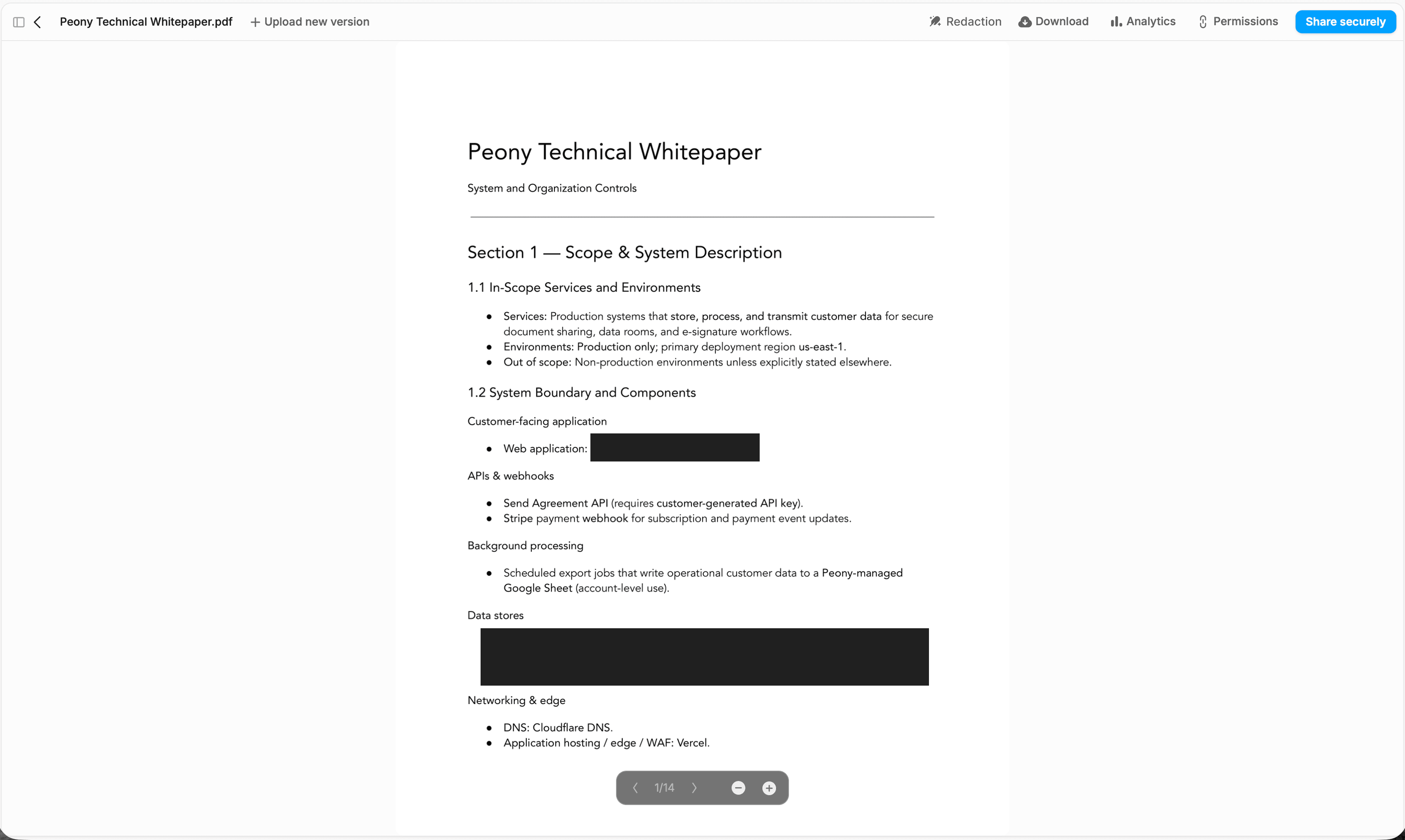
Peony's AI scans every document and flags every instance of sensitive data — emails, names, financial figures, custom categories — in seconds. Your team reviews and confirms; redactions are then flattened into the PDF permanently.
AI-powered detection
The AI scans every page for PII, financial figures, customer names, contract terms, and sensitive identifiers. It understands document context — recognizing that a name in a revenue table is a customer worth redacting, not just text.
Permanent, irreversible removal
Approved redactions permanently strip sensitive content from shared versions. Recipients cannot recover redacted text through copy-paste, OCR, or PDF extraction. Your original unredacted files remain securely stored with full access controls.
Stage-gated disclosure
Share redacted versions with Phase 1 bidders and unredacted access with shortlisted parties — from the same data room. Granular permissions control who sees what at each deal stage, eliminating duplicate document sets.
Bulk review workflow
Scan entire folders in one pass. The AI flags every instance of sensitive information across hundreds of documents. Review and approve suggestions in a single workflow instead of opening each PDF individually.
Audit trail for every decision
Every redaction is logged — who approved it, when, and what was removed. Creates a defensible compliance record for regulatory inquiries, post-deal disputes, and SOC 2, GDPR, CCPA, and HIPAA audits.
What's the difference AI redaction makes vs manual?
AI redaction collapses 2–3 days of analyst review into 2–3 hours of approving suggestions, scans every page with equal attention, and produces a complete audit trail of every decision. Manual redaction leaves missed PII, duplicate document sets, and no record of who removed what.
Without AI redaction
- 2-3 days per document set for manual review
- Analyst fatigue leads to missed PII on later pages
- Separate redacted copies for each bidder group
- No audit trail of what was redacted or by whom
- One missed customer name can breach confidentiality
With Peony AI redaction
- 2-3 hours — AI flags, your team approves
- AI scans every page with equal attention
- One room, permission-based access per deal stage
- Full audit trail of every redaction decision
- Permanent removal — no way to recover from shared versions
Who is AI redaction built for?
AI redaction is built for sell-side M&A advisors, biotech BD teams, litigation associates, and fund administrators sharing sensitive documents with multiple counterparties. Anyone running a staged-disclosure process where one missed PII instance could blow a deal, breach confidentiality, or trigger a regulatory issue.
Sell-side M&A
A 200-page CIM going to 8 bidders. AI redacts customer names, revenue by client, and employee compensation in minutes. Phase 1 bidders see redacted financials. Shortlisted bidders get full access. One room, two permission levels.
Regulatory and compliance filings
Before sharing clinical trial data, patent filings, or regulatory submissions externally, AI strips patient identifiers, proprietary formulas, and confidential terms. The audit trail proves exactly what was shared and when.
LP reporting and fund administration
Share portfolio company financials with LPs while redacting sensitive deal terms, co-investor identities, or carry structures that are not appropriate for all recipients. Stage-gated access by LP tier.
How does Peony deliver enterprise redaction without enterprise pricing?
Peony bundles Advanced Redaction into Deal Team at $64/admin/month with no per-page fees or per-deal charges — legacy VDRs charge $50,000+ per deal for the same capability. A 4-person boutique advisory running 10 deals a year pays $3,072 instead of $250,000+.
Datasite charges $50,000-$100,000+ per deal for redaction capabilities. Firmex offers manual redaction only — no AI detection. Ideals and Digify do not offer redaction at all. Peony delivers AI-powered redaction with automatic PII detection, bulk review, stage-gated permissions, and a complete audit trail — enabled on request and tuned to your data types before it goes live on your account. For a boutique M&A advisory running 10 deals per year, that is over $250,000 in annual savings versus legacy VDR pricing.
"Every now and then, you come across a product that has a massive positive impact on your business. Peony is one such product."
Panos Moutafis
Founder & CEO, Zenus
Redaction is one layer of a complete security stack
2FA and audit logs on every plan. Password protection, Simple NDA gating, dynamic watermarks, and screenshot protection on Business. Advanced NDA, granular permissions, and Screenshield on Data Room. Advanced Redaction on Deal Team.
Frequently asked questions
I'm a sell-side banker and I need to redact customer names from our $120M deal's CIM before Phase 1 bidders see it — can AI catch what my tired analyst might miss?
Yes. On Peony Deal Team ($64/admin/month), Advanced Redaction scans every page of your CIM for customer names, revenue-by-client breakdowns, employee compensation, and supplier terms — then highlights them for your team to review and approve. For your $120M deal, the AI catches items your analyst might miss at midnight on page 140 — a customer name in a footnote, a compensation figure buried in an exhibit. Once approved, Peony permanently removes the content so your Phase 1 bidders cannot recover it through copy-paste, OCR, or PDF extraction. Firmex offers manual redaction only with no AI detection. Datasite charges $50,000+ per deal for comparable tools.
We're managing a $175M process with Phase 1 and Phase 2 bidders — can I share redacted versions with early bidders and unredacted versions with shortlisted ones from the same data room?
Yes. On Deal Team ($64/admin/month), Advanced Redaction lets you create stage-gated disclosure for your $175M process: Phase 1 bidders see redacted financials and customer names, while your shortlisted Phase 2 bidders get unredacted access — all from the same data room using granular permissions. This eliminates maintaining separate document sets and reduces the risk of accidental disclosure that could kill your auction dynamics or trigger regulatory issues.
Our biotech BD team is sharing clinical trial data with 3 potential licensing partners on a $95M deal — what sensitive data categories does AI redaction catch?
On Deal Team ($64/admin/month), Peony's Advanced Redaction detects protected health information (PHI), patient identifiers, investigator names, site locations, proprietary compound formulas, and unpublished efficacy data across your clinical documents. For your $95M licensing deal, the AI understands document context — it recognizes that a name in a patient demographics table is PHI requiring HIPAA-compliant redaction, not just a random string. It also catches standard PII, financial figures, and jurisdiction-specific identifiers. Your BD team reviews AI suggestions in a single workflow rather than opening each clinical study report individually.
I'm a litigation associate producing privileged documents for a $55M dispute — can opposing counsel recover redacted content from what we share?
No. When your team approves a redaction in Peony Deal Team ($64/admin/month), the sensitive content is permanently removed at the file level. For your $55M dispute, opposing counsel cannot recover redacted text through copy-paste, OCR, PDF layer extraction, or any other method. This is critical for privilege logs where inadvertent disclosure could result in waiver. The original unredacted file remains in your data room with full access controls, and every redaction decision is logged in the audit trail — creating a defensible record that privileged content was identified and stripped before production.
Our boutique M&A advisory runs 10 deals per year in the $50M-$200M range — how does Peony's redaction compare to Datasite and Firmex?
Peony Deal Team is $64/admin/month (minimum 4 admins) with Advanced Redaction, automatic PII and financial figure detection, stage-gated disclosure, and a complete audit trail — no per-page fees or per-redaction charges. For your 10-deal pipeline, a 4-person team pays $3,072/year. Datasite charges $50,000-$100,000+ per deal for comparable tools — meaning your 10 deals would cost $500,000+ annually. Firmex provides manual redaction only with no AI detection at any price. For your $50M-$200M mandates, Peony delivers enterprise-grade redaction at a small fraction of Datasite's cost.
Our biotech team needs to redact patient data across 300 clinical study reports for a $280M acquisition data room — can AI handle that volume?
Yes. On Deal Team ($64/admin/month), Peony's Advanced Redaction scans entire folders or your full data room in one pass, flagging every instance of PHI, patient IDs, and site locations across your 300 clinical documents. For your $280M acquisition, your regulatory team reviews AI suggestions in a single workflow rather than opening each PDF individually. AI redaction reduces review time from 2-3 days of manual work to 2-3 hours of approving suggestions — and catches identifiers a fatigued reviewer would miss in an adverse event table on page 87.
I'm a sell-side banker on a $160M deal and the seller's board wants proof that only redacted versions were shared with specific bidders — does Peony track that?
Yes. On Deal Team ($64/admin/month), every redaction decision is logged with who approved it, when, and what was removed. For your $160M deal, the audit trail documents exactly which bidders received redacted versus unredacted versions at each deal stage — critical evidence if a confidentiality breach is alleged post-closing. Combined with page-level analytics, you can confirm exactly who viewed which version and when. Your seller's board gets a defensible record that sensitive customer data was stripped before any Phase 1 bidder accessed the materials.
Our law firm needs AI redaction for a $42M matter — is Deal Team at $64/admin/month really cheaper than having our paralegals do it manually?
For your $42M matter, a paralegal manually redacting a 200-page contract set takes 8-12 hours at $75-$150/hour — that is $600-$1,800 per document set, per matter. Peony Deal Team at $64/admin/month gives your entire firm unlimited AI redaction across all matters simultaneously. The AI scans every page, flags PII, financial figures, and privileged content, and your paralegals review and approve in minutes instead of hours. For a firm managing multiple concurrent matters, the math is straightforward: $768/year per admin versus thousands in paralegal time per matter. Datasite charges $50,000+ per deal and Firmex has no AI redaction at all.
Related features
Security
Enterprise-grade protection with NDA gating, granular permissions, watermarks, screenshot blocking, and audit logs.
AI Extraction
Ask questions across every document in your data room and get cited answers with exact page numbers.
Page Analytics
Track who viewed your documents, which pages they read, and how long they spent — confirm redacted versions were accessed correctly.