
Deliver Phase 1 ESAs Clients Can Read — Not Redistribute
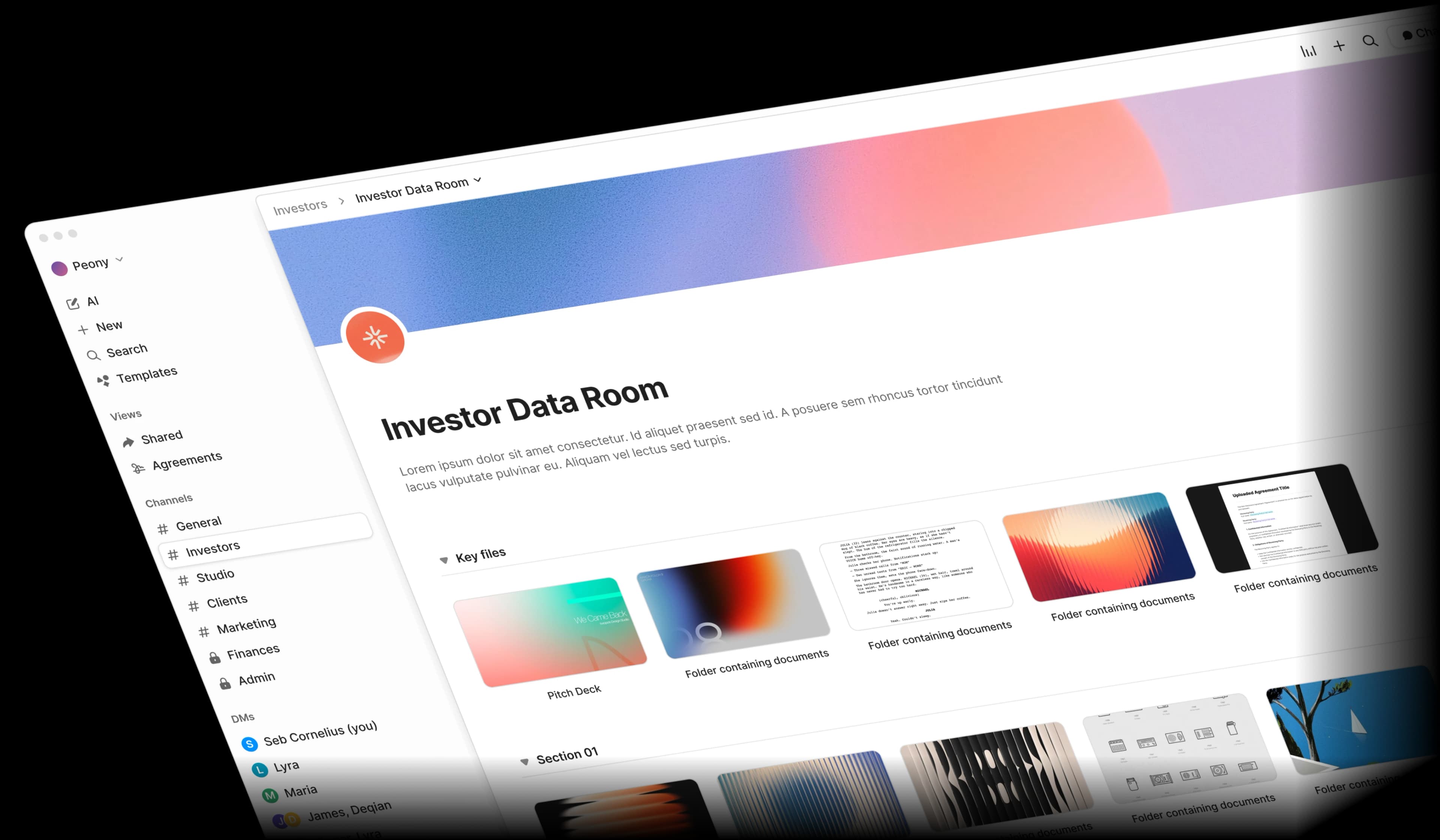
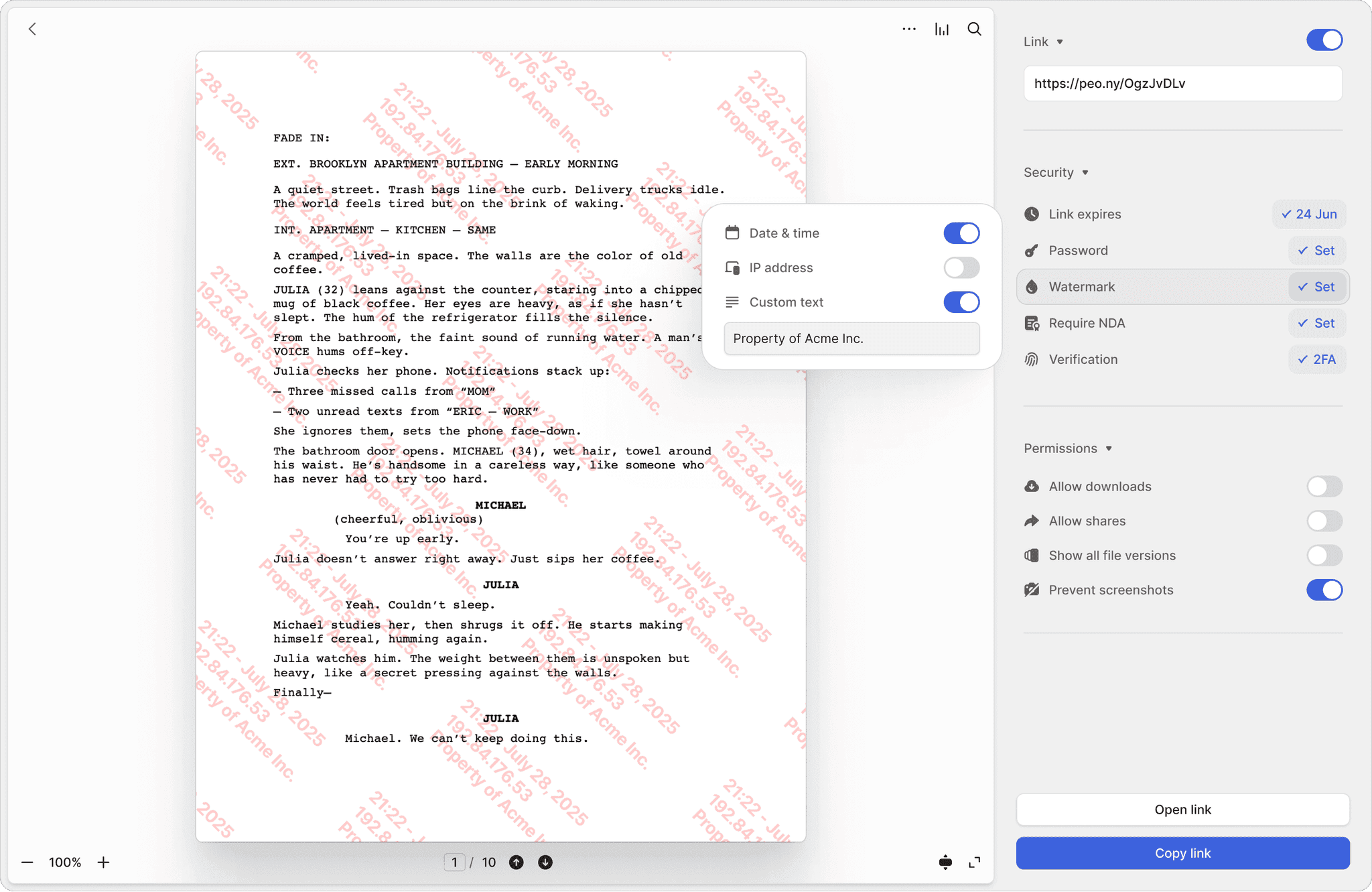
Your report is your product and your liability perimeter. Peony delivers it as a view-only link — no download, screenshot protection on, every page watermarked to the viewer, expiry aligned to the 180-day viability window, and page-level proof of who read what. Clients read the report; they don't forward it, and they don't feed it to ChatGPT. More than 8,000 customers run sensitive document delivery this way.
Quick answer · Updated July 2026
How do environmental consultants deliver Phase 1 ESA reports securely? With a view-only link instead of a PDF attachment. In Peony, the report is restricted to named, email-verified viewers; downloads and printing are off; screenshot shortcuts and recording are blocked in the browser; every page carries the viewer's identity as a dynamic watermark; and the link expires in step with the ASTM E1527-21 viability window. Who it's for: environmental professionals authoring Phase 1 ESAs — and appraisers, engineers, and consultants delivering any paid expert report. Why it matters: reliance stays with the parties who paid for it, stale reports stop circulating, and there is no file for a client to upload into an AI tool that trains on uploads by default.
No credit card required
An emailed PDF un-writes your limitations section
You drafted the report for the sole use of the named client. Then it left as an attachment — and got forwarded, relied on without a reliance letter, kept past its viability window, and uploaded into AI tools. The delivery method should enforce the perimeter the report asserts.
The report is the product — email gives it away
A Phase 1's own limitation language says only the named client may rely on it. Then the PDF goes out as an attachment and the perimeter dissolves: client forwards to lender, lender to counsel, counsel to the next buyer — parties who never signed your contract or bought a reliance letter are relying on your professional opinion for free.
Clients feed your report to ChatGPT
The newest leak path is an AI system. A client uploads your couple-hundred-page ESA into a chatbot, it generates a plausible-sounding "you missed this" list, and you spend unbilled hours rebutting hallucinations — while consumer AI tools train on your copyrighted work product by default.
Stale copies outlive the 180-day clock
Under ASTM E1527-21 a Phase 1 is presumed viable for 180 days, one year at most with updates. An emailed PDF doesn't know that: copies keep circulating and getting relied on long after the viability window closes — a liability you cannot recall.
No proof of who actually read it
When a dispute surfaces, the questions are always the same: who accessed the report, when, and which sections? Email forwarding leaves you nothing. A delivery method with per-viewer, per-page records turns that from guesswork into an audit trail.
The delivery method that matches the report's legal architecture
Whether you issue thirty Phase 1s a year solo or a hundred across a multi-office firm, the workflow is the same: named viewers, view-only access, watermarks, viability-aligned expiry, and per-page proof. Most report authors start on the Business plan ($30/admin/month — screenshot protection and download prevention) and step up to Data Room ($52/admin/month) for per-viewer watermarks and reliance workflows. See the full plan comparison.
How do you deliver a Phase 1 only the named parties can read?
Share the report as a view-only link restricted to named viewers — email-verified, downloads and printing off, screenshot protection on, and every page stamped with the viewer's identity via dynamic watermarks. The delivery method finally matches what your limitations section asserts: the named client reads the report; nobody else holds it. When the lender needs access, that's a reliance letter and their own named link — not a forwarded attachment. The full author-side workflow is in our Phase 1 ESA report delivery guide.
Named viewers only
Allow-list the exact people who may open the report — client, lender, counsel — with email verification at the door. A forwarded link stops at someone who isn't on the list.
Read, not take
Downloads, printing, and copying off; screenshot shortcuts, recording tools, and capture extensions blocked in modern desktop browsers on the Business plan.
Photos trace back
No software stops a phone camera — so per-viewer watermarks make any captured page attributable to the person who captured it, with name, email, and timestamp.
How do you stop a Phase 1 circulating past its viability window?
ASTM E1527-21 gives a Phase 1 a shelf life — presumed viable within 180 days, one year at most if five components are updated. Link expiry makes the access window and the viability window the same thing: the report self-retires at day 180, and if you update the five components, you extend the link instead of re-emailing a new PDF into the wild. Deal falls over? Revoke access the same afternoon. No other delivery method can recall a stale report.
Expiry aligned to viability
Set links to expire at the 180-day mark by default — the report stops being readable when it stops being presumed reliable.
Revoke in one click
Buyer walked, deal died, invoice unpaid? Pull access instantly across every viewer — something an emailed attachment can never do.
Re-issue on update
After updating the five components, extend the same link to the one-year mark — one canonical copy, never a stale duplicate in someone's shared drive.
How do you prove who read the report — and keep it out of AI tools?
Page-level analytics record who opened the report, when, and which pages they actually read — evidence when someone claims they relied on your findings, and a sales signal when a reliance-party link goes quiet. And because viewers read in the browser without ever holding the file, there is no PDF for a client to drag into ChatGPT: the AI busy-work loop — upload, hallucinated critique, unbilled rebuttal — gets cut at the source. More than 8,000 customers run sensitive document delivery this way. The full argument is in how to stop clients uploading your reports to ChatGPT.
Pages-read records
Per-viewer, per-page analytics with timestamps — who opened the executive summary, who sat on the REC findings, who never opened it at all.
No file, no AI upload
View-only delivery removes the easy path into consumer AI tools that train on uploads by default — and watermarks make the hard paths attributable.
Reliance as a workflow
Reliance letters signed via built-in e-signatures, each party on their own personalised link — reliance expands one named party at a time, the way you drafted it.
Built for the people who write the reports
The buyer's diligence side has data rooms everywhere. Peony also serves the other side of the table: the professionals whose work product those rooms are full of.
Solo EPs and small environmental firms
A 1-15 person firm issuing 30-100 Phase 1s a year delivers every report as a named-viewer, view-only link: reliance stays sold rather than leaked, stale reports self-retire at day 180, and the pages-read record answers "who actually read the RECs section" before it becomes a dispute. The full workflow is in our Phase 1 ESA delivery guide.
Multi-office environmental & engineering firms
Firms on lender panels delivering portfolio work — dozens of sites, one institutional client, strict document-handling terms — run each engagement from its own room with granular permissions, per-party links, and exportable audit trails. When the client is a buyer running full diligence, point them to our environmental due diligence guide — that side of the table is covered too.
Appraisers, engineers & expert-report authors
The same delivery problem hits every paid expert report: appraisals forwarded past the client, structural reports uploaded into AI tools, opinions relied on by parties who never engaged you. Appraisal guidance now tells professionals not to enter confidential information into tools that can't safeguard it — our ChatGPT-upload guide covers the whole pattern, and secure client file sharing covers the day-to-day.
"Ease of use, drag and drop capabilities, rapid response in support, and great service and value. It was easy to navigate throughout the platform as well as setting up our data room."
Joseph Garcia
Providence Water
Frequently asked questions
Can clients read my Phase 1 ESA without being able to download or screenshot it?
Yes. You share the report as a view-only link: downloads and printing are switched off, and screenshot protection (Business plan, $30/admin/month) blocks screenshot shortcuts, screen-recording tools, and capture extensions in modern desktop browsers. Honest limit: no software on earth can stop a phone camera pointed at a screen — which is why the Data Room plan ($52/admin/month) adds dynamic watermarks stamping every page with the viewer's name, email, and timestamp, so even a photographed page traces back to the person who captured it. Our guide to stopping phone photos of documents explains the full capture chain.
How does view-only delivery stop clients from uploading my report to ChatGPT?
Because there is no file to upload. When the report lives at a view-only link with downloads off, the client reads it in the browser — they never hold the PDF, so they cannot drag it into ChatGPT, Claude, or Gemini. That matters because consumer ChatGPT uses uploaded file content for model training by default unless the user opts out, and an AI-generated "you missed this" list costs you unbilled hours to rebut. We wrote the full playbook in how to stop clients uploading your reports to ChatGPT.
Can I make report links expire in step with the 180-day viability window?
Yes — and this is the move that makes delivery match ASTM E1527-21. A Phase 1 is presumed viable within 180 days of acquisition, extendable to one year only if five components are updated (interviews, lien search, government records review, site reconnaissance, and the EP declaration). Set link expiry to the 180-day mark and the report self-retires when its presumption of viability does; if you update the five components, extend the link to the one-year mark. Stale copies stop circulating because there are no copies — just access you control. Full workflow in our Phase 1 ESA report delivery guide.
How do reliance letters work with controlled delivery?
Each reliance party gets their own named link. Your client's lender buys the reliance letter, signs it via built-in e-signatures, and receives a personalised link — watermarked with their identity, expiring with the viability window. Nobody forwards a PDF, so "the lender's counsel passed it to the next buyer" stops happening, and page-level analytics give you a record of exactly who accessed the report and when — useful evidence if an unauthorized party ever claims they relied on it. Delivery control turns the reliance letter from an honor system into an enforced product.
What does secure report delivery cost for a small environmental firm?
There is a free tier, and paid plans are per admin seat — Business is $30/admin/month and Data Room is $52/admin/month — with unlimited free viewers, so your client, their lender, and counsel never need paid seats. A solo EP pays about the price of one reliance letter per year to control every report they issue; a five-person firm running 100 Phase 1s a year protects a few hundred thousand dollars of report value for the cost of a single soil sample. Median setup time is 4m19s, so the first controlled delivery can go out between site visits.
Will a 300-page Phase 1 with appendices actually work — including on mobile?
Yes. The Data Room plan has unlimited storage and no file-size caps, so a full Phase 1 with historical records, agency correspondence, photo logs, and the database report goes out as one link instead of a 25MB email bounce or a split ZIP. Viewers stream pages in the browser on desktop or mobile — no plugin, no account required beyond email verification — and auto-indexing keeps the report and its appendices organized. Attorneys read it at their desk; the client's project manager reads it on site.
Who already uses Peony for consultant report delivery?
More than 8,000 customers use Peony, including environmental and real-estate firms delivering assessment reports, appraisals, and diligence work product. We do not publish client names in marketing, by design — the discretion an EP owes a client site applies to how we treat our own customers. Uptime has been 99.96% since August 2025, which matters when a lender's counsel opens your report the night before closing.
Send the next report as a link you still control
View-only delivery with named viewers, screenshot protection, per-viewer watermarks, viability-aligned expiry, and page-level proof — on per-admin pricing with recipients free. Join the 8,000+ customers who run sensitive document delivery on Peony. No credit card required.
No credit card required