
The evaluation is simulated. The paperwork is real
Every funded trader you take on submits real KYC documents and signs a real agreement — thousands of times over. Peony is the secure document layer for that flow: collect trader documents through no-account upload links, e-sign funded-account agreements at scale, and white-label the whole thing on your own domain — sitting alongside your KYC vendor, not replacing it. More than 8,000 customers run sensitive document processes this way.
Quick answer · Updated July 2026
What does a prop firm need from a document platform? A funded-trader firm onboards individual retail customers at volume, and each one submits verification documents and signs a funded-account agreement. The platform has to do three jobs a CRM database and an inbox can't: securely collect KYC documents through no-account upload links (alongside your identity vendor, not as one), e-sign agreements at scale with a timestamped, versioned audit trail, and present the whole flow white-labeled on your own brand. Peony does all three on per-seat pricing — Business at $30/admin/month, Data Room at $52/admin/month — and is SOC 2 Type II-ready. It is a document layer, not a KYC/AML provider.
No credit card required
A prop firm's document flow breaks the tools it starts with
The trading may be simulated, but the trader agreement, the identity documents, and the payout obligations are real — and regulators and payment processors increasingly expect KYC before you pay anyone. Email, chat, and a bolted-on CRM e-sign fail at the one thing that matters at scale: a controlled, per-trader, on-brand record of what each customer submitted and signed.
Trader KYC documents scattered across email and Discord
Every funded trader has to hand over ID, proof of address, and supporting files before payout. Collected over email or chat, that PII scatters across inboxes with no per-trader trail. The room should be the controlled intake, not a mailbox.
Trader agreements signed inconsistently — or not at all
A funded-account agreement is a real contract even when the account is simulated. Chasing signatures by email means missed signatures, wrong versions, and no defensible record of who signed what, when.
Signed agreements and IDs buried inside a monolithic CRM
Most prop-firm CRMs bolt on a thin e-sign and dump the result in a database row. It works until compliance, a payment processor, or a dispute asks you to produce exactly what a specific trader signed and submitted.
The signing page looks like someone else's product
You're a direct-to-consumer brand, but the trader's signing page and upload portal carry a generic vendor's chrome. Every off-brand screen in the funnel is a trust leak with a paying retail customer.
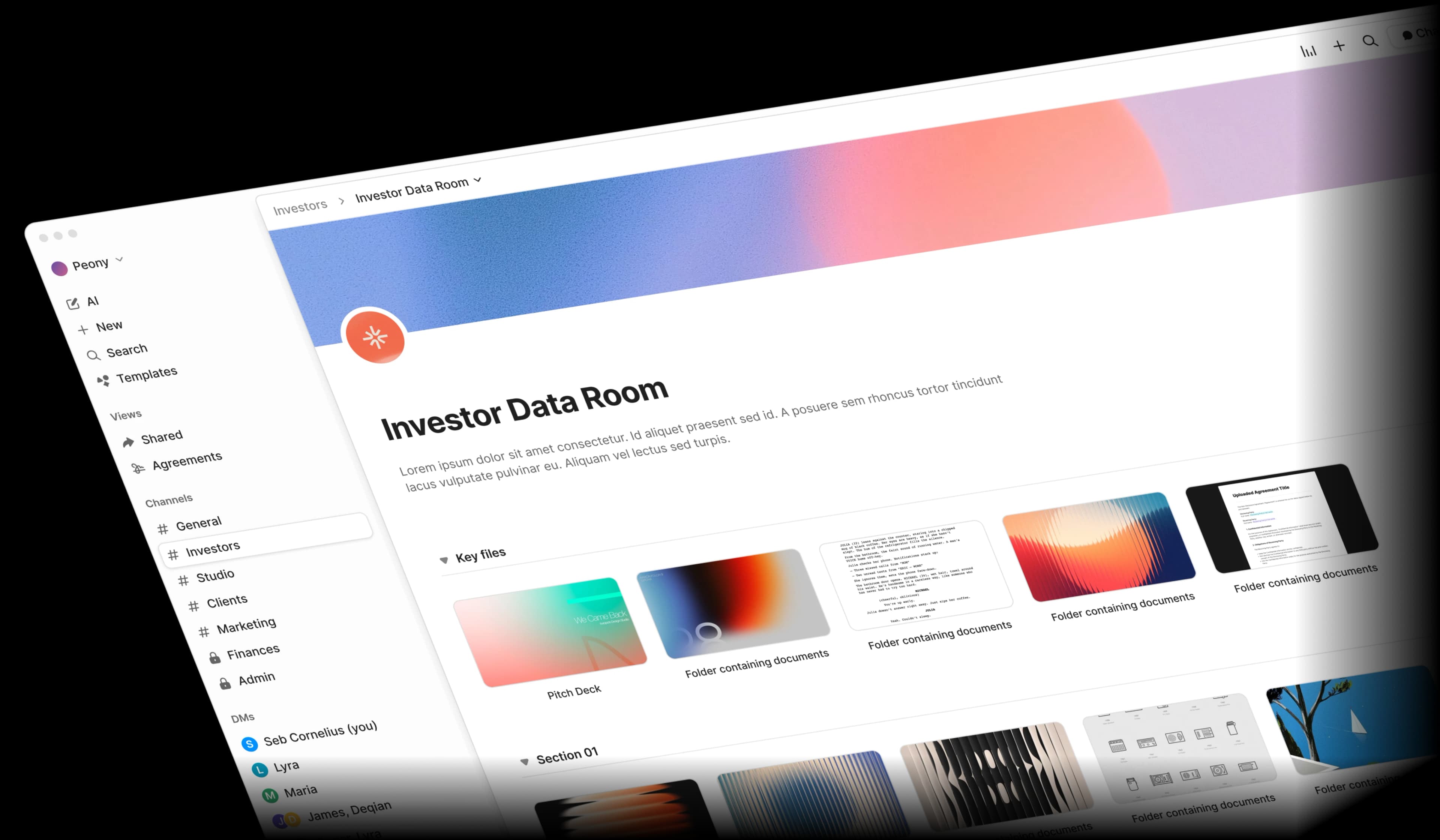
One document layer, from evaluation to funded agreement
Peony gives the trader-onboarding paperwork a proper home: collect verification documents through no-account upload links, e-sign funded-account agreements at scale, and store it all on your brand — the dedicated document layer that sits alongside your KYC vendor and platform. For a firm processing real volume, lead with the Data Room plan ($52/admin/month). See the full plan comparison.
How do you collect KYC and verification documents from thousands of traders securely?
Make the room the single controlled intake for everything a trader submits. Send each trader a personalised, permissioned upload link — no account required — and their ID, proof of address, and supporting files land in one access-controlled space with a per-trader evidence trail of what was collected and when. Peony is the secure document layer; your KYC vendor (Sumsub, iDenfy, Veriff) still makes the identity determination. You stop scattering sensitive PII across inboxes and chat. See the full playbook on how to collect documents from clients securely.
Personalised, no-account upload links
Each trader gets their own link into pre-built folders — they upload directly, with nothing to sign up for. The same pattern accounting firms use to collect client documents at scale.
A per-trader evidence trail
Every submission is logged and attributed. Peony holds and logs the evidence; it does not itself certify identity — that stays with your KYC provider.
PII in one controlled place
Sensitive documents sit behind permissioned access and revocable links, not in a dozen inboxes and DMs.
How do you e-sign funded-account agreements at scale — and keep them on-brand?
Send the funded-account or trader agreement to every passing trader from inside the room. Each trader signs in the browser with no account, and the executed agreement is filed against that trader with a timestamped audit trail — email, IP, and the exact version signed. Put the whole flow on your own domain with your logo so it reads as your product, not a third-party signing tool. See how to e-sign customer agreements at scale.
In-browser signing, no account
Traders review and sign the agreement in the Peony viewer; signing and storage are one step, so no signed PDF gets re-uploaded into a separate system.
A defensible, versioned record
Every signature carries a timestamped log with email, IP address, and document version — the record a US ESIGN/UETA workflow relies on.
White-label the whole flow
Custom domain plus logo and brand styling so the signing page and portal look like your trading brand end to end.
How do the documents stay controlled — and fit the platform you already run?
Keep one current version of every agreement, watermark what's sensitive, and cut access cleanly when it should end — with every open logged. Peony is the dedicated document layer that sits alongside your trading platform, CRM, and storage rather than replacing them: push analytics and signature events toward your CRM, use the MCP server to move artifacts programmatically, and scope deeper platform integration with our team directly.
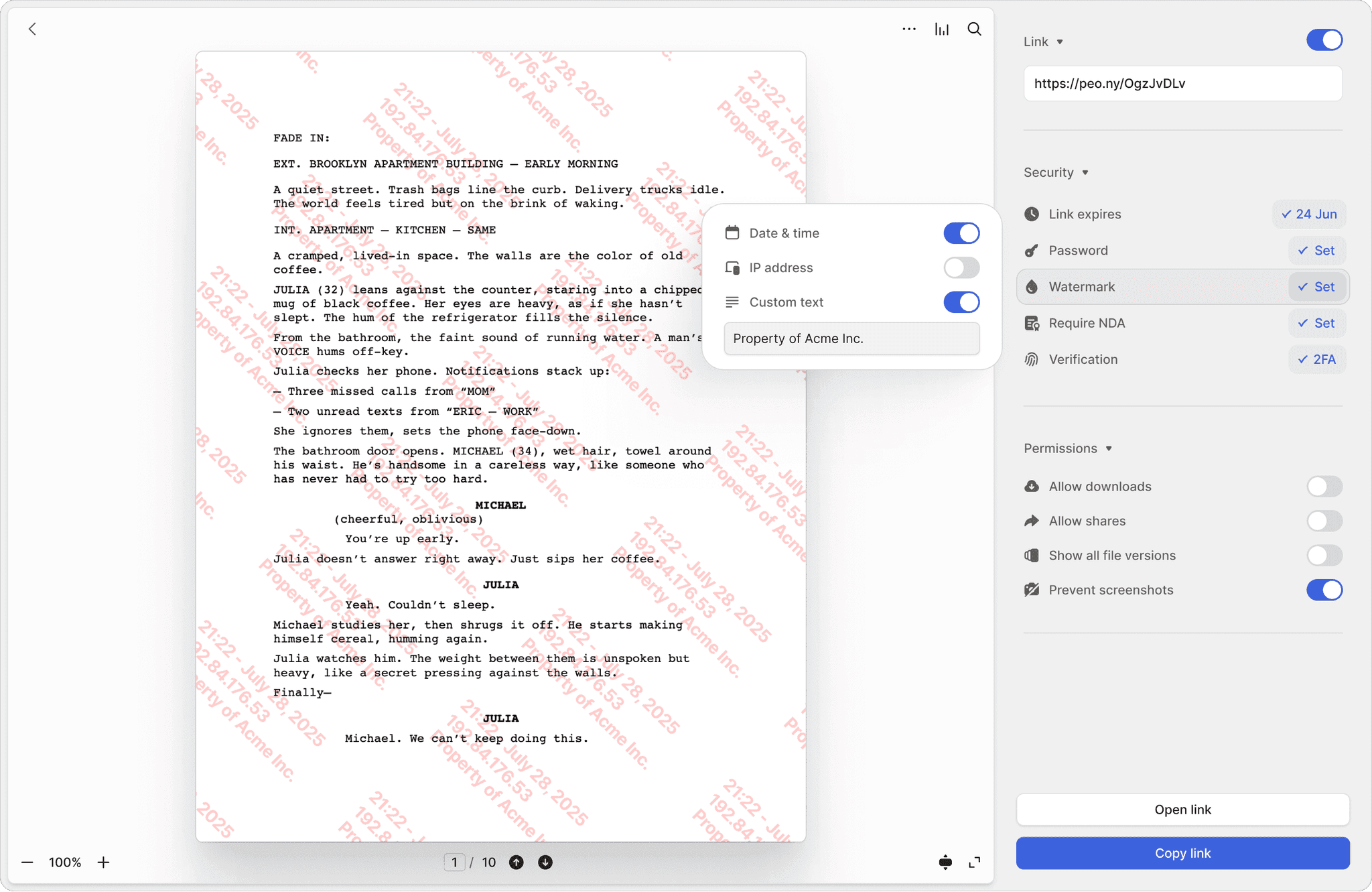
One current version, full log
A trader is never served a stale contract; link expiry and instant revoke end access on your terms, and every view is recorded.
Watermarks on sensitive documents
Dynamic watermarks (Data Room, $52/admin/month) stamp viewer identity and timestamp, so a leaked ID or agreement points back to a source.
Sits alongside your stack
CRM push of analytics and signature events, a publicly available MCP server, and custom-domain white-label; email sean@peony.ink for platform-level integration.
"Ease of use, drag and drop capabilities, rapid response in support, and great service and value. It was easy to navigate throughout the platform as well as setting up our data room."
Joseph Garcia
Providence Water
Frequently asked questions
Do traders need a Peony account to upload their documents or sign an agreement?
No — and for a retail firm processing thousands of individual traders, that's the point. You send each trader a personalised, permissioned upload link; they drop their ID, proof of address, and any supporting files straight into their own space with no account to create and no password to reset. The same is true for signing: a trader receives a secure link, reviews the funded-account agreement in the browser, and signs in place with no account on their end. Every action is timestamped and attributed, so you get a clean per-trader record without adding a signup step to your funnel.
Is Peony a KYC or AML provider — can it verify a trader's identity for us?
No, and we won't pretend otherwise. Identity matching and AML screening are done by your KYC vendor — Sumsub, iDenfy, Veriff, or whoever you already run. What Peony is is the secure document layer around that: the controlled intake where a trader submits sensitive documents, the per-trader evidence trail of exactly what was collected and when, and the archive where the signed agreement and supporting files live afterward. Peony holds and logs the evidence; your verifier makes the identity call. That division is deliberate — you keep your specialist KYC tool and stop scattering the actual documents across email, Discord, and a CRM database.
Can we e-sign funded-account and trader agreements at volume, with a legally defensible record?
Yes. On Peony Business ($30/admin/month) you send agreement signature requests to traders directly from the room — each trader gets a secure link, reviews the agreement in the Peony viewer, and signs in the browser. Every signature carries a timestamped audit trail with email, IP address, and the exact document version signed, which is the record a US e-signature (ESIGN/UETA) workflow rests on. Because signing and storage live in the same place, the executed agreement is filed against that trader automatically — no re-uploading a signed PDF back into a separate system.
Can we white-label the signing pages, trader portal, and notification emails with our brand?
Yes — and for a direct-to-consumer trading brand that matters. Put the room on your own custom domain, apply your logo and brand styling so the signing page and upload portal look like your product rather than a third-party tool, and the trader sees a consistent branded experience from evaluation to funded agreement. This is on the paid tiers; the branding depth increases on the Data Room plan.
How do the signed agreements and uploaded IDs actually get stored, controlled, and retrieved?
Each trader's documents live in a permissioned space you control. There is one current version of any agreement, so a trader can never be served a stale contract; dynamic watermarks (Data Room, $52/admin/month) stamp sensitive documents with viewer identity; link expiry and instant revoke let you cut access cleanly when it should end; and every open is logged. Retrieval is a search away rather than a dig through an inbox. Note Peony is a secure document-management and sharing layer — for formal records-retention schedules, pair it with your compliance policy.
Can Peony sit alongside our existing platform, CRM, and storage instead of replacing them?
That's the intended shape. Peony is the dedicated document-collection, e-sign, and secure-sharing layer — it doesn't ask you to rip out your trading platform, your CRM, or your storage. Today you can push room analytics and signature events toward your CRM, and there's a publicly available MCP server an AI agent can use to read a room and push artifacts into it. For deeper platform integration — embedding signing in your own funnel, event webhooks, or a sandbox — talk to our team at sean@peony.ink; we scope those with firms directly rather than overselling a self-serve API we haven't shipped.
How does pricing work for a firm onboarding thousands of traders a month?
Peony is priced per admin seat, not per signed envelope or per uploaded file — so onboarding volume doesn't meter you into a surprise bill. Business is $30/admin/month (upload links, unlimited e-signatures, Simple NDA gating, screenshot protection) and Data Room is $52/admin/month (adds dynamic watermarks, Advanced NDA with countersigning, granular permissions). Your admins — ops, compliance, payouts — hold the seats; your traders transact for free on the other side of a link. Compare that to per-envelope e-signature pricing plus a separate file-collection tool plus separate storage.
Give your trader paperwork a home
Collect KYC documents through no-account links, e-sign funded-account agreements at scale, and keep the whole flow on your brand — priced per seat, not per envelope, and sitting alongside the KYC vendor and platform you already run. Join the 8,000+ customers who run sensitive document processes on Peony. No credit card required.
No credit card required