
The data room for manuscripts, book proposals and rights deals
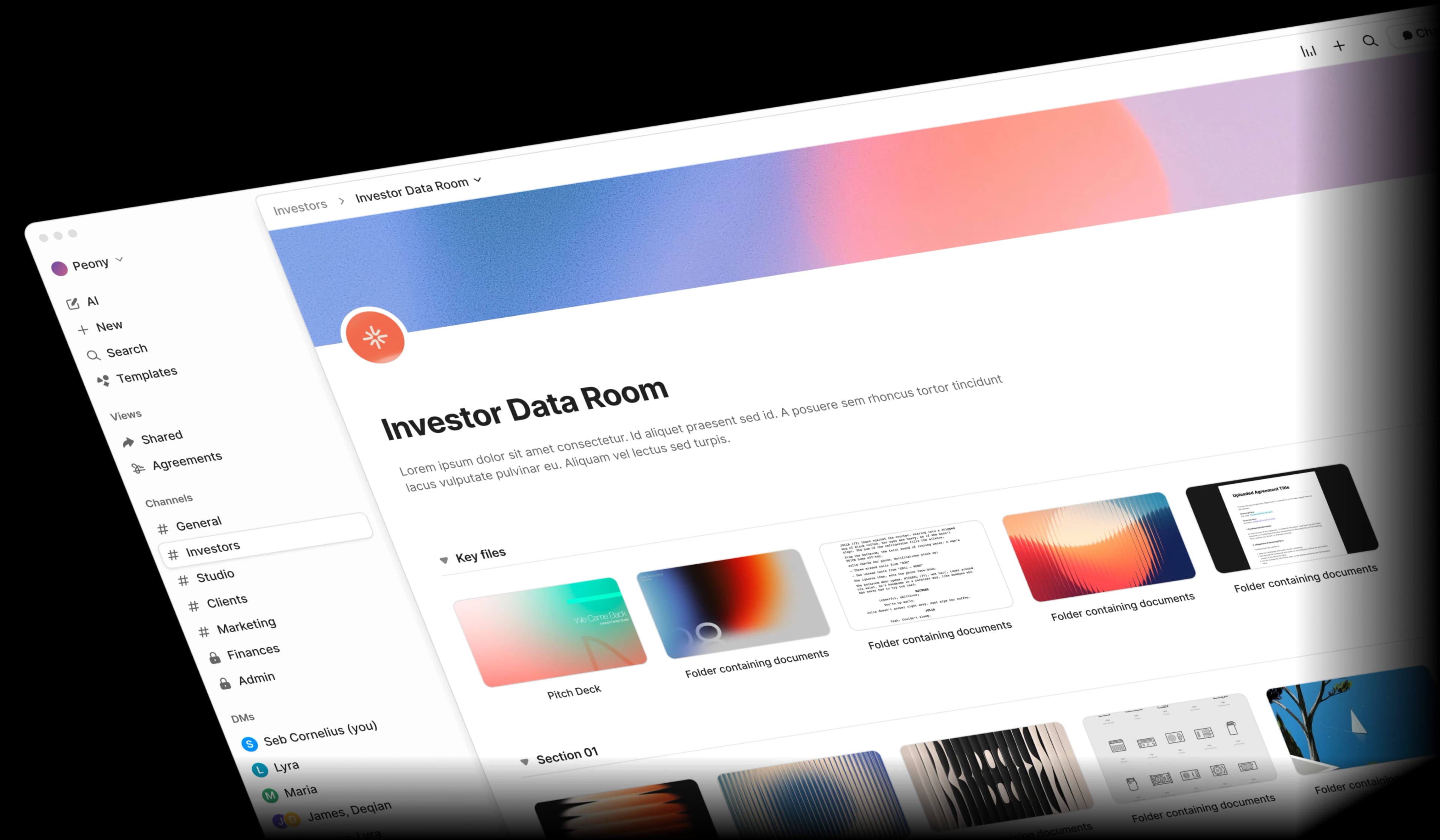
Send a manuscript or proposal to agents, editors and beta readers as a view-only link instead of an attachment. Each reader's name is watermarked on every page, you see who read how far, and you can close access the day a submission ends. Contracts are signed in the same place.
No credit card · 7-day Data Room trial that never auto-charges · agents, editors and readers view free, no account · 24/7 support
8,000+ customers in 60+ countries · $44.7B in client assets
Peony staff can't open your documents, your documents aren't used to train AI, and Peony has had no data breach since launch.
What is Peony for authors and publishers, and who is it for?
Peony is a virtual data room that authors, literary agents and publishers use to share unpublished manuscripts and book proposals as view-only links, sign contracts, and run rights and acquisition deals.
- Submit without losing control: send the manuscript as a link limited to named readers, with downloads off and each reader's identity on every page.
- See who is reading: page-by-page analytics show which agent or editor finished the sample chapters and who stopped at the synopsis.
- Close the deal: sign agency, publishing and rights agreements with built-in e-signatures, and keep the executed copies in one place.
Peony at a glance
- Built for
- Authors, ghostwriters, literary and rights agents, independent presses, publishers and film and TV scouts
- Typical plan
- Data Room, $52 per admin per month billed yearly ($75 monthly): unlimited rooms, documents and storage, a signed NDA with audit record, dynamic watermarks, granular folder and file permissions, Visitor Q&A, a custom domain, AI room generation and Index documents.
- Pricing
- Business $30, Data Room $52 and Deal Team $64 (minimum 4 admins) per admin per month billed yearly ($44, $75 and $89 monthly); Enterprise is custom. Free ($0) covers 50 documents and 500 MB as tracked single-file links; data rooms start on Business.
- Agents, editors and readers
- Agents, editors and readers are unlimited and free on every plan and don't need a Peony account. You pay per admin, not per viewer.
- Rooms and storage
- Unlimited data rooms, documents and storage on Data Room and above, and no per-file size cap on any plan. Business includes 3 data rooms per admin, 1,000 documents per admin and 100 GB of storage, with no per-file size cap.
- Formats
- Word, PDF and Apple Pages manuscripts open in the browser, so readers never hold the file.
- Signatures
- Built-in e-signatures with a timestamp, IP address and audit log on every signature. Signers need no account.
- Security
- AES-256 at rest, TLS 1.2+ in transit. Peony staff can't open your documents, your documents aren't used to train AI, and Peony has had no data breach since launch. Peony's incident-response policy commits to telling affected customers within 72 hours of confirming an incident that affects customer data. SOC 2 Type II-ready and ISO 27001-ready, with both audits underway. Compliance and certifications
- Setup
- Median 4 min 19 s from sign-up to first uploaded document (State of M&A Data Rooms, Q3 2026 edition).
- Trial
- 7-day Data Room trial you start yourself: no credit card, and it never auto-charges. Rooms, files, links, analytics and NDA settings carry over when you upgrade. AI features switch on after you upgrade.
- Support
- 24/7 support, handled directly by the Peony team across Europe, US and Asia hours, with no outsourced tier. Everyone you speak to on Peony support has M&A experience at elite boutiques or bulge-bracket banks, VC experience, or has raised $1M+ themselves.
- Customers
- 8,000+ teams in 60+ countries, with $44.7B in client assets.
Why do authors and publishers need a data room?
An unpublished book is at its most valuable and its most exposed before publication, when it has to be read by people outside your control.
A manuscript attachment can't be recalled
Once a Word file or PDF is in someone's inbox it can be forwarded, uploaded or posted, and you will never know. Manuscript phishing is a known problem in publishing: thieves pose as agents or editors and simply ask for the file.
You can't tell who actually read it
Twenty agents have the proposal. A sent email tells you nothing about who opened it, who read the sample chapters and who never got past the first page.
Early readers multiply copies
Every beta, sensitivity and expert reader gets a full copy. One careless share, or one file pasted into an AI tool, puts unpublished work outside your control.
Rights deals run on scattered paperwork
Translation, audio and screen rights each bring their own offers, contracts and royalty statements. Spread across inboxes, they are hard to audit and harder to sell.
What do authors, agents and publishers use Peony for?
Six jobs, from the first query to the sale of screen and translation rights.
Query agents and publishers
Send the query, synopsis and sample chapters as one tracked link per agent or editor, and see who read what before you follow up.
See page-level analyticsRun a beta read
Give beta, sensitivity and expert readers a view-only link limited to their email, with their name watermarked on every page and expiry when the read ends.
See dynamic watermarksShare a full manuscript under NDA
Put an NDA in front of a memoir, a ghostwritten book or an embargoed title, so every reader agrees to terms before page one.
See NDA gatingSign agency and publishing contracts
Send the agency agreement, publishing contract or ghostwriting agreement for e-signature. Each party signs in the browser, and the signed PDF stays with its audit log.
See e-signaturesSell translation, audio and screen rights
Give each rights buyer or scout its own view of the manuscript, sales history and rights list, and keep competing bidders apart.
See visitor groupsSend advance copies before publication
Share the advance reading copy with reviewers, booksellers and endorsers as an expiring link, and see who has opened it before publication day.
See link expiryWhat should an author share at each stage, and with whom?
A book changes hands at six points between first draft and rights sales, and each one needs a different control. The table shows what is usually shared at each stage, who sees it and the Peony setting that keeps it contained. For the reasoning behind view-only links, see how to prevent PDF forwarding.
| Stage | What you share | Who sees it | Control that matters |
|---|---|---|---|
| Querying | Query letter, synopsis and sample chapters | Literary agents and acquiring editors | One tracked link per recipient |
| Proposal on submission | Book proposal, comparable titles and platform data | Editors at several publishers | Page analytics and link expiry |
| Beta and expert reads | Full manuscript | Beta, sensitivity and expert readers | Allow list, downloads off and watermark |
| Contract | Agency, publishing and rights agreements | Author, agent, publisher and lawyers | E-signatures with an audit log |
| Pre-publication | Advance reading copy and cover | Reviewers, booksellers and endorsers | Expiring, watermarked links |
| Rights sales | Manuscript, sales history and rights list | Translation, audio and screen buyers | NDA and per-buyer access |
Which Peony plan does an author or publisher need?
Most authors and agents start on Business for named-reader allow lists, download prevention and unlimited e-signatures. Data Room adds each reader's name watermarked on every page, signed NDAs and unlimited rooms for an agency or press with many titles. Readers are always free. See all pricing.
| Control | Starts on |
|---|---|
| Page-by-page analytics and link expiry | Free, $0 |
| Allow list, email verification and download prevention | Business, $30/admin/month |
| Screenshot protection | Business, $30/admin/month |
| Unlimited e-signatures | Business, $30/admin/month |
| Dynamic watermarks with each reader's identity | Data Room, $52/admin/month |
| Signed NDA with a PDF for both parties | Data Room, $52/admin/month |
| Unlimited rooms, documents and storage | Data Room, $52/admin/month |
Frequently asked questions
What is Peony, and is it a good fit for authors and publishers?
Yes. Peony is a virtual data room that authors, literary agents and publishers use to share manuscripts as view-only links, watermark every page with the reader's name and see who read each page. Data Room, the most popular plan, is $52 per admin per month billed yearly ($75 monthly), with unlimited rooms and storage; inviting readers is free and unlimited.
How do I send my manuscript to agents or beta readers without it being copied or leaked?
Share it as a view-only link, not an attachment. In Peony the reader opens the manuscript in the browser and never holds the file. On Business ($30/admin/month) you limit the link to named email addresses, turn off downloads and add screenshot protection. On Data Room ($52/admin/month) each reader's name and email are watermarked across every page, so any leaked page points back to one person.
Can I see whether an agent or editor actually read my submission?
Yes. Peony's page-by-page analytics, included on every plan, show who opened your link, when, and how long they spent on each page. You can tell an editor who read all three sample chapters from one who stopped at the synopsis, and time your follow-up to match. Send each agent or editor a separate link so the reading data is tied to the right person.
Is my unpublished manuscript protected by copyright before I share it?
Generally yes. In the United States, the United Kingdom and other Berne Convention countries, copyright protects a manuscript automatically from the moment it is written down. What copyright doesn't give you is a record of who received your work. A Peony link adds that record: who opened the manuscript, when and which pages, with each reader's name watermarked on the copy they saw.
How do beta readers open the manuscript? Do they need an account?
No. A beta reader clicks your link, verifies their email if you require it, and reads in the browser. They don't need a Peony account or an app. You choose whether they can download, and you can end access for one reader or for everyone at any time. Readers are always free, because Peony charges per admin.
What goes in a non-fiction book proposal, and how should I send it?
A non-fiction book proposal usually contains an overview, an author biography and platform, the market and comparable titles, a chapter outline and one or two sample chapters. Send it as one tracked link per editor instead of an attachment. You'll see which sections each publisher read, and you can replace the file with a new version without sending a new link.
Can a literary agency or small press run all its titles in Peony?
Yes. Data Room ($52/admin/month) includes unlimited rooms, documents and storage, so each title or author gets its own room for the manuscript, contract and royalty statements. Only the staff who manage rooms need a paid admin seat. Authors, editors, scouts and co-agents view for free.
Can we sign the agency agreement or publishing contract in Peony?
Yes. Upload the contract, place signature fields for the author, the agent and the publisher, and each party signs in the browser without an account. Every signature carries a timestamp and IP address, and the signed PDF is stored with its audit log. E-signatures are unlimited from Business ($30/admin/month), and Free includes 3 a month.
We're selling screen or translation rights. How do we share the book with several buyers at once?
Give each buyer or scout its own link or group. On Data Room ($52/admin/month) every buyer signs the NDA first, sees only what you release and reads a copy watermarked with their identity, and buyers never see each other. Page analytics show who finished the book, which is usually the best sign of a serious offer.
Can I try Peony before I pay?
Yes. Peony's Data Room plan has a 7-day free trial you start yourself, with no credit card, and it never converts to paid on its own. Rooms, files, links, analytics and NDA settings carry over when you upgrade. AI features, such as AI document Q&A and AI room generation, switch on once you're on a paid plan.