
The data room built for sell-side bankers running several mandates at once
Last updated: September 2026. Pricing verified against peony.ink/pricing.
Peony is a virtual data room (VDR) for boutique and regional investment banks, independent M&A advisors, and business brokers moving upmarket: teams running 2 to 10 concurrent sell-side mandates at $5M to $500M enterprise value. Pricing is per admin, not per deal, so the fourth mandate of the year costs the same as the first. Unlimited rooms, unlimited bidders, 4-tier bidder access, and a moderated Q&A workflow, live in under 5 minutes.Trusted by 6,800+ teams across M&A, fundraising, and investor workflows. Rated 4.8/5 on G2 and 4.9/5 on Capterra.
- Pricing
- Per admin, not per deal. Data Room $52/admin/mo, Deal Team $64/admin/mo (billed annually)
- Rooms & bidders
- Unlimited data rooms on Data Room and Deal Team, unlimited bidders and viewers
- Setup
- Under 5 minutes self-serve (median 4 min 19 s)
- Per-deal charges
- None. No per-page, per-GB, or per-bidder fees
- Mandate size
- $5M to $500M enterprise value
- Updated
- September 2026
24/7 dedicated support for enterprise deals
Why does per-deal VDR pricing break for boutiques?
Per-deal pricing bills the same four bankers again every time a new mandate signs. A firm running 3 concurrent sell-side mandates on per-deal Datasite quotes of $30,000 to $60,000 pays $90,000 to $180,000 a year in data-room costs; the same firm on Peony pays $1,872 for three Data Room admins, or $3,072 for the four-admin Deal Team floor, and the number does not change when a fourth mandate signs. At a $150M enterprise value with a 1.5% to 2.5% blended success fee, a $40,000 passthrough is 1% to 2% of expected fee. A Peony seat is rounding noise.
What a legacy VDR quotes for one mandate

Per-page metering, quote-only pricing
$30K–$60K
initial quote, 5-month mandate

Per-page metering, quote-only pricing
$25K–$50K
initial quote, 5-month mandate

Per-deal subscription, quote-only pricing
$8K–$25K
initial quote, 5-month mandate

Per-project, storage and user based
$5K–$20K
initial quote, 5-month mandate
Three concurrent mandates, one year
$90,000–$180,000
On Datasite per-deal quotes. SRS Acquiom's study of 3,800+ deals found actual VDR bills ran 2 to 10 times the initial quote, with 15%+ of deals over $50,000 at close.
These are initial quotes on a 5-month, $150M mandate; close-day totals run higher, and the Datasite, Intralinks, and Ideals comparison pages show $50,000+ per deal and $15,000-$30,000 per project.

What Peony charges, on every mandate

Peony Deal Team
Per admin, minimum 4, billed annually
$64/admin
per month
Every mandate the team runs this year
$3,072 total
4 admins x $64/mo x 12 months on Deal Team. A solo adviser on Data Room pays $624 a year. No per-deal, per-page, or per-bidder fees.
What slows a boutique sell-side team down?
Four frictions show up on almost every lower-middle-market mandate: the passthrough the client refuses to pay, the permission matrix the analyst manages by hand, Q&A run on email, and the days it takes IT to provision a room. Peony removes each one.
The $40K passthrough
Clients increasingly refuse a $30K to $60K Datasite line as expense reimbursement, leaving the bank to absorb it against a success fee. Peony's published per-admin price folds into the retainer or the expense cap without a conversation.
The 252-cell permission matrix
An 18-bidder Round 1 with 14 top-level folders is 252 permission cells on a legacy VDR, edited by hand at every gate. On Peony, permissions sit on the visitor group, so unlocking Tier B for the shortlist is one edit.
Q&A on email and spreadsheets
A 15-bidder Round 1 produces 1,200 to 3,000 questions in four weeks. Run on email, the analyst misses the 48-hour SLA and the record does not survive a process-integrity inquiry. Peony keeps every question, draft, approval, and answer in the room.
Days to provision a room
When the CIM is ready, waiting on vendor onboarding costs momentum with the client. A Peony room is live before the kickoff call ends: median time from account creation to first uploaded document is 4 minutes 19 seconds.
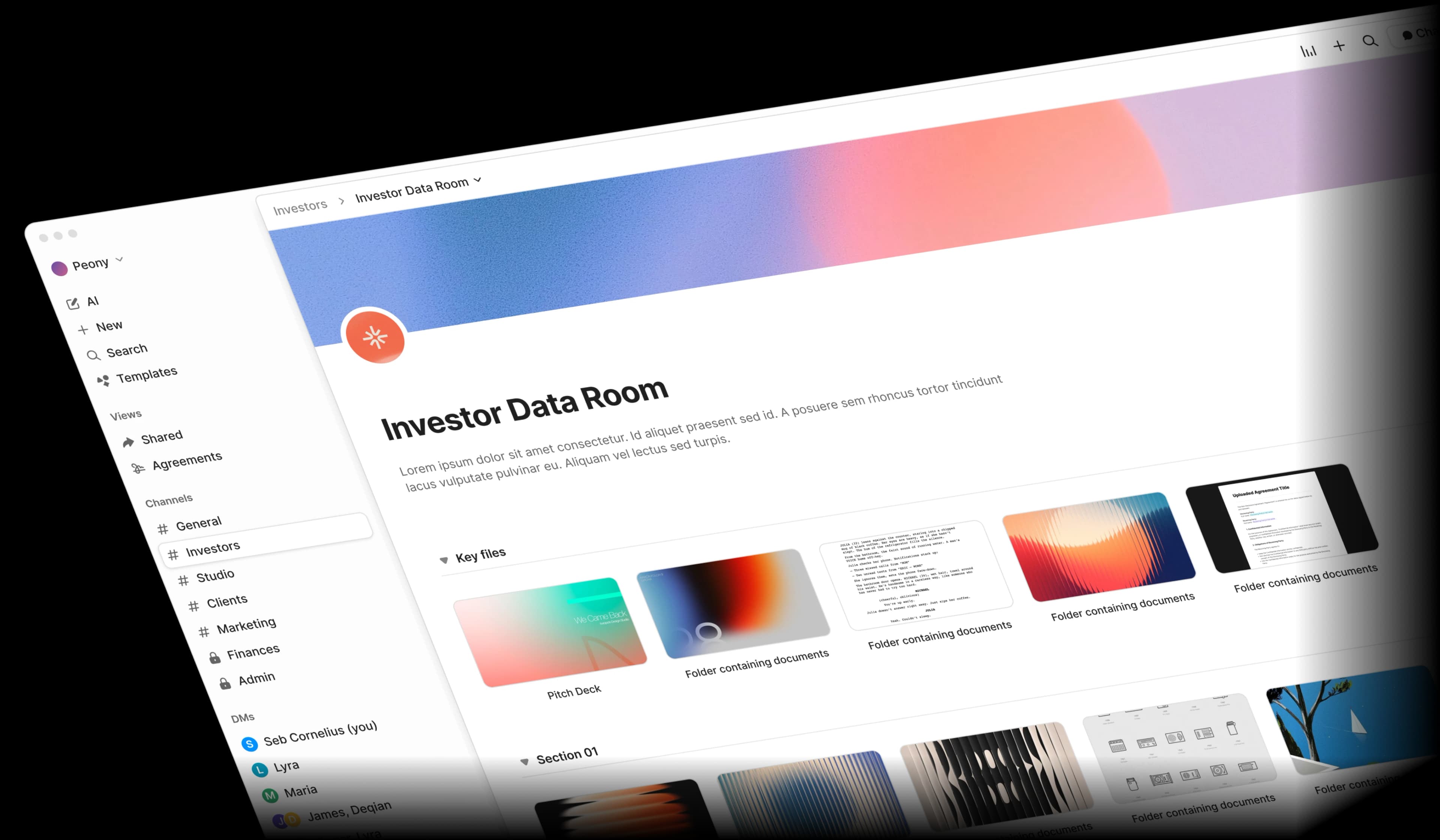
How does the 4-Tier Bidder-Access Architecture run on Peony?
The 4-Tier Bidder-Access Architecture is a single data room with four permission states that mirror the process letter: Tier A for the IOI round, Tier B for the LOI shortlist, Tier C for confirmatory diligence, and Tier D for the pre-signing red folder. On Peony each tier is a set of folders granted to a visitor group, so bidders advance through the gates by changing group permissions rather than rebuilding rooms.
Build the full room once. Unlock it in stages. Tier B, C, and D folders are invisible to Tier A bidders, not merely locked. When a bidder drops out, one click revokes access while every other group continues undisturbed.
| Tier | Stage and bidder count | What unlocks | On Peony |
|---|---|---|---|
| A | IOI round, weeks 0-4, 8-25 NDA-signed bidders | CIM, redacted 3-year and LTM financials, market overview, org chart, anonymized customer concentration, management bios | NDA gate on the room (Simple NDA on Business, Advanced NDA with countersigned PDF on Data Room); every bidder in its own visitor group; Advanced Redaction (Deal Team) permanently blacks out customer names and comp before Tier A opens; dynamic watermarks on every page |
| B | LOI round, weeks 5-10, 3-7 shortlisted bidders | Full management deck, unredacted financials, top-customer revenue detail, key contracts, IP register, employee comp summary | One permission edit on the shortlist group unlocks every Tier B folder; page-level analytics show which bidder is working the model and which is skimming the CIM |
| C | Confirmatory diligence, weeks 11-18, 1-2 final bidders | Employee-level compensation, customer-level revenue and margin, litigation register, employment agreements, IT documentation | Screenshield and download prevention on the most sensitive folders; Q&A SLA tightens to 24 hours; revoke the backup bidder in one click when exclusivity is granted |
| D | Pre-signing red folder, weeks 16-24, 1 winning bidder | Disclosure schedules, R&W insurance underwriting materials, executive retention term sheets, sensitive M&A history | Single-group folder; on Deal Team, the archive download freezes the room as a tamper-proof, OTP-protected closing binder |
Visitor groups
One group per bidder or consortium. Each group carries its own folder access, its own links, and its own analytics, and no group learns another exists. Included on Data Room.
Granular per-file permissions
View, download, or no access per file and per group. Tier-tag the folder tree once and advance bidders by changing the group, not 252 cells.
NDA gating
Gate Tier A behind your own NDA template. Advanced NDA on Data Room delivers a signed PDF to both sides with a full audit trail, which is what bidder counsel expects for the file.
Dynamic watermarks
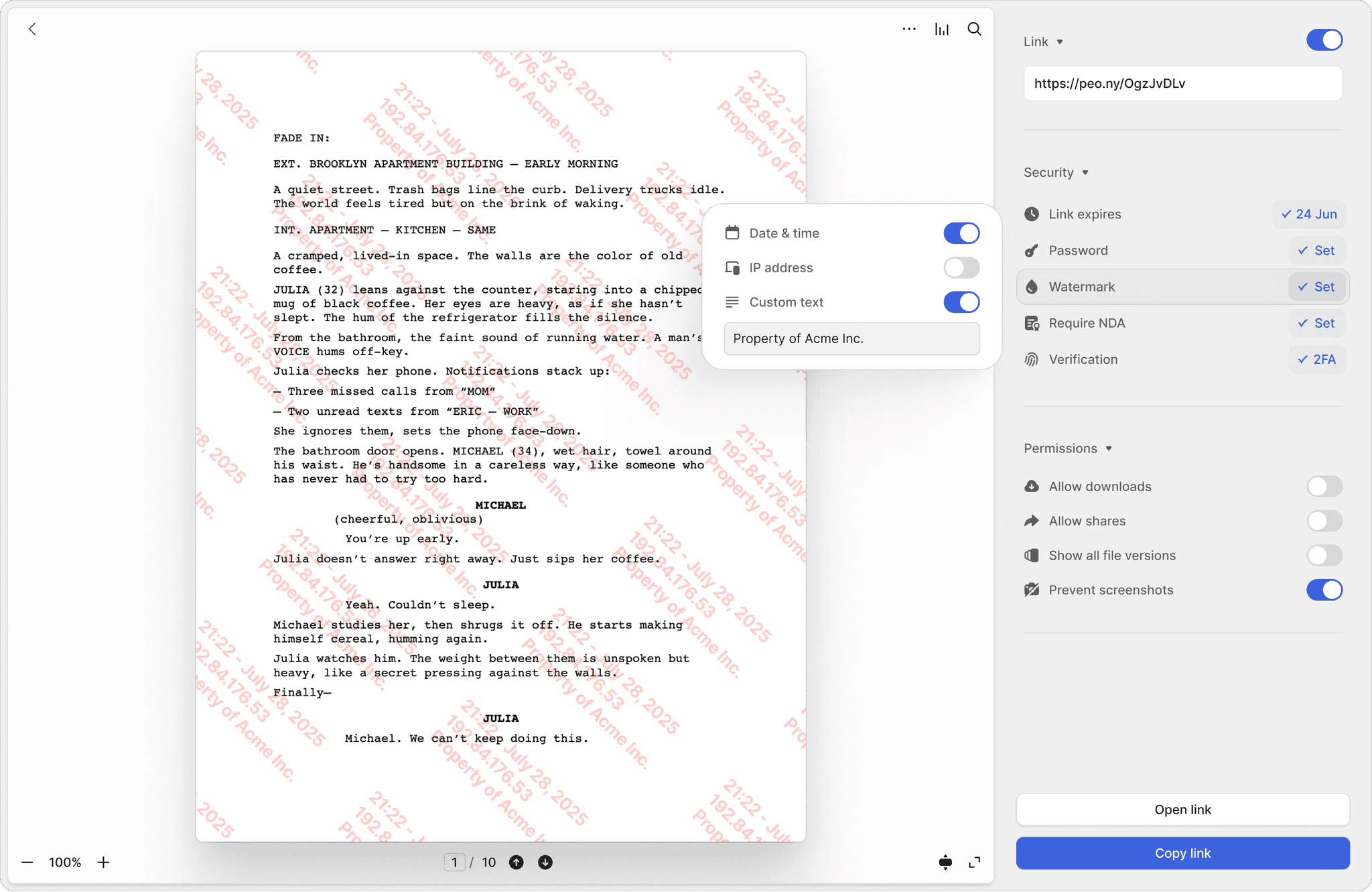
Every page carries the viewer's name, email, and timestamp. A leaked CIM traces to one named individual in one bidder group on one mandate.
Page-level analytics
Time on page, pages viewed, and downloads per bidder, so the IOI shortlist is built on which buyers actually worked the financials.
Q&A workflow
Bidders ask inside the room; your team drafts, reviews, and publishes. AI document Q&A pulls a cited first draft from the room's documents.
Instant revoke
When a bidder drops at the IOI deadline or exclusivity is granted, revoke the group in one click. No support ticket, no waiting on IT.
Custom domain and branding
The room loads on your bank's domain with your logo and colors (Data Room). Deal Team sets a different domain and brand per data room.
Advanced Redaction
Permanently black out customer names, comp figures, and dates before Tier A opens, inside the room rather than in a separate tool. Deal Team.
Auto-indexing
Upload the seller's 500 to 1,500 documents in bulk and Peony numbers and files them into a structured index, so the analyst is not hand-filing for the first week.
Screenshield
Screen-capture and screen-recording prevention on the confirmatory folders where customer-level revenue and employee-level comp live. Data Room.
Audit trail and archive
Every view, download, print, and NDA acceptance logged per named viewer. Deal Team freezes the room as a tamper-proof archive for the closing binder.
How do I keep 8-25 bidders from seeing each other?
Isolate on two axes. Document access is isolated by tier and by visitor group, so a bidder sees only its authorized folders and never learns that deeper folders or other bidders exist. Activity and Q&A are isolated by group, so per-bidder engagement is visible only to your sell-side team and nothing a bidder submits is visible to another bidder.
One room. Twenty bidders. Zero cross-visibility. A strategic acquirer and a financial sponsor can work the same room on the same afternoon without either learning the other is looking, and the audit log records every action with bidder, user, IP, device, and timestamp for any post-closing process-integrity inquiry.
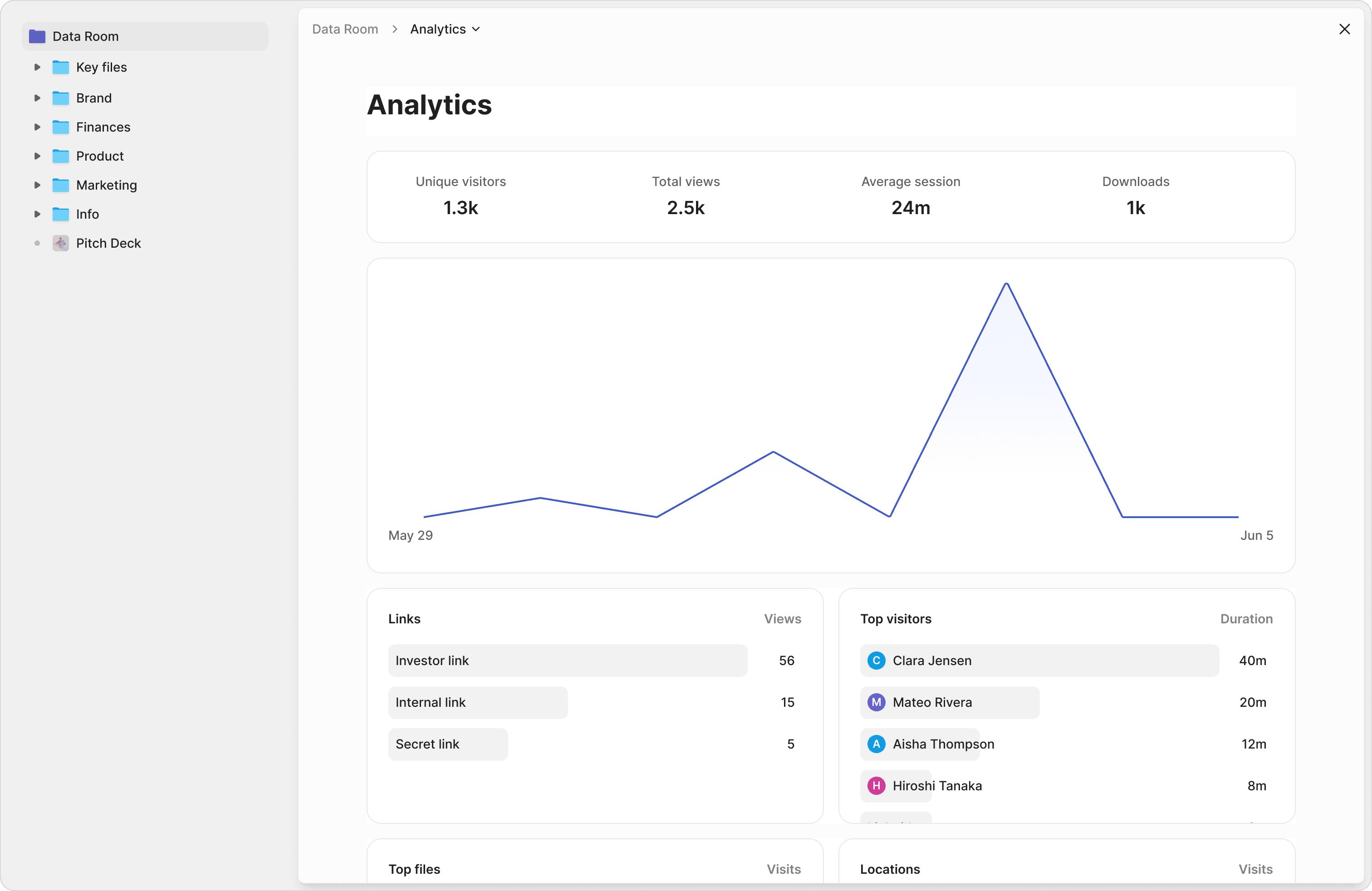
Axis 1: document access by tier and group
Every folder is tagged to a tier; every bidder sits in a visitor group with a tier. The room renders only the authorized tier on each page load, so Tier B folders are invisible to a Tier A bidder, not just locked.
Axis 2: activity and Q&A by group
Your team sees per-bidder engagement: folders opened, documents read, time on page, downloads. Bidders see none of it. Answers publish only after your review, so nothing crosses between groups; question teams keep each group's Q&A private on Data Room, and Deal Team adds routed approvals.
Name the groups in the process letter
Name each bidder group in the engagement-letter exhibit and the bid procedures letter. A post-closing inquiry can then trace exactly which group had access to what, when it advanced, and on what evidence the shortlist was selected.
How does the Q&A workflow run across bidders?
Questions are submitted inside the room, triaged to a subject-matter expert, drafted with a cited AI first draft, reviewed by the banker, and published only after approval, with every step logged. A 15-bidder Round 1 generates 80 to 200 questions per bidder over four weeks, and the 2026 mid-market standard is a 48-hour response window that tightens to 24 hours in Round 2 and confirmatory.
Nothing leaves your side unapproved. Basic Q&A on Data Room keeps the threads inside the room. The Advanced Q&A module on Deal Team assigns each question to an owner, sets a deadline, and keeps the full audit history of who drafted, who approved, and when.
1. Submit and triage
Bidders submit questions in the room, tagged by category (financial, legal, commercial, IT, HR, tax, operations) as the bid procedures letter requires. The analyst routes each one to the CFO, GC, CRO, or CTO.
2. Draft with citations
AI document Q&A (5x usage on Data Room, 10x on Deal Team) proposes a first draft from the room's own documents with citations, so a customer-concentration question starts from the schedule rather than from a blank page.
3. Review, publish, log
The banker reviews and approves before anything reaches a bidder. On Deal Team, deadlines track the 48-hour SLA and the audit history records drafter, approver, and publish time, which is the record a process-integrity dispute turns on.
How do I bill the data room in the engagement letter?
Three clauses to revisit if your template was drafted before 2024: the data-room cost line, retainer creditability, and the expense cap. With a published per-admin price, all three become legible to the client on signing day, with no month-4 overage and no add-on when Round 1 grows to 22 bidders.
Option 1: reimbursed at cost, with a cap
Replace "data room expenses reimbursed at cost via Datasite or a comparable platform" with "reimbursed at cost, not to exceed $[CAP], on a platform selected by Advisor." The cap forces the conversation up front and lets you default to a flat-rate room without renegotiating mid-mandate. A Data Room seat is $624 a year; the cap is never tested.
Option 2: folded into a creditable retainer
$50,000 to $100,000 is the modal 2026 retainer on a $40M to $300M mandate, fully creditable against the success fee at close. Fold the data room into the retainer and its creditability automatically credits the room. The client never sees a separate VDR line at all.
Option 3: absorbed inside the expense cap
$25,000 to $50,000 is the modal expense cap, with seller approval required above it. On Peony the cap covers the data room plus printing, travel, and counsel support without a single mid-mandate approval. At a $150M enterprise value and a 1.5% to 2.5% fee, a $40,000 Datasite line is 1% to 2% of fee; a Peony seat rounds to zero.
Which Peony plan fits a boutique bank?
Deal Team for a banking team of four or more, Data Room for a solo adviser or a two-person shop, Business for teaser and CIM distribution before the diligence room opens. All three are priced per admin and billed annually; monthly billing is available at a higher rate.
Deal Team
$64/admin/month
Billed annually, minimum 4 admins ($89 billed monthly). $3,072 a year at the floor.
For teams of 4+ running several mandates. All Data Room features, plus:
- Advanced Redaction for Tier A redacted financials
- Advanced Q&A module: assign, set deadlines, audit history
- Data room archive download (tamper-proof, OTP-protected)
- Document upload notifications, team and counter-parties
- Per data room domain and branding
- Custom email body and header on share notifications
- OAuth SSO (Google and Microsoft)
- SOC 2 Type II report and standard DPA from the dashboard
- API access and custom integrations
- Unlimited analytics retention, 10x AI document Q&A
- Priority support and a dedicated account manager
Data Room
$52/admin/month
Billed annually ($75 billed monthly). $624 a year for one admin.
For a solo adviser or a two-person shop. All Business features, plus:
- Unlimited data rooms, storage, and file size
- Dynamic watermarking on every page
- Advanced NDA: signed PDF for both parties, audit trail
- Granular per-file permissions and audit trail
- Group permissions via visitor groups
- Custom domain and branding
- Auto-indexing and AI room generation
- Screenshield screen-capture prevention
- Custom access questions and welcome message
- Basic Q&A inside the room, 5x AI document Q&A
- Migration assistance from your current VDR
Business
$30/admin/month
Billed annually ($44 billed monthly).
For teasers and CIM distribution before the room opens. All Free features, plus:
- Up to 1,000 documents and 3 data rooms per admin
- Email authentication and allow/block visitor lists
- Simple NDA (acknowledge only, logged in analytics)
- Advanced analytics and dropoff reports, CSV export
- Screenshot protection and download prevention
- AI document Q&A
- Remote access revocation
- Custom logo and background, Peony branding removed
- Folders, bulk upload, and multi-file sharing
- Unlimited e-signatures and collected initials
Enterprise (custom pricing) adds SAML SSO, custom DPA, MSA, and SLA, BYOK, custom data residency, and self-hosted deployment. Full plan detail at peony.ink/pricing.
How does Peony secure a sell-side process?
Peony secures every CIM, financial model, and legal exhibit with AES-256 encryption at rest and TLS 1.3 in transit on SOC 2 Type II-ready infrastructure, and is GDPR, CCPA, and HIPAA compliant. Dynamic watermarks, NDA gating, Screenshield, and two-factor authentication sit on top, so any leak traces back to a specific viewer.
Procurement-ready without a sales call. Deal Team customers download the SOC 2 Type II report and standard DPA from the dashboard. Enterprise adds SAML SSO, BYOK, custom data residency, and self-hosted deployment for regulated counterparties.
How does Peony compare with legacy VDRs for a banker?
On price, setup time, and Q&A tooling Peony wins for a $5M to $500M mandate; Datasite and Intralinks keep an edge only on $500M+ cross-border processes. Per-deal figures are for a 5-month, $150M enterprise value mandate; legacy pricing models are third-party estimates for quote-only vendors, sourced on the Datasite, Intralinks, and Ideals pricing teardowns.
| Dimension | Peony | Datasite | Intralinks | Firmex (Datasite-owned) | Ideals |
|---|---|---|---|---|---|
| Pricing model | Per admin, flat: Free ($0), Data Room $52, Deal Team $64/admin/mo annual | Per page uploaded, $0.40 to $0.85 per page (about $0.60 typical) | Per page, $0.40 to $0.85, about $10K/yr minimum | Per deal; reported entry tiers $399 to $995/mo | Per project by storage and users, $500 to $2,000/mo small, up to $20K+/mo large M&A |
| Cost per mandate (5 months, $150M EV) | No per-deal charge; the seat covers every mandate | $30K to $60K | $25K to $50K | $8K to $25K | $5K to $20K |
| Three concurrent mandates, one year | $1,872 (3 Data Room admins) or $3,072 (Deal Team floor) | $90K to $180K | 3 x per-deal quote | 3 x per-deal quote | 3 x per-project quote |
| Published pricing a client can verify | Yes, at peony.ink/pricing | No, quote only | No, quote only | No, quote only | Tier names only (Core, Premier, Enterprise) |
| Metered on pages or storage | No | Per page | Per page | No (per-project term) | Per GB |
| Setup time | Under 5 minutes (median 4 min 19 s) | Days | Days | 20+ minutes | 30+ minutes |
| Auto-indexing of uploaded documents | Included (Data Room) | Manual filing or managed-service add-on | Manual filing | Manual filing | Manual filing |
| AI Q&A drafting with citations | Included (Business and up) | Add-on | Add-on | Not included | Not included |
| Custom domain for the bank's brand | Included (Data Room); per room on Deal Team | Add-on | Add-on | Higher-tier annual plans | Add-on |
| Platform uptime | 99.96% measured | 99.9% SLA | Not published | 99.9% SLA | 99.95% SLA |
Datasite and Intralinks remain defensible on $500M+ cross-border processes with multi-language bidder pools and procurement whitelists. For the $5M to $500M mandates boutiques actually run, the cost premium no longer corresponds to a feature gap.
Frequently asked questions
Can I run multiple deals under one Peony subscription?
Yes. Every paid Peony plan is priced per admin, not per deal, and the Data Room and Deal Team plans include unlimited data rooms on a single subscription. A banker running four sell-side mandates opens four isolated rooms, each with its own folder tree, bidder list, NDA template, and audit trail, and the bill does not change when a fifth mandate signs. Business is capped at 3 data rooms per admin, which suits teaser and CIM distribution rather than full diligence rooms. On Data Room ($52/admin/month billed annually, $624 per admin per year) a solo adviser's entire annual deal book is covered by one seat; on Deal Team ($64/admin/month billed annually, minimum 4 admins) a boutique's whole banking team shares one subscription across every live mandate. Legacy VDRs quote each mandate separately, at $30,000 to $60,000 per deal for Datasite and $8,000 to $25,000 for Firmex (owned by Datasite since July 2021), so a boutique running three concurrent processes pays $90,000 to $180,000 a year on Datasite pricing for the same staff Peony covers at $1,872 (three Data Room admins) or $3,072 (the four-admin Deal Team floor).
Can bidders see each other in the data room?
No. In Peony each bidder, or each consortium, is its own visitor group with its own folder permissions, its own access links, and its own dynamic watermark identity. A Tier A bidder does not see that Tier B, C, or D folders exist, let alone another bidder's downloads or activity, and page-level analytics are visible only to your sell-side team. Questions are moderated by your team before anything publishes, so a bidder never sees another bidder's questions or your answers to them: question teams keep each bidder group's questions private on the Data Room plan, and the Deal Team plan adds assign-an-expert and approve-before-release routing. For a 15-bidder Round 1 that isolation is a process-integrity requirement rather than a preference: if a losing bidder later alleges selective disclosure, the room's audit trail, logged per named viewer with timestamp, IP, and device, is the defensible record. Visitor groups, granular per-file permissions, dynamic watermarking, and the audit trail are all included on Data Room ($52/admin/month billed annually).
Can I brand the room as my bank rather than as Peony?
Yes. On the Data Room plan the room loads on your own custom domain (for example deals.yourbank.com) with your logo, colors, and theme across the viewer and link pages, and Peony branding is removed from Business upward. Deal Team adds per-data-room domain and branding, so a boutique running mandates under a sector sub-brand or a co-advised process can give each room its own domain and identity, plus a custom subject line, body copy, and header on the share-notification emails bidders receive. A first-time bidder clicks your branded link, accepts your NDA on one screen, and is reading the CIM without creating an account. Legacy VDRs typically charge custom branding as an add-on or reserve it for higher-tier annual contracts.
How do I export the audit trail for the bid-procedures record?
Every view, download, print, NDA acceptance, and Q&A event in a Peony data room is logged against a named individual with timestamp, IP address, and device, and the audit trail is included on Data Room and above. Export it on demand for the bid-procedures record, alongside CSV analytics exports (available from Business) that show per-bidder time on page and pages viewed. For the closing binder, Deal Team adds a data room archive download: a tamper-proof, OTP-protected snapshot of the room frozen at a point in time, which is what R&W insurers, buyer counsel, and a post-closing process-integrity inquiry ask for. Analytics retention is 2 years on Data Room and unlimited on Deal Team, so on Deal Team the record outlives any survival period in the SPA.
What does it cost for a 5-banker boutique running 6 mandates a year?
$3,840 a year on Deal Team, or $3,120 a year on Data Room, and neither figure moves with mandate count. Five bankers on Deal Team at $64/admin/month billed annually is 5 x $64 x 12 = $3,840, which buys unlimited data rooms, Advanced Redaction for Tier A redacted financials, the Advanced Q&A module, per-room branding, OAuth SSO, the SOC 2 Type II report and standard DPA, and the closing-binder archive download for all six mandates. Five Data Room seats at $52/admin/month billed annually is $3,120 with unlimited rooms, dynamic watermarks, Advanced NDA, granular permissions, and Basic Q&A, but without redaction, Advanced Q&A, or SSO. Six mandates on the $30,000 to $60,000 per-deal Datasite quotes boutiques report is $180,000 to $360,000, and SRS Acquiom's study of 3,800+ deals found actual VDR bills ran 2 to 10 times the initial quote. On Deal Team, six mandates work out to $640 of data-room cost per mandate, which fits inside any expense cap without a client conversation.
Does unlocking Tier B for the LOI shortlist need a second room or a re-upload on Peony?
No. Build the full room once with every folder tagged to its tier, then unlock the Tier B folders for the shortlist's visitor group in one permission edit; the 3 to 7 shortlisted bidders see the management deck and unredacted financials on their next login with no re-invitation, no new NDA, and no broken links. Peony sets permissions per visitor group and per file, which is the difference between one edit and the 252-cell matrix an 18-bidder, 14-folder room creates on a legacy VDR. Visitor groups and granular file permissions are included on Data Room ($52/admin/month billed annually). The full tier map is in the sell-side playbook.
How does the Q&A workflow run across 15 bidders without leaking answers between them?
Route every question through the room rather than email, and keep your team as the only party that publishes. Bidders submit questions inside Peony's Q&A; your analyst triages each one to the CFO, GC, or CRO; AI document Q&A drafts a cited first answer from the room's own documents (5x usage on Data Room, 10x on Deal Team; bidder Q&A itself starts on the Data Room plan); the banker reviews; and the answer publishes only after approval. On Deal Team, the Advanced Q&A module assigns each question to an owner, sets a deadline against your 48-hour Round 1 SLA, and keeps a full audit history of who drafted, who approved, and when. Document access, folders, NDA, and analytics are isolated per bidder group through visitor groups, and question teams keep each group's Q&A invisible to every other group on the Data Room plan; the structured routing, with named experts and approval before release, is the Deal Team Advanced Q&A module. In a 15-bidder Round 1 with 80 to 200 questions per bidder, that workflow is what keeps a two-analyst team inside the SLA.
Can I quote Peony instead of a Datasite passthrough in the engagement letter?
Yes. Peony publishes its per-admin price, so you can quote Data Room at $52/admin/month (or Deal Team at $64/admin/month for the whole team) in the engagement-letter exhibit and fold it into the retainer or the expense cap, and the client can verify the figure at peony.ink/pricing before signing. If the letter is already signed with Datasite committed, or the process is live, see the passthrough triage in the playbook. Read the $40K passthrough triage.
Which Peony plan should a solo M&A adviser use versus a 6-banker boutique?
A solo adviser or a two-person shop runs on Data Room; a team of four or more runs on Deal Team; teaser and CIM distribution before the room opens fits Business. Data Room ($52/admin/month billed annually) gives one seat unlimited rooms, unlimited storage, dynamic watermarking, Advanced NDA with a countersigned PDF, granular permissions and audit trail, custom domain, auto-indexing, Screenshield, and Basic Q&A, which covers a lower-middle-market adviser closing three to five mandates a year at $624 per year. Deal Team ($64/admin/month billed annually, minimum 4 admins, $3,072 per year at the floor) adds Advanced Redaction, the Advanced Q&A module, per-room branding, the archive download, upload notifications, OAuth SSO, API access, the SOC 2 Type II report and standard DPA, and a dedicated account manager. Business ($30/admin/month billed annually) is the teaser layer: up to 1,000 documents and 3 data rooms per admin, email authentication, allow/block lists, Simple NDA, screenshot protection, download prevention, and dropoff analytics with CSV export.
Do PE bidders need the room to be on Datasite or Intralinks?
No. Mid-market PE associates grade a sell-side room on whether the CIM is organized, whether Q&A answers land inside 48 hours, and whether staged folders unlock predictably at IOI, LOI, and confirmatory, not on the vendor's logo; the exception is $1B+ AUM sponsors with corporate procurement whitelists, and those buyers rarely appear in a sub-$300M bidder pool. 6,800+ teams run deal, fundraising, and investor workflows on Peony, and it is rated 4.8/5 on G2 and 4.9/5 on Capterra. The playbook covers what PE buyers actually grade.
Related resources for bankers and M&A advisors
Investment Banking Data Room: The Sell-Side Banker's Playbook
The full operator guide behind this page: the 4-Tier Bidder-Access Architecture, tier-tagged folder tree, Q&A discipline, and the $40K passthrough triage.
M&A Data Room (Single Deal)
The single-mandate companion page: security, e-signatures, and the 9-month $936 deal math.
M&A Advisor vs Business Broker vs Investment Bank
Which intermediary runs which deal size, and why the title on the card matters less than the buyer list and the process.
M&A Advisor Fees
Retainers, Lehman scales, minimum fees, and the engagement-letter clauses that move the base, including where the data room sits.
Best M&A Advisors
The advisor benchmark hub across sectors and cities, for sellers choosing a banker and bankers checking the field.
Best M&A Data Rooms (Scored Comparison)
The product-comparison companion: seven VDRs scored on permissions, watermarking, Q&A, analytics, and price.
Data Room Cost Calculator
Enter storage, months, and admins to see what a mandate costs on Peony next to published and quote-only vendors.
Peony Pricing
Free, Business, Data Room, Deal Team, and Enterprise, priced per admin with no per-deal, per-page, or per-bidder fees.