
The private credit data room for fundraising, deals and borrower reporting
The data room built for direct lending velocity: run the LP fundraise against the ILPA DDQ, clone an underwriting room for every new credit facility, and collect financials and covenant certificates from each borrower without the email chase, with unlimited rooms on Data Room.Unlimited rooms. No-login borrower uploads. Set up in under 5 minutes: median 4 min 19 s from sign-up to first upload.
No credit card · 7-day Data Room trial that never auto-charges · borrowers, co-lenders and LPs view free, no account
24/7 dedicated support for enterprise deals
Last updated October 2026
8,000+ customers in 60+ countries · $44.7B in client assets
Peony staff can't open your documents, your documents aren't used to train AI, and Peony has had no data breach since launch.
What is Peony's private credit data room, and who is it for?
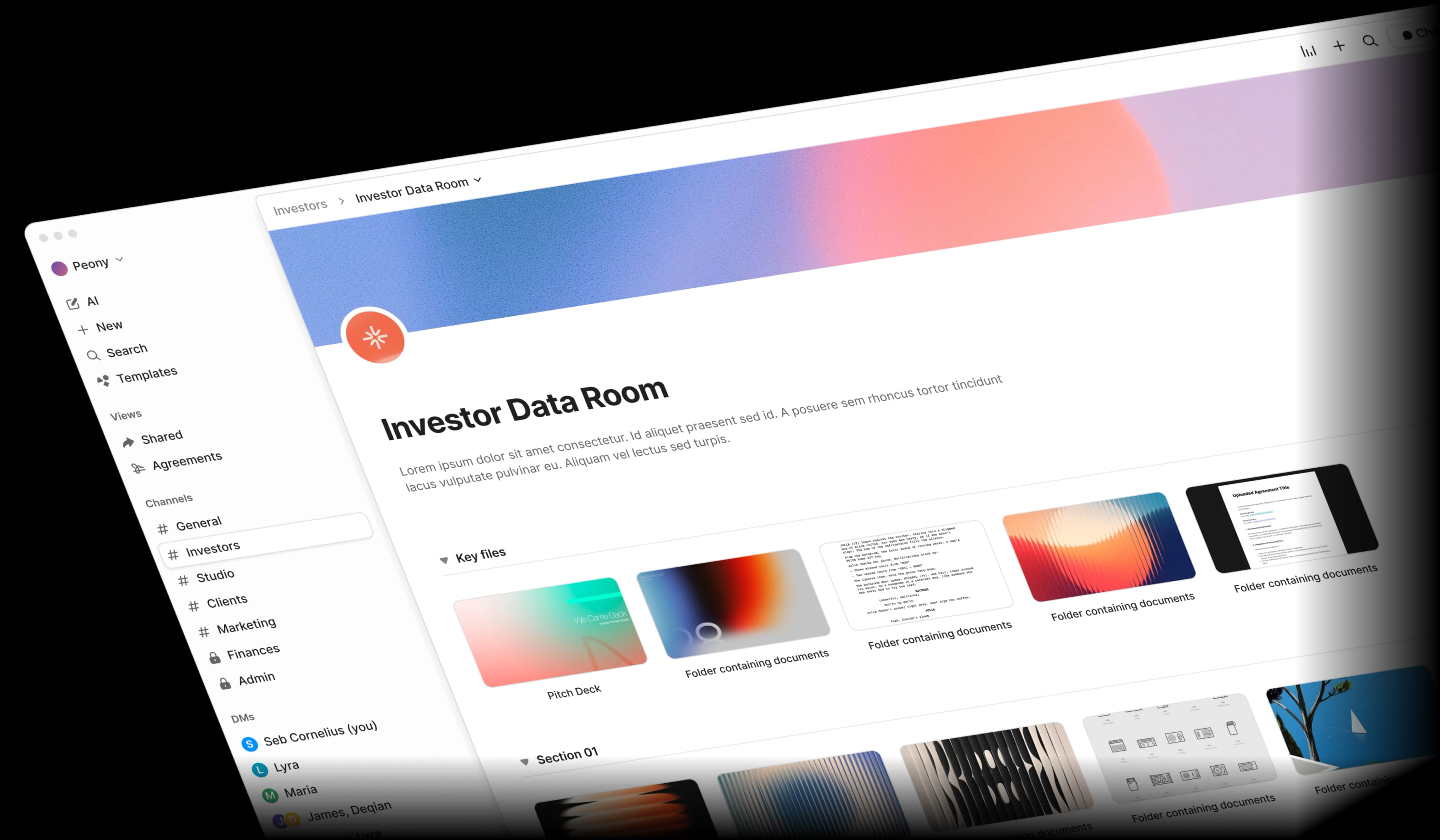
Peony is a virtual data room that direct lenders and private credit funds use to run the LP fundraise, an underwriting room per facility, borrower reporting by upload, and quarterly LP reporting. Data Room, Peony's most popular plan, is $52 per admin per month billed yearly with unlimited rooms and storage, and borrowers, co-lenders and LPs never pay.
A private credit data room is the permissioned online workspace a lending fund uses to share and collect confidential documents: the PPM, track record and DDQ for LPs, the credit agreement and financials for each facility, and the recurring reports borrowers deliver under the credit agreement. The full architecture, folder by folder, is in our private credit data room guide.
- The LP fundraise: a room mapped to the ILPA DDQ behind a signed NDA, a dynamic watermark on every page, and page-level analytics showing which LPs read the track record.
- A room per deal: duplicate your template underwriting room for each new facility, with a group per borrower, sponsor, counsel and co-lender, and your credit memo hidden from every outside group.
- Borrower and LP reporting: each borrower uploads financials and certificates into its own folder with no account, and each LP opens only its own statements and K-1s.
Peony at a glance
- Built for
- Direct lending funds and private credit managers (senior, unitranche, asset-based and specialty lending), venture lenders, and emerging credit managers preparing a first raise: fundraise rooms, per-deal underwriting rooms, borrower reporting and LP reporting.
- Typical plan
- Data Room, $52 per admin per month billed yearly ($75 monthly): unlimited rooms, documents and storage with no per-file size cap, an Upload folder per borrower, a group with its own folder and file permissions per LP, borrower or co-lender, a signed NDA with audit record, dynamic watermarks, Visitor Q&A, access questions, a custom domain and a per-visitor audit trail.
- Pricing
- Business $30, Data Room $52 and Deal Team $64 (minimum 4 admins) per admin per month billed yearly ($44, $75 and $89 monthly); Enterprise is custom. Free ($0) covers 50 documents and 500 MB as tracked single-file links; data rooms start on Business.
- Borrowers, co-lenders and LPs
- Borrowers, co-lenders and LPs are unlimited and free on every plan and don't need a Peony account. You pay per admin, not per viewer.
- Rooms and storage
- Unlimited data rooms, documents and storage on Data Room and above, and no per-file size cap on any plan. Business includes 3 data rooms per admin, 1,000 documents per admin and 100 GB of storage, with no per-file size cap.
- Versus per-deal VDRs
- Flat per-admin pricing with unlimited rooms: a 4-admin credit team on Data Room pays $2,496 a year whether it opens 2 rooms or 40, while legacy VDRs quote deal by deal.
- Borrower uploads
- Set a borrower's folder to Upload and its team adds files from their link with no Peony account; each upload lands in that folder, attributed to the link and viewer (Data Room). Upload also grants View and Download on that folder, so each borrower gets its own folder and group.
- Deal rooms
- Duplicate a data room copies its files and folders into a copy you convert to a data room from its menu; groups, links and analytics start clean. Hide new content by default keeps a new upload hidden from every group until you release it.
- LP reporting
- One group per LP or vehicle with its own folder permissions; page-level analytics show who opened each quarterly report. Logs are kept 2 years on Data Room and with no time limit on Deal Team and Enterprise; Deal Team adds a daily new-file email to LPs.
- Works alongside
- Allvue, Chronograph, iLEVEL or your spreadsheets stay the monitoring and analytics system; Peony is the secure document layer in front of them. Admins download files for spreading; API access is on Deal Team, enabled on request.
- File management
- Upload new version keeps a file's place and link and keeps every earlier version; AI room generation drafts the folder structure, and Index documents numbers every file (Data Room plan).
- Live models
- Peony renders .html files live with JavaScript running, so a Claude or ChatGPT artifact (a model, dashboard or calculator) stays interactive for the viewer, behind your NDA gate, permissions and analytics. The dynamic watermark applies to documents, so pair a live model with screenshot protection and an NDA gate.
- Enterprise
- Deal Team ($64 per admin per month billed yearly, minimum 4 admins) adds OAuth SSO, API access, room archive download, advanced redaction, Advanced Q&A routing, priority support and a dedicated account manager. Enterprise (custom pricing) adds SAML SSO, BYOK, self-hosted or white-label deployment, and custom data residency including EU-region hosting. Deal Team and Enterprise provide a standard DPA with SCCs on request.
- Security
- AES-256 at rest, TLS 1.2+ in transit. Peony staff can't open your documents, your documents aren't used to train AI, and Peony has had no data breach since launch. Peony's incident-response policy commits to telling affected customers within 72 hours of confirming an incident that affects customer data. SOC 2 Type II-ready and ISO 27001-ready, with both audits underway. Compliance and certifications
- Setup
- Median 4 min 19 s from sign-up to first uploaded document (State of M&A Data Rooms, Q2 2026 edition).
- Trial
- 7-day Data Room trial you start yourself: no credit card, and it never auto-charges. Rooms, files, links, analytics and NDA settings carry over when you upgrade. AI features switch on after you upgrade.
- Support
- 24/7 support, handled directly by the Peony team across Europe, US and Asia hours, with no outsourced tier. Everyone you speak to on Peony support has M&A experience at elite boutiques or bulge-bracket banks, VC experience, or has raised $1M+ themselves.
- Customers
- 8,000+ customers in 60+ countries, with $44.7B in client assets.
Which private credit teams use a data room, and for what?
Direct lenders, asset-based and venture lenders, emerging credit managers and fund IR teams use a Peony data room to raise capital, underwrite each facility, collect borrower reporting and share quarterly reporting with LPs.
The private credit teams on Peony already run this way: from Australian middle-market direct lenders to South African private credit managers to pre-launch ventures preparing a first raise.
Direct lending funds
Senior and unitranche lenders to the sponsored middle market: a cloned underwriting room per facility, a fundraise room for the next vintage, and an upload folder per borrower for monthly financials and quarterly compliance certificates (Data Room, $52/admin/mo billed yearly).
Asset-based and specialty lenders
Borrowing-base certificates, aging reports and inventory schedules uploaded into each borrower's period folders, with collateral, lien search and appraisal files in the deal room (Data Room).
Venture and growth lenders
Underwriting rooms for venture-backed borrowers and ongoing reporting from each one. The startup-borrower version is in our venture debt data room guide.
Emerging credit managers
A fundraise room mapped to the ILPA DDQ, behind an NDA, with page-level analytics on every LP. Business ($30/admin/mo billed yearly) covers 3 rooms per admin; Data Room adds watermarks and per-LP folder permissions.
Fund IR and operations teams
A permanent LP reporting room for quarterly reports, capital account statements, K-1s and capital-call notices, with a group per LP or vehicle. See also Peony for investor relations.
Co-lenders and club deals
One deal room with a group, NDA, watermark and question team per co-lender, and the lead lender's credit memo at No access for every outside group (Data Room).
Why does a private credit fund need a different data room setup from a private equity firm?
A direct lender opens a room every few weeks and collects borrower reporting all year, so it needs unlimited rooms and no-account borrower uploads at a flat per-admin price, which Peony's Data Room plan provides. Per-deal pricing and a shared inbox don't scale to that tempo; a reusable template room does.
Credit funds are document factories. A private equity firm opens a few rooms a year. A direct lender opens one every few weeks, while LP DDQs get deeper and borrower financials pile up in Outlook. The market behind that tempo is large: KBRA's surveillance alone assessed 2,416 middle-market sponsored borrowers in 2025, accounting for over $1 trillion of private direct lending debt (KBRA, February 2026).
Credit funds are document factories
Per-deal pricing at credit velocity
Legacy VDRs quote room by room. Close 15–25 facilities a year and the data room line item multiplies with every new deal you underwrite.
Borrower reporting dies in email
Monthly financials, covenant certificates, and borrowing-base certificates from 35 borrowers arrive as attachments — chased by hand, filed nowhere, invisible to auditors.
LP diligence runs on the DDQ
Institutional LPs work through the ILPA DDQ section by section — loss history, valuation policy, covenant discipline. A fundraise room that isn't mapped to it bleeds momentum.
Every reader needs a different slice
LPs, co-lenders, counsel, auditors, and borrowers all touch the fund's documents — and none of them should see the others' files.
What rooms does a direct lending fund run in Peony?
Peony runs a direct lending fund in three kinds of room: a fundraise room for LP diligence, an underwriting room cloned for each facility, and a permanent LP reporting room.
Built for how direct lending actually operates: one fund, three rooms (the fundraise, the deals, and LP reporting), with borrower document collection that runs itself: each borrower uploads into its own folder, with no account and no attachments to forward. All of it sits in one workspace, under one subscription, with separate permissions per room.
| Room | Who opens it | What it holds | Setup in Peony | Plan |
|---|---|---|---|---|
| Fundraise room | Prospective LPs and their consultants | Firm and team, track record with loss and recovery data, strategy, LPA, PPM and side letters, DDQ answers | Signed NDA gate, access questions, staged folders at No access, dynamic watermarks, page-level analytics, a question team per LP | Data Room |
| Underwriting room (one per facility) | Deal team, borrower, sponsor, counsel, co-lenders | Financials and model, QoE, credit agreement, liens and security, insurance, your credit memo | Duplicated from a template room; a group per party; the credit memo at No access for outside groups; an Upload folder for the borrower's diligence files | Data Room |
| Borrower reporting room | Each borrower's controller or CFO | Monthly and quarterly financials, compliance certificates, borrowing-base certificates, insurance certificates | A group and Upload folder per borrower, identical period folders, every other borrower's folder at No access | Data Room |
| LP reporting room | Committed LPs, consultants and auditors | Quarterly reports, capital account statements, K-1s, capital-call and distribution notices | A group per LP or vehicle, Hide new content by default, dynamic watermarks, page-level analytics; daily new-file emails to LPs on Deal Team | Data Room or Deal Team |
Unlimited deal rooms, cloned from your template
Stand up a new underwriting room in minutes from the same folder template, every few weeks, without a new contract or a new quote. Peony's Data Room plan includes unlimited rooms and storage at $52 per admin per month — the 20th room of the year costs the same as the first: nothing extra.
Template once, clone every deal
Keep one canonical underwriting folder structure — financials, QoE, credit agreement, liens, insurance — and replicate it for every new facility so nothing gets invented deal by deal. Duplicate the template room and the folder tree comes with it; groups, links and analytics start clean.
Flat per-admin pricing
A 4-admin credit team on the Data Room plan runs $2,496 a year, viewers free — while legacy VDRs quote five figures, deal by deal, year after year.
Three rooms, one platform
Run the LP fundraise room, every per-deal underwriting room, and the permanent LP reporting room side by side with separate permissions — no duplicate subscriptions.
No-login uploads for every borrower
Send each portfolio company an upload link that drops files straight into their folder — no accounts, no passwords, no portal training. An empty period folder shows you who's missing, a one-click resend chases the late ones, and every submission is attributed to the borrower contact who sent it, for your auditors.
No-account upload links
Borrowers won't create logins — so don't make them. One link per borrower, pointing into their own folder, with nothing else visible.
One-click reminders
Resend a late borrower's invite from its group row when quarter-end covenant certificates and monthly financials are due, so your operations team stops writing "gentle nudge" emails. Deal Team adds a custom invite email.
Attributed intake, exportable
Every arrival is attributed to the link and viewer who sent it, organized per borrower per period, and ready to download to your spreading and monitoring stack — or pull via API on the Deal Team plan.
Watermarks, NDA gates, and page-level analytics
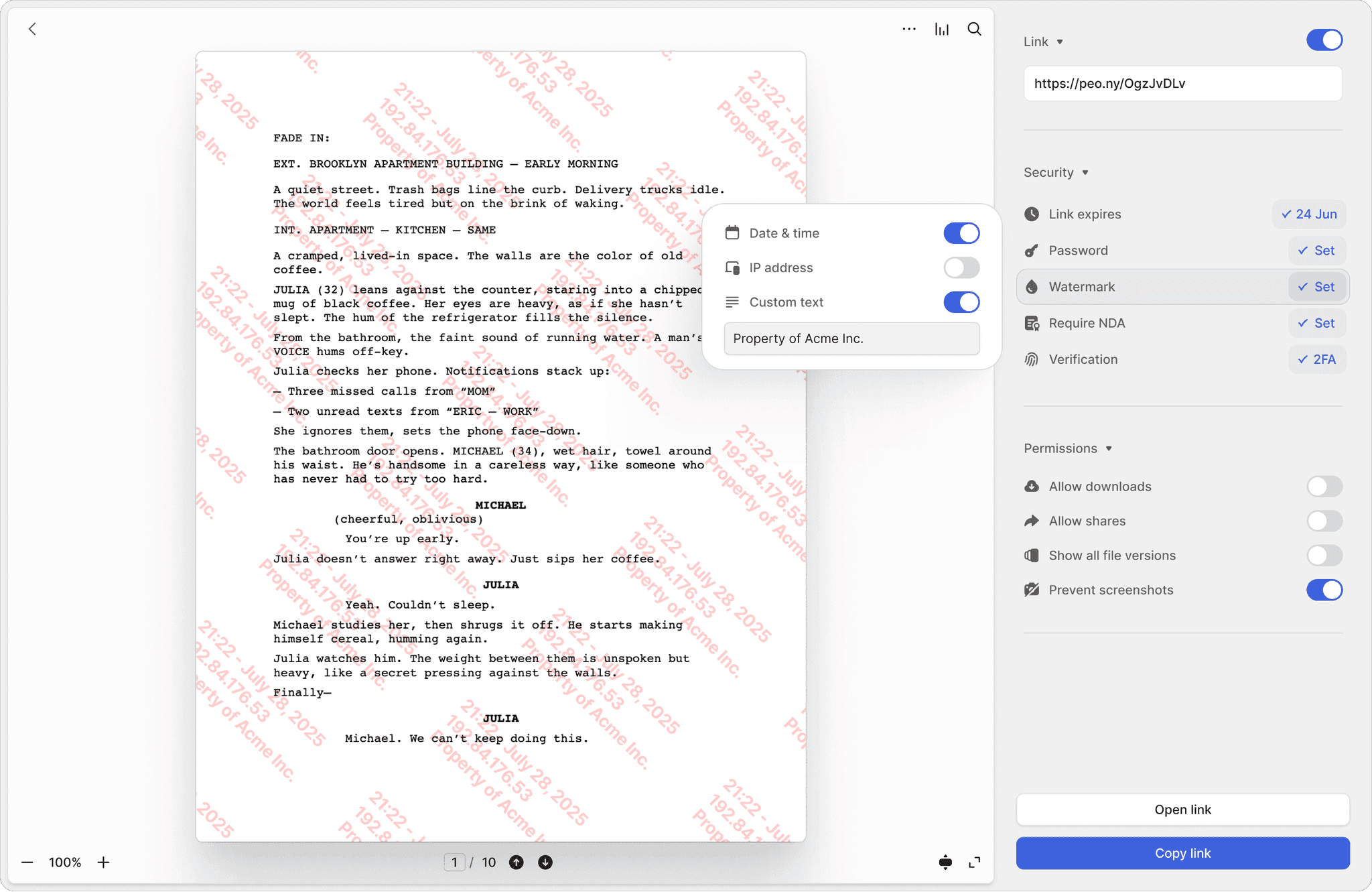
Gate the fundraise room behind an NDA, stamp every page with the viewer's identity, and watch which LPs go deep on your track record. When auditors or LP operational due diligence teams ask who saw what and when, export the answer in seconds.
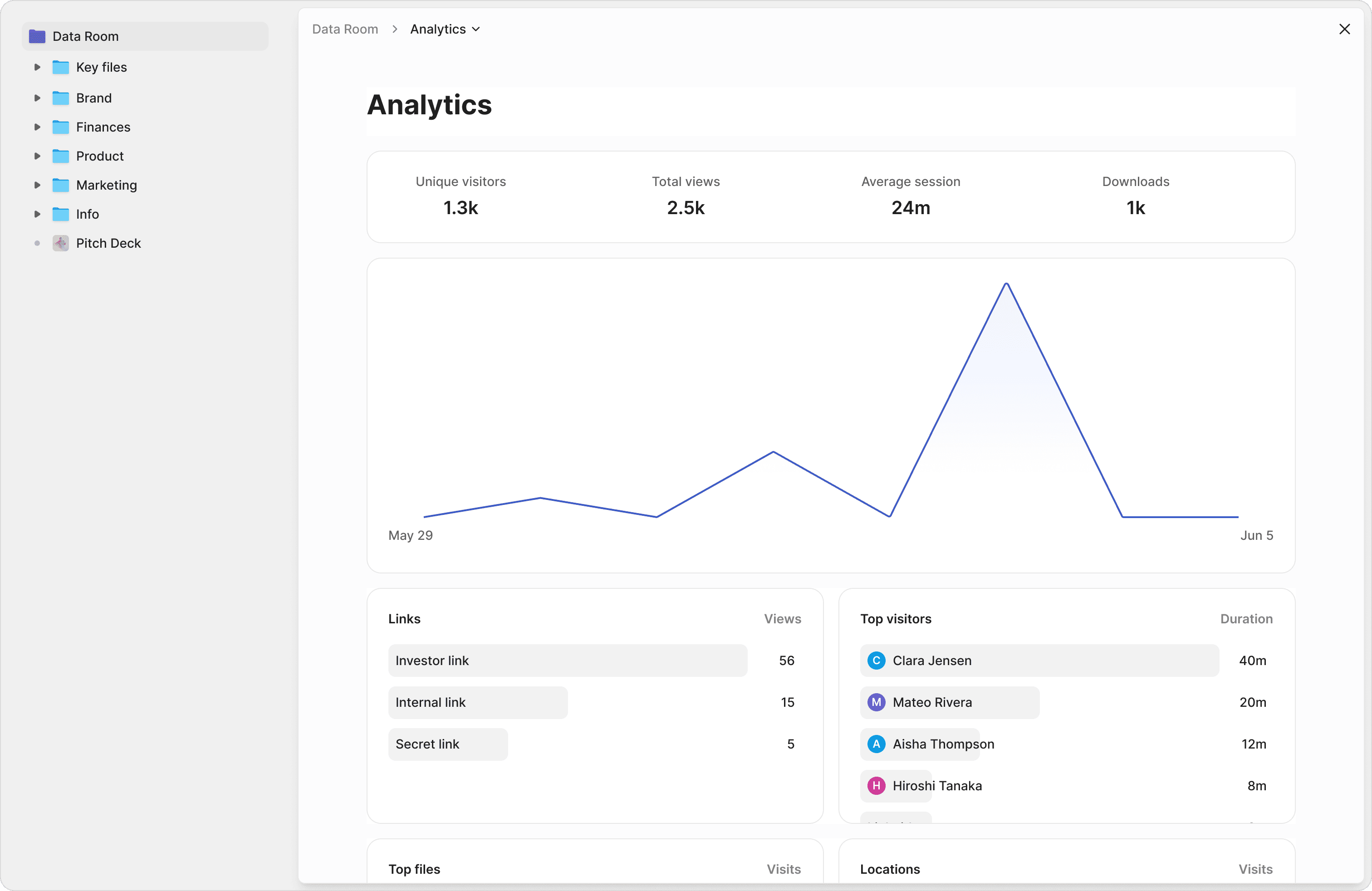
Page-level LP analytics
See which pages of the PPM and track record each LP reviewed and for how long — so IR follows up with the engaged, not the polite.
Compliance-ready logs
Exportable activity logs (a CSV of views, sessions and downloads, any time) and a per-visitor audit trail with timestamps, IP addresses, and device details, with a copy of the full trail on request after close — for SEC exams, fund audits, and LP operational due diligence.
Granular permissions
LPs, co-lenders, counsel, and borrowers each see exactly their slice — folder-level permissions and revocable, personalized links keep the rest invisible.
How do we collect borrower financials without email attachments?
Peony's file collection gives each borrower a no-account upload link that points into its own folder, so financials and covenant certificates arrive attributed to the sender instead of as email attachments. Set that borrower's folder to Upload and its controller adds files straight from the link. Borrowers never create logins, and your team stops forwarding attachments. Each upload lands in that borrower's folder, attributed to the link and the viewer who sent it, so quarter-end covenant certificates, borrowing-base certificates and monthly financials arrive into a per-borrower folder structure instead of an analyst's inbox. Upload also lets a borrower open what is already in its folder, so give each borrower its own group and folder, with every other borrower's folder at No access, which removes it from that group's view, file names included. Use the same period folders for every borrower and an empty folder shows at a glance who hasn't delivered; resend a late borrower's invite from its group row in one click. Upload permission and per-folder access are on Data Room ($52 per admin per month billed yearly), and borrowers upload free. The full workflow is in our borrower reporting guide.
Which software tracks borrower submissions and sends reminders when portfolio companies report late?
Peony tracks submissions and chases late borrowers in one reporting room: uploads land in each borrower's period folders attributed to the sender, empty folders show who is late, and Resend invite re-emails them. With 40 portfolio companies, give each its own group and Upload folder with identical period folders inside (this quarter's financials, compliance certificate and so on), and the folder tree becomes the submission tracker: a filled folder shows the file and which borrower contact sent it the moment the upload finishes, and an empty one is your late list. Peony also emails you each time a borrower opens the room (visitor notifications), and the Analytics tab lists every visitor with their most recent visit, so you can tell a borrower who never opened the link from one who opened it and still left the folder empty. To chase, click Resend invite to N on each late borrower's group row: Peony re-sends the invitation to everyone on that group at once, up to 250 recipients per resend (Business plan and above), so your operations team stops writing nudge emails one by one. On Deal Team ($64 per admin per month billed yearly, minimum 4 admins), Custom invite email lets you edit the subject and body with a live preview, so the invitation can name the overdue certificate and its due date. Upload folders and per-folder access are on Data Room ($52 per admin per month billed yearly), and borrowers upload free with no account.
What does a direct lender collect from each borrower, and how often?
The credit agreement sets the pack and the calendar: commonly financial statements, an officer's compliance certificate and, on asset-based facilities, a borrowing-base certificate, plus insurance certificates and board materials.
| Document | What it is | Typical cadence |
|---|---|---|
| Financial statements | Balance sheet, income statement and cash-flow statement, the raw material your team spreads | Monthly or quarterly, per the credit agreement; audited annually |
| Covenant compliance certificate | An officer's certificate on covenant compliance, delivered with the financials | Quarterly and annually; sample language: within 45 days after each fiscal quarter |
| Borrowing-base certificate | The borrower's statement of the eligible collateral behind an asset-based facility, such as receivables and inventory | Periodically, usually monthly |
| Insurance certificates | Evidence that required coverage is in place | On renewal, or as the agreement requires |
| Board materials | Board decks and minutes under your information rights | Per board meeting |
Cadence sources: the Journal of Accountancy (borrowing-base certificate, usually monthly) and sample loan-covenant language published by Holland & Knight (compliance certificate within 45 days after each fiscal quarter).
Where does a portfolio monitoring platform fit next to the room?
Use both for different jobs: a monitoring platform such as Allvue, Chronograph or S&P's iLEVEL runs covenant tracking, valuations and dashboards, and Peony is the secure document layer where borrower and LP files arrive and stay controlled.
Keep in your monitoring platform or model
- Spread financials and covenant calculations
- Valuations and risk ratings
- Portfolio dashboards and LP-facing analytics
Run through Peony
- Borrower uploads with no account, attributed to the sender
- Per-borrower, per-period folders that show what is late
- Underwriting rooms for every new facility
- The fundraise room and the LP reporting room
- Downloads for spreading, or API access on Deal Team (enabled on request)
How do private credit teams run their rooms in Peony?
In Peony, portfolio operations runs borrower reporting, the deal team clones an underwriting room per facility, investor relations runs the fundraise and LP rooms, and the fund controller pulls the audit record. All four work on the same Data Room plan.
Head of portfolio operations: 60 borrowers, five documents each, every quarter.
One borrower reporting room with a group and an Upload folder per borrower and identical period folders inside each. Peony shows what arrived in every folder and who sent it, so the empty folders are the follow-up list; resend those borrowers' invites in one click and download the new files for spreading. Visitor notifications email you when a late borrower opens the room.
(Data Room)
Deal team associate: a new unitranche facility every few weeks.
Duplicate the template underwriting room, convert the copy to a data room, and add groups for the borrower, sponsor, counsel and co-lenders. The credit memo folder stays at No access for every outside group, and each party's questions go to its own question team.
(Data Room)
Investor relations lead: raising Fund III while Fund II reports quarterly.
A fundraise room behind a signed NDA and access questions, with page-level analytics on the track record, next to a permanent LP reporting room with a group per vehicle. Hide new content by default keeps the quarter's statements hidden until release.
(Data Room)
Fund controller: audit season and an LP's ODD questionnaire.
Open a borrower's period folder to show which contact sent each certificate, open the per-visitor audit trail for any LP or auditor, and export a CSV of views, sessions and downloads filtered to one link or viewer.
(Data Room)
Twenty deals a year. One document layer.
"Peony is by far the simplest and most intuitive way to populate and share data rooms with investors and partners. All the key analytics and features integrated into a sleek interface!"
Mark Petrov
Head of Financials, Loop
Michael Hui
Managing Director, Piton Partners
Peony is a standout for data rooms and gated file sharing — it gave us the control and visibility needed to close the deal with a great viewer experience.
No credit card · 7-day Data Room trial that never auto-charges · borrowers, co-lenders and LPs view free, no account
What goes in a private credit fundraise data room for institutional LP due diligence?
A private credit fundraise room in Peony should follow the ILPA DDQ: firm and team, strategy and sourcing, track record with loss and recovery data, sample deals, fund terms, valuation and monitoring, operations, and compliance. Institutional LPs diligence credit funds against the ILPA Due Diligence Questionnaire (DDQ 2.0, released November 2021), which ILPA intends to standardize the key areas of inquiry investors pose to managers, so structure the room to answer it and each LP finds its answers where it expects them. Put the LPA, PPM and side letters under fund terms, and lead the track record with realized losses, defaults and recoveries. Peony adds NDA gating, dynamic watermarks, and page-level analytics so you can see which LPs are deep in the track-record section and which went quiet. Keep the detailed track record and LPA at No access until an LP qualifies, and give each LP its own question team in Visitor Q&A so its follow-up questions stay private. These controls are on Data Room ($52 per admin per month billed yearly), and every LP views free. The ODD side of the raise is in our LP operational due diligence guide.
1. Firm and team
GP bios, ownership, the GP commitment and credit committee membership
2. Strategy and sourcing
Target borrower profile, sourcing, sector focus, position sizing and leverage policy
3. Track record
Loan-by-loan history with realized losses, defaults and recoveries, and vintage performance
4. Sample deals
Anonymized credit memos and covenant packages from representative facilities
5. Fund terms
LPA, PPM, subscription documents, fee and waterfall terms, side-letter policy
6. Valuation and monitoring
Valuation policy, covenant-monitoring process and portfolio risk limits
7. Operations and service providers
Fund administrator, auditor, counsel, recent audited financials
8. Compliance
Registrations, compliance manual, ESG and DEI policies
Numbering the folders keeps both sides on the same reference: Index documents numbers every folder and file (1, 1.1, 1.2...) so both sides can say "open 2.3" (Data Room plan). For the general fund-raise structure, see the investor data room guide; for fundraising rooms outside credit, see Peony for fundraising.
How should a private credit fund share quarterly reports and K-1s with LPs?
Run a permanent Peony LP reporting room with a group per LP or vehicle: each LP opens only its own statements and K-1s, watermarked, and you see who read each report.
Turn on Hide new content by default and the quarter's capital account statements stay hidden until you release them group by group; on Deal Team, LPs get a daily email when new files are added. ILPA released an updated Reporting Template and a new Performance Template on January 22, 2025, and says they should be implemented beginning Q1 2026 (ILPA), so a quarterly package built to them belongs in a room where you can see which LPs opened it. Page-level analytics show who read each report and for how long, so re-up conversations start from data. Peony renders .html files live with JavaScript running, so a Claude or ChatGPT artifact (a model, dashboard or calculator) stays interactive for the viewer, behind your NDA gate, permissions and analytics. See how to share an interactive LP report and the LP reporting guide.
Can borrowers, co-lenders or LPs see each other's files in Peony?
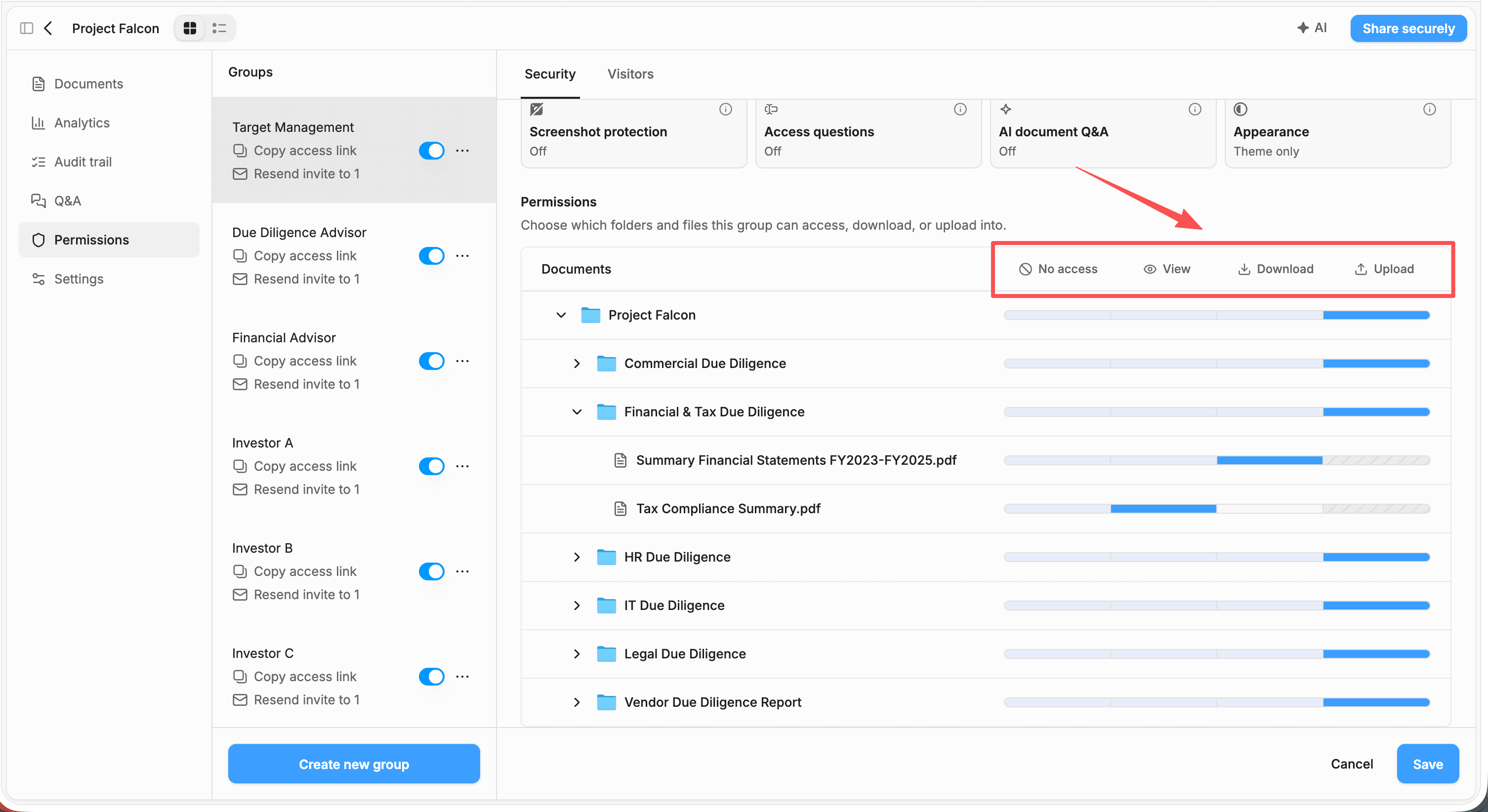
No. In Peony, each borrower, co-lender and LP gets its own group and folder permissions; a folder at No access is absent from that group's view, and invitees never see who else is invited.
- No access hides a folder or file, names included, so one borrower never sees that another borrower's folder exists (Data Room).
- Upload also grants View and Download on that folder, so each borrower uploads into its own folder rather than a shared drop folder.
- Question teams keep each LP's or co-lender's Visitor Q&A private to it, while your answer side sees every question (Data Room).
- Revoke one party by switching its group off; its link stops working and every other group is untouched (Business and above).
- Advanced redaction on Deal Team saves a new PDF with a borrower name or pricing term removed before you share it.
Is Peony auditable enough for SEC exams and LP operational due diligence?
Yes. Peony logs every page view, upload, download and signature with timestamps, IP addresses and device details, so you can show an examiner or an LP's ODD team who saw what, and when. That record sits on infrastructure secured with AES-256 encryption at rest, TLS 1.3 in transit, SOC 2 Type II and ISO 27001 readiness (both audits underway), and GDPR, CCPA, and HIPAA compliance. When auditors ask when a borrower's compliance certificate arrived, the answer is a file in that borrower's folder, attributed to the link and viewer who uploaded it, not an inbox search. On Data Room, the per-visitor audit trail shows every file each person opened and downloaded, and logs are kept 2 years (with no time limit on Deal Team and Enterprise); your CCO can export a compliance-ready CSV of views, sessions and downloads in seconds, filtered to one link or viewer, and a copy of the full audit trail is provided on request after a deal closes. Peony completes your security questionnaire or vendor-risk form. Peony staff can't open, move or edit the documents in your room. Peony has had no data breach since launch. Your CCO and counsel decide how Peony fits your written compliance program.
- Encryption: AES-256 at rest and TLS 1.2 or higher in transit.
- Your documents aren't used to train AI: Peony's LLM providers work under data-handling agreements that prohibit training on customer content.
- Viewers read documents in the browser; files never leave Peony unless you allow downloads on a link.
- Peony's incident-response policy commits to telling affected customers within 72 hours of confirming an incident that affects customer data.
- SOC 2 Type II-ready and ISO 27001-ready, with both audits underway. The standard DPA with SCCs is available on request on Deal Team and Enterprise.
- Admins sign in with an emailed one-time code or Google, with no password fallback; Deal Team adds OAuth SSO, and Enterprise adds SAML SSO, BYOK and EU-region hosting.
Hosting, access control and audit logs are in the security overview, and the audit status in compliance and certifications.
Who supports a private credit team on Peony?
Peony support runs 24/7, handled directly by the Peony team across Europe, US and Asia hours, with no outsourced tier. Everyone you speak to on Peony support has M&A experience at elite boutiques or bulge-bracket banks, VC experience, or has raised $1M+ themselves.
- 24/7 dedicated support for enterprise deals, with priority support and a dedicated account manager on Deal Team.
- Peony staff can't open, move or edit the documents in your room. Peony has had no data breach since launch.
How do you set up a private credit data room in Peony?
Setting up a private credit data room in Peony takes five steps: pick the plan, build a template room, add a group per party, set folder permissions, then invite and track.
The median time on Peony from account creation to first uploaded document is 4 min 19 s (State of M&A Data Rooms, Q2 2026 edition).
Pick the plan
Data Room ($52/admin/mo billed yearly) for a fund running deal rooms and borrower uploads: unlimited rooms, Upload folders and per-group permissions. Business ($30) for an emerging manager's first fundraise room. Deal Team ($64, minimum 4 admins) when you need API access or Advanced Q&A routing.
Build a template room
Number the underwriting folders once (financials, QoE, credit agreement, liens and security, insurance, credit memo) and keep the template free of deal files. Duplicate a data room copies its files and folders into a copy you convert to a data room from its menu; groups, links and analytics start clean.
Add a group per party
A group for each borrower, sponsor, counsel, co-lender or LP, each with its own NDA, watermark and analytics.
Set folder permissions
Upload on each borrower's own folder, No access on the credit memo and on every other party's folders, and Hide new content by default in the room's settings. Click Save before you switch groups.
Invite and track
Peony emails each listed address an invitation; viewers open in the browser with no account. Page-level analytics show who read what, and Resend invite chases a late borrower in one click.
What does a private credit data room cost on Peony?
On Peony, private credit rooms run on Data Room at $52 per admin per month billed yearly ($75 monthly), with unlimited rooms, documents and storage, and borrowers, co-lenders and LPs view free.
Priced for a fund, not per deal
Legacy data rooms quote every new facility. Peony is flat, per-admin, with unlimited rooms — so velocity is free. You pay per admin, not per viewer and not per data room, so the bill follows your team size, not your deal count; the virtual data room cost guide compares the pricing models.
| Rooms opened in a year | Data Room (4 admins) | Deal Team (4 admins) | Per-deal VDR |
|---|---|---|---|
| 5 | $2,496 | $3,072 | A quote for each room |
| 20 | $2,496 | $3,072 | A quote for each room |
| 40 | $2,496 | $3,072 | A quote for each room |
Business
For emerging credit managers
$30 /admin/mo billed yearly
NDA gating, screenshot protection, AI Q&A, 3 data rooms per admin.
Data Room · Most popular
For funds cloning a room per deal
$52 /admin/mo billed yearly
Unlimited rooms & storage, borrower Upload folders, dynamic watermarks, per-group permissions.
Deal Team
For teams feeding a monitoring stack
$64 /admin/mo billed yearly
API access, Advanced Redaction & Q&A (min 4 admins).
Prices are per admin per month billed yearly; monthly billing costs more. Free ($0) covers 50 documents and 500 MB as tracked single-file links; data rooms start on Business. Business includes 3 data rooms per admin, 1,000 documents per admin and 100 GB of storage, with no per-file size cap. Compare every feature on the pricing page.
Frequently asked questions
What is Peony, and is it a good fit for private credit funds and direct lenders?
Yes. Peony is a virtual data room that direct lenders and private credit funds use to run fundraise and LP reporting rooms, open an underwriting room per deal and collect borrower reporting by upload. Data Room, the most popular plan, is $52 per admin per month billed yearly ($75 monthly), with unlimited rooms and storage; inviting borrowers, co-lenders and LPs is free and unlimited.
Can I try Peony before I pay?
Yes. Peony's Data Room plan has a 7-day free trial you start yourself, with no credit card, and it never converts to paid on its own. Rooms, files, links, analytics and NDA settings carry over when you upgrade. AI features, such as AI document Q&A and AI room generation, switch on once you're on a paid plan.
What is the best data room setup for a private credit fund that opens 20 deal rooms a year?
A fund-level platform with unlimited rooms, not per-deal contracts: on Peony's Data Room plan ($52 per admin per month billed yearly), the 14th deal room of the year costs nothing more than the first. A direct lending fund runs three kinds of rooms at once: the fundraise room for LP due diligence, a cloned underwriting room for every new credit facility, and a permanent LP reporting room, with an upload folder for each borrower's ongoing reporting. Data Room includes unlimited data rooms, documents and storage with no per-file cap, and duplicating a template room copies its folder tree for the next facility. Legacy VDRs quote per deal, which multiplies with a credit fund's velocity; the virtual data room cost guide compares the pricing models.
Can borrowers upload documents without creating accounts?
Yes. Peony gives each borrower an upload link into its own folder, and the borrower's team adds files from the browser with no Peony account or password. That is the feature private credit operations teams use most: no-account upload links per borrower, per period. Your borrowers click a link, drop the files, and are done, with no passwords to reset and no portal training. Upload is set per folder on the Data Room plan ($52 per admin per month billed yearly), and it also lets that borrower open what is already in its folder, so each borrower gets its own folder and group. Your team sees exactly what arrived, when, and who sent it, and identical period folders show what is still missing across all borrowers at a glance.
How often should private credit funds collect borrower financials?
As often as the credit agreement requires: commonly monthly or quarterly financial statements, a quarterly officer's compliance certificate, and, on asset-based facilities, a borrowing-base certificate usually every month. Sample loan-covenant language published by Holland & Knight calls for an officer-signed covenant compliance certificate within 45 days after the end of each fiscal quarter, and the Journal of Accountancy describes the borrowing-base certificate as submitted to the lender periodically, usually monthly; actual terms vary deal by deal. Annual audited statements and insurance certificates on renewal complete most reporting packs. In Peony, mirror the agreement's calendar with one folder per period inside each borrower's folder, so every cycle's financials and certificates land in the same place.
Does Peony replace Allvue, Chronograph, or iLEVEL?
No. Peony works alongside Allvue, Chronograph and S&P's iLEVEL: those are portfolio monitoring and analytics platforms, and Peony is the secure document layer in front of them, where borrower documents arrive, live and stay auditable. Allvue, Chronograph and iLEVEL handle covenant tracking, valuations and dashboards, and Peony is not trying to replace them: funds that need monitoring analytics buy one of those platforms. The collected documents reach your analysts and your spreading process through downloads, or through API access on Peony's Deal Team plan ($64 per admin per month billed yearly, minimum 4 admins), enabled on request.
Which borrower data collection platforms do private credit funds use?
Private credit funds collect borrower data through portfolio monitoring platforms such as Allvue, Chronograph and S&P's iLEVEL, and through secure document intake such as Peony, where borrowers upload with no account. The two jobs differ. Monitoring platforms run covenant tracking, valuations and dashboards on the numbers; the intake layer is where the documents behind those numbers arrive from each borrower's controller and stay attributable to the person who sent them. On Peony's Data Room plan ($52 per admin per month billed yearly), each borrower gets its own group and upload folder, your internal credit memo stays at No access, and the files reach your spreading process by download or, on Deal Team, through API access enabled on request. See the borrower reporting guide for the folder structure.
How do we give LPs access without exposing everything?
Granular folder permissions and personalized links: in Peony, each LP sees only its own vehicle's quarterly reports, capital account statements and K-1s, while flagship and co-invest materials stay separated inside one data room. Give each LP or vehicle its own group: a folder at No access is absent from that group's view, file names included, and invitees never see who else is invited. Watermarks tie every page to the viewer, and access can be revoked instantly when a consultant rolls off, by removing their email or switching the group off, with no duplicate rooms and no re-uploading. Turn on Hide new content by default and next quarter's statements stay hidden until you release them group by group. Granular permissions and dynamic watermarks are on Data Room ($52 per admin per month billed yearly).
Can co-lenders in a club deal share one Peony room?
Yes. In Peony, each co-lender gets its own group in the deal room, with its own folder permissions, NDA, watermark and analytics, and co-lenders view free with no Peony account. The lead lender's internal credit memo and committee materials stay at No access for every outside group, and invitees never see who else is invited. Visitor Q&A with a question team per co-lender keeps each lender's questions private (Data Room); on Deal Team, Advanced Q&A routing assigns each question to an expert and an approver before the answer is released. When a co-lender drops out, switch its group off and its link stops working, with every other group untouched.
How much does a private credit data room cost?
On Peony, a private credit fund runs on Data Room at $52 per admin per month billed yearly ($75 monthly), with unlimited rooms and storage, and borrowers, co-lenders and LPs view free. Peony starts free for a first fundraise conversation: Free ($0) covers 50 documents and 500 MB as tracked single-file links; data rooms start on Business. The Business plan ($30 per admin per month billed yearly) adds 3 data rooms per admin, NDA gating, screenshot protection, and AI document Q&A. The Data Room plan adds dynamic watermarks, granular permissions with borrower upload folders, plus unlimited data rooms and storage: the fit for a fund cloning a new underwriting room every few weeks. The Deal Team plan ($64 per admin per month, minimum 4 admins) adds API access, Advanced Redaction, and the Advanced Q&A module. A 4-admin credit team on the Data Room plan runs $2,496 a year with viewers free, against legacy VDRs whose median annual cost runs to five figures, quoted deal by deal (see the virtual data room cost guide).
Go deeper
Guides from the Peony team on fund data rooms and document operations.
The private credit data room guide
One fund, three rooms: architecture, folder trees and cost math for funds opening 20 deals a year.
Borrower reporting, without the email chase
The reporting pack, per-borrower folders and how collected files reach your spreading stack.
LP operational due diligence
What institutional LPs' ODD teams test on a manager, and how to structure the room for it.
Best data rooms for private equity & credit
The vendor landscape compared — including where flat-rate pricing beats per-deal quotes.
The investor data room, structured right
What LPs expect to find, folder by folder, before they commit to a fund.
Collect documents without the email chase
No-login uploads, one-click resends, and audit trails for recurring document collection.
Related solutions: equity deals on Peony for private equity, LP portals on Peony for investor relations, and Peony for hedge funds.
Where do these figures come from?
- KBRA, Private Credit Q4 2025 Middle Market Borrower Surveillance Compendium (February 25, 2026): 2,416 MM-sponsored borrowers assessed in 2025, over $1 trillion of private direct lending debt
- ILPA, Due Diligence Questionnaire 2.0 (released November 1, 2021)
- ILPA, updated Reporting Template and new Performance Template (January 22, 2025): recommended for implementation beginning Q1 2026
- Holland & Knight, Gavin Williams, "Time to Check the Financial Covenants" (May 15, 2017): sample compliance-certificate timing
- Journal of Accountancy, "Asset-Based Financing Basics" (August 1, 2011): borrowing-base certificate cadence
- State of M&A Data Rooms (Q2 2026 edition): median time from sign-up to first uploaded document
Sources checked October 17, 2026.
Run the fundraise. Clone the deal room. End the email chase
Join 8,000+ customers using Peony to control documents across fundraising, deals, and reporting — with $44.7B in client assets under management.
The median time from sign-up to first uploaded document on Peony is 4 min 19 s (State of M&A Data Rooms, Q2 2026 edition).
- Borrowers, co-lenders and LPs never need a seat or an account.
- Unlimited rooms on Data Room: twenty deals cost the same as one.
- Live in minutes; the 7-day trial never auto-charges.
No credit card · 7-day Data Room trial that never auto-charges · borrowers, co-lenders and LPs view free, no account · 24/7 support
24/7 dedicated support for enterprise deals
Last updated: October 2026